Add it to your home screen and it opens full screen: no browser bars, one tap away, and everything stays signed in. Free, nothing to download from an app store.
- Tap the Share button in your browser
- Scroll down and choose “Add to Home Screen”
- Open GrowSomeFood from your home screen
- Open your browser’s menu
- Choose “Add to Home screen” or “Install app”
- Open GrowSomeFood from your home screen
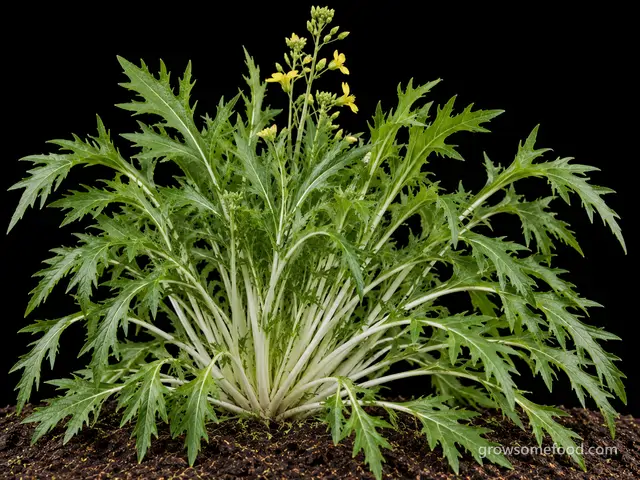
Mizuna
A mild, feathery Japanese green that cuts in three weeks and regrows again and again - the most forgiving and least peppery of the greens sold as mustards, and a genuine winter salad crop.
Entirely edible raw or cooked, leaves and thin white stems alike - one of the mildest greens in the cabbage family, with none of the fieriness of true mustard. Very high in vitamin K, so people on blood-thinning medication should keep their intake steady rather than swinging. Raw brassicas in enormous daily quantities can affect thyroid function in iodine-deficient people, which is a non-issue for normal eating and reduced further by cooking.
Overview
The one thing to knowBaby leaves are ready about 21 days from sowing and full-size leaves at around 40, and because it regrows so vigorously after cutting, one sowing can be sheared four or more times.
Mizuna is the easy one. It makes a wide, spreading rosette of deeply cut, feathery leaves on slender white stalks, and its flavor is gentle - a faint peppery tang rather than the horseradish heat of a true mustard. Baby leaves are ready about 21 days from sowing and full-size leaves at around 40, and because it regrows so vigorously after cutting, one sowing can be sheared four or more times.
Two things set it apart from its neighbors in the seed rack. It is unusually tolerant at both ends: hardier in cold than most salad greens, standing through hard frost and cutting all winter under a low tunnel, and slower to bolt in warmth than arugula or true mustard. And it stays mild at every size - a big mature mizuna leaf is still salad, where a big mustard leaf is a cooking green and a big arugula leaf is a mouthful of pepper.
One correction worth knowing. Mizuna is almost always sold and shelved under mustard greens, but it is a different species: mizuna is Brassica rapa, the species of turnip, napa cabbage, bok choy, tatsoi and komatsuna, while the true leaf mustards (Southern Giant Curled, Red Giant, Ruby Streaks) are Brassica juncea. Growing them side by side is fine. It matters if you save seed - see Propagation, where the isolation rule is the opposite of the one printed on most mustard packets.
Quick facts
- Sprouts in
- 5 days3 to 10
- Soil to sprout
- 70 °F45 to 85
- Start indoors
- 4 weeks before transplant3 to 5
- Life cycle
- Annual
- Seed to save
- About 100 days after planting85 to 120
- Height
- 15 in10 to 20
- Spread
- 18 in10 to 24
- Cold
- Takes hard frostdamaged below 15°F
- Heat
- Struggles above 85°F
- Self-sows
- Yes, expect volunteers
Full sun or part sun or part shade · medium water · well-drained soil · 8 in apart (4 to 12) · direct sow or transplant
When to plant
Fall sowing is open for 9 more days. Next: spring, Mar 13 to Apr 24.
- Direct sow Aug 21 – Sep 30 Open now · 9 days leftAbout 9 weeks before to 4 weeks before your first frost (Oct 25 here)The better crop. Mizuna matures into cooling weather with almost no bolting pressure, takes hard frost standing, and under a low tunnel keeps cutting deep into winter.
- Direct sow Mar 13 – Apr 24 Opens in 173 daysAbout 4 weeks before to 2 weeks after your last frost (Apr 10 here)Sow as soon as the ground is workable; young plants take frost easily. Mizuna holds longer into warm weather than most brassica greens, but it still bolts eventually - sow a short row every two weeks.
- Transplant Mar 20 – Apr 17 Opens in 180 daysAbout 3 weeks before to 7 days after your last frost (Apr 10 here)Transplants buy a couple of weeks on the first cut. Rarely worth it for a crop this fast, but useful for getting full-size rosettes established before flea beetles peak.
Frost here: last around Apr 10 (Mar 27 to Apr 24 most years), first around Oct 25. Zone averages, your own yard may run a week or two either way.
Life stages
Five stages, about 4 weeks from sowing to the first pull. Windows are typical; your zone and weather move them.
Germination
Day 0 to 5 from sowing- WaterKeep the seedbed evenly moistdailySow 1/4-1/2 inch deep. Mizuna germinates fast and reliably in cool or warm soil - 3 to 5 days is normal - so the only thing to get right is not letting the surface crust or dry.
Watch for- No emergence in 10 days (old seed or a dry bed - rare)
Seedling
Day 5 to 18 from sowing- ProtectCover against flea beetles from the day you sowFlea beetles pepper young brassica leaves with shot-holes, and the leaf is the crop here. Floating row cover laid at sowing and sealed at the edges is close to essential for unblemished salad leaves.
- ThinThin by how you plan to cut itFor baby-leaf salad, sow thickly and leave it dense - 1 to 2 inches. For big feathery full-size rosettes, thin to 8-12 inches. Eat every thinning; they are the first salad.
Watch for- Shot-hole peppering on the first true leaves (flea beetles)
- Seedlings sheared off overnight (slugs or cutworms)
Rosette filling out
Day 18 to 38 from sowing- WaterWater steadily - about an inch a weekevery 4 daysIts Japanese name means water greens for a reason. Even moisture keeps the thin stems crisp and the flavor gentle; drought stress makes leaves stringy, sharpens the bite and pushes early bolting.
- FertilizeLight nitrogen keeps the regrowth comingevery 3 weeksYou are cutting the same plant repeatedly, so it needs feeding to rebuild. A light nitrogen feed every 3 weeks, or a liquid feed after each hard cut, keeps the rosette pushing new leaves.
Watch for- Aphids on leaf undersides and down in the crown
- Cabbage worms chewing ragged holes
- Central stalk beginning to rise in a warm spell
Harvest
Day 21 to 40 to the first pull from sowing, picking to about day 100- HarvestCut baby leaves at 21 days, full leaves at 40every 4 daysBaby mizuna is ready about three weeks from sowing at 3-4 inches; full feathery leaves at 6-10 inches take around 40 days. Both are mild - pick by what you want on the plate, not by ripeness.
- HarvestShear the whole rosette an inch above the crownevery 18 daysThis is one of the very best cut-and-come-again greens: shear the plant an inch or two above the growing point and it regrows for another full cut in 2-3 weeks. Four or more cuttings from one sowing is normal in cool weather.
Watch for- Regrowth slowing after several cuts (start the next succession)
- Bolting stalk rising from the center of the rosette
Bolting and seed set
Day 70 to 100 from sowing- HarvestEat the flower buds before they openA bolting mizuna gives a bonus crop: the tender flowering shoots and unopened buds are sweet and broccoli-raab-like, good stir-fried or steamed. Take them before the yellow flowers open.
- HarvestOr let one plant pod for seedLeave a healthy plant to flower and set its slender pods, then cut the stalks as they dry and thresh out the tiny round seed. Read the crossing rule in Propagation first - mizuna is Brassica rapa, not a true mustard.
Watch for- Yellow four-petal flowers open (leaves now tough - switch to buds or seed)
- Pods shattering and self-sowing a volunteer patch
Harvest
- Baby leaves 3-4 inches, about 21 days from sowing
- Full feathery leaves 6-10 inches on thin white stalks, about 40 days
- Cut any time - flavor stays mild at every size, unlike true mustards
- Cut before a bolting stalk rises from the center of the rosette
- Cut baby leaves at 21 days, full leaves at 40 · every 4 days
- Shear the whole rosette an inch above the crown · every 18 days
Per plant 30 to 150 leaves, 8 to 56 ozPicking cut and it regrows
Cook with Mizuna
Watch out for
6 to know. 1 is high-risk: Flea Beetles. 5 are active in September.
Flea BeetlesSeverity High PestnowThe defining pest of this crop, because the leaf is what you sell yourself on: a peppered mizuna leaf is still edible but ruins a salad.
Row cover sealed to the soil from the day of sowing, plus fall sowings that miss the beetles' peak, is the whole answer here.
Dozens of pinhead-sized round holes peppered across the leaves, thickest on the youngest, most tender growth. Tiny beetles that spring away as you brush the plants or lean in for a closer look - that jump is the identification. Seedlings that go lacy and stop growing, and transplants that sit and sulk instead of taking off. Damage heaviest in warm, dry weather and along the edge of a bed nearest weedy ground or last year's crop debris. On root crops, shallow narrow grooves or channels scarring the skin at harvest, from larvae feeding underground.
Row cover and healthy fast growth carry most crops through, and on an established plant the damage is usually cosmetic and needs nothing at all. Where a young planting is genuinely being stripped, kaolin clay coats the leaves and deters feeding, and spinosad will knock the beetles back. Spinosad is acutely toxic to bees while the spray is still wet - apply it at dusk when bees are not flying, never onto plants in flower, and follow the product label. Anything you spray must be labeled for the plant you are treating, and you must observe its pre-harvest interval on a crop you are picking. Yellow sticky traps are useful for telling you when the beetles have arrived. Where the damage falls on the part you eat, harvesting young often beats them outright; where you are growing for a root or a fruit, leaf damage can simply be tolerated. Larvae feeding underground cannot be reached by a foliar spray, so rotation and clean beds are what work against those.
Floating row cover or fine insect mesh, laid over the bed from the day of sowing or transplanting and sealed at the edges so nothing can walk in underneath, is the single best defense - and on the crops they favor it is close to essential. Leave it on until plants are large and growing strongly, or until flowering on anything that needs pollinating. Push growth: a well-watered, unchecked plant outgrows the damage, so the whole game is getting seedlings through their vulnerable weeks fast. Keep beds weed-free, since related weeds host the beetles alongside your crop, and clear crop debris at the end of the season where the adults overwinter. Rotate away from a bed that grew a related crop last year. Where you can, shift sowing dates - cooler-season and fall plantings often miss the peak of adult feeding entirely.
Flea beetles are tiny dark beetles - often shiny black or bronze, rarely more than a couple of millimeters long - with enlarged back legs that let them spring away like fleas the moment you lean in. The adults chew countless small round pits and shot-holes through leaves, giving the foliage a peppered, buckshot-riddled look. They overwinter as adults in leaf litter, hedgerows, and crop debris, emerge hungry in spring, and are worst in warm dry spells. The damage is mostly a seedling and transplant problem: a small plant with a few leaves can be checked, stunted, or killed outright, while the same plant shrugs them off once it is large and growing strongly. Different species specialize on different plant families, so the beetles hammering your brassicas are not the ones on your nightshades. Some species also have larvae that feed on roots and tubers underground.
Slugs & SnailsSeverity Medium PestnowA seedling-stage problem: a wet week can erase a newly sown cutting bed overnight, while an established rosette shrugs the damage off.
The row cover you are already using against flea beetles blocks them too if the edges are sealed to the soil.
Irregular ragged holes chewed out of the middle of leaves and along the edges - not the clean-edged cuts a caterpillar leaves. Seedlings that vanish overnight, or that are cut off at soil level with nothing left behind. Silvery dried slime trails across leaves, soil, pots, and paving in the morning: this is the giveaway that tells you it was mollusks rather than an insect. Chewed pits in ripe fruit, especially where it rests on the ground. Damage that shows up on the lowest, dampest leaves first and gets worse after rain or evening watering. Turn over a board, an upturned pot, or a clump of dense mulch during the day and look for the animals themselves sheltering in the cool underneath.
Hand-picking works and costs nothing: go out an hour after dark with a headlamp, drop what you find into soapy water, and repeat nightly for a week or two - persistence is what wins, not any single product. Shallow beer traps sunk to soil level catch them too, but need emptying and refilling daily to be worth anything. Iron-phosphate bait is the standard control and is far lower-risk around pets and wildlife than the old metaldehyde products, but it is not harmless: many formulations include EDTA, and a dog that eats a quantity of pellets can develop iron toxicosis. Scatter it thinly per the label, never in piles, and keep dogs off a baited bed. Clear fallen foliage and debris in autumn, where the eggs are laid. In a wet climate this is a population you manage each season rather than one you eradicate - and on most established plants light grazing is cosmetic and needs nothing at all.
Take away the daytime shelter first: lift boards and upturned pots, clear piles of debris, keep dense mulch pulled back from crowns and stems, and give crowded plantings enough airflow to dry out. Water in the morning rather than the evening so the surface is dry by the time they come out. Copper tape around containers and raised beds gives them a shock they will not cross, and it is the one barrier that reliably works. Get plants past the vulnerable stage quickly - start seedlings in pots and set them out at a decent size rather than direct-sowing into a cold wet bed, since most plants stop being worth defending once the leaves toughen. Leave the ground beetles, frogs, toads, and ground-feeding birds alone, because they eat mollusks all night for free and broad-spectrum slug pellets kill them too. Where thick-leaved or resistant varieties exist for what you are growing, they take far less damage.
Slugs and snails are nocturnal mollusks that rasp ragged holes in soft leaves, shear off seedlings at ground level, and chew into ripe fruit that touches the soil. They feed at night and in the early morning and spend the day hidden under boards, pots, dense mulch, leaf litter, and low foliage, becoming active in exactly the cool, damp, shaded conditions that suit young plants. Damage is heaviest in wet spells and on tender spring growth: a single wet week can erase a row of seedlings while an established, tough-leaved plant of the same species is barely marked. They lay clusters of small pearly eggs in damp soil and under debris, so a garden with plenty of cover carries a resident population year after year rather than being invaded from outside.
AphidsSeverity Medium PestnowThe gray waxy cabbage aphid tucks down among the crowded white stalks at the base of the rosette, where a hose jet aimed at the leaves never reaches it.
Under a winter low tunnel, mild still air lets colonies build with no predators around - shear the patch back hard rather than spraying a leaf you eat raw.
Dense clusters of tiny insects packed onto shoot tips, flower buds, and the undersides of young leaves. Curled, cupped, or distorted new growth that never opens properly. A sticky shine on the leaves - and on whatever sits under the plant - that later goes black with sooty mold. Tiny white cast skins left behind where a colony has been feeding. Ants running steadily up and down the stems, which is often the first thing you notice. Mottled, streaked, or misshapen leaves that do not grow out can mean a virus the aphids brought with them rather than the feeding itself.
Knock the colonies off with a hard jet of water and repeat every few days - on most plants that alone ends it. Pinch out or prune off the worst-infested tips rather than treating the whole plant. If colonies keep rebuilding, spray insecticidal soap or horticultural oil directly onto the insects, covering leaf undersides, and repeat weekly until they are gone; treat early or late in the day, and never spray a wilted or heat-stressed plant. Avoid broad-spectrum insecticides - they kill the ladybugs, lacewings, and parasitic wasps that were about to solve the problem for you, and aphid numbers usually come back worse afterward. Anything you spray must be labeled for the plant you are treating; follow that label and observe its pre-harvest interval. On anything you eat, wash leaves, heads, and buds well before use, since aphids hide down in crowns, folds, and tight growth.
Go easy on nitrogen: the soft, lush growth that heavy feeding produces is exactly what aphids breed on. Check new growth once a week through spring and early summer so you catch colonies while they are still small, and rub the first few out with your fingers. Leave flowering plants nearby and skip broad-spectrum sprays - ladybugs, lacewings, hoverflies, and parasitic wasps do most of this work for free, and they only stay if there is something for them to eat. Keep ants off the plant where you can, since they protect aphids from those predators. Water steadily so plants are not stressed, and check any new plant over before you bring it home or move it indoors, since aphids usually arrive on something else.
Aphids are small soft-bodied sap-suckers - green, black, gray, pink, or waxy white, and mostly wingless - that gather in dense colonies on the tenderest new growth: shoot tips, buds, and the undersides of young leaves. They breed extremely fast in mild weather, so a few can become hundreds inside a week. Their feeding curls and distorts soft growth, and the sticky honeydew they excrete coats everything below and turns black with sooty mold. Ants often farm and defend the colonies for that honeydew. A few aphids are normal on almost any plant and a healthy plant shrugs them off; only dense, persistent colonies do real damage, and some aphids also spread plant viruses as they feed.
ClubrootSeverity Medium DiseasenowMizuna is Brassica rapa and is infected as readily as cabbage or turnip.
A crop this fast often outruns visible damage, but it still builds spore load in the soil - so rotate a cutting bed rather than sowing successions into the same ground all season.
Midday wilting that recovers overnight, yellowing and stunting with no obvious cause, and - the giveaway - swollen, distorted, clubbed roots instead of clean ones when a plant is pulled.
There is no cure once the soil is infested. Pull and destroy affected plants - bag them, do not compost them - lime the bed, and keep brassicas off that ground for years. Rotation and pH are the whole game here.
Rotate at least 4 years out of every brassica, counting the fast salad ones and any brassica cover crop. Lime toward pH 7.0-7.2, since the pathogen dislikes alkaline soil, and improve drainage. Plant only clean seed and transplants, never move infested soil or plants around the garden, and grow resistant or tolerant varieties where the disease is known to be present.
A soil-borne pathogen (Plasmodiophora brassicae) that infects brassica roots and swells them into distorted, clubbed galls. Affected plants stunt and yellow, wilt on warm afternoons and recover overnight, and never size up properly. It is worst in acidic, poorly drained ground, and the resting spores survive in soil for up to 20 years, moving around on soil, tools, boots, water and infected transplants.
Cabbage Worms & LoopersSeverity Low PestnowRarely worth spraying on a crop cut every two or three weeks - hand-picking keeps ahead of it.
The finely divided leaf hides a green caterpillar well, so look along the white stalks and shake a cut bunch out before it goes in a salad.
Ragged holes in the leaves, dark-green frass in the crown, and green caterpillars that match the leaf and hide along midribs and leaf undersides. White butterflies fluttering low over the bed mean eggs are going down now - look under the leaves for the small pale-yellow eggs, laid one at a time rather than in clusters.
Bt (Bacillus thuringiensis kurstaki) is the one to reach for first: it affects only caterpillars and is safe around bees, parasitic wasps, and hoverflies. Spinosad also works, but it is not caterpillar-specific - while the spray is still wet it is toxic to bees and to the parasitic wasps that hunt cabbage worms for you. If you use it, spray at dusk so it dries before bees are out, and never wet open flowers, including flowering companions like dill or nasturtium. Follow the label for both. On a small planting, hand-picking and rubbing off eggs is enough on its own.
Floating row cover from sowing or transplant is the near-complete fix - it stops the adults ever laying. Seal it at the soil edges and lift it only to weed or harvest. Otherwise check leaf undersides twice a week, rub off the eggs, and hand-pick the caterpillars. Let dill, cilantro, or other umbels flower nearby to feed the parasitic wasps that do this work for you.
The brassica caterpillar complex: velvety green imported cabbageworms (larvae of the white cabbage butterfly) and inch-worming cabbage loopers (a moth larva). Both chew large ragged holes through the leaves, then work into whatever folds up at the center - head, curd, sprout, or growing crown - fouling it with green pellet droppings. Fast leaf crops are usually cut before the damage matters; slow heading crops suffer most. Nasturtium carries the same mustard-oil chemistry that cues the butterflies to lay, so it hosts them too and is often planted nearby as a decoy.
White RustSeverity Low DiseaseUncommon on a fast cutting crop, but a dense unthinned baby-leaf bed in a wet spring is exactly the condition it wants.
Thin, water at the base, and shear the patch rather than leaving affected leaves standing.
Shiny white raised blister-pustules on the undersides of the leaves, yellow spots or blotches on the upper surface above them, and thickened, swollen or distorted shoots and stems where infection is heavy.
Strip and destroy affected leaves promptly, and harvest ahead of a prolonged wet spell - the crop is usually still perfectly usable if you catch it early. Copper can protect new growth where pressure is high through a long wet season.
Space and thin for airflow, water at the base and in the morning so the foliage dries, rotate crucifers, and clear infected leaves and debris rather than leaving them standing in the bed.
A fungal-like disease (Albugo) of brassicas and other crucifers, common in cool, wet weather. It produces raised, shiny, chalky-white blister-like pustules on the undersides of the leaves, with yellow blotches showing through on the upper surface, and in bad cases it swells and distorts stems, shoots and flowering growth.
Good & bad neighbors
Plant nearby
-
Umbel flowers feed the parasitic wasps and hoverflies that hunt aphids and cabbage worms for you.
-
Same cool season, same water, same cutting rhythm - the two share a salad bed and a harvest schedule perfectly.
-
Aphid trap crop that draws aphids and their predators toward it and away from the cutting bed.
- Traditional pairings, thin evidence
-
Different root depth and the same cool-season window - a tidy space-sharing pair.
-
Allium scent is traditionally credited with masking brassicas from cabbage-worm moths and root-maggot flies.
-
Fast row-mate that also works as a flea-beetle trap crop, pulling beetles off the leaves you actually want unblemished.




Keep apart
-
FennelFennel's root exudates inhibit most vegetables, mizuna included - give it its own corner.
- Traditional pairings, thin evidence
-
Tall beans shade a low cool-season green out; traditional lore also holds beans and brassicas suppress each other, though the evidence is thin.
-
Traditional antagonist that shares some pests and competes for feed; keep in separate beds.

Varieties · 4
You pick one when you add Mizuna to your garden. Its days to maturity set your harvest window.
Green mizuna 2 varieties
Mizuna (Kyona)
Broad spreading rosette of lacy, deeply cut bright-green leaves on many thin white stalks.
open-pollinatedheirloomcut-and-come-againrapaThe standard open-pollinated Japanese green mizuna, sold in most catalogs simply as Mizuna or by its older name Kyona. A wide fountain of finely serrated bright-green leaves on white stalks, very mild, exceptionally quick to a baby-leaf cut and vigorous on regrowth. Open-pollinated, so this is the one to grow if you intend to save seed.
Early Mizuna
Slightly more upright, finely divided green leaves on white stalks.
fastbaby-leafcut-and-come-againrapaA selection made for speed, reaching cutting size a few days ahead of standard mizuna. Useful for tight succession sowings, for the last sowing before frost, and for baby-leaf cutting beds where you want the shortest possible turnaround. Flavor and habit are otherwise the same mild feathery green.
Red and purple mizuna 2 varieties
Red Kingdom
Lacy, deeply cut leaves in dark purple-red with green undersides and pale stalks.
hybridornamentalcold-colorrapaA hybrid red mizuna with deeply serrated leaves in dark purple-red over green, holding its color better than most purple greens and deepening it in cold weather. Slower and a little less vigorous than the green types, and grown mainly as the color component of a home salad mix. Handsome enough to earn a place in an ornamental bed.
Miz America
Finely serrated deep burgundy leaves with contrasting pale midribs.
hybridsaladbaby-leafornamentalA red-leaved hybrid with the fine mizuna leaf shape, deep burgundy color and a slightly stronger bite than the green types, widely sold for baby-leaf salad mixes. Worth one honest note: catalogs disagree about its parentage, some listing it as Brassica rapa like true mizuna and others as Brassica juncea. If you plan to save seed from it, check your own supplier's listing rather than assuming the rapa isolation rule applies.
Grower tips
Notes from growers, tagged with the zone they grow in. A person reads every post before it appears.
Nobody has posted about Mizuna yet. The first one usually saves someone a season.
Free account. Your post shows your grower name and zone, never your email.