Add it to your home screen and it opens full screen: no browser bars, one tap away, and everything stays signed in. Free, nothing to download from an app store.
- Tap the Share button in your browser
- Scroll down and choose “Add to Home Screen”
- Open GrowSomeFood from your home screen
- Open your browser’s menu
- Choose “Add to Home screen” or “Install app”
- Open GrowSomeFood from your home screen

Lemon Verbena
Safe as food and tea; the intensely lemon-scented leaves are used for tea, desserts, and drinks. The concentrated essential oil is a recognised skin sensitizer - it is prohibited in fragrances by IFRA and banned in EU cosmetics - so do not apply the oil to skin. The leaf and leaf tea are not affected and are safe to enjoy. Very large or prolonged medicinal-strength doses are best avoided in pregnancy.
Overview
The most intensely lemon-scented herb there is - a tender South American shrub grown for its fragrant leaves for tea, desserts, and drinks; hardy outdoors only in warm zones, and a potted, overwintered treasure everywhere else.
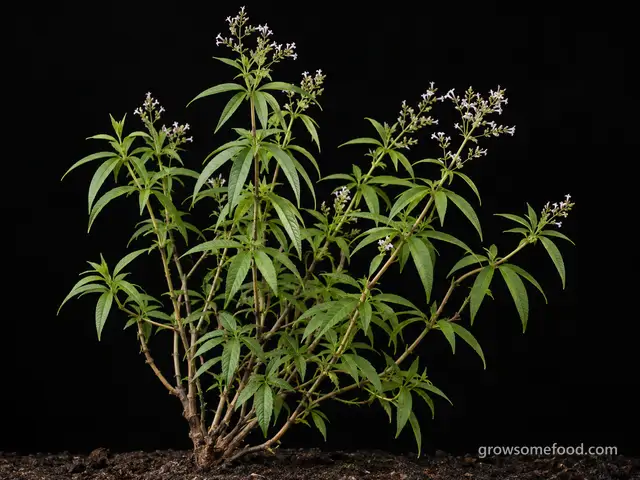
Lemon verbena (Aloysia citrodora) has, leaf for leaf, the purest and most intense lemon scent of any herb - brush a plant and the air fills with clean, sweet lemon. A tender deciduous shrub from the mountains of Argentina, Chile, and Peru, it's grown for its narrow, glossy, lemon-drenched leaves, which make an exquisite herbal tea (verveine) and flavor desserts, syrups, sorbets, custards, and cool summer drinks better than almost anything else.
The catch is that it's frost-tender, hardy in the ground only in zones 8-11. Everywhere colder it's grown as a container plant, set out for summer and brought into a cool, bright, frost-free spot for winter - where, being deciduous, it drops every leaf and looks dead until it releafs (often very late) in spring. It's a little demanding compared to a mint or a thyme, but no other herb delivers that concentrated lemon fragrance, and it dries beautifully for winter tea, so it earns its keep.
At a glance
- Sun
- Full sun · Part sun
- Water
- Medium
- Spacing
- 24–48 in (typ. 36)
- Mature height
- 36–120 in (typ. 60)
- Start by
- Transplant · Cuttings
- Frost
- Tender
- Spread
- 24–96 in (typ. 48)
- Soil
- Well-drained
- Temperature
- Damaged below 15°F · struggles above 100°F
When to plant
Zone 7a typical frost: last Apr 10 · first Oct 25 (spring frost runs Mar 27–Apr 24 in a typical spread of years)
Life stages
- Establishing (year 1) day 0–90 from transplant
-
Water to establish, then keep drainage sharpevery 4 dWater new plants regularly the first season to root in, but ensure sharp drainage - lemon verbena wants moisture without wet feet, and rots in soggy soil.
-
Grow it in a pot in cold zonesTender to about 15-20F, lemon verbena is hardy in the ground only in zones 8-11. In colder zones grow it in a container from the start so it can be moved to shelter for winter.
Root rot in wet soilSudden leaf drop from cold, transplant shock, or moving (normal - it releafs) -
Water to establish, then keep drainage sharpevery 4 d
- Spring leaf-out Apr, May, Jun (yearly)
-
Prune hard in spring to force bushy growthLemon verbena is leggy by nature and is slow to leaf out in spring (be patient - it often looks dead until late). Cut it back hard as new growth begins to build a bushier, more productive plant.
-
Feed for vigorous leafy growthevery 21 dA hungry plant in growth, it appreciates regular light feeding through spring and summer for a strong flush of fragrant leaves.
Very late leaf-out (normal - don't give up on it too early)Spider mites and whiteflies, especially on plants overwintered indoors -
Prune hard in spring to force bushy growth
- Summer leaf harvest Jun, Jul, Aug, Sep (yearly)
-
Cut leafy sprigs freely all summerevery 7 dHarvest stem tips and leaves as needed; frequent cutting keeps the plant bushy and productive. The lemon aroma is strong throughout, and cutting doubles as shaping.
-
Take a big crop to dry at peakCut generously in mid to late summer for drying - lemon verbena is one of the few herbs that keeps its intense lemon scent beautifully when dried for winter tea.
Whitefly and spider mite in hot, dry, or sheltered conditionsLegginess (prune and harvest to keep it bushy) -
Cut leafy sprigs freely all summerevery 7 d
- Winter dormancy (deciduous) Jan, Feb, Nov, Dec (yearly)
-
Overwinter potted plants under coverIn cold zones move the pot before frost into a cool, bright, frost-free spot (garage, porch, cool room). Lemon verbena is deciduous and drops all its leaves in winter - this is normal; keep it barely moist and don't assume it's dead.
-
Mulch heavily where borderline-hardyIn zones 8-9 where it's root-hardy, cut back and mulch the crown deeply; the top may die back and it will resprout from the base in late spring.
Overwatering a leafless dormant plant (rots the roots - keep it barely moist)Assuming a bare plant is dead (it releafs late in spring) -
Overwinter potted plants under cover
Harvest
- Style
- Cut and come again
- Typical yield
- 40–250 sprigs (typ. 100)
- By weight
- 8–64 oz (typ. 24)
- First production
- 0–1 yrs (typ. 0)
- Leafy stems in active growth from late spring through fall
- Strong lemon aroma throughout the growing season; a big harvest in mid-to-late summer for drying
- Cut stem tips above a leaf node to shape and force branching
Watch out for
Root Rot Medium
Root rot is not one organism but a group of soil fungi and water molds - Pythium, Phytophthora, Fusarium, Rhizoctonia and others - that sit harmlessly in most soils and only turn destructive when the ground stays saturated. Waterlogged soil drives the air out, the roots suffocate, and the weakened tissue is invaded and goes soft, brown, and stringy. Because the damage is underground you usually see it first as something that looks like drought: wilting, yellowing, stunting, a plant that does not respond to being watered. Overwatering, heavy compacted ground, a low spot that collects runoff, a pot with no drainage or a saucer left standing full, and cold wet soil in winter are the usual causes. Once roots have actually rotted there is no cure - this is a problem you prevent rather than treat.
Watch for: Wilting in the middle of the day on a plant whose soil is damp - the classic tell, and the reason people water a rotting plant and finish it off. Leaves yellowing from the bottom up, dull off-color foliage, and growth that stalls for no visible reason. Whole shoots, or one side of the plant, collapsing while the rest still looks fine. Soft, dark, or mushy tissue at the base of the stem or at the crown, sometimes with a sour smell. Lift a failing plant and look at the roots: healthy ones are firm and pale, rotted ones are brown or black and slimy, and the outer layer slips off between your fingers leaving a thread of core behind. Seedlings that topple over at soil level are the same problem, called damping-off.
Prevent: Drainage is the whole defense. Match the plant to the site first - something that wants sharp drainage will not survive heavy clay or a low, water-collecting spot however well you tend it. Where the ground is heavy, plant on a raised bed, berm, or slope, or grow in a container. Set plants at the depth they were already growing, since burying the crown or the root flare is a common cause of rot, and keep mulch pulled back a few inches from the stem base instead of piled against it. Water the soil rather than the calendar: check that the top inch or two is dry before watering again, cut back hard in cool weather and winter dormancy, and never leave a pot standing in a full saucer. Do not plant or dig in soggy ground, and go easy on rich amendments for plants that want it lean. Rotate annual crops, and start with clean healthy plants and fresh mix.
Treat: There is no cure for tissue that has already rotted, so act on the conditions rather than looking for a spray. Stop watering at once and fix the drainage - open up compacted soil, or move the plant to a raised, sharply drained position or a container. Lift a badly affected plant, cut away every soft dark root and rotted section with a clean blade back to firm pale tissue, and replant only the healthy parts into fresh free-draining soil or mix. Often the better move is to give up on the plant and save its offspring instead: cuttings, offsets, or divisions taken from firm healthy growth root readily and give you a clean start. Bin the rotted material rather than composting it, and correct the drainage before you replant, because the rot comes straight back in the same wet spot.
The risk window is winter, when a dormant, leafless plant is still being watered on a growing-season schedule. Water a resting plant only enough to keep the roots from drying out completely, and use a sharply drained mix and pot.
Spider Mites Medium
Spider mites are not insects but tiny sap-feeding arachnids, smaller than a grain of salt, and you almost always notice the damage before you notice them. They live on the undersides of leaves and drain the cells one at a time, which is why the leaf goes finely stippled with pale dots before it bronzes and dries. They breed explosively in hot, dry, dusty, still air - a generation can pass in a week at high temperature - so a barely visible population becomes a webbed, bronzed plant within a fortnight. Drought-stressed plants and plants wintered indoors in dry heated air are the classic hosts. Broad-spectrum insecticides make matters worse rather than better, because they kill the predatory mites and lady beetles that normally hold mites in check.
Watch for: Fine pale stippling or speckling across the upper leaf surface, as though the color had been sandblasted out of it, and later a dull bronze or rusty cast over the whole leaf. Delicate webbing across leaf joints, shoot tips, and undersides - that comes with a heavy infestation and means you caught it late. Leaves that dry, curl, and drop early while the plant looks thirsty no matter how much you water it. Hold a leaf over a sheet of white paper and tap it: the specks that fall and then start walking are mites. With a hand lens, look on the undersides for the mites themselves, pale or reddish, and their round translucent eggs. Damage that shows up first on the hottest, dustiest, most sheltered side of a plant, or on a pot sitting near a radiator indoors.
Prevent: Do not let plants get drought-stressed - that is the single strongest trigger, and a plant watered steadily through heat is far less likely to have a mite problem at all. Hose the foliage down, undersides included, during hot dry spells: it knocks mites off, washes away the dust they thrive in, and raises the humidity around the plant for a while. Indoors and under cover, keep the air from going hot, dry, and stagnant, wipe or rinse the leaves occasionally, and keep pots away from radiators and heating vents. Inspect any plant carefully before you bring it indoors for winter or set it among others, since mites almost always arrive on something else. Avoid broad-spectrum insecticides: they wipe out the predatory mites, lacewings, and lady beetles that do most of this work for you, and reliably leave you with a worse outbreak than you started with.
Treat: Start with water. A strong jet aimed at the leaf undersides, repeated every few days for a couple of weeks, knocks populations down and breaks the cycle - on many plants that alone ends it. On anything that regrows quickly, shearing back badly infested growth resets the plant to clean foliage. If it keeps building, spray insecticidal soap or horticultural oil directly onto the undersides where the mites actually live, and repeat every five to seven days for three rounds: contact sprays do not kill the eggs, so a single application always fails. Anything you spray must be labeled for the plant you are treating - follow the label and observe its pre-harvest interval on anything you eat. Predatory mites are an effective release in a greenhouse or on an indoor plant. Above all, correct the heat, dust, and drought stress that caused it, or the mites simply come back.
Overwintered indoor plants are the classic hotspot - check regularly through winter, paying attention to the leaf undersides.
Whiteflies Medium
Tiny white sap-sucking insects that cluster on leaf undersides and lift off in a cloud when the foliage is brushed. They weaken growth, and the honeydew they excrete coats the leaves below in a sticky film that blackens with sooty mold. Some species also transmit plant viruses. They breed fast in warm, still, sheltered air, which is why they are far more trouble under cover and on plants overwintered indoors than on the same plant outside.
Watch for: Clouds of tiny white insects rising when you shake the plant, flat scale-like nymphs stuck to the leaf undersides, a sticky shine on the leaves below them, black sooty mold over that, and yellowing, weakened growth.
Prevent: Inspect the undersides of any new plant before it joins the others, and quarantine anything you are bringing under cover or indoors for winter. Avoid crowding and heavy nitrogen feeding, which produce the soft growth they prefer. Hang yellow sticky traps early to catch the build-up while it is still small, and encourage lacewings, ladybugs and parasitic wasps outdoors.
Treat: Hose off light infestations, then spray insecticidal soap or horticultural oil onto the leaf undersides where they actually sit. Sprays do not kill the eggs, so repeat every few days for two or three weeks or the population simply rebuilds. Yellow sticky traps knock back the adults, and outdoors natural enemies usually finish the job.
Lemon verbena is often overwintered indoors, which is exactly where whiteflies do their damage. The natural leaf drop of dormancy helps break the cycle, so a plant kept cool and dormant is far less troubled than one kept warm and in leaf.
Good & bad neighbors
Varieties · 1
Open, somewhat leggy woody shrub with whorls of narrow, pointed, glossy light-green leaves and airy sprays of tiny white-to-pale-lilac flowers.
The species and essentially the only form grown: a tender deciduous shrub with narrow, glossy, intensely lemon-scented leaves in whorls, tiny pale lilac-white summer flowers, and no real named cultivars. Grown from cuttings for tea, desserts, drinks, and fragrance; potted and overwintered in cold zones.
Grow
Give it full sun, warmth, and sharply drained soil; start from a rooted cutting or transplant, and in any zone colder than 8 grow it in a pot so you can bring it in for winter.
Lemon verbena wants full sun, warmth, and well-drained soil. It's almost always started from a rooted cutting or a transplant - seed is rarely available and slow and unreliable to germinate, and cuttings root readily and give you an exact copy. Set plants out only after all frost danger has passed; they're heat-lovers.
The single most important decision is where it lives. In zones 8-11 it's hardy in the ground and grows into a large, woody, somewhat leggy shrub 3-10 feet tall. In any colder zone, grow it in a container from the start: a good-sized pot with sharp drainage, out on the patio for summer and moved indoors before the first fall frost. Feed it in growth - it's hungry - and prune it hard each spring to counter its naturally leggy, open habit and build a bushier, leafier plant.
Care
Water without waterlogging, feed in growth, prune hard in spring for bushiness, harvest freely, and - in cold zones - overwinter the leafless dormant pot cool, bright, and barely moist.
In the growing season, keep lemon verbena watered but never waterlogged (it rots in soggy soil), feed it regularly since it's a hungry plant in active growth, and harvest and prune freely - cutting keeps it bushy and productive against its leggy nature. Watch for whitefly and spider mites, especially on plants grown or overwintered indoors, where dry sheltered air favors them.
The defining care task is overwintering in cold zones. Before the first fall frost, move the pot into a cool, bright, frost-free place (an unheated but frost-free garage, porch, or cool room). Being deciduous, it will drop all its leaves and look completely dead - this is normal; keep it only barely moist, do not overwater the leafless plant, and be patient, because it often doesn't releaf until quite late in spring. Prune it back and resume feeding and watering as new growth appears. Where it's root-hardy (zones 8-9), cut back and mulch the crown deeply and it resprouts from the base.
Harvest
Snip leafy stem tips above a leaf node whenever the plant is in growth, taking no more than about a third at once; make one big cut in mid-to-late summer for drying, and a last one before the fall move indoors.
Harvest by snipping leafy stem tips just above a leaf node - that is where the plant branches, so every cut also fights its naturally leggy habit and builds a bushier shrub. Take no more than about a third of the plant at a time and it rebounds fast. The lemon oil is strongest in the morning once the dew has dried, and it stays strong right through the season, so there is no narrow window to hit.
Make one generous cut in mid to late summer, when the plant is at full size — that is the batch you dry for winter tea. In cold zones, take a final harvest (and a few insurance cuttings) before the pot comes indoors in fall, since the plant drops every leaf in dormancy anyway. Cut into leafy growth rather than back into bare old wood, and leave the woody framework to carry next year's flush.
Storage
It dries better than almost any herb, holding its scent for a year - hang bundles or dehydrate on the lowest setting and store the leaves whole. It also freezes, and makes syrups and infused sugar.
Lemon verbena is one of the very few herbs that keeps its aroma almost intact when dried, which is what makes a jar of it worth having in January. Bundle whole stems and hang them upside down in a warm, dry, airy, shaded spot until the leaves are crisp, or use a dehydrator on its lowest setting — heat drives off the lemon oil you are trying to keep. Strip the leaves and store them whole in a sealed jar out of the light, crumbling them only as you use them; they hold their scent for a year or more.
Fresh sprigs keep about a week in the fridge, wrapped in a barely damp towel. The leaves also freeze well — whole in a bag, or steeped and frozen into cubes. For a longer-lived form of the flavor, make a lemon verbena syrup (steep leaves in hot sugar syrup, strain, refrigerate), an infused sugar (leaves layered in a jar of sugar for a week or two, then sifted out), or an infused vinegar for the pantry.
Propagation & seed saving
Softwood tip cuttings taken in late spring and summer root readily - and they are the only practical route, since seed is rarely offered and unreliable. Take insurance cuttings before overwintering.
Lemon verbena is a cutting-grown plant. Seed is rarely available, slow, and unreliable, and there are no named cultivars to keep true, so nearly every plant in cultivation traces back to a cutting. Take softwood tip cuttings 4-6 inches long from healthy, non-flowering shoots in late spring or summer, strip the lower leaves, and set them in a gritty, free-draining mix. Keep them under a dome, bag, or propagator in bright indirect light and only barely moist — wet cuttings rot, as wet roots do on the mature plant — and most root in three to six weeks.
The habit worth building is taking a few insurance cuttings every late summer, before the pot goes into its winter quarters. Overwintering is where lemon verbena is most often lost, usually to an overwatered dormant pot or one cold night in the wrong place, and a couple of rooted young plants on a windowsill cost nothing — and mean you never have to buy the plant again.
In the kitchen
The premier lemon-flavoring herb: a fragrant tea on its own, and an infusion for custards, sorbets, syrups, cakes, poached fruit, and drinks - added fresh or as a steeped infusion, then removed.
Lemon verbena is the aristocrat of lemon flavorings. On its own the fresh or dried leaves make a superb, pure-lemon herbal tea (French verveine, Spanish hierba luisa), soothing and caffeine-free. In cooking, it's used above all as an infusion: steep the leaves in warm cream, milk, syrup, or poaching liquid to draw out the lemon oil, then lift them out. That infusion perfumes custards, ice creams and sorbets, panna cotta, cakes and shortbread, syrups, poached fruit, jellies, and cocktails and cold drinks.
Because the leaves themselves are somewhat tough and fibrous, they're usually infused and removed or finely minced rather than eaten whole in quantity. The flavor is more intense than lemon balm or lemongrass, so a little goes a long way. It pairs beautifully with summer fruit, and its exceptional retention of scent when dried means a jar of dried leaves flavors tea and baking all winter.
Nutrition
Used in tea and infusion amounts rather than for calories; its value is aromatic and antioxidant, with a long tradition as a soothing, digestive tea rather than a nutrient source.
Lemon verbena is used in the small amounts of a tea or an infusion, so it is not a source of meaningful calories or bulk nutrition. Its leaves are rich in aromatic and antioxidant compounds - chiefly citral and other lemon-scented terpenes, plus verbascoside and flavonoids - which give both the intense lemon scent and a genuine antioxidant profile studied in the lab.
Its practical value is as a soothing, caffeine-free tea with a long folk tradition as a mild digestive and calmative, taken after meals to settle the stomach and relax - much like chamomile or lemon balm. Enjoy it freely as a pleasant, aromatic tea and flavoring; the concentrated essential oil is a different thing entirely - a recognised skin sensitizer, prohibited in fragrances by IFRA and banned in EU cosmetics, so keep it off your skin. As a food, it's about fragrance and flavor rather than nutrition.
Traditional & historical uses
Lemon verbena is widely used in South American folk medicine and beyond as a soothing, caffeine-free tea. Its intensely lemon leaves are taken as a digestive and carminative after meals and as a mild calmative for nervousness and sleep, and the plant is a studied source of antioxidants. Gentle and pleasant as a tea; treat the essential oil with care. Educational only, not medical advice.
This section records how people have traditionally used this plant, and what is known about the risks. It is history and general information — not medical advice, and not a recommendation to treat anything. Plants are not dosed like medicines, some interact with prescriptions, and some are harmful in ways that are not obvious. Talk to a clinician before using any plant medicinally.
Lemon verbena is more than a fragrant tea - across its native South America (where it is known as cedron or hierba luisa) and in European herbal tradition, it is a valued digestive and calming remedy.
Traditional uses: the intensely lemon-scented leaves are brewed as a tea taken after meals as a digestive and carminative - to settle the stomach and ease indigestion, bloating, and cramping - and as a gentle calmative for nervousness, restlessness, and to help with sleep, much like chamomile or lemon balm. Its leaves are rich in antioxidant and aromatic compounds - chiefly citral and other terpenes plus verbascoside and flavonoids - and modern research has looked at lemon-verbena extracts for their antioxidant and anti-inflammatory effects, including on exercise-related muscle stress, though clinical evidence remains preliminary.
Honest caveats: the leaf tea is gentle, pleasant, and safe for most people in ordinary amounts. The concentrated essential oil is a different matter: verbena oil is a recognised skin sensitizer - prohibited in fragrances by IFRA and banned in EU cosmetics under the Cosmetics Regulation - so do not apply it to skin. Large or prolonged medicinal-strength doses of the herb are best avoided in pregnancy and by those with kidney problems. Educational information, not medical advice.
History
A South American native carried to Europe by Spanish explorers in the 1700s, prized in perfumery and as verveine tea, and named for a Spanish queen - now a global container herb.
Lemon verbena is a relative newcomer to the Old World. Native to the Andean regions of Argentina, Chile, and Peru, it was brought to Europe by Spanish and Portuguese explorers in the 1700s, where its extraordinary lemon fragrance made it an instant favorite - grown in gardens and glasshouses, distilled for perfumery, and brewed as the fashionable herbal tea verveine that remains popular in France and Spain. Its botanical name Aloysia honors Maria Luisa (Louisa) of Parma, queen of Spain, and its Spanish name hierba luisa ('Louisa's herb') carries the same royal association.
Long valued in South American folk medicine as a digestive and calming tea (and still widely drunk there as cedron or hierba luisa), it spread through European and then North American gardens as a treasured fragrance and flavoring plant. Because it is tender, it became the classic conservatory and container herb in cool climates - a tradition of potting it up and bringing it in for winter that gardeners still follow today.
Troubleshooting
A bare plant in winter is normal dormancy, not death; late spring leaf-out is normal; leaf drop follows cold or moving; tiny webbing or flying white specks are mites and whitefly.
Dropped all its leaves and looks dead: almost always normal - lemon verbena is deciduous and goes fully leafless in winter dormancy, and it also drops leaves after cold, transplanting, or being moved; keep it barely moist, be patient, and it releafs. Slow to leaf out in spring: normal - it's notoriously late; don't give up on it until early summer, and scratch a stem to check for green underneath. Fine webbing and stippled, dusty leaves: spider mites, common on indoor and overwintered plants in dry air - rinse the foliage and raise humidity. Clouds of tiny white insects: whitefly, again worst indoors - use yellow sticky traps and insecticidal soap. Wilting despite watering, soft roots: root rot from soggy soil or an overwatered dormant pot - improve drainage and water far less. Leggy and sparse: its natural habit - prune hard in spring and harvest often to keep it bushy.
Growing across climates
Hardy in the ground only in zones 8-11, where it becomes a large shrub; everywhere colder it's a container plant overwintered under frost-free cover - a herb defined by its frost-tenderness.
Lemon verbena's culture is entirely shaped by its frost-tenderness (hardy only to about 15-20°F). Zones 10-11: an easy evergreen-to-deciduous woody shrub outdoors, growing large (to 6-10 feet) with year-round harvest in full sun and sharp drainage. Zones 8-9: root-hardy in the ground with protection - cut back and mulch the crown deeply, and it dies back and resprouts from the base each spring. Zones 3-7: grow it strictly in a container, out for summer and moved into a cool, bright, frost-free space for winter dormancy, where it drops its leaves and rests; this is the standard method and works well. Anywhere: it demands full sun, warmth, and excellent drainage, and its whole calendar - out in spring after frost, in before fall frost - revolves around keeping it from freezing.
Cook it
All 1 recipe →Grower tips
No grower tips for Lemon Verbena yet. Yours could be the first.
Sign in to share what works in your garden.