
Add it to your home screen and it opens full screen: no browser bars, one tap away, and everything stays signed in. Free, nothing to download from an app store.
- Tap the Share button in your browser
- Scroll down and choose “Add to Home Screen”
- Open GrowSomeFood from your home screen
- Open your browser’s menu
- Choose “Add to Home screen” or “Install app”
- Open GrowSomeFood from your home screen

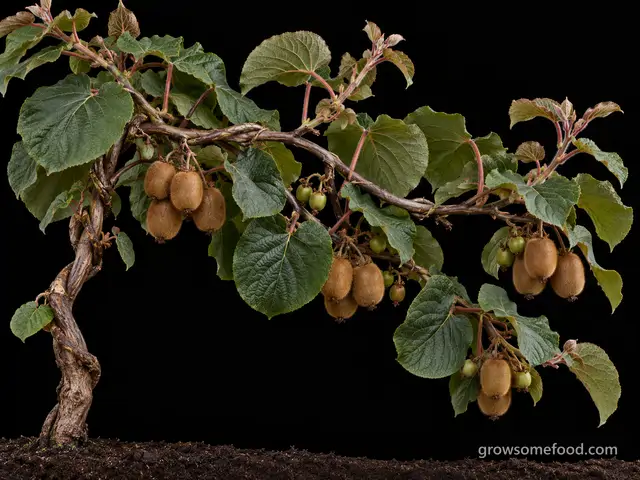
Kiwi
The brown fuzzy supermarket kiwi, grown at home: a hugely vigorous, decades-living vine for zones 7-9 that needs a strong trellis, hard annual pruning, patience - and both a male and a female plant, because only females fruit and only with a male nearby.
Safety notes The fuzzy brown skin is edible but is usually peeled, or the flesh is scooped out with a spoon. Kiwi is a recognised food allergen and can cause severe reactions, including anaphylaxis, especially in young children; it also cross-reacts with latex, banana and avocado (latex-fruit syndrome) and with birch pollen. Mouth tingling can be an early sign - anyone with a reaction beyond mild tingling, or any latex allergy, should avoid kiwi and seek medical advice.
Overview
Fuzzy kiwi (Actinidia deliciosa) is the familiar brown, fuzzy, egg-sized fruit of the supermarket, and it is a spectacular backyard vine for gardeners with room, warmth, and patience: a fast, powerful, decades-living plant that drapes a pergola or trellis and, once mature, buries you in vitamin-C-rich fruit that stores for months. It is a warm-climate crop - it needs the long, mild season of zones 7 to 9 to ripen its big fruit, and its dormant wood is damaged around 10°F. If you garden colder than that, the plant you want is its cold-hardy cousin, hardy kiwi, which has its own entry.
The one thing to knowIt is a warm-climate crop - it needs the long, mild season of zones 7 to 9 to ripen its big fruit, and its dormant wood is damaged around 10°F.
Quick facts
- Winter chill
- 700 hours below 45°FRange: 500–900 hours
- Height
- 7 ftRange: 6–8 ft
- Spread
- 20 ftRange: 10–30 ft
- Support
- Grows better on a trellis or stake
- Cold
- Takes light frostdamaged below 10°F
- Heat
- Struggles above 95°F
- Life cycle
- Perennial, lives about 40 years
- Soil
- Well-drained
- Water
- Medium
- Plant spacing
- 12 ftRange: 10–15 ft
When to plant
Nothing is open today. Spring transplanting opens 5 months, Mar 20 to May 10.
- Transplant Mar 20 – May 10 Opens in 152 daysAbout 3 weeks before to 4 weeks after your last frost (Apr 10 here)The cool edge of fuzzy-kiwi range and workable with care: choose a frost-sheltered site with good cold-air drainage, wrap the trunk each winter, and expect the harvest to run late into October. Hardy kiwi is the easier crop here.
Frost here: last around Apr 10 (Mar 27 to Apr 24 most years), first around Oct 25. Zone averages, your own yard may run a week or two either way.
Life stages
Establish, grow, repeat
Getting established and returning each season are different parts of the story.
Stage 1 of 6 · Getting established
Years 1-2: planting & building a trunk
About the first 1.4 years after planting
Care at this stage
-
Build a STRONG trellis or pergola before planting
Fuzzy kiwi is an enormously vigorous vine that can grow 10-20+ feet a year and becomes heavy and long-lived - it needs a stout structure (a T-bar trellis on 4x4 posts, a heavy pergola, or a strong fence), not a flimsy one. Put it up first; a mature kiwi will tear apart anything undersized.
-
Plant a MALE and FEMALE (fuzzy kiwi is dioecious)
This is the make-or-break fact: male and female flowers are on separate plants, only females fruit, and only then if a compatible MALE blooms nearby to pollinate them. Plant one male per up to eight females and match the species - a female Hayward needs a fuzzy male such as Tomuri, and a hardy-kiwi male cannot substitute. Golden kiwi (A. chinensis) is a different species again and needs a chinensis male.
-
Train one strong shoot up to build a trunk and arms
The first two years are framework: train the single strongest shoot straight up a stake to the top wire, then let two arms run in opposite directions along it as permanent cordons. Rub off competing shoots. You're building a structure to carry decades of fruit, not chasing early crops.
-
Water generously - kiwis are thirsty
Kiwis have large leaves and high water needs; keep the root zone consistently moist (they don't tolerate drought OR waterlogging). Deep, regular watering is essential to establish and grow the vigorous vine.
Months are typical seasonal windows; climate, variety, and plant age can shift them.
Harvest
- Cut a test fruit: the seeds have turned jet black, which means the sugars have risen even though the fruit is still hard
- Picked FIRM but mature in fall - it will not soften or sweeten fully on the vine
- Harvested before a hard freeze; a light frost after leaf drop does no harm
- Fruit parts from the vine cleanly at the stem when lifted and twisted
- Ready to EAT only after ripening off the vine, when it yields to gentle pressure in the palm
- Pick FIRM but mature - it will not sweeten on the vine · every 4 days
- Get the crop in before a hard frost
- Ripen it off the vine, a batch at a time
Per plant 20 to 100 pounds per vine, 20 to 100 lbPicking pick as they ripen
Cook with kiwis
Watch out for
4 to know. 1 is high-risk: Phytophthora Root & Crown Rot. 1 is active in October.
Phytophthora Root & Crown RotSeverity High DiseaseSeason: Apr–SepWilting, yellowing and stunting that does not improve with watering, a thinning canopy of small pale leaves, and dieback from the shoot tips.
Kiwis are thirsty but wholly intolerant of waterlogging, so soggy ground is their main disease vulnerability. Plant on a raised mound or berm and give the vine moist BUT well-drained conditions - drainage here is the entire defense.
Wilting, yellowing and stunting that does not improve with watering, a thinning canopy of small pale leaves, and dieback from the shoot tips. Dig and the feeder roots are dark, soft or brittle rather than white and firm, and on many plants the tissue at the base of the stem is discolored under the bark. Worst in low spots, and wherever a downspout, driveway or compacted path drains into the bed.
Very hard to reverse once established. Improve the drainage immediately, cut watering back, and mulch with coarse material rather than fine, which stays sodden. Remove severely affected plants and correct the site before replanting - and do not put another susceptible plant back into the same wet spot. Phosphonate (phosphite) treatments can suppress it in a valuable specimen, but drainage and siting do far more.
Drainage is the whole defense. Plant on a mound, berm or raised bed in heavy soil, and never in a hollow that holds winter water. Redirect roof and hard-surface runoff away from the planting, water deeply but infrequently so the surface dries between waterings, do not pile mulch against stems, and do not overwater in cold weather when the plant is using little. Use resistant rootstocks or tolerant varieties where they exist for the crop, and never move soil from an infected area.
A soil-borne water mold (Phytophthora species) that rots feeder roots and, on many plants, the crown at the soil line whenever the ground stays saturated. Rotted roots cannot take up water, so the plant looks drought-stressed even in wet soil: the canopy thins, leaves go small and pale, growth stalls, and dieback works in from the tips over months or years. It is the commonest cause of death in plants that want moisture but cannot tolerate standing water, and it travels in surface water and on tools, boots and moved soil.
Deer (browse resistance)Severity Medium WildlifenowSeason: Apr–OctGrowth cleanly missing overnight, with the plant browsed back to a level line about as high as a deer can comfortably reach.
Deer can seriously set back or even kill establishing vines by repeatedly stripping the new shoots. A tall trellis that lifts most of the growth out of reach solves it as the vine matures; the vulnerable stage is the first couple of years.
Growth cleanly missing overnight, with the plant browsed back to a level line about as high as a deer can comfortably reach. Ragged, torn stem ends rather than the clean angled cut a rabbit leaves - the single most reliable identifier. Buds and flowers gone while the foliage below is untouched, since deer often take the best part first. Hoof prints and droppings in soft ground near the damage. Repeat visits, with fresh damage each morning once a planting has been found. On young trees, shredded and stripped bark and broken low branches in autumn - that is antler rubbing rather than feeding.
There is no chemical fix, only exclusion and recovery. Get physical protection up immediately after the first damage, because deer return to a known meal, and reinforce or rotate whatever you were relying on before. Most plants regrow from browsing if the crown and roots are intact - feed and water a grazed plant and protect the regrowth while it comes back. What does not recover in the same season is anything whose buds or flowers have been taken, and a young tree whose bark has been rubbed right around the trunk is usually lost. Where deer pressure is genuinely heavy, the honest answer is to fence properly or to grow the plants deer leave alone, rather than to keep replacing losses.
Fencing is the only thing that reliably works. Eight feet is the standard for excluding deer, or two parallel four-foot fences a few feet apart, which they will not jump because they cannot judge the landing. Short of that, cage individual plants: a sturdy wire cage or trunk guard around every young tree, left on until the trunk is thick and the canopy is above browse height, prevents both browsing and antler rubbing and is the single highest-value thing you can do for a young tree. Repellent sprays do help at moderate pressure, but they wash off and deer habituate, so reapply after rain and rotate between different types through the season. Motion-activated sprinklers, scent deterrents, and noise devices work for a while and then stop. Siting matters too: plants close to the house, in daily traffic, and screened behind other planting get browsed less than the same plant out at the boundary.
Deer are the largest garden problem across much of the country, and where pressure is high they set the limit on what you can grow at all. They browse at night and around dawn and dusk, taking tender shoots, leaves, buds, flowers, and fruit within about five feet of the ground, and they come back night after night to anything they have found and liked. Because they have no upper incisors they tear rather than cut, leaving ragged stem ends - that is how you tell deer damage from a rabbit's clean angled cut. In fall, bucks rub their antlers on young trunks and can strip the bark right around a stem, which kills a young tree outright. Palatability varies enormously between plants and between seasons: a herd short of food in late winter eats things it ignores in June, and no plant is truly deer-proof.
Scale & Sooty MoldSeverity Medium PestSeason: May–AugRows of small brown, tan, black, white, or waxy bumps along stems, twigs, leaf midribs, and leaf undersides that do not brush off but can be scraped loose with a fingernail.
One of the more common kiwi pests, encrusting the canes and trunk. The annual hard pruning removes most buildup and a dormant oil in winter smothers what is left; rarely devastating on a healthy vine.
Rows of small brown, tan, black, white, or waxy bumps along stems, twigs, leaf midribs, and leaf undersides that do not brush off but can be scraped loose with a fingernail. A sticky shine on the leaves - and on the floor, table, or path beneath the plant - that later turns black with sooty mold. Ants running steadily up and down the stems, since they farm and defend scale for that honeydew; often the first sign anything is wrong. Yellowing leaves, weak thin growth, and dieback of individual branches or canes that are heavily encrusted. On fruit crops, scale covers and sooty mold directly on the fruit. Check the leaf undersides and the shaded inner wood, which is where colonies build up unseen.
Horticultural oil is the main control: it works by smothering, so it has to coat the insects thoroughly - stems, twigs, and leaf undersides - and it usually needs repeating, because the waxy covering shields them and no single pass reaches everything. On deciduous woody plants a dormant-season oil smothers the overwintering stage while the leaves are out of the way, and timing a growing-season spray to the crawler stage, when the young are mobile and uncovered, is far more effective than spraying settled adults. On a small plant or a light infestation, scrub or wipe the scales off by hand, or dab them with a cotton swab of rubbing alcohol. Prune out and destroy badly encrusted wood rather than trying to save it. Wash off the sooty mold once the scale is gone - it lives on the honeydew, not on the plant, and stops once the supply does. Anything you spray must be labeled for the plant, and oils can burn delicate foliage, so test first.
Inspect. Look over leaf undersides and stems regularly - on a crop you pick, every harvest is a scouting chance - and check every new plant thoroughly before you buy it, plant it, or set it beside anything else, because scale almost always arrives on a plant rather than flying in. Quarantine new houseplants for a few weeks. Keep plants unstressed and not over-fertilized, since soft, forced growth is what populations build on. Prune for airflow and light to open up the shaded inner growth where scale hides, and prune out heavily infested wood as routine maintenance - on anything that gets a hard annual pruning, that alone removes most of any buildup. Leave the lady beetles, lacewings, and parasitic wasps alone, since they normally keep scale down to nothing, and keep ants off the plant where you can, because ants protect the colonies from those predators. Indoors, avoid hot, dry, still winter air.
Scale insects are sap-suckers that spend most of their lives immobile, fixed to a stem, twig, or leaf underside beneath a waxy or shell-like cover. They look far more like bumps, blisters, or crusty encrustations than like insects, which is why an infestation is usually well established before anyone notices it. Soft scales excrete large amounts of sticky honeydew that drips onto everything below and grows a black sooty mold - and those blackened leaves are often the first thing a gardener actually sees. Armored scales produce no honeydew but sit under a hard shield that protects them from most sprays. They spread as tiny mobile crawlers in the weeks after hatching, which is the only stage that moves and the only stage that is easy to kill. Populations build on stressed plants, on crowded shaded growth, and above all on plants kept indoors in dry, still air over winter.
Spider MitesSeverity Low PestSeason: Jun–AugFine pale stippling or speckling across the upper leaf surface, as though the color had been sandblasted out of it, and later a dull bronze or rusty cast over the whole leaf.
They build up on kiwi's large leaves in hot, dry, dusty conditions and stress the vine, but rarely threaten it. Restoring vine vigor and moisture usually resolves it.
Fine pale stippling or speckling across the upper leaf surface, as though the color had been sandblasted out of it, and later a dull bronze or rusty cast over the whole leaf. Delicate webbing across leaf joints, shoot tips, and undersides - that comes with a heavy infestation and means you caught it late. Leaves that dry, curl, and drop early while the plant looks thirsty no matter how much you water it. Hold a leaf over a sheet of white paper and tap it: the specks that fall and then start walking are mites. With a hand lens, look on the undersides for the mites themselves, pale or reddish, and their round translucent eggs. Damage that shows up first on the hottest, dustiest, most sheltered side of a plant, or on a pot sitting near a radiator indoors.
Start with water. A strong jet aimed at the leaf undersides, repeated every few days for a couple of weeks, knocks populations down and breaks the cycle - on many plants that alone ends it. On anything that regrows quickly, shearing back badly infested growth resets the plant to clean foliage. If it keeps building, spray insecticidal soap or horticultural oil directly onto the undersides where the mites actually live, and repeat every five to seven days for three rounds: contact sprays do not kill the eggs, so a single application always fails. Anything you spray must be labeled for the plant you are treating - follow the label and observe its pre-harvest interval on anything you eat. Predatory mites are an effective release in a greenhouse or on an indoor plant. Above all, correct the heat, dust, and drought stress that caused it, or the mites simply come back.
Do not let plants get drought-stressed - that is the single strongest trigger, and a plant watered steadily through heat is far less likely to have a mite problem at all. Hose the foliage down, undersides included, during hot dry spells: it knocks mites off, washes away the dust they thrive in, and raises the humidity around the plant for a while. Indoors and under cover, keep the air from going hot, dry, and stagnant, wipe or rinse the leaves occasionally, and keep pots away from radiators and heating vents. Inspect any plant carefully before you bring it indoors for winter or set it among others, since mites almost always arrive on something else. Avoid broad-spectrum insecticides: they wipe out the predatory mites, lacewings, and lady beetles that do most of this work for you, and reliably leave you with a worse outbreak than you started with.
Spider mites are not insects but tiny sap-feeding arachnids, smaller than a grain of salt, and you almost always notice the damage before you notice them. They live on the undersides of leaves and drain the cells one at a time, which is why the leaf goes finely stippled with pale dots before it bronzes and dries. They breed explosively in hot, dry, dusty, still air - a generation can pass in a week at high temperature - so a barely visible population becomes a webbed, bronzed plant within a fortnight. Drought-stressed plants and plants wintered indoors in dry heated air are the classic hosts. Broad-spectrum insecticides make matters worse rather than better, because they kill the predatory mites and lady beetles that normally hold mites in check.
Good & bad neighbors
Plant nearby
-
A clover cover beneath the trellis fixes nitrogen, holds moisture for the thirsty vine, suppresses weeds, and feeds the bees kiwi needs for pollination.
-
Different species, routinely sold under one name. This page is fuzzy kiwi (A. deliciosa) - the brown egg-sized supermarket fruit, a zones 7-9 vine damaged around 10F, picked hard in fall and ripened indoors. Hardy kiwi (A. arguta / kolomikta) makes grape-sized smooth fruit eaten whole and takes about -25F, so it is the one to grow if your winters are colder. Critically, their MALES ARE NOT INTERCHANGEABLE: a hardy male cannot pollinate a fuzzy female, or the reverse.
- Traditional pairings, thin evidence
-
A strong bee magnet that draws pollinators to the kiwi bloom, helping carry pollen from the male to the female vines - genuinely useful given kiwi's pollination needs.
-
A deep-rooted guild plant at the base of the vine: mines nutrients and its cut leaves make a nutrient-rich mulch for the hungry kiwi; keeps the root zone covered.
-
Draws bees and other pollinators to the area during bloom; a naturalistic pollinator-support pairing rather than a proven benefit.



Keep apart
-
Black walnut's juglone can injure many plants; keep the long-lived kiwi vine well outside a walnut's root zone.
Varieties · 4
You pick one when you add Kiwi to your garden. Its days to maturity set your harvest window.
Hayward
THE commercial kiwi - the large, brown, fuzzy, egg-sized green-fleshed fruit sold worldwide, bred in New Zealand in the 1920s and still dominant a century later - and the standard for home growing in zones 7-9.
Variety details for Hayward
Large, egg-sized, brown-fuzzy fruit with bright-green flesh and black seeds.
fuzzy-kiwideliciosafemalelarge-fruitExcellent flavour and outstanding storage (months in the fridge), but it needs a long, mild season and a fuzzy-kiwi male such as Tomuri or Chico Male to fruit at all. Female; late-ripening; not cold-hardy.
Tomuri Male (fuzzy)
A fuzzy-kiwi (Actinidia deliciosa) MALE pollinizer whose late bloom overlaps well with Hayward, the standard late female - the classic partner planting for home fuzzy kiwi.
Variety details for Tomuri Male (fuzzy)
Non-fruiting vine with abundant late blooms; vigorous, warm-climate.
fuzzy-kiwideliciosamalepollinizerBears no fruit; one male pollinates up to eight fuzzy females. It cannot pollinate a hardy kiwi, and a hardy-kiwi male cannot pollinate your Hayward, so match the species when you buy.
Saanichton 12
A somewhat cold-hardier fuzzy kiwi selection from Vancouver Island that ripens well and pushes the crop slightly north of Hayward's range, with large, good-flavoured fruit.
Variety details for Saanichton 12
Large, brown-fuzzy fruit with green flesh; on a somewhat hardier vine than Hayward.
fuzzy-kiwideliciosafemalecold-hardier-fuzzyStill a female needing a fuzzy male pollinizer and a fairly long, mild season, and still worth wrapping the trunk of at the cold edge - but the most sensible pick for the cool end of fuzzy-kiwi country.
Chico Male (fuzzy)
The other widely sold fuzzy-kiwi MALE, sometimes listed as Matua and often the one a nursery has in stock when Tomuri is gone.
Variety details for Chico Male (fuzzy)
Non-fruiting vine carrying heavy flushes of creamy flowers; vigorous.
fuzzy-kiwideliciosamalepollinizerIt bears no fruit; its job is to bloom alongside your females, and one male serves up to eight of them. Tomuri's later bloom is the closer match for Hayward specifically, so where you have the choice, pair Tomuri with Hayward - but a Chico male beside a female beats a female on her own by an infinite margin.
Grower tips
Notes from growers, tagged with the zone they grow in. A person reads every post before it appears.
Nobody has posted about Kiwi yet. The first one usually saves someone a season.
Free account. Your post shows your grower name and zone, never your email.