
Add it to your home screen and it opens full screen: no browser bars, one tap away, and everything stays signed in. Free, nothing to download from an app store.
- Tap the Share button in your browser
- Scroll down and choose “Add to Home Screen”
- Open GrowSomeFood from your home screen
- Open your browser’s menu
- Choose “Add to Home screen” or “Install app”
- Open GrowSomeFood from your home screen

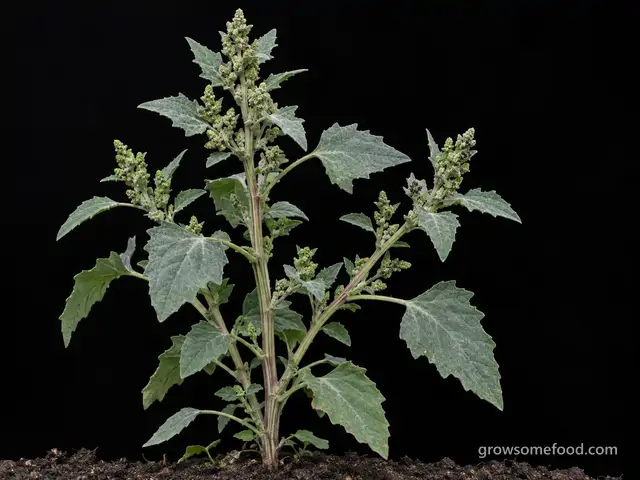
Lamb's Quarters
The 'wild spinach' hiding in your garden as a weed - milder and far more nutritious than the spinach you buy, plus quinoa-like edible seeds, on a plant that grows itself for free.
Safety notes Lamb's quarters is a safe, nutritious cooked green (a relative of spinach and quinoa). Like spinach, its leaves are high in OXALATES, so eat cooked and in normal amounts (not huge raw quantities), and those prone to kidney stones should moderate it. The tiny seeds are edible like quinoa but rinse/soak them to remove bitter saponins. As with any forage, avoid sprayed or roadside plants, and don't harvest where soil nitrates may be high. Identified by its mealy, white-coated young leaves.
Overview
Lamb's quarters (Chenopodium album) is proof that some of the best vegetables are the ones we call weeds. This tall, fast-growing annual - a close relative of both spinach and quinoa - is one of the finest wild greens in the world: its young leaves, cooked like spinach, are mild, tender, and, by many measures, more nutritious than any cultivated leafy green. It even offers a bonus grain, its tiny black seeds being a wild cousin of quinoa.
Quick facts
- Sprouts in
- 12 daysRange: 7–20 days
- Soil temperature
- 65 °FRange: 55–75 °F
- Height
- 48 inRange: 24–84 in
- Spread
- 18 inRange: 8–30 in
- Cold
- Takes light frostdamaged below 20°F
- Heat
- Struggles above 100°F
- Life cycle
- Annual
- Save seeds
- About 90 days after plantingRange: 70–120 days
- Self-sows
- Yes, expect volunteers
- Soil
- Well-drained
- Water
- Medium
- Plant spacing
- 14 inRange: 8–24 in
When to plant
Nothing is open today. Spring sowing opens 6 months, Apr 10 to Jun 5.
- Direct sow Apr 10 – Jun 5 Opens in 172 daysAbout at to 8 weeks after your last frost (Apr 10 here)If growing on purpose, sow in warm spring soil after last frost in full sun and rich ground; far more often it volunteers abundantly and needs no sowing.
Frost here: last around Apr 10 (Mar 27 to Apr 24 most years), first around Oct 25. Zone averages, your own yard may run a week or two either way.
Life stages
From the first start to harvest
Follow the growing sequence. Choose a stage to see its care and signs to watch for.
Stage 1 of 3 · The growing sequence
Seedling & young growth
Day 0 to 35 from sowing
Care at this stage
-
Recognize the mealy young leaves
Seedlings come up in spring in warm, disturbed, rich soil. The young leaves are diamond/goosefoot-shaped with a distinctive white, mealy (flour-dusted) coating, especially underneath - the key ID feature. No care needed; it's a vigorous grower.
Stages can overlap; weather, variety, and growing conditions change the pace.
Harvest
- Tender young tips and leaves (spring through summer) - the prime eating stage
- For seed: ripe black seed clusters in fall, rinsed of saponins
- Pick young tips and leaves for cooking · every 10 days
- A superior wild spinach
Picking cut and it regrows
Cook with Lamb's Quarters
Watch out for
4 to know. None are high-risk for Lamb's Quarters. 1 is active in October.
Aggressive Self-Seeding & SpreadSeverity Medium DisordernowSeason: Aug–OctRipe seed heads or stalks shedding onto the ground, and a flush of volunteer seedlings coming up well beyond where the parent plant stood - most obvious in the first weeks of the plant's growing season.
A single lamb's quarters plant can produce tens of thousands of long-lived seeds. Harvesting the tops regularly keeps plants from ever maturing, which makes the crop and the control the same job.
Ripe seed heads or stalks shedding onto the ground, and a flush of volunteer seedlings coming up well beyond where the parent plant stood - most obvious in the first weeks of the plant's growing season.
Hoe or hand-pull volunteers while they are small and before they set seed - the existing seed bank will keep germinating for several seasons either way, so this is an ongoing job rather than a single fix. Where the volunteers are themselves edible, harvesting them is the easiest control, but only ever eat or grow on a seedling you can positively identify.
Cut, deadhead or harvest the seed heads before they ripen and shatter, which is far easier than dealing with what they drop. Where the plant is grown deliberately, keep it in defined rows or a contained bed so that volunteers are obvious, and site it only where naturalizing is welcome.
Not a pest but a management issue. This plant sets and sheds seed prolifically, so anything left to ripen builds a persistent seed bank in the soil and returns as a heavy flush of volunteers the following season. Much of that seed stays viable for years, which is why one season of letting it go can take several seasons to undo.
Look-Alikes in the Weed PatchSeverity Medium DisorderSeason: May–SepPositive checks before you pick: diamond or goosefoot-shaped leaves; a WHITE mealy, flour-dusted coating on the undersides and growing tips; no smell at all when a leaf is crushed; no flowers with petals and no berries; and green or pink-striped stems, never smooth red-purple ones.
Lamb's quarters itself has no deadly look-alike, but it grows shoulder to shoulder with plants that do, so the positive ID checks matter more here than negative ones.
Positive checks before you pick: diamond or goosefoot-shaped leaves; a WHITE mealy, flour-dusted coating on the undersides and growing tips; no smell at all when a leaf is crushed; no flowers with petals and no berries; and green or pink-striped stems, never smooth red-purple ones. Anything strongly scented, berried, or growing on a thick smooth magenta stem is a different plant.
If you are unsure after picking, throw the whole gathering out rather than sorting it at the sink. If someone has eaten an unidentified green, call poison control or a doctor straight away rather than waiting for symptoms.
Learn the white mealy coating first - it is the one feature none of the look-alikes share - and pick tips one plant at a time rather than grabbing a mixed handful from a weed patch. Watch a patch come up so you know what is in it, and never eat a wild green you cannot name with certainty.
Lamb's quarters volunteers in the same warm, rich, disturbed ground as several plants you must not eat. Black nightshade (Solanum nigrum / S. ptychanthum) is the one to know - it comes up in the same beds at the same time, and its foliage and unripe green berries are toxic, especially to children and pets. Young pokeweed shoots (Phytolacca americana) push up nearby and are strongly emetic and purgative, with dangerous roots. Aromatic goosefoot relatives such as epazote (Dysphania ambrosioides) are a milder issue - toxic in quantity from ascaridole - and are used as a seasoning, never as a pot-herb.
Leaf MinersSeverity Low PestSeason: Jun–AugPale, winding squiggly tunnels or translucent blotches inside the leaves, sometimes with tiny larvae visible when held to the light.
Pale, winding squiggly tunnels or translucent blotches inside the leaves, sometimes with tiny larvae visible when held to the light.
Pick off and destroy affected leaves; a vigorous, well-watered plant easily outgrows light damage. Cut back hard for a clean fresh flush if heavily hit.
Remove badly mined leaves, rotate away from beet-family crops, and use row cover early if miners are a known problem.
The same leaf miners that affect spinach, chard, and beets sometimes tunnel quinoa leaves, leaving pale winding or blotchy trails - cosmetic and rarely damaging to the grain crop.
Nitrate / Oxalate AccumulationSeverity Low DisorderSeason: Jun–AugPlants growing lush in very high-nitrogen soil (near manure or heavy fertilizer) may carry higher nitrate levels.
Plants growing lush in very high-nitrogen soil (near manure or heavy fertilizer) may carry higher nitrate levels.
Cook rather than eat raw in bulk; source greens from moderate-fertility, unsprayed ground.
Cook the greens (reducing oxalates), eat in normal amounts, moderate if prone to kidney stones, and avoid harvesting from heavily manured or nitrate-rich sites.
A food-safety consideration rather than a plant problem: like spinach, lamb's quarters is high in oxalates and can accumulate nitrates when growing in heavily fertilized or manured soil.
Good & bad neighbors
All of these are traditional pairings. The evidence is thin, so treat them as a nudge, not a rule.
Plant nearby
-
A close relative in the same family, similarly grown/foraged for nutritious greens and grain-like seed; the two share warm-season, rich-soil habits and complementary wild-food uses.
-
A classic warm-season garden volunteer among corn and other summer crops; harvested young it's free greens, though it competes if left to grow tall, so pull the excess.
-
Lamb's quarters is the wild, warm-season counterpart to spinach - when cool-season spinach bolts in summer heat, lamb's quarters takes over as the garden's cooked green, extending the 'spinach' season all summer.
Varieties · 2
You pick one when you add Lamb's Quarters to your garden. Its days to maturity set your harvest window.
Lamb's Quarters (Chenopodium album)
The common wild spinach: a fast-growing annual with mealy-white-coated goosefoot leaves, superb cooked greens, and quinoa-like edible seeds.
Variety details for Lamb's Quarters (Chenopodium album)
Upright branching annual with diamond-shaped leaves dusted white/mealy underneath and dense green seed spikes.
speciesannualwild-spinachedibleAbundant, nutritious, and free - a garden 'weed' worth eating.
Magentaspreen / Tree Spinach (Chenopodium giganteum)
A cultivated giant relative grown as an edible ornamental, with striking magenta-pink new growth on tall plants - the young leaves and shoots are eaten like lamb's quarters.
Variety details for Magentaspreen / Tree Spinach (Chenopodium giganteum)
Tall plant with vivid magenta-pink young leaves and tips over green goosefoot foliage.
speciescultivatedornamental-ediblemagenta-tipsA deliberately grown version of the wild-spinach idea.
Grower tips
Notes from growers, tagged with the zone they grow in. A person reads every post before it appears.
Nobody has posted about Lamb's Quarters yet. The first one usually saves someone a season.
Free account. Your post shows your grower name and zone, never your email.