
Add it to your home screen and it opens full screen: no browser bars, one tap away, and everything stays signed in. Free, nothing to download from an app store.
- Tap the Share button in your browser
- Scroll down and choose “Add to Home Screen”
- Open GrowSomeFood from your home screen
- Open your browser’s menu
- Choose “Add to Home screen” or “Install app”
- Open GrowSomeFood from your home screen

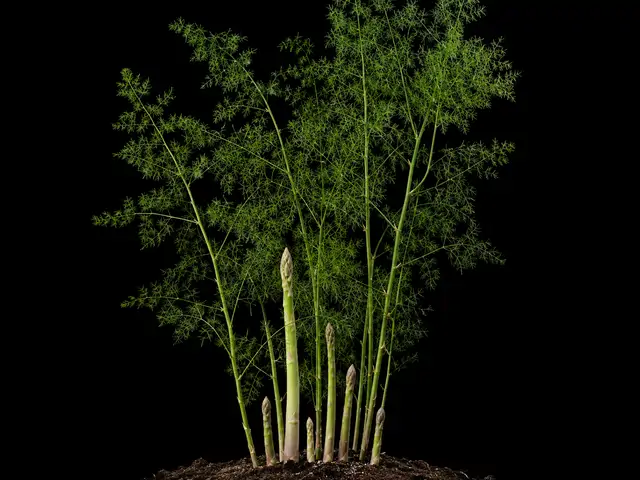
Asparagus
A long-lived perennial worth the wait: plant crowns once, invest two patient years, and harvest spears every spring for 15-20 years from the same bed.
Safety notes The young spears are the food. The mature fern's red berries (on female plants) are mildly toxic and not for eating. Handling the ferns can cause a skin rash in sensitive people, and asparagus makes urine smell distinctive - both harmless.
Overview
Asparagus is the garden's great long-term investment. Unlike almost everything else you grow, you plant it once - as dormant crowns in a deep trench - and a well-made bed then produces spears every spring for 15 to 20 years or more. The catch is patience: you must let the plants establish for two years before harvesting in earnest, resisting the temptation to cut those first tender spears.
The one thing to knowUnlike almost everything else you grow, you plant it once - as dormant crowns in a deep trench - and a well-made bed then produces spears every spring for 15 to 20 years or more.
Quick facts
- Sprouts in
- 21 daysRange: 14–42 days
- Soil temperature
- 75 °FRange: 60–85 °F
- Height
- 5 ftRange: 4–6 ft
- Spread
- 24 inRange: 18–36 in
- Cold
- Takes hard frostdamaged below -35°F
- Heat
- Struggles above 90°F
- Life cycle
- Perennial, lives about 20 years
- Save seeds
- Second yearafter overwintering a few plants
- Self-sows
- Yes, expect volunteers
- Soil
- Well-drained
- Water
- Medium
- Plant spacing
- 15 inRange: 12–18 in
When to plant
Nothing is open today. Spring transplanting opens 5 months, Mar 6 to Apr 17.
- Transplant Mar 6 – Apr 17 Opens in 138 daysAbout 5 weeks before to 7 days after your last frost (Apr 10 here)Early-spring crown planting; asparagus needs winter dormancy, so it thrives across most of the temperate US.
Frost here: last around Apr 10 (Mar 27 to Apr 24 most years), first around Oct 25. Zone averages, your own yard may run a week or two either way.
Life stages
Establish, grow, repeat
Getting established and returning each season are different parts of the story.
Stage 1 of 4 · Getting established
Year 1: establishing the crown
The first year after planting
Care at this stage
-
Plant crowns in a deep trench and backfill slowly
Set crowns 12-18 inches apart in a trench 6-8 inches deep, roots spread out, and cover with just 2 inches of soil. As spears grow through the season, gradually fill the trench with 2 inches at a time until level.
-
Do NOT harvest this year - let every spear fern out
The single most important rule: leave all first-year spears to grow into tall ferns. Those ferns build the underground crown that feeds every future harvest. Cutting now starves the plant for years.
-
Weed diligently - asparagus hates competition
A weedy first year is the most common cause of a weak bed. Hand-weed and mulch; the crop will crowd out weeds itself once established.
-
Water steadily through the first season
Keep the new bed evenly moist (about 1 inch/week) while the crowns establish; they're drought-tolerant later but not now.
Months are typical seasonal windows; climate, variety, and plant age can shift them.
Harvest
- Spears 6-8 inches tall with tight, unopened tips
- Thicker than a pencil (thin spears mean the season is ending)
- Firm and crisp - snap cleanly at the base
- Snap or cut spears 6-8 inches tall, daily in peak
- Ease into harvest: nothing year 1, ~2 weeks year 2, full 6-8 weeks year 3+
- Stop cutting when spears thin to pencil-width
Per plant 8 to 48 ozPicking pick as they ripen
Cook with spears
Watch out for
4 to know. 2 are high-risk: Asparagus Beetle, Fusarium Crown & Root Rot. None are active in October.
Asparagus BeetleSeverity High PestSeason: Apr–AugSmall beetles and dark, humpbacked larvae on spears and ferns; brown scarring and bent 'shepherd's crook' spears; rows of dark eggs stuck on end to the spears.
Small beetles and dark, humpbacked larvae on spears and ferns; brown scarring and bent 'shepherd's crook' spears; rows of dark eggs stuck on end to the spears.
Hand-pick adults and larvae (knock them into soapy water) and rub off eggs; spinosap or neem for heavy infestations. Keeping ferns clean matters most - defoliated ferns starve next year's crop.
Clean up all fern debris in fall to destroy overwintering adults; harvest spears promptly and completely in season (removes egg-laying sites); encourage lady beetles and the parasitic wasp that attacks the eggs.
The signature asparagus pest: the common asparagus beetle (a blue-black beetle with cream squares and red margins) and the spotted asparagus beetle (orange with black dots). Adults and slug-like larvae chew spears and ferns, scarring and bending spears and defoliating the ferns that feed the crown.
Fusarium Crown & Root RotSeverity High DiseaseSeason: Apr–AugSlow decline of individual crowns - fewer, thinner spears, yellowing ferns, and reddish-brown rot and streaking inside cut roots and crowns.
This is the asparagus-specific Fusarium complex, not the general wet-soil root rot: the fungus builds up in ground where asparagus grew before, so a failed bed should be re-sited rather than replanted.
Slow decline of individual crowns - fewer, thinner spears, yellowing ferns, and reddish-brown rot and streaking inside cut roots and crowns.
No cure once a crown is infected - remove badly affected plants, keep the bed vigorous and well-drained, and don't replant asparagus into the same infected ground.
Plant only healthy, disease-free crowns of tolerant varieties into well-drained soil in a new site (Fusarium builds up where asparagus grew before); avoid drought and over-harvest stress that let the fungus advance.
A soil-borne fungal complex (chiefly Fusarium species) that rots asparagus roots and crowns, causing gradual decline: yellowing, wilting ferns, thin spears, and eventual death of the crown. The main reason old beds fade, and it's worsened by wet or compacted soil and stress.
Asparagus RustSeverity Medium DiseaseSeason: Jun–SepYellowing then orange, brick-red, or black raised pustules and streaks on the fern stems and needles; premature browning of the ferns in mid-to-late summer.
Yellowing then orange, brick-red, or black raised pustules and streaks on the fern stems and needles; premature browning of the ferns in mid-to-late summer.
Remove and destroy affected fronds; a protective fungicide can help in a bad year, but the main defense is resistant varieties, airflow, and fall sanitation.
Plant rust-resistant varieties (most modern hybrids and Mary Washington), space and site for good airflow and quick dew drying, avoid overhead watering, and cut and destroy infected ferns in fall.
A fungal disease (Puccinia asparagi) that attacks the summer ferns, progressing through orange, then rusty-red, then black pustules; heavy infection defoliates ferns early and weakens the crown, cutting next year's spear yield.
CutwormsSeverity Low PestSeason: Apr–MaySeedlings and transplants toppled at the soil line overnight, or shoots chewed and notched near the base, with the severed tops left lying beside the stumps.
Cutworms behave differently on asparagus: instead of felling seedlings they notch and gouge emerging spears, or cut them off at the soil line in early spring. Heavy pressure is rare in an established bed and usually passes once harvest gets going.
Seedlings and transplants toppled at the soil line overnight, or shoots chewed and notched near the base, with the severed tops left lying beside the stumps. Dig an inch down within a few inches of the damage and you will usually find the culprit: a plump, dull gray-brown caterpillar that curls into a C when touched.
Dig around each fallen plant and destroy the caterpillar - left alone, one cutworm will fell another plant every night. Replant the gaps with collars fitted. Hand-picking after dark with a flashlight works well on a small bed, and a fast-growing crop soon outgrows the vulnerable stage.
Push a cardboard, foil or tin-can collar an inch into the soil around each seedling and transplant so the stem cannot be reached. Cultivate the bed a couple of weeks before planting to expose the larvae to birds and drying, and clear grassy weeds and debris, which is where the moths lay their eggs.
The soil-dwelling larvae of night-flying moths. They spend the day curled just under the surface and come out after dark to chew through young stems at soil level, felling seedlings and transplants outright - a toppled plant lying beside its own stump is the signature. Some species also climb to gouge and notch emerging shoots and spears. They are worst in freshly worked ground, in beds that were weedy or grassy the year before, and on the first plantings of spring.
Good & bad neighbors
Plant nearby
-
The classic asparagus pairing: tomatoes are said to deter asparagus beetles (via solanine), and asparagus roots to deter root nematodes that trouble tomatoes. They also occupy the bed at complementary times.
- Traditional pairings, thin evidence
-
Grown with tomatoes at the asparagus bed's edge; the aromatic herbs are credited with helping repel asparagus beetles.
-
Its umbel flowers attract the ladybugs and lacewings that prey on asparagus beetle eggs and larvae.
-
Interplanted to suppress soil nematodes and add pest-repelling scent around the long-lived bed.
-
Traditional interplanting said to benefit both; parsley's flowers draw beneficial insects to the perennial bed.




Varieties · 6
You pick one when you add Asparagus to your garden. Its days to maturity set your harvest window.
Millennium
The new benchmark: a vigorous all-male hybrid from Canada that out-yields the old Jersey series, tolerates a wide range of soils, and is exceptionally winter-hardy and long-lived.
Variety details for Millennium
Uniform medium-to-thick deep-green spears with tight tips.
all-malehybridcold-hardyhigh-yieldResists Fusarium (tolerant), Rust (tolerant)
The top choice for cold and northern gardens.
Jersey Knight
A widely grown all-male Jersey hybrid known for large, high-quality green spears and strong disease resistance.
Variety details for Jersey Knight
Thick, tender, deep-green spears with purple-tinged tips.
all-malehybriddisease-resistanthigh-yieldResists Rust, Fusarium, Crown rot
Being phased out as growers switch to Millennium, but still a proven, productive choice where available.
Jersey Giant
An early, cold-hardy all-male Jersey hybrid producing heavy yields of uniform green, purple-bracted spears.
Variety details for Jersey Giant
Uniform large green spears with purple bracts at the tip.
all-malehybridearlycold-hardyResists Rust, Fusarium
Long a northern favorite; like the other Jerseys, gradually superseded by Millennium.
Mary Washington
The century-old American heirloom standard: open-pollinated (mixed male and female plants), rust-resistant, with long, straight, flavorful green spears.
Variety details for Mary Washington
Long, straight, deep-green spears with slightly purple tips.
open-pollinatedheirloomrust-resistantResists Rust
Lower-yielding than modern all-male hybrids and it self-sows, but beloved and easy to grow from seed.
Purple Passion
A striking deep-purple variety with about 20% more sugar than green types - tender and sweet enough to eat raw, though the color turns green when cooked.
Variety details for Purple Passion
Thick, glossy burgundy-purple spears that green when heated.
purplesweetopen-pollinatedgourmetIncludes male and female plants and yields somewhat less; grown for flavor and novelty.
UC 157
The standard for warm, mild-winter regions: a California-bred hybrid tolerant of heat and drought and adapted to the short dormancy of low-chill areas.
Variety details for UC 157
Smooth, uniform green spears with tight, well-closed tips.
hybridheat-tolerantwarm-climateResists Fusarium (tolerant)
The go-to where classic cold-climate varieties struggle.
Grower tips
Notes from growers, tagged with the zone they grow in. A person reads every post before it appears.
Nobody has posted about Asparagus yet. The first one usually saves someone a season.
Free account. Your post shows your grower name and zone, never your email.