Add it to your home screen and it opens full screen: no browser bars, one tap away, and everything stays signed in. Free, nothing to download from an app store.
- Tap the Share button in your browser
- Scroll down and choose “Add to Home Screen”
- Open GrowSomeFood from your home screen
- Open your browser’s menu
- Choose “Add to Home screen” or “Install app”
- Open GrowSomeFood from your home screen
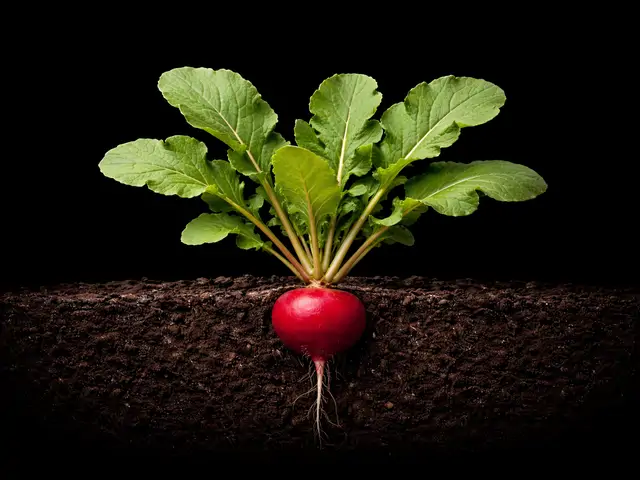
Radish
Root, young leaves, and immature green seed pods are all edible. No toxic parts; the leaves are slightly bristly and best cooked.
Overview
The fastest crop in the garden: a peppery cool-season root you can harvest in three to four weeks, sown in short successions for a steady supply.
Radishes are the instant-gratification vegetable - many varieties go from seed to plate in three or four weeks, which makes them the classic first crop for kids and impatient gardeners. They're a cool-season root, crisp and peppery, and the whole craft of growing them is timing: sow a short row every one to two weeks so you always have some sizing up, and harvest promptly, because a radish left too long turns woody, hollow, and fiery.
Beyond the familiar red globes, radishes range from long white icicles to spicy black winter types and mild daikons the size of your forearm. They're brassicas (cabbage-family), which shapes their pests, and they mature so fast they double as living row-markers and soil-looseners interplanted with slower crops.
At a glance
- Sun
- Full sun · Part sun
- Water
- Medium
- Spacing
- 1–3 in (typ. 2)
- Mature height
- 6–12 in (typ. 8)
- Start by
- Direct sow
- Frost
- SemiHardy
- Germination
- 3–7 days (typ. 5) @ 45–85 °F (typ. 65)
- Spread
- 3–8 in (typ. 5)
- Soil
- Well-drained
- Temperature
- Damaged below 26°F · struggles above 80°F
- Seed ready
- 60–90 days (typ. 75) (for saving)
When to plant
Zone 7a typical frost: last Apr 10 · first Oct 25 (spring frost runs Mar 27–Apr 24 in a typical spread of years)
Life stages
- Germination day 0–5 from sowing
-
Keep the seedbed moist for fast sproutingevery 1 dRadishes are one of the quickest crops - up in 3-6 days. Keep the surface damp and they'll rocket out of the ground.
Rare with fresh radish seed - nearly always sprouts fast -
Keep the seedbed moist for fast sproutingevery 1 d
- Seedling day 5–15 from sowing
-
Thin to 2 inches immediatelyRadishes crowd fast and unthinned ones make all leaves and no bulb. Thin to 1-2 inches as soon as you can tell them apart - the thinnings are a peppery salad green.
-
Winter radishes: thin to 4-6 inchesDaikon, black Spanish, and watermelon radishes build roots several times the size of a spring radish, and at spring spacing they crowd into a mat of leaves with nothing underneath. Thin to 4-6 inches apart in the row as soon as you can tell the seedlings apart - the wider end for a long daikon, the narrower for round types.
-
Guard young leaves from flea beetlesevery 4 dFlea beetles love radish leaves. Row cover from sowing keeps them (and root maggots) off.
Flea beetle shot-holes on the leavesOvercrowding (all top, no root) -
Thin to 2 inches immediately
- Root swelling day 15–25 from sowing
-
Keep water steady for mild, crisp rootsevery 3 dEven moisture and fast growth make radishes sweet and crisp. Drought or a stall makes them woody, cracked, and fiery-hot.
Cracked roots from uneven wateringBolting in heat (a flower stalk - the root turns pithy) -
Keep water steady for mild, crisp rootsevery 3 d
- Harvest day 25–32 from sowing
-
Pull promptly at full size - don't waitSpring radishes are ready in 3-4 weeks and go pithy, hot, and split if left even a few days too long. Pull as soon as shoulders reach full size.
-
Sow the next succession as you harvestBecause they finish so fast, sow a fresh short row every 1-2 weeks for a continuous supply.
Roots going pithy, woody, or hollow if left too longSplitting after a late soak -
Pull promptly at full size - don't wait
Harvest
- Style
- One-time harvest
- Typical yield
- 1–1 roots (typ. 1)
- By weight
- 0.5–48 oz (typ. 1)
- Root shoulders pushing up to full size (about 1 inch for round spring types)
- Firm and crisp, not yet cracking
- Before any flower stalk appears
Watch out for
Flea Beetles High
Flea beetles are tiny dark beetles - often shiny black or bronze, rarely more than a couple of millimeters long - with enlarged back legs that let them spring away like fleas the moment you lean in. The adults chew countless small round pits and shot-holes through leaves, giving the foliage a peppered, buckshot-riddled look. They overwinter as adults in leaf litter, hedgerows, and crop debris, emerge hungry in spring, and are worst in warm dry spells. The damage is mostly a seedling and transplant problem: a small plant with a few leaves can be checked, stunted, or killed outright, while the same plant shrugs them off once it is large and growing strongly. Different species specialize on different plant families, so the beetles hammering your brassicas are not the ones on your nightshades. Some species also have larvae that feed on roots and tubers underground.
Watch for: Dozens of pinhead-sized round holes peppered across the leaves, thickest on the youngest, most tender growth. Tiny beetles that spring away as you brush the plants or lean in for a closer look - that jump is the identification. Seedlings that go lacy and stop growing, and transplants that sit and sulk instead of taking off. Damage heaviest in warm, dry weather and along the edge of a bed nearest weedy ground or last year's crop debris. On root crops, shallow narrow grooves or channels scarring the skin at harvest, from larvae feeding underground.
Prevent: Floating row cover or fine insect mesh, laid over the bed from the day of sowing or transplanting and sealed at the edges so nothing can walk in underneath, is the single best defense - and on the crops they favor it is close to essential. Leave it on until plants are large and growing strongly, or until flowering on anything that needs pollinating. Push growth: a well-watered, unchecked plant outgrows the damage, so the whole game is getting seedlings through their vulnerable weeks fast. Keep beds weed-free, since related weeds host the beetles alongside your crop, and clear crop debris at the end of the season where the adults overwinter. Rotate away from a bed that grew a related crop last year. Where you can, shift sowing dates - cooler-season and fall plantings often miss the peak of adult feeding entirely.
Treat: Row cover and healthy fast growth carry most crops through, and on an established plant the damage is usually cosmetic and needs nothing at all. Where a young planting is genuinely being stripped, kaolin clay coats the leaves and deters feeding, and spinosad will knock the beetles back. Spinosad is acutely toxic to bees while the spray is still wet - apply it at dusk when bees are not flying, never onto plants in flower, and follow the product label. Anything you spray must be labeled for the plant you are treating, and you must observe its pre-harvest interval on a crop you are picking. Yellow sticky traps are useful for telling you when the beetles have arrived. Where the damage falls on the part you eat, harvesting young often beats them outright; where you are growing for a root or a fruit, leaf damage can simply be tolerated. Larvae feeding underground cannot be reached by a foliar spray, so rotation and clean beds are what work against those.
A top radish pest, because they hammer the brassica foliage. The fast radish crop usually outgrows light feeding under row cover; sow early or in cooler weather, and rotate away from brassica beds.
Cabbage Root Maggot High
The larvae of a small gray fly that lays its eggs at the soil line against brassica stems. The white maggots hatch and tunnel down into the roots, scarring and rotting them, so plants wilt on warm days, stunt, take on a blue-green cast, and can die outright; root brassicas are tunneled through and spoiled. It is worst in cool, wet spring soil, on transplants and early sowings, and in ground that grew brassicas the year before.
Watch for: Sudden wilting on the first warm days even though the soil is moist, stunted plants with a bluish cast, and - on pulling a failing plant - brown tunnels and slimy scarring through the roots with small white maggots inside.
Prevent: Cover the crop with floating row fabric from the day you sow or transplant, sealing the edges down to the soil so the fly cannot reach the stems, or fit a cardboard or felt collar disc flat around each stem to block egg-laying. Rotate at least three years away from ground that grew brassicas, and do not plant into fresh manure.
Treat: There is no rescue once the maggots are inside the roots. Pull and destroy badly infested plants rather than composting them, and reset the bed with row cover and rotation. Beneficial nematodes drenched into the soil help suppress the larvae in a bed you have to keep using.
Radish roots are tunneled and scarred brown, which spoils them outright rather than merely checking growth. Early spring sowings into cold wet ground are the worst; row cover from the day you sow is effectively the whole answer.
Clubroot Medium
A soil-borne pathogen (Plasmodiophora brassicae) that infects brassica roots and swells them into distorted, clubbed galls. Affected plants stunt and yellow, wilt on warm afternoons and recover overnight, and never size up properly. It is worst in acidic, poorly drained ground, and the resting spores survive in soil for up to 20 years, moving around on soil, tools, boots, water and infected transplants.
Watch for: Midday wilting that recovers overnight, yellowing and stunting with no obvious cause, and - the giveaway - swollen, distorted, clubbed roots instead of clean ones when a plant is pulled.
Prevent: Rotate at least 4 years out of every brassica, counting the fast salad ones and any brassica cover crop. Lime toward pH 7.0-7.2, since the pathogen dislikes alkaline soil, and improve drainage. Plant only clean seed and transplants, never move infested soil or plants around the garden, and grow resistant or tolerant varieties where the disease is known to be present.
Treat: There is no cure once the soil is infested. Pull and destroy affected plants - bag them, do not compost them - lime the bed, and keep brassicas off that ground for years. Rotation and pH are the whole game here.
Radishes are usually pulled long before clubbing costs you the crop, but they are brassicas. Running radish successions through the same bed all season is a quiet way to build spore load.
Aphids Low
Aphids are small soft-bodied sap-suckers - green, black, gray, pink, or waxy white, and mostly wingless - that gather in dense colonies on the tenderest new growth: shoot tips, buds, and the undersides of young leaves. They breed extremely fast in mild weather, so a few can become hundreds inside a week. Their feeding curls and distorts soft growth, and the sticky honeydew they excrete coats everything below and turns black with sooty mold. Ants often farm and defend the colonies for that honeydew. A few aphids are normal on almost any plant and a healthy plant shrugs them off; only dense, persistent colonies do real damage, and some aphids also spread plant viruses as they feed.
Watch for: Dense clusters of tiny insects packed onto shoot tips, flower buds, and the undersides of young leaves. Curled, cupped, or distorted new growth that never opens properly. A sticky shine on the leaves - and on whatever sits under the plant - that later goes black with sooty mold. Tiny white cast skins left behind where a colony has been feeding. Ants running steadily up and down the stems, which is often the first thing you notice. Mottled, streaked, or misshapen leaves that do not grow out can mean a virus the aphids brought with them rather than the feeding itself.
Prevent: Go easy on nitrogen: the soft, lush growth that heavy feeding produces is exactly what aphids breed on. Check new growth once a week through spring and early summer so you catch colonies while they are still small, and rub the first few out with your fingers. Leave flowering plants nearby and skip broad-spectrum sprays - ladybugs, lacewings, hoverflies, and parasitic wasps do most of this work for free, and they only stay if there is something for them to eat. Keep ants off the plant where you can, since they protect aphids from those predators. Water steadily so plants are not stressed, and check any new plant over before you bring it home or move it indoors, since aphids usually arrive on something else.
Treat: Knock the colonies off with a hard jet of water and repeat every few days - on most plants that alone ends it. Pinch out or prune off the worst-infested tips rather than treating the whole plant. If colonies keep rebuilding, spray insecticidal soap or horticultural oil directly onto the insects, covering leaf undersides, and repeat weekly until they are gone; treat early or late in the day, and never spray a wilted or heat-stressed plant. Avoid broad-spectrum insecticides - they kill the ladybugs, lacewings, and parasitic wasps that were about to solve the problem for you, and aphid numbers usually come back worse afterward. Anything you spray must be labeled for the plant you are treating; follow that label and observe its pre-harvest interval. On anything you eat, wash leaves, heads, and buds well before use, since aphids hide down in crowns, folds, and tight growth.
Radish is usually out of the ground before aphids matter; check the leaf undersides on any crop you let stand.
Cutworms Low
The soil-dwelling larvae of night-flying moths. They spend the day curled just under the surface and come out after dark to chew through young stems at soil level, felling seedlings and transplants outright - a toppled plant lying beside its own stump is the signature. Some species also climb to gouge and notch emerging shoots and spears. They are worst in freshly worked ground, in beds that were weedy or grassy the year before, and on the first plantings of spring.
Watch for: Seedlings and transplants toppled at the soil line overnight, or shoots chewed and notched near the base, with the severed tops left lying beside the stumps. Dig an inch down within a few inches of the damage and you will usually find the culprit: a plump, dull gray-brown caterpillar that curls into a C when touched.
Prevent: Push a cardboard, foil or tin-can collar an inch into the soil around each seedling and transplant so the stem cannot be reached. Cultivate the bed a couple of weeks before planting to expose the larvae to birds and drying, and clear grassy weeds and debris, which is where the moths lay their eggs.
Treat: Dig around each fallen plant and destroy the caterpillar - left alone, one cutworm will fell another plant every night. Replant the gaps with collars fitted. Hand-picking after dark with a flashlight works well on a small bed, and a fast-growing crop soon outgrows the vulnerable stage.
Radishes grow fast enough to outpace them, and a few gaps in a thickly sown row hardly show.
Good & bad neighbors
Varieties · 13
Round bright-red roots, larger than Cherry Belle, white interior.
A larger round red that stays crisp and mild even at good size and resists going hollow, extending the harvest window - a dependable choice across climates.
Small round bright-red roots with crisp white flesh.
An AAS-winning classic round red radish: fast, mild, crisp, and reliable, holding its quality a little longer than most before going pithy. The definitive beginner and market radish.
Large round bright-red roots with crisp white flesh.
A large round red that stays mild, sweet, and solid at well above the usual radish size - a good pick when you want more radish per plant without woodiness.
Round, bright-red, globe-shaped roots with crisp white flesh.
One of the earliest round reds and often the first radish of spring - quick, uniform, bright, and crisp, a longtime market standard.
Round roots in mixed colors: white, pink, red, and purple.
A colorful blend that produces round radishes in white, pink, red, and purple from one packet - mild, crisp, and a favorite for salads, market bunches, and growing with kids.
Oblong roots, scarlet-red shading to a white base, white flesh.
The elegant elongated heirloom: oblong roots with a red top fading to a white tip, mild and crisp, and the classic radish for buttered bread and salt. Best pulled young.
Round smooth bright-red roots with white interior.
A bright, smooth round red with crisp, peppery flesh and dependable performance - a solid all-purpose salad radish.
Uniform round bright-red roots, smooth, white flesh.
A fast, uniform hybrid round red that stands well in the ground before going pithy and shows good disease resistance - a reliable market-quality workhorse.
Round roots, scarlet on top with a white base, white flesh.
A pretty round radish with a bright-red top and a clean white tip, mild and crisp - popular for salads and market bunches for its two-tone look.
Long, slender, tapered pure-white roots up to 6 inches.
A long, tapered white heirloom radish, mild and crisp, that tolerates a bit more warmth than round types and slices beautifully. Named for its icicle shape.
Long, blunt-tipped, pure-white roots 12-18 inches long and 2-3 inches thick, with the top third pushed up out of the ground.
A standard Japanese daikon and the easiest long white radish for home gardens: mild, crisp, blunt-tipped roots that go into pickles, simmered dishes, and slaws. Sow in late summer for a fall crop - spring sowings bolt - and give it deep, loose, stone-free soil and 6 inches between plants so the root has somewhere to go.
Round roots 3-4 inches across with rough, matte-black skin and crisp, dense, snow-white flesh.
The classic European winter radish, grown for centuries as a keeper: rough matte-black skin over dense, sharply pungent white flesh. Far hotter and firmer than a salad radish, so it's a cooking and storing root - grated into slaws, roasted, or buried in damp sand for the winter. Sow in late summer for fall and thin to about 4 inches.
Round roots 2-4 inches across, pale green-white skin outside, bright pink-red flesh within - the cross-section is the whole point of growing it.
A large winter radish with a pale green-white exterior hiding a vivid pink-red interior - striking sliced, mild and sweet, best sown for fall and holding much longer than spring types. Thin to about 4-5 inches: at spring-radish spacing it makes leaves instead of a root.
Grow
Direct-sow shallow into cool soil, thin to 2 inches at once, and start the next succession as you harvest.
Always direct-sow - radishes grow too fast to bother transplanting. Sow ½ inch deep, an inch apart, in loose soil from as soon as it's workable in spring; they germinate in cool soil (down to ~45°F) and sprout in just 3-6 days. Full sun and steady moisture give the mildest, crispest roots.
The one job people skip is thinning: unthinned radishes crowd into a mat of leaves with no bulb underneath. Thin to 1-2 inches the moment you can handle the seedlings, and eat the thinnings. Then keep sowing - a fresh short row every week or two - because a single big planting all matures at once and then bolts. Ease off in the heat: warm weather makes radishes bolt and turn unpleasantly hot.
Care
Fast, even growth is everything: steady water and thinning make mild crisp roots; heat and drought make them hot and woody.
Radish care is almost entirely about keeping growth fast and uninterrupted. Steady, even moisture is the key - a radish that grows quickly and without a check is mild, sweet, and crisp, while one that stalls from drought or heat turns woody, pithy, and eye-wateringly hot. Water consistently and mulch lightly to hold it.
They need little feeding (rich soil with compost is plenty; too much nitrogen grows leaves at the root's expense) and no support. Their fast cycle usually outruns disease. The main watch-outs are flea beetles chewing the leaves and, in cool wet springs, cabbage root maggots tunneling the roots - both are handled by floating row cover laid at sowing and by rotating out of brassica beds.
Harvest
Pull promptly at full size - a few days late and they're pithy and hot. Winter radishes hold longer and store.
The golden rule is don't wait. Spring radishes are ready about 3-4 weeks from sowing, when the shoulders reach full size (roughly an inch across for round red types), and they deteriorate fast - a few days too long and they turn hollow, woody, and fiery, or split. Just pull them; the tops make a handy handle. Check often as harvest nears.
Winter and daikon radishes are the exception: they take 50-60 days, size up much larger, and hold in good condition far longer (and store for months). If a spring planting bolts on you, don't despair - the tender green seed pods that follow are a crisp, spicy treat eaten like snap peas, and the peppery leaves cook up like any green.
Storage
Tops off, spring radishes keep 1-2 weeks in the fridge; winter radishes store for months cold and humid.
Twist the tops off first (they wick moisture from the root fast), then store spring radishes in a perforated bag in the crisper, where they keep crisp for 1-2 weeks - or submerged in a jar of water in the fridge for longer. Limp radishes revive with an ice-water soak. Winter and daikon types are real keepers, storing for months in the crisper or in damp sand in a cool cellar.
The greens are perishable - refrigerate and use in a few days. For preserving, radishes pickle and ferment beautifully (quick-pickled radishes are a bright condiment), and the surplus of a big daikon crop is often turned into salt-preserved or fermented pickles. Sliminess, dark spots, or a strong off smell mean a root has gone.
Growing across climates
A cool-season sprinter everywhere: spring and fall crops in cold zones, a fall-through-spring staple in hot ones, off in high summer.
Radishes are cool-season everywhere and simply refuse high heat, which bolts them and turns them hot. Zones 3-5: sow from early spring through the summer's cooler stretches and again in fall - the long cool shoulders suit them well. Zones 6-7: classic spring-and-fall crop, easing off in midsummer; fall radishes are the mildest. Zones 8-9: flip the calendar - radishes are a fall-through-spring crop and summer is fully off. Zones 10+: grow only in the coolest months with afternoon shade. Because they finish in weeks, they slot into almost any gap in the cool season, and their speed makes them the easiest crop to succession-sow anywhere.
Troubleshooting
All leaves and no root means crowding, heat, or too much nitrogen; hot woody roots mean slow growth; shot-holes are flea beetles.
Lots of leaves, tiny or no bulb: the top three causes are unthinned crowding, too much nitrogen, or warm weather - thin hard, ease off the feed, and sow in cool weather. Woody, pithy, or fiery-hot roots: slow growth from drought, heat, or leaving them too long; grow fast with steady water and harvest on time. Cracked or split roots: a heavy watering after a dry spell. Bolting (a flower stalk): heat and long days - harvest and resow, and eat the seed pods. Shot-hole pinpricks in the leaves: flea beetles; use row cover. Wilting with tunnels in the root: cabbage root maggot - row cover at sowing and rotate out of brassica beds.
Nutrition
Crisp, near-zero-calorie, and vitamin-C rich, with cabbage-family compounds - and the greens are more nutritious than the root.
Radishes are almost all water and crunch, at only a handful of calories, but they punch above their weight: a good source of vitamin C, with potassium, folate, and fiber, and - as members of the cabbage family - the same glucosinolate compounds (the source of their peppery bite) that are studied for antioxidant and detoxification-supporting effects across brassicas.
Two bonuses gardeners have that shoppers don't: the peppery greens, which carry more vitamin C, calcium, and iron than the root and cook like any hearty green; and the crisp seed pods of a bolted plant, edible and nutritious. Eat the whole plant and a fast, tiny crop becomes a surprisingly complete one.
In the kitchen
Raw for peppery crunch, roasted mellow and sweet, quick-pickled bright - plus the greens and seed pods that shoppers never get.
Raw is the radish's day job: sliced thin on buttered bread with salt (the French classic), tossed into salads and tacos, or served whole as a crunchy, peppery snack. Roasting transforms them - the heat mellows the bite and brings out a turnip-like sweetness, a revelation to most people. Quick-pickled, they're a bright, tangy topping for rich dishes and the pink jewel of a banh mi. Daikon goes into slaws, simmered soups, and Korean and Japanese pickles.
Then cook the parts nobody buys: sauté the peppery greens with garlic or blend them into pesto and soup, and toss the crisp seed pods from a bolted plant into a stir-fry or pickle jar. Match variety to use - mild round reds for snacking, long icicles for slicing, spicy black winter radishes for cooking, daikon for pickles.
Propagation & seed saving
Easy annual seed-saving: let a few plants bolt, dry the pods, and one plant yields a jar of seed that comes true.
Radishes are annuals that flower and seed the same season, which makes seed-saving simple: let a few of your best plants bolt (skip the roots you'd eat), and they'll send up branching stalks of white or pink flowers followed by plump green seed pods. Let the pods dry brown and papery on the plant, then strip and crack them out - one plant yields a lot of seed, and radish seed stays viable 4-5 years.
Two notes: radishes cross readily with other radish varieties flowering nearby (and are insect-pollinated, so isolate by distance or timing for pure seed), and you should save from open-pollinated types, not hybrids. Because they set seed so fast, a radish is one of the quickest crops to take from seed all the way back to seed in a single season - and a great teaching plant for it.
Traditional & historical uses
Modest but real folk use for digestion and respiratory relief, backed loosely by its cabbage-family compounds; mostly, it's good food.
This section records how people have traditionally used this plant, and what is known about the risks. It is history and general information — not medical advice, and not a recommendation to treat anything. Plants are not dosed like medicines, some interact with prescriptions, and some are harmful in ways that are not obvious. Talk to a clinician before using any plant medicinally.
The radish has a genuine if modest place in traditional medicine, especially in Asian systems, where the root and its juice were used to aid digestion, ease coughs and congestion, and support the liver and gallbladder - and there's loose modern rationale in its fiber and its cabbage-family glucosinolate and enzyme content. Black radish in particular has a folk reputation as a digestive and bile stimulant.
That bile-stimulating action carries the one caution that always goes with it: if you have gallstones or any bile-duct disease, don't use radish or radish juice as a digestive remedy - pushing bile flow against a stone or a blocked duct can bring on painful biliary colic. See a clinician instead.
Keep it honest otherwise: these are gentle food-level effects, not treatments, and the evidence is mostly traditional. Enjoy radishes for their vitamin C, fiber, and the beneficial compounds shared across all brassicas. As with the whole cabbage family, they're wholesome, low-calorie food that supports a healthy diet rather than a remedy.
History
One of the oldest cultivated crops: eaten in ancient Egypt and China, fed to the pyramid builders, and spread worldwide for its speed.
Radishes are among humanity's oldest cultivated vegetables - grown in ancient Egypt (where, with onions and garlic, they reportedly fed the pyramid laborers), prized in ancient Greece, and independently important in China, where the large daikon and winter types were domesticated. The name traces to the Latin radix, simply 'root.'
Their unmatched speed from seed to harvest made them a universally useful crop: they were among the first European vegetables planted in the Americas, and they spread across the world as a quick, reliable food. The enormous diversity we grow today - tiny round reds, long white icicles, jet-black winter radishes, and giant mild daikons - reflects thousands of years of selection on different continents from that same fast-growing wild root.
Cook it
All 8 recipes →Grower tips
No grower tips for Radish yet. Yours could be the first.
Sign in to share what works in your garden.