
Add it to your home screen and it opens full screen: no browser bars, one tap away, and everything stays signed in. Free, nothing to download from an app store.
- Tap the Share button in your browser
- Scroll down and choose “Add to Home Screen”
- Open GrowSomeFood from your home screen
- Open your browser’s menu
- Choose “Add to Home screen” or “Install app”
- Open GrowSomeFood from your home screen
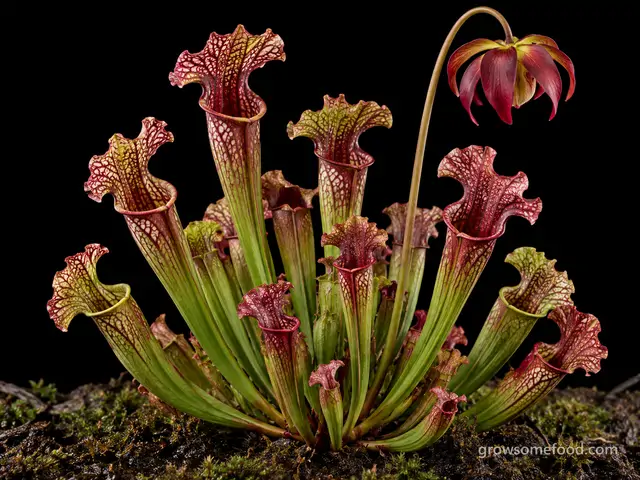
Pitcher Plant
The dramatic native bog carnivore: tall, colorful, hollow pitchers that lure and drown insects. A hardy, long-lived bog-garden centerpiece for full sun and constant pure water - the easy, showy carnivorous plant to start with.
Safety notes Grown as an ornamental bog plant, not a food - the pitchers hold a soup of drowned, digesting insects and are not edible. The fluid and prey are harmless to touch but should not be drunk. Pitcher plants are safe around children and pets, though the tall, hollow pitchers are best left intact rather than picked apart. Like other carnivorous plants they are harmed, not helped, by being fed human food.
Overview
Pitcher plants (Sarracenia) are the showstoppers of the North American bog - clumps of tall, hollow, elegantly veined pitchers in green, yellow, red, and white that can stand two to three feet high. Each pitcher is a passive pitfall trap: nectar and vivid color lure insects to the slippery rim, they lose their footing, tumble in, and are digested in the fluid pooled at the bottom. Like all carnivores, Sarracenia do this because they grow in nutrient-poor, acidic, waterlogged bog and must catch their own nitrogen.
The one thing to knowPitcher plants (Sarracenia) are the showstoppers of the North American bog - clumps of tall, hollow, elegantly veined pitchers in green, yellow, red, and white that can stand two to three feet high.
Quick facts
- Sprouts in
- 40 daysRange: 21–70 days
- Soil temperature
- 78 °FRange: 70–85 °F
- Height
- 24 inRange: 6–48 in
- Spread
- 18 inRange: 8–36 in
- Cold
- Takes hard frostdamaged below -40°F
- Heat
- Struggles above 100°F
- Life cycle
- Perennial, lives about 30 years
- Soil
- Tolerates wet soil
- Water
- High
- Plant spacing
- 15 inRange: 8–24 in
When to plant
Nothing is open today. Spring transplanting opens 6 months, Apr 10 to Jun 9.
- Transplant Apr 10 – Jun 9 Opens in 173 daysAbout at to 9 weeks after your last frost (Apr 10 here)Set out nursery plants or divisions into a full-sun bog planter or peat-sand bog bed as growth resumes in spring; most trumpet species are hardy and establish quickly. Never plant into garden soil.
Frost here: last around Apr 10 (Mar 27 to Apr 24 most years), first around Oct 25. Zone averages, your own yard may run a week or two either way.
Life stages
Establish, grow, repeat
Getting established and returning each season are different parts of the story.
Stage 1 of 4 · Getting established
Settling into the bog
Day 0 to 60 after transplanting
Care at this stage
-
Keep it standing in pure water
Pitcher plants are among the wettest-loving carnivores - stand the pot in a tray of distilled, rain, or reverse-osmosis water so the peat-sand medium is constantly wet, even shallowly flooded in summer. Never use tap, spring, softened, or mineral water: the salts slowly poison the plant. This is the single most important rule.
-
NEVER fertilize or use potting soil
Sarracenia grow in nutrient-poor bog and feed themselves on insects. Fertilizer, compost, and ordinary potting soil burn and rot the roots. Pot only in a lean mix of pure peat moss with washed silica sand or perlite - nothing richer.
Months are typical seasonal windows; climate, variety, and plant age can shift them.
Watch out for
5 to know. 2 are high-risk: Mineral Burn (Bad Water & Fertilizer), Missed Winter Dormancy. 1 is active in October.
Mineral Burn (Bad Water & Fertilizer)Severity High DisordernowSeason: year-roundTraps and leaves blackening and dying back for no obvious reason, stunted weak growth, and a white mineral crust forming on the soil surface, especially in plants watered from the tap.
Traps and leaves blackening and dying back for no obvious reason, stunted weak growth, and a white mineral crust forming on the soil surface, especially in plants watered from the tap.
Dilute or fully replace with fresh pure water and move the plant to a clean, soft-water container; badly affected plants may not recover, so prevent it by keeping the water lean.
Use ONLY distilled, rainwater, or reverse-osmosis water, always; pot only in pure peat and washed sand/perlite; never fertilize or use potting soil, compost, or garden soil.
As with all carnivores, hard, alkaline, or mineral-rich water - and any fertilizer - harms bladderwort, whose delicate stems and traps need soft, acidic, nutrient-poor water; mineral and nutrient loading dissolves the plant and feeds smothering algae.
Missed Winter DormancySeverity High DisorderSeason: Nov–MarA plant that keeps growing weakly all winter and then slowly declines - smaller traps each flush, loss of vigor, and eventual collapse despite otherwise correct care.
A plant that keeps growing weakly all winter and then slowly declines - smaller traps each flush, loss of vigor, and eventual collapse despite otherwise correct care.
None once the turions are lost - prevent it by protecting the resting buds; keep a backup strand or share plants so a colony can be restarted.
Give a genuine cold dormancy of about 3-4 months near 35-50 degrees F every winter - outdoors in zones 7-10, or in an unheated garage, cold frame, or refrigerator in colder zones or indoors.
Applies to TEMPERATE sundews only: hardy species (round-leaved, threadleaf) kept warm and growing all winter never form their required resting bud, gradually weaken, and can die - while subtropical species need no dormancy and are unaffected.
Crown RotSeverity Medium DiseaseSeason: Nov–MarA plant that fails to green up or emerge in spring when everything around it does - the most common way this gets discovered, and by then it is already too late.
Rot of the crown and rhizome, most common in cold, stagnant, waterlogged winter conditions and where dead pitchers are left to decay against the crown. Ease off water during dormancy, cut away dead pitchers in late winter, and give it airflow. Cut out rotted tissue and repot into fresh airy peat-sand; heavily rotted rhizomes are often lost.
A plant that fails to green up or emerge in spring when everything around it does - the most common way this gets discovered, and by then it is already too late. Stems that wilt, blacken, and collapse in wet weather while the soil is clearly damp rather than dry. A crown that is soft, dark, brown, or mushy when you press or lift it, sometimes with a foul smell, instead of firm and pale. New growth that pulls away from the crown with almost no resistance. Clumps browning and going hollow in the middle while the outer growth stays alive. In stands and cover crops, patches wilting, yellowing, and thinning out after wet spells or over a mild wet winter.
There is usually no cure once the crown itself has rotted: the plant is lost, and the job is to save what you can and fix the site. Lift it, cut away every soft, dark, rotted part with a clean blade back to firm tissue, and replant only healthy divisions or firm outer growth into fresh, sharply drained soil or medium. On potted and specialist plants, repotting into fresh airy medium and keeping them drier with better airflow gives the best chance, though a badly rotted crown is usually beyond saving. Bin the rotted material rather than composting it. Replant somewhere better drained rather than back into the same wet spot - or start again from seed, cuttings, or self-sown seedlings, which is the realistic option for anything that resents being moved at all.
Drainage and airflow at the crown are everything. Match the plant to the site first: a dry-adapted perennial planted in heavy or enriched ground is on borrowed time whatever else you do. In wet or clay soil, plant on a slope, berm, raised bed, or gritty rock-garden site so water drains away from the crown rather than standing over it. Set plants at the right depth - never bury the crown - and keep mulch, dead leaves, and debris pulled back from it rather than piled against it, since damp material resting on the crown is a common trigger. Do not overwater, and ease right off during dormancy, when a resting plant wants to be barely damp rather than wet. Give crowded plantings enough space and airflow to dry out, and do not sow a stand too thickly. In cold, wet climates, divide in spring rather than fall, so plants are not recovering from surgery through the wettest months.
Crown rot is the rotting of a plant at the crown - the growing point where the stems meet the roots, right at or just below soil level. Soil fungi and water molds that live in most ground attack that tissue whenever it sits wet, cold, and airless, and because the crown is the one part a perennial cannot regrow from, losing it usually means losing the plant. It is above all a winter problem: a plant that survives hard frost perfectly well in dry ground rots out in a wet one, and the classic story is a perennial that simply never comes back in spring. Dry-adapted plants growing in heavy or over-improved soil are the most vulnerable, along with anything that has mulch, wet leaves, or piled debris sitting against the crown, and anything planted too deep.
Pitcher Plant Moths (Exyra)Severity Medium PestSeason: May–SepPitchers that wilt, collapse, or have their tops cut off; holes chewed in the pitcher walls; silk webbing and dark frass inside the tubes.
Pitchers that wilt, collapse, or have their tops cut off; holes chewed in the pitcher walls; silk webbing and dark frass inside the tubes.
Cut off and destroy infested pitchers with the caterpillars inside; a targeted caterpillar insecticide can help in bad infestations.
Remove and destroy dead and infested pitchers in late winter to break the cycle; inspect pitchers through summer; good airflow and hygiene help.
Specialist moths whose caterpillars live inside and mine the pitchers, eating the walls from within, cutting off pitcher tops, and filling them with silk and frass - a genuine pest of Sarracenia, especially in collections.
AphidsSeverity Low PestSeason: Apr–JulDense clusters of tiny insects packed onto shoot tips, flower buds, and the undersides of young leaves.
On a carnivorous plant skip the usual sprays: oily products coat and foul the pitchers. Rinse the crown out, or use a product known to be safe on carnivorous plants. The plant's own traps catch some aphids but not the ones tucked into the emerging growth.
Dense clusters of tiny insects packed onto shoot tips, flower buds, and the undersides of young leaves. Curled, cupped, or distorted new growth that never opens properly. A sticky shine on the leaves - and on whatever sits under the plant - that later goes black with sooty mold. Tiny white cast skins left behind where a colony has been feeding. Ants running steadily up and down the stems, which is often the first thing you notice. Mottled, streaked, or misshapen leaves that do not grow out can mean a virus the aphids brought with them rather than the feeding itself.
Knock the colonies off with a hard jet of water and repeat every few days - on most plants that alone ends it. Pinch out or prune off the worst-infested tips rather than treating the whole plant. If colonies keep rebuilding, spray insecticidal soap or horticultural oil directly onto the insects, covering leaf undersides, and repeat weekly until they are gone; treat early or late in the day, and never spray a wilted or heat-stressed plant. Avoid broad-spectrum insecticides - they kill the ladybugs, lacewings, and parasitic wasps that were about to solve the problem for you, and aphid numbers usually come back worse afterward. Anything you spray must be labeled for the plant you are treating; follow that label and observe its pre-harvest interval. On anything you eat, wash leaves, heads, and buds well before use, since aphids hide down in crowns, folds, and tight growth.
Go easy on nitrogen: the soft, lush growth that heavy feeding produces is exactly what aphids breed on. Check new growth once a week through spring and early summer so you catch colonies while they are still small, and rub the first few out with your fingers. Leave flowering plants nearby and skip broad-spectrum sprays - ladybugs, lacewings, hoverflies, and parasitic wasps do most of this work for free, and they only stay if there is something for them to eat. Keep ants off the plant where you can, since they protect aphids from those predators. Water steadily so plants are not stressed, and check any new plant over before you bring it home or move it indoors, since aphids usually arrive on something else.
Aphids are small soft-bodied sap-suckers - green, black, gray, pink, or waxy white, and mostly wingless - that gather in dense colonies on the tenderest new growth: shoot tips, buds, and the undersides of young leaves. They breed extremely fast in mild weather, so a few can become hundreds inside a week. Their feeding curls and distorts soft growth, and the sticky honeydew they excrete coats everything below and turns black with sooty mold. Ants often farm and defend the colonies for that honeydew. A few aphids are normal on almost any plant and a healthy plant shrugs them off; only dense, persistent colonies do real damage, and some aphids also spread plant viruses as they feed.
Good & bad neighbors
First rule: keep Garden vegetables, herbs & flowers (rich-soil plants) apart. Never bed pitcher plants with ordinary garden plants, which need fertile soil and tap water - exactly what kills carnivores.
Plant nearby
-
Sundews share identical bog culture and catch the small gnats and midges that slip past the pitchers, adding glistening ground-level texture; they self-sow harmlessly into a Sarracenia bog.
-
The signature bog-garden pairing: flytraps want the same full sun, pure water, peat-sand bog, and winter dormancy, and their low snap traps sit neatly among the tall pitchers - a classic combined carnivorous planter.
-
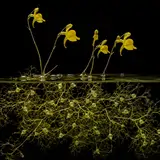
Terrestrial bladderworts thrive in the same wet peat and often appear on their own, adding small bright flowers; they compete only for tiny aquatic prey the pitchers don't take.
-
Sphagnum MossLive sphagnum is the ideal living carpet for a pitcher-plant bog - it keeps the surface acidic and wet, signals good water quality by dying in mineral water, and sets off the pitchers beautifully.
Keep apart
-
Garden vegetables, herbs & flowers (rich-soil plants)Never bed pitcher plants with ordinary garden plants, which need fertile soil and tap water - exactly what kills carnivores. Keep Sarracenia in their own dedicated peat-sand bog with pure water only.
Varieties · 6
You pick one when you add Pitcher Plant to your garden. Its days to maturity set your harvest window.
Purple Pitcher Plant (Sarracenia purpurea)
Good first pickThe toughest and most cold-hardy pitcher plant, ranging far up the East Coast and into Canada.
Variety details for Purple Pitcher Plant (Sarracenia purpurea)
Low, fat, red-purple-veined pitchers lying at an angle, holding a pool of water inside.
specieshardylow-growingwater-holdingLow, squat, purple-veined pitchers that hold rainwater and drown their prey; extremely hardy and the best choice for cold-winter gardens.
Judith Hindle (hybrid)
Good first pickOne of the most popular Sarracenia hybrids: robust, hardy, and easy, with squat richly red pitchers marked in white and a strong constitution.
Variety details for Judith Hindle (hybrid)
Stout, deep-red pitchers with white patterning and a ruffled lid on a vigorous clump.
hybridredvigoroushardyAn excellent, forgiving choice for a first pitcher plant and a reliable garden performer.
Yellow Trumpet (Sarracenia flava)
The classic tall trumpet pitcher: slender yellow-green pitchers up to 2-3 feet with a broad, red-throated lid, and large fragrant yellow spring flowers.
Variety details for Yellow Trumpet (Sarracenia flava)
Tall, upright yellow-green trumpets with a wide flaring lid, often red-veined at the throat.
speciestallyellow-greentrumpetA spectacular, vigorous species of the southeastern coastal plain and the backbone of many hybrids.
White-Topped Pitcher (Sarracenia leucophylla)
Widely considered the most beautiful Sarracenia: tall pitchers topped with crisp white 'windows' laced in green and red veins, especially striking in a strong fall flush.
Variety details for White-Topped Pitcher (Sarracenia leucophylla)
Tall trumpets with a white, red-and-green-veined upper section and flaring lid.
speciestallwhite-toppedred-veinedA tall, dramatic bog centerpiece and a favorite for hybridizing.
Hooded Pitcher (Sarracenia minor)
A distinctive species whose pitcher hood arches over the opening and is dotted with translucent 'windows' that confuse trapped insects.
Variety details for Hooded Pitcher (Sarracenia minor)
Green-to-red pitchers with a domed hood over the mouth speckled with pale translucent spots.
specieshoodedtranslucent-windowsant-specialistEspecially good at catching ants; a charming, more modest-sized bog plant.
Sweet Pitcher (Sarracenia rubra)
A smaller, clumping species with slender red-veined pitchers and notably sweet-scented maroon flowers.
Variety details for Sweet Pitcher (Sarracenia rubra)
Slender, upright, red-veined pitchers in dense clumps, with fragrant deep-red spring flowers.
speciessmallerfragrant-flowersred-veinedForms tidy colonies and suits smaller bog planters where the giant trumpets would overwhelm. Note: two subspecies - ssp. alabamensis (Alabama canebrake pitcher plant) and ssp. jonesii (mountain sweet pitcher plant) - are federally endangered and CITES Appendix I. Buy only nursery-propagated plants of the common forms, and never collect or trade those two.
Grower tips
Notes from growers, tagged with the zone they grow in. A person reads every post before it appears.
Nobody has posted about Pitcher Plant yet. The first one usually saves someone a season.
Free account. Your post shows your grower name and zone, never your email.