Add it to your home screen and it opens full screen — no browser bars, one tap away, and everything stays signed in. Free, nothing to download from an app store.
- Tap the Share button in your browser
- Scroll down and choose “Add to Home Screen”
- Open GrowSomeFood from your home screen
- Open your browser’s menu
- Choose “Add to Home screen” or “Install app”
- Open GrowSomeFood from your home screen
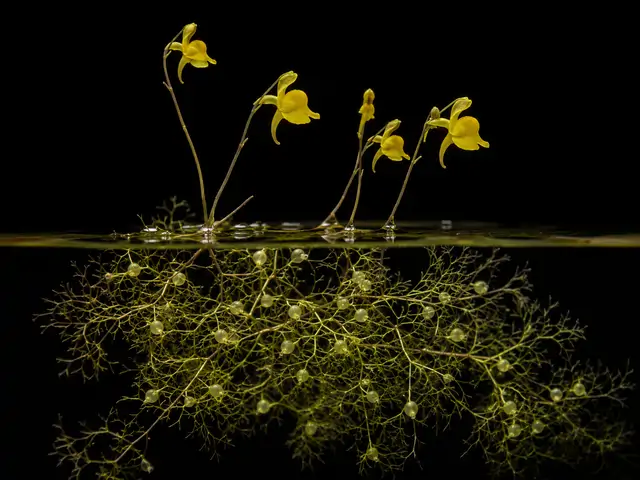
Bladderwort
Grown as an aquatic ornamental curiosity, not a food - the bladders trap and digest microscopic aquatic animals and are not edible. Bladderwort is harmless to touch and safe around children and pets, and its tiny suction traps are far too small to affect anything but plankton-sized prey. As with all carnivorous plants, it needs no feeding and is harmed by nutrient-rich or fertilized water.
Overview
The hidden carnivore: mostly-invisible aquatic plants whose feathery underwater stems carry hundreds of tiny vacuum 'bladders' that snap prey in under a millisecond - the fastest trap in the plant kingdom - announced only by bright flowers above the water.
Bladderwort (Utricularia) is the strangest and most secretive of the common carnivorous plants. Most species are aquatic - often rootless, free-floating tangles of fine, feathery stems drifting just under the surface of ponds and ditches - and their traps are nearly invisible: hundreds of tiny sealed bladders scattered along the stems, each a primed vacuum that snaps open in under a millisecond to suck in a water flea or mosquito larva, then resets. It is the fastest trapping motion known in the entire plant kingdom. For most of the year you would never know the plant was carnivorous, or even there - until summer, when it lifts small, bright, snapdragon-like flowers (usually cheerful yellow) a few inches above the water on slender stalks.
Like all carnivores, bladderwort hunts because it lives in nutrient-poor water and needs to catch its nitrogen. It is one of the most widespread carnivorous genera in North America - aquatic species float in soft-water ponds from coast to coast, while smaller terrestrial species creep through wet, acidic sands and bogs, especially in the Southeast. Given clean, soft, low-nutrient water and full sun, it is easy and even self-sufficient, and it often arrives on its own in a carnivorous bog. A container of aquatic bladderwort is a living curiosity that also quietly helps consume mosquito larvae.
At a glance
- Sun
- Full sun · Part sun
- Water
- High
- Spacing
- 4–24 in (typ. 12)
- Mature height
- 1–12 in (typ. 4)
- Start by
- Direct sow · Division
- Frost
- Hardy
- Germination
- 14–60 days (typ. 30) @ 68–82 °F (typ. 75)
When to plant
Zone 7a typical frost: last Apr 10 · first Oct 25
Life stages
- Settling into the water day 0–30 from transplant
-
Use pure, soft, low-nutrient water - not tapevery 7 dAquatic bladderwort needs soft, acidic, nutrient-POOR water - top up its pond or tray with distilled, rain, or reverse-osmosis water. Hard, alkaline, or nutrient-rich tap water and any fertilizer feed algae and slowly harm the fine traps. Simply drop a strand of floating bladderwort into the water; it is often rootless and needs no planting.
-
NEVER fertilize the waterBladderwort thrives precisely because it lives in nutrient-poor water and catches its own food. Any fertilizer - or nutrient runoff, or rich potting soil in the container - triggers algae blooms that smother it. Grow it in a peat-lined bog pot or a clean container of pure water with no added nutrients.
Green water or algae taking over (nutrients too high - use purer water, no fertilizer)Strands dissolving or blackening (hard/mineral/rich water) -
Use pure, soft, low-nutrient water - not tapevery 7 d
- Spring & summer growth Apr, May, Jun, Jul, Aug, Sep (yearly)
-
Full sun and clean, soft water all seasonevery 7 dGive bladderwort full sun to bright light; strong light drives vigorous growth of the fine, feathery underwater stems. Keep the water topped up with pure water through the season - aquatic species form floating or submerged mats that lengthen quickly in warm, sunny, low-nutrient water.
-
Let the bladders hunt - never feed itScattered along the underwater stems are hundreds of tiny bladder traps, each a sealed vacuum that snaps open in under a millisecond to suck in passing water fleas, mosquito larvae, and other microscopic prey - the fastest trapping motion known in plants. It catches all it needs from the water itself; never add food or fertilizer.
Fast-spreading feathery mats in warm sun (healthy growth)Duckweed or filamentous algae smothering the mat (skim it off; reduce nutrients)Water turning green (nutrient overload) -
Full sun and clean, soft water all seasonevery 7 d
- Summer flowers above the water Jun, Jul, Aug, Sep (yearly)
-
Bright snapdragon-like flowers held above the surfaceIn summer, bladderwort sends up slender stalks that lift small, bright, snapdragon-like flowers - usually yellow, sometimes purple - a few inches ABOVE the water, well clear of the submerged traps so pollinators aren't caught. The cheerful flowers are often the only sign of the plant hidden below. Aquatic species may flower only in warm, sunny, undisturbed water.
-
Let it self-sow, or leave the seed for next yearThe flowers are visited by small insects and, in terrestrial species especially, set fine seed that self-sows onto wet peat. Aquatic species multiply mainly by fragmentation rather than seed, so simply let the mat grow and break apart to spread.
Small yellow (or purple) flowers on thin stalks above the water (the main visible sign)Terrestrial species self-sowing onto damp peat nearby -
Bright snapdragon-like flowers held above the surface
- Winter rest (temperate species) Jan, Feb, Mar, Oct, Nov, Dec (yearly)
-
Temperate species overwinter as sinking turionsCold-hardy aquatic bladderworts (like the common/greater bladderwort) survive winter by forming tight resting buds called turions at the stem tips; as the water cools these detach and SINK to the bottom, where they rest safe from ice, then rise and regrow in spring. Just leave the pond or container undisturbed and deep enough not to freeze solid. Subtropical and terrestrial species behave differently and may grow on in mild climates.
-
Keep the water level up and stable over winterDon't let a bladderwort container dry out or freeze solid over winter. Keep the water topped up (with pure water) and, in cold zones, deep enough that the turions resting on the bottom stay below the ice. Disturbing or draining the container in winter can lose the resting buds.
The floating mat breaking up and sinking in fall (normal - it is forming winter turions)Container freezing solid (move deeper or shelter in the coldest zones)Turions resting on the bottom (leave them undisturbed to regrow in spring) -
Temperate species overwinter as sinking turions
Watch out for
Mineral Burn (Bad Water & Fertilizer) Disorder Highyear-round
Not a pest but the number-one killer of carnivorous plants: dissolved minerals from tap, spring, softened, or bottled water - and any fertilizer or rich soil - accumulate in the peat and slowly poison the salt-intolerant roots.
Watch for: Traps and leaves blackening and dying back for no obvious reason, stunted weak growth, and a white mineral crust forming on the soil surface, especially in plants watered from the tap.
Prevent: Use ONLY distilled, rainwater, or reverse-osmosis water, always; pot only in pure peat and washed sand/perlite; never fertilize or use potting soil, compost, or garden soil.
Treat: Flush and repot into fresh peat-sand and switch immediately to pure water; badly salt-damaged plants may not recover, so prevent it from the start.
Algae & Duckweed Overgrowth Disorder HighApr, May, Jun, Jul, Aug, Sep
The signature threat to aquatic bladderwort: excess nutrients trigger blooms of filamentous algae, green water, or duckweed that shade out and physically smother the fine underwater stems and their traps, choking the plant.
Watch for: Green or cloudy water, mats of stringy algae or a carpet of duckweed over the surface, and the bladderwort mat weakening beneath it.
Prevent: Keep the water lean - pure water only, never fertilize, keep out nutrient-rich debris and runoff, and give full sun to a vigorous, competitive plant.
Treat: Skim off algae and duckweed by hand, dilute with fresh pure water to lower nutrients, and remove any decaying organic matter; persistent blooms mean the water is too rich.
Missed Winter Dormancy Disorder MediumJan, Feb, Mar, Nov, Dec
A slow, invisible killer of temperate carnivorous plants: kept warm and growing year-round (typically on a windowsill), a flytrap never gets its required cold winter rest, gradually exhausts its reserves, and dies over one to two years.
Watch for: A plant that keeps growing weakly all winter and then slowly declines - smaller traps each flush, loss of vigor, and eventual collapse despite otherwise correct care.
Prevent: Give a genuine cold dormancy of about 3-4 months near 35-50 degrees F every winter - outdoors in zones 7-10, or in an unheated garage, cold frame, or refrigerator in colder zones or indoors.
Treat: Provide the cold rest as soon as possible; a plant caught early usually recovers over a season once it gets its dormancy back on schedule.
Crown Rot Disease LowJan, Feb, Nov, Dec
Fungal rot of the central crown and rhizome, most common in cold, stagnant, waterlogged conditions during winter dormancy or when dead leaves are left to decay against the crown.
Watch for: A soft, mushy, browning center; collapsing new growth pulling away easily from the rhizome; a foul smell - typically over a cold, wet winter.
Prevent: Ease off water during dormancy (just damp, not flooded), provide good airflow, remove blackened dead leaves, and avoid burying the crown; do not let a dormant plant sit cold and sodden.
Treat: Cut away rotted tissue, treat with a fungicide, repot into fresh airy peat-sand, and keep drier with better airflow; heavily rotted plants are often lost.
Good & bad neighbors
Varieties · 5
The large, transcontinental aquatic bladderwort (long known as U. vulgaris in North America): free-floating feathery mats studded with bladders, topped by showy yellow snapdragon-like flowers above the water in summer. Extremely cold-hardy, overwintering as sinking turions; the classic pond and container species.
A terrestrial species of wet sands and bog margins with showy, fragrant, deep-yellow flowers on erect stalks and a distinctive downward-pointing spur ('horn'). Grown in constantly wet peat-sand rather than open water; a bright bog-garden accent.
A tiny, extremely widespread aquatic bladderwort that forms fine hair-like mats in shallow water and even in aquariums, with small yellow flowers. One of the most cosmopolitan carnivorous plants and among the easiest to grow in a container of soft water.
An unusual aquatic species with whorled, brush-like floating stems and rare, pretty purple-pink flowers - a change from the usual yellow. Native to soft-water ponds and lakes of eastern North America; a collector's choice for its color and distinctive form.
A minuscule terrestrial bladderwort of the Southeast that scatters tiny bright-yellow flowers on thread-fine zigzag stalks over wet sand and peat. Often turns up on its own in a carnivorous bog and self-sows freely; charming and completely undemanding.
Grow
Full sun and clean, soft, low-nutrient PURE water (rain/distilled/RO) with no fertilizer - that is the whole recipe. Aquatic species just float; terrestrial ones grow in wet peat-sand. Keep temperate species from freezing solid in winter.
Bladderwort is refreshingly simple once you understand it is really about water quality. Aquatic species want soft, acidic, nutrient-poor water in full sun - so top up their pond, tub, or bog-pot tray only with distilled, rain, or reverse-osmosis water, and add no fertilizer of any kind. Hard or alkaline tap water and any nutrients feed the algae that smother it, so clean, lean water is everything. Most aquatic bladderwort is rootless - you simply drop a strand into the water and let it float and grow; it needs no planting.
Terrestrial species grow in constantly wet, lean peat-sand just like other bog carnivores, kept saturated with pure water. Either way, never use rich soil or fertilizer. The one seasonal consideration is winter: temperate aquatic species (like the common bladderwort) survive by forming resting buds (turions) that sink to the bottom, so keep the container topped up and, in cold zones, deep enough that those turions never freeze solid. Bladderwort is often the easiest carnivore of all to keep alive - it asks only for clean water, sun, and to be left alone.
Care
Keep the water clean, soft, and free of fertilizer, in full sun; skim off algae and duckweed; let it grow and fragment to spread; and keep temperate species' winter turions from freezing. Nearly hands-off.
Bladderwort is close to hands-off. The main task is guarding water quality: top up only with pure water, never add fertilizer, and keep nutrient-rich debris and runoff out of the container. Its chief enemy is algae and duckweed, which thrive on any excess nutrients and can shade out and smother the fine underwater stems; if they build up, skim them off and dilute the water with fresh pure water to keep nutrients low. Keep the plant in full sun for vigorous growth and its best show of flowers.
Let the plant spread on its own - aquatic species multiply mainly by simply growing and breaking apart (fragmentation), so a healthy mat quietly expands, and terrestrial species self-sow onto wet peat. There is no pruning, feeding, or repotting to do; if a container gets overgrown, just remove and give away some of the mat. The only real seasonal care is overwintering temperate species: leave the container undisturbed as the mat forms sinking turions in fall, keep the water level up, and make sure it does not freeze solid, and the buds will rise and regrow in spring.
Harvest
Nothing is harvested for food - bladderwort is grown as an aquatic curiosity. The reward is its bright summer flowers and the astonishing hidden traps; it can even help clear mosquito larvae from a container.
There is nothing to harvest from bladderwort - it is not a crop and nothing about it is edible. The reward is entirely in the fascination: bright summer flowers hovering above the water, and the astonishing hidden machinery below - hundreds of microscopic vacuum traps firing faster than the eye can follow. Under a hand lens or microscope, watching the bladders snap shut on a water flea is one of the great small spectacles of the plant world.
There is even a modest practical payoff: because the traps consume tiny aquatic animals, a container of aquatic bladderwort can help reduce mosquito larvae in still water. As with every carnivorous plant, though, it needs no feeding and no help - and adding fertilizer or food to 'boost' it does the opposite, fouling the water and smothering the plant with algae. Grow it to watch and to flower, not to harvest, and let it hunt the water on its own.
Storage
Nothing to store as food; temperate aquatic species self-store as sinking winter buds (turions), and terrestrial species bank fine seed. Keep turions from freezing and surface-sow seed for new plants.
There is nothing to store or preserve from bladderwort. The storage that matters is how the plant banks itself for winter. Temperate aquatic species don't persist as a big permanent plant; instead, as the water cools each fall, the stem tips form tight resting buds called turions that break off and sink to the bottom, resting safely below the ice until spring, when they rise and grow into new floating plants. To carry a colony through winter, simply leave the container undisturbed, keep the water topped up with pure water, and - in cold zones - keep it deep enough that the turions on the bottom never freeze solid.
Terrestrial and many warm-climate species instead bank themselves as fine seed, which stores cool and dry and is surface-sown on wet peat (never buried) to raise new plants; these species often self-sow. So a bladderwort planting renews itself through sinking winter buds and self-sown seed rather than as a durable clump - which is why keeping the turions safe over winter and letting terrestrial species reseed are the keys to a lasting colony.
Propagation & seed saving
The easiest carnivore to multiply: aquatic species spread simply by growing and fragmenting - lift off a strand and float it in more clean water - while terrestrial species self-sow from fine seed. No wild collection needed.
Bladderwort is arguably the easiest carnivorous plant of all to propagate. Aquatic species spread by pure growth and fragmentation: the floating mat lengthens and naturally breaks apart, and each piece carries on as an independent plant. To make more, you literally just lift off a strand of healthy stem and drop it into another container of clean, soft, low-nutrient water - no rooting, no soil, no special conditions. A vigorous plant produces far more than any pond needs.
Temperate aquatic species also multiply through the turions they form each winter, each of which grows into a new plant in spring. Terrestrial species spread from fine seed, self-sowing onto wet peat and easily raised by surface-sowing fresh seed (never buried - it needs light). Because it increases so effortlessly, there is never any reason to collect bladderwort from the wild, where its clean-water habitats are increasingly scarce. A single shared strand is enough to start a colony - and to pass on to other growers.
Nutrition
Not human food - the nutrition story is the plant's own: microscopic vacuum traps snap up water fleas and mosquito larvae to supply the nitrogen its nutrient-poor water lacks. Fertilizer and rich water are poisons, not feed.
Bladderwort has no role as human food - its prey is microscopic, and nothing about it is edible. What is extraordinary is how the plant feeds itself, using the most sophisticated trap in the plant kingdom. Each tiny bladder along the underwater stems is pumped empty of water to create a partial vacuum, sealing a trapdoor fringed with trigger hairs. When a passing water flea, rotifer, or mosquito larva brushes the hairs, the trapdoor flips open in under a millisecond, the vacuum sucks the animal and surrounding water inside, and the door snaps shut - after which the plant digests the prey and resets the trap. This lets bladderwort harvest nitrogen from the plankton of nutrient-poor water where roots would starve.
As with every carnivore, the usual rules are reversed: fertilizer and nutrient-rich water kill a bladderwort, not by burning it directly so much as by triggering the algae blooms that smother it, and by upsetting the soft, lean water it needs. The plant makes its energy from sunlight and gets its 'fertilizer' by hunting microfauna. Keep its water clean, soft, and lean, in full sun, and let the bladders feed it - a plant that eats the water itself, one water flea at a time.
Troubleshooting
Green water and algae mean too many nutrients; a dissolving or blackening plant usually means hard or mineral water; no flowers often means too little sun or an unsettled plant; lost winter colonies mean frozen or disturbed turions. It is almost always water quality, light, or winter handling.
Water turning green; algae or duckweed smothering the mat: the classic bladderwort problem - too many nutrients in the water. Never fertilize, top up only with pure water, keep rich debris and runoff out, and skim off algae and duckweed; lean, clean water is the fix. Strands dissolving, blackening, or melting away: usually hard, alkaline, or mineral water - switch to distilled or rainwater. Plant grows but never flowers: often not enough sun, or a recently introduced or disturbed plant that needs a settled season; give it full sun and time in still water. Colony vanishes over winter: the temperate turions either froze solid (keep the container deeper or sheltered in cold zones) or were disturbed when you drained or cleaned it - leave the bottom undisturbed over winter. Mat looks dead in early spring: be patient - temperate species regrow from turions that rise from the bottom as the water warms. Overgrown, tangled container: simply pull out and remove excess mat. The reliable checklist: clean soft low-nutrient water, full sun, and undisturbed winter turions.
History
Long a botanical marvel for its lightning-fast vacuum traps, bladderwort was closely studied by Darwin and remains a widespread but under-noticed native carnivore - and an indicator of the clean, soft-water wetlands it needs.
Bladderwort has fascinated naturalists precisely because its carnivory is so hidden. For centuries it was known mainly as an odd pond weed with pretty yellow flowers; only close study revealed the tiny bladders and their astonishing function. Charles Darwin examined Utricularia in detail for his 1875 book Insectivorous Plants, puzzling over how the bladders caught prey, and later researchers, aided by high-speed imaging, confirmed that the traps fire in under a millisecond - among the fastest movements in the whole plant kingdom, driven by stored elastic energy and a pumped-out vacuum rather than muscle.
Despite being one of the most widespread carnivorous plants on Earth - Utricularia grows on every continent except Antarctica, and native species occur across nearly all of North America - bladderwort remains under-noticed, in part because it is so easily overlooked beneath the water. Ecologically it is an indicator of clean, soft, nutrient-poor water: it disappears from ponds polluted by nutrient runoff, so its presence signals a healthy wetland. That sensitivity is also why, like all carnivores, it is best enjoyed from shared or nursery stock rather than collected from increasingly threatened wild waters.
Growing across climates
One of the most widely adaptable carnivores: hardy aquatic species (common bladderwort) overwinter as sinking turions far into the cold North, while terrestrial and subtropical species suit the warm South. The limits are water quality and winter freezing, not heat.
Bladderwort as a genus is remarkably adaptable, with a native species for almost any climate that offers clean, soft water. Cold North (zones 3-5): the very hardy aquatic species (common/greater bladderwort, U. macrorhiza) thrive, overwintering as turions that sink below the ice - just keep containers deep enough not to freeze solid. Temperate middle (zones 6-7): an easy range for aquatic species in ponds, tubs, and bog-pot trays, with reliable summer flowers and natural winter dormancy. Warm South (zones 8-10): the home of many small terrestrial species (U. subulata, U. cornuta) in wet savannas and bog margins, plus warm-water aquatics that may grow nearly year-round. Indoors or in warm climates: subtropical species can grow year-round in a bright container of soft water. Hot, dry climates: workable only with a reliable supply of pure water to keep the container topped up and lean. Everywhere, bladderwort's limits are the same two things: clean, soft, low-nutrient water and, for temperate species, protecting the winter turions from freezing solid - meet those, and it grows across an enormous range.
No grower tips for Bladderwort yet — yours could be the first.
Sign in to share what works in your garden.