Add it to your home screen and it opens full screen: no browser bars, one tap away, and everything stays signed in. Free, nothing to download from an app store.
- Tap the Share button in your browser
- Scroll down and choose “Add to Home Screen”
- Open GrowSomeFood from your home screen
- Open your browser’s menu
- Choose “Add to Home screen” or “Install app”
- Open GrowSomeFood from your home screen
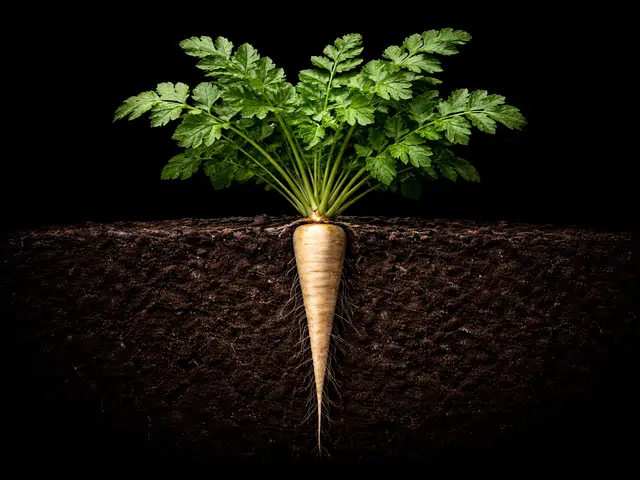
Parsnip
Only the root is eaten. The foliage and sap contain furanocoumarins that cause phytophotodermatitis - a blistering sunburn-like rash when sap on skin meets sunlight. Wear long sleeves and gloves when handling the tops, especially in summer sun. The root peel carries furanocoumarins too, and diseased, mouldy or cankered roots build up far higher levels - discard those rather than trimming and eating them, and peel stored or blemished roots generously.
Overview
A long-season, cold-loving root that trades patience for sweetness: fresh seed, a whole growing season, and a few hard frosts turn out nutty, honeyed roots.
Parsnips are the patient gardener's root: they look like a pale carrot, take a whole season (100-130+ days) to mature, and reward the wait with a sweet, nutty, almost honeyed flavor that no store parsnip matches. The catch is that they earn that sweetness only after several hard frosts, which convert their starch to sugar - so parsnips are a crop you plant in spring and harvest through fall and winter.
Two facts make or break them. First, parsnip seed dies fast - it's viable barely a year, so you must buy fresh seed every season; old seed is the number-one reason a row never comes up. Second, germination is slow and finicky (up to four weeks), and the seedbed cannot be allowed to dry out during that stretch. Clear those two hurdles and the rest is nearly hands-off.
At a glance
- Sun
- Full sun · Part sun
- Water
- Medium
- Spacing
- 3–6 in (typ. 4)
- Mature height
- 12–24 in (typ. 18)
- Start by
- Direct sow
- Frost
- Hardy
- Germination
- 14–28 days (typ. 21) @ 50–75 °F (typ. 65)
- Spread
- 6–12 in (typ. 8)
- Soil
- Well-drained
- Temperature
- Damaged below -30°F · struggles above 85°F
- Seed ready
- 420–480 days (typ. 450) (for saving)
- Self-sows
- Yes — expect volunteers
When to plant
Zone 7a typical frost: last Apr 10 · first Oct 25 (spring frost runs Mar 27–Apr 24 in a typical spread of years)
Life stages
- Germination day 0–21 from sowing
-
Use fresh seed and never let the bed dryevery 1 dParsnip seed lives barely a year - buy new every season. Germination takes up to 4 weeks, and a single dry spell kills the crop. Cover the row with a board or damp burlap and keep it moist.
-
Mark the slow row with radishesSow a few radishes in the row to mark the line and break the crust while parsnips take their time.
No emergence after 4 weeks (old seed or a dry-out - the classic parsnip failure)Soil crusting over the seedbed -
Use fresh seed and never let the bed dryevery 1 d
- Seedling day 21–55 from sowing
-
Thin to 3-4 inches apartCrowded parsnips make small, forked roots. Thin once seedlings are a couple inches tall; wear gloves - the foliage sap can irritate skin.
-
Weed carefully while plants are smallevery 14 dSlow parsnips are easily swamped by weeds early. Keep the row clean by hand.
OvercrowdingSkin rash from handling foliage in sun (wear sleeves) -
Thin to 3-4 inches apart
- Top and root growth day 55–120 from sowing
-
Water deeply and evenly through summerevery 7 dThe long taproot needs steady moisture to grow straight and smooth. Deep, even watering prevents splitting and forking.
-
Mulch to hold moisture and moderate soil temperatureA mulch layer steadies the moisture the long root depends on and keeps weeds down over the long season.
Forked or split roots from uneven waterCanker (rot) at the crown in wet soil -
Water deeply and evenly through summerevery 7 d
- Frost sweetening day 120–150 from sowing
-
Leave in the ground for frost to sweeten themTwo to four weeks of near-freezing weather turns the root's starch to sugar. Parsnips harvested before frost are bland; after frost they're sweet and nutty.
-
Mulch heavily before hard freezeA thick straw mulch keeps the ground diggable so you can harvest through winter, and protects roots you're overwintering.
Tops dying back in fall (normal)Ground freezing solid before you've mulched -
Leave in the ground for frost to sweeten them
- Harvest day 130–200 from sowing
-
Dig after the first hard frosts, all winter longLoosen deeply with a fork alongside the root - parsnips run long and snap off if you just pull. Dig as needed from after frost until spring growth restarts.
-
Clear the bed before spring regrowthOverwintered roots turn woody and bitter once they resprout in spring. Lift the last of them before that starts.
Roots snapping off if pulled without looseningSpring regrowth signaling roots are past their best -
Dig after the first hard frosts, all winter long
Harvest
- Style
- One-time harvest
- Typical yield
- 1–1 roots (typ. 1)
- By weight
- 4–16 oz (typ. 8)
- Root shoulders 1.5-2.5 inches across
- The plant has been through several hard frosts (for sweetness)
- Tops have died back for the season
Watch out for
Carrot Rust Fly High
A small shiny-black fly whose maggots tunnel rusty-brown channels through carrot roots (and parsnip, celery, parsley). The classic carrot-family pest, worst in spring and fall.
Watch for: Rusty tunnels and dark scars through the root when cut; stunted, reddish, wilting tops; larvae in the soil around the crown.
Prevent: Float row cover over the bed from sowing (the flies find carrots by scent), rotate away from last year's carrot ground, and delay sowing past the spring egg-laying peak.
Treat: No spray rescue once maggots are in the root - harvest early, cut away damaged sections, and reset with row cover and rotation next season. Beneficial nematodes drenched into the soil suppress larvae.
Parsnip Canker High
The main disease of parsnips: fungal rots (chiefly Itersonilia) that cause brown, black, or orange rotting lesions at the crown and shoulders, often entering through growth cracks or rust-fly damage. Worst in wet, heavy soil late in the season.
Watch for: Brown-to-black sunken rot at the crown and root shoulders, sometimes orange, spreading down the root; worse after a wet autumn.
Prevent: Grow canker-resistant varieties (Gladiator, Albion, Javelin, Cobham), ensure sharp drainage, rotate on a 3-4 year cycle, avoid nicking roots, earth up the shoulders, and don't over-fertilize with nitrogen.
Treat: No cure once a root is cankered - discard the root rather than trimming off the rot and eating the sound part. Fungal infection drives the root's furanocoumarin levels up several-fold, so a cankered, mouldy or badly bruised parsnip is not worth salvaging. Lift and remove affected roots rather than leaving them to spread, and peel stored or blemished roots generously. Prevention through variety and drainage is the whole strategy.
Root-Knot Nematodes Medium
Microscopic soil roundworms (Meloidogyne species) that invade roots and force them to swell into beady galls. A galled root cannot take up water and nutrients properly, so the plant stunts, yellows, wilts in heat despite watering, and yields poorly, and root and tuber crops come up forked, knobbly, hairy or cracked instead of clean. They are worst in warm, sandy soils and build up steadily wherever a susceptible crop is grown in the same ground year after year. The wounds they leave also open the way for fusarium wilt and rots.
Watch for: Stunted, yellowing, unthrifty plants that wilt in the heat even though the soil is moist, and poor yields for no obvious reason. Confirm by digging: beady swellings strung along the roots and side rootlets, and root crops that are forked, branched, cracked or knotted rather than clean.
Prevent: Rotate to non-hosts, and grow resistant varieties where they exist for your crop. A French marigold cover crop grown thickly the season before and turned in genuinely lowers populations. Build organic matter and mulch heavily, which feeds the soil life that suppresses them. Plant only clean stock, never move soil from an infested bed around the garden, and solarize badly infested ground through the hottest part of summer.
Treat: There is no in-season cure. Pull and destroy affected plants rather than composting them, and bring that ground back over several seasons with rotation, resistant varieties and marigold cover crops. Where a crop can be grown in a container of fresh mix, that sidesteps the problem entirely.
Parsnips come up forked, knobbly and stunted - the damage people normally blame on stones. Worst in the warm sandy soils of the South; dig a root in midsummer and look for beading on the side rootlets before you blame the bed.
Aphids Low
Aphids are small soft-bodied sap-suckers - green, black, gray, pink, or waxy white, and mostly wingless - that gather in dense colonies on the tenderest new growth: shoot tips, buds, and the undersides of young leaves. They breed extremely fast in mild weather, so a few can become hundreds inside a week. Their feeding curls and distorts soft growth, and the sticky honeydew they excrete coats everything below and turns black with sooty mold. Ants often farm and defend the colonies for that honeydew. A few aphids are normal on almost any plant and a healthy plant shrugs them off; only dense, persistent colonies do real damage, and some aphids also spread plant viruses as they feed.
Watch for: Dense clusters of tiny insects packed onto shoot tips, flower buds, and the undersides of young leaves. Curled, cupped, or distorted new growth that never opens properly. A sticky shine on the leaves - and on whatever sits under the plant - that later goes black with sooty mold. Tiny white cast skins left behind where a colony has been feeding. Ants running steadily up and down the stems, which is often the first thing you notice. Mottled, streaked, or misshapen leaves that do not grow out can mean a virus the aphids brought with them rather than the feeding itself.
Prevent: Go easy on nitrogen: the soft, lush growth that heavy feeding produces is exactly what aphids breed on. Check new growth once a week through spring and early summer so you catch colonies while they are still small, and rub the first few out with your fingers. Leave flowering plants nearby and skip broad-spectrum sprays - ladybugs, lacewings, hoverflies, and parasitic wasps do most of this work for free, and they only stay if there is something for them to eat. Keep ants off the plant where you can, since they protect aphids from those predators. Water steadily so plants are not stressed, and check any new plant over before you bring it home or move it indoors, since aphids usually arrive on something else.
Treat: Knock the colonies off with a hard jet of water and repeat every few days - on most plants that alone ends it. Pinch out or prune off the worst-infested tips rather than treating the whole plant. If colonies keep rebuilding, spray insecticidal soap or horticultural oil directly onto the insects, covering leaf undersides, and repeat weekly until they are gone; treat early or late in the day, and never spray a wilted or heat-stressed plant. Avoid broad-spectrum insecticides - they kill the ladybugs, lacewings, and parasitic wasps that were about to solve the problem for you, and aphid numbers usually come back worse afterward. Anything you spray must be labeled for the plant you are treating; follow that label and observe its pre-harvest interval. On anything you eat, wash leaves, heads, and buds well before use, since aphids hide down in crowns, folds, and tight growth.
Aphids on the tops seldom do enough damage to affect the root; a row cover over young plants keeps them off.
Cutworms Low
The soil-dwelling larvae of night-flying moths. They spend the day curled just under the surface and come out after dark to chew through young stems at soil level, felling seedlings and transplants outright - a toppled plant lying beside its own stump is the signature. Some species also climb to gouge and notch emerging shoots and spears. They are worst in freshly worked ground, in beds that were weedy or grassy the year before, and on the first plantings of spring.
Watch for: Seedlings and transplants toppled at the soil line overnight, or shoots chewed and notched near the base, with the severed tops left lying beside the stumps. Dig an inch down within a few inches of the damage and you will usually find the culprit: a plump, dull gray-brown caterpillar that curls into a C when touched.
Prevent: Push a cardboard, foil or tin-can collar an inch into the soil around each seedling and transplant so the stem cannot be reached. Cultivate the bed a couple of weeks before planting to expose the larvae to birds and drying, and clear grassy weeds and debris, which is where the moths lay their eggs.
Treat: Dig around each fallen plant and destroy the caterpillar - left alone, one cutworm will fell another plant every night. Replant the gaps with collars fitted. Hand-picking after dark with a flashlight works well on a small bed, and a fast-growing crop soon outgrows the vulnerable stage.
Parsnip seed is slow and erratic to germinate, so the seedlings you do get are precious and stay vulnerable for a long time. Losing them to cutworms usually means resowing the whole row.
Good & bad neighbors
Varieties · 9
Long, smooth, slender white roots with fine tapering.
A hybrid known for long, slender, very smooth roots with excellent canker resistance and sweet flavor - a strong performer where canker has been a problem.
Smooth, broad-shouldered wedge-shaped white roots of uniform size.
A well-regarded open-pollinated variety with good canker resistance, smooth wedge-shaped roots, and notably sweet, low-fibre flesh. A favorite of British allotment growers.
Smooth, uniform white wedge-to-tapered roots with good length.
A vigorous F1 hybrid, the first widely grown one, with strong canker resistance, reliable germination for a parsnip, and smooth, uniform, sweet white roots. A dependable modern choice.
Smooth, tapered, pure-white roots of even shape, up to 12 inches.
A refined heirloom prized for very smooth, uniform, pure-white tapered roots with sweet, fine-grained flesh - a market and show favorite that also cooks beautifully.
Long tapering creamy-white roots with a broad, dished crown.
The classic long-rooted heirloom, named for the slight depression at the crown where the leaves attach. Long, tapering, creamy-white roots with rich sweet flavor - the traditional garden parsnip, needing deep loose soil.
Long, smooth, cylindrical-to-tapered white roots, very uniform.
A hybrid bred for uniform, smooth-skinned, canker-resistant roots and reliable performance - clean, even parsnips that store and cook well.
Smooth, narrow-shouldered, tapering creamy-white roots.
Grown for sweet flavor and smooth, narrow-shouldered roots that slip out of the ground easily. A good all-round garden parsnip that sweetens well after frost.
Broad-shouldered, wedge-shaped white roots, shorter than long types.
A shorter, broad-shouldered, wedge-shaped parsnip that tolerates heavier and shallower soils where long types struggle - sweet, smooth-skinned, and an easier grow on clay.
Long, smooth, tapering white roots of high uniformity.
A high-quality long-rooted variety with smooth white skin and sweet, tender flesh - a productive choice where soil is deep enough to grow it to full length.
Grow
Buy fresh seed every year, direct-sow into deep loose soil, and keep the bed moist for the slow 3-4 week germination.
Start with new seed - this is not optional. Direct-sow only (the long taproot won't transplant), into deep, loose, stone-free soil worked well below the root's reach; stones and clods cause the forked, hairy roots. Skip fresh manure, which forks them too. Sow ½ inch deep in spring once the soil is above about 50°F, a little thicker than you'd like because germination is uneven.
Then the whole battle is keeping that seedbed damp for the three to four weeks parsnips take to sprout - mist daily, or lay a board or burlap over the row and check under it. Interplanting fast radishes marks the slow row and breaks the soil crust. Once up, thin to 3-4 inches and wear sleeves and gloves: the foliage sap can raise a sun-triggered rash in warm weather.
Care
Water deeply and evenly through the long summer, mulch to hold moisture, and otherwise leave them be.
Once established, parsnips are low-maintenance for a long time. The main job is even, deep watering through summer - the long root needs steady moisture to grow straight and smooth, and swings between dry and wet cause splitting and forking. A mulch layer holds that moisture even, moderates soil temperature, and suppresses the weeds that would otherwise crowd the slow-growing plants.
They're light feeders and dislike high nitrogen (it grows tops and forks roots). Compost-enriched soil at planting is enough. In wet, heavy ground watch the crown for canker - a brown rot at the shoulder - which is the main disease and is largely prevented by good drainage, resistant varieties, and not planting parsnips in the same spot two years running.
Harvest
Dig after several hard frosts and continue through winter; loosen deeply first, and clear the bed before spring regrowth.
Don't rush it. Parsnips harvested before frost taste bland and starchy; after two to four weeks of near-freezing weather their starch converts to sugar and they turn genuinely sweet. So the harvest season is fall through winter - dig as you need them. Loosen the soil deeply with a fork right alongside each root before lifting, because parsnips grow long and snap off underground if you just pull.
In cold zones, a heavy straw mulch keeps the ground diggable and the roots protected so you can harvest all winter - a natural cold cellar. The one deadline: clear the bed before the overwintered roots resprout in spring, because once they put up new growth the root turns woody and bitter. Wear gloves and sleeves when cutting back tops.
Storage
Best stored in the ground under mulch; otherwise fridge or damp sand for 1-2 months. Frost is the flavor, not a threat.
The garden bed is the best parsnip store - mulched, in the ground, they hold beautifully all winter and only get sweeter. Once dug, trim the tops and keep unwashed roots in a perforated bag in the crisper for a month or two, or pack them in damp sand in a cool cellar for longer. They shrivel in dry, warm air, so keep them cold and humid.
For surplus: parsnips freeze well after blanching (they're ideal for winter soups and roasts), and dry or can into soup stock. Signs a root has gone are softness, dark sunken spots, or mold - though a little surface roughness or forking is purely cosmetic.
Growing across climates
A cold-climate specialist: needs a long season plus real frost, so it shines in zones 3-7 and struggles where winters stay warm.
Zones 2-4: parsnip heartland - the long cool summer and hard fall frosts are exactly what it wants; sow in spring and harvest through fall (mulch deep to keep digging into winter). Zones 5-7: excellent - sow spring to early summer and dig from after the first frosts through the whole winter, the sweetest roots of the cold season. Zone 8: workable with a spring or late-summer sowing, though milder winters mean less dramatic frost-sweetening. Zones 9+: marginal - without reliable hard frost the roots stay starchy and bland, and the heat shortens the useful season; grow them as a winter novelty at best. This is one crop cold-climate gardeners get to win at.
Troubleshooting
No germination means old seed or a dried seedbed; forked roots come from stones or fresh manure; a bland taste means no frost yet; canker is a drainage problem.
Nothing came up: the classic parsnip failure - old seed (buy fresh yearly) or a seedbed that dried out during the slow 3-4 week germination. Forked, hairy, or split roots: stones and clods in the soil, fresh manure, or crowding; dig deep and de-stone, skip manure, thin harder. Bland, starchy flavor: harvested before enough hard frost - leave them longer. Brown rot at the crown or shoulders (canker): a wet-soil disease; improve drainage, rotate, and grow canker-resistant varieties like Gladiator or Albion. A blistering rash after weeding: parsnip sap plus sun (phytophotodermatitis) - handle foliage covered up. Woody, bitter roots in spring: overwintered too long and resprouting; clear them before spring growth.
Nutrition
A dense, sweet root: more fiber and calories than a carrot, with real vitamin C, folate, potassium, and manganese.
Parsnips are one of the more substantial root vegetables - starchier and higher in calories than carrots, which is exactly why they were a staple energy food in Europe before the potato arrived. They're an excellent source of fiber (both the filling and the gut-friendly kind), with meaningful vitamin C, folate, vitamin K, potassium, and manganese, plus antioxidants concentrated in and just under the skin.
The frost-driven starch-to-sugar conversion that makes them taste sweet also means a cold-harvested parsnip carries more available sugars than one dug early. Roasting caramelizes those sugars further. Nutritionally, treat the parsnip as a wholesome starchy vegetable - a sweeter, more nutrient-dense stand-in for potato in soups, mashes, and roasts.
In the kitchen
Roast them for caramelized sweetness, mash them silkier than potato, or simmer them into the backbone of winter soups.
Roasting is where the parsnip sings: cut into wedges, tossed with oil and a little honey or maple, and roasted hot, the frost-built sugars caramelize into something almost dessert-like with crisp edges. Mashed, alone or blended with potato, they make a silkier, sweeter, nuttier purée. Simmered, they're a backbone of winter soups and stews (curried parsnip soup is a classic), and grated raw they add sweetness to slaws and fritters.
They pair naturally with warm spices - nutmeg, cumin, curry - and with apple, pear, and browned butter. Peel older roots and, on very large ones, cut out the woody core. And because a parsnip's flavor peaks after frost, save the best cooking for your cold-weather harvest, when they're at their sweetest.
Propagation & seed saving
Biennial and generous: let one overwintered root bolt in year two and it self-sows a lifetime of seed - just use it fresh. Glove up first: the flowering second-year plant is the most phototoxic form of parsnip.
Parsnips flower and seed in their second year, so seed-saving is easy in cold climates where roots overwinter naturally: leave a couple of your best plants in the ground, and the next summer they bolt into tall yellow flower umbels that set masses of flat, papery seed. They readily self-sow, and volunteer parsnips will show up around a plant you let go to seed.
The crucial rule that trips people up: parsnip seed is short-lived. It's often dead by the following year, so save it fresh each season and plant it the very next spring - don't stockpile it. Let the seed dry on the plant, gather before it scatters, and store cool and dry for one season only. Save from open-pollinated varieties, and note parsnip crosses with wild parsnip (the same species), so isolate for pure seed.
Cover up before you touch a seeding plant. A second-year parsnip in full summer flower is the most phototoxic form the crop takes - furanocoumarin content peaks in the flowering plant, and July-August sun is exactly the sensitiser. Wear gloves and long sleeves whenever you cut flowering stems or strip seed heads by hand, keep the sap off bare skin, and do the job in the evening if you can. Seed-savers handle more parsnip sap on sunnier days than anyone else in the garden.
Traditional & historical uses
Little modern medicinal role beyond being wholesome food - but the plant's sap is a genuine skin hazard worth respecting.
This section records how people have traditionally used this plant, and what is known about the risks. It is history and general information — not medical advice, and not a recommendation to treat anything. Plants are not dosed like medicines, some interact with prescriptions, and some are harmful in ways that are not obvious. Talk to a clinician before using any plant medicinally.
The parsnip has a modest folk-medicine history - the root was used traditionally as a warming, nourishing winter food and mild diuretic - but there's no meaningful modern medicinal claim: it's simply good, fiber- and nutrient-rich food. The more important health note runs the other way. Parsnip foliage and sap contain furanocoumarins, and skin contact with the sap followed by sunlight causes phytophotodermatitis, a delayed blistering rash that can be severe.
So the honest medicine section for a parsnip is a caution, not a cure: eat the root freely for its nutrition, but handle the tops in long sleeves and gloves, especially on sunny summer days, and keep the sap off your skin. This is the same chemistry that makes wild parsnip a notorious roadside hazard.
History
A European staple sweetener and starch crop before sugar and potatoes; Romans prized it, and colonists carried it worldwide.
The parsnip is a native of Eurasia, cultivated since antiquity. Before cane and beet sugar, its frost-sweetened root was one of Europe's main sweeteners, used in cakes, jams, and even wine; and before the potato crossed the Atlantic, it was a staple winter starch and energy food across the continent. The Romans grew and valued it (Emperor Tiberius is said to have had parsnips imported), and its cultivation spread throughout medieval Europe.
Colonists carried parsnips to the Americas early, where they grew readily. The potato eventually displaced it as the go-to starch, nudging the parsnip toward its current status as a seasonal specialty - but its old roles as sweetener and cold-season staple are exactly why it tastes best straight out of frozen winter ground.
Cook it
All 3 recipes →Grower tips
No grower tips for Parsnip yet. Yours could be the first.
Sign in to share what works in your garden.