Add it to your home screen and it opens full screen: no browser bars, one tap away, and everything stays signed in. Free, nothing to download from an app store.
- Tap the Share button in your browser
- Scroll down and choose “Add to Home Screen”
- Open GrowSomeFood from your home screen
- Open your browser’s menu
- Choose “Add to Home screen” or “Install app”
- Open GrowSomeFood from your home screen
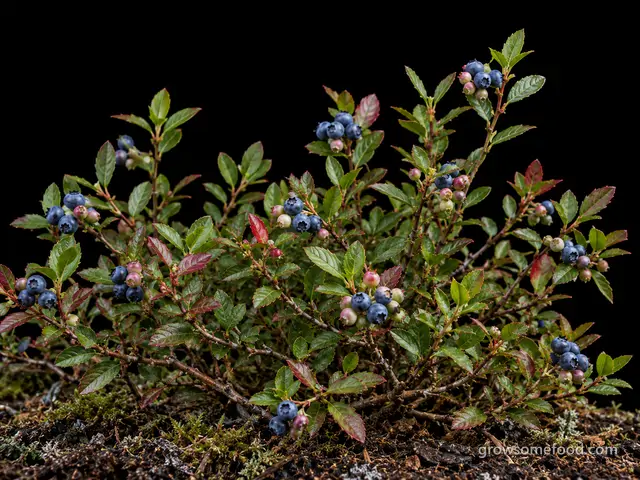
Lowbush Blueberry
The true wild blueberry - a knee-high native that spreads by rhizome into an edible groundcover, carries far more flavor per berry than any highbush type, and is managed by mowing half of it flat each year.
Lowbush blueberries are entirely safe - this is the true wild blueberry of the northern barrens. Eat only fully blue, dead-ripe fruit; green and red berries are simply sour, not toxic. The plant that grows beside it and looks most like it, black huckleberry (Gaylussacia baccata), is also edible - just seedier - so a mix-up is harmless. Every true blueberry carries a small five-pointed crown at the blossom end; if a blue-black berry lacks it, identify it before eating.
Overview
The one thing to knowLowbush blueberry (Vaccinium angustifolium) is the blueberry in the freezer aisle labelled wild, and it is a genuinely different plant from the bush you buy at a garden center.
Lowbush blueberry (Vaccinium angustifolium) is the blueberry in the freezer aisle labelled wild, and it is a genuinely different plant from the bush you buy at a garden center. It is not a bush at all: it is a spreading, rhizomatous mat 6 to 18 inches high that runs sideways through acid, sandy, infertile ground and knits into a continuous carpet. Maine and the Canadian Maritimes do not plant it - they clear land and manage what comes up, which tells you most of what you need to know about how tough and self-sufficient it is.
The berries are small, dark, and dense, with a far higher skin-to-flesh ratio than a highbush blueberry - which means more flavor and more anthocyanin per mouthful, and a taste most people recognize instantly as the real one. In fall the whole mat turns fierce scarlet and burgundy, which makes it one of the best edible groundcovers there is for an acid, sunny, sandy site where little else thrives. Two things make it different to grow: it needs soil more acidic than most gardeners expect (pH 4.0-5.2), and it is pruned by mowing half the patch flat to the ground on a two-year cycle rather than by thinning canes. Get those two right and it is close to maintenance-free for decades.
Quick facts
- Winter chill
- 1000 hours below 45°F800 to 1200
- Life cycle
- Perennial, lives about 50 years
- Height
- 12 in4 to 24
- Spread
- 36 in18 to 120
- Cold
- Takes hard frostdamaged below -40°F
- Heat
- Struggles above 90°F
- Self-sows
- Yes, expect volunteers
Full sun or part sun · medium water · well-drained soil · 24 in apart (18 to 36) · transplant or cuttings or division
When to plant
Fall transplanting is open for 6 more days. Next: spring, Mar 13 to May 8.
- Transplant Aug 16 – Sep 27 Closes in 6 daysAbout 10 weeks before to 4 weeks before your first frost (Oct 25 here)Fall planting lets the shallow roots settle before summer heat. Mulch well; the plants are hardy but a new one has not yet rooted into the mulch layer.
- Transplant Mar 13 – May 8 Opens in 173 daysAbout 4 weeks before to 4 weeks after your last frost (Apr 10 here)
Frost here: last around Apr 10 (Mar 27 to Apr 24 most years), first around Oct 25. Zone averages, your own yard may run a week or two either way.
Life stages
One stage to settle in, then four that repeat each year. Windows are typical; your zone and weather move them.
Years 1-3 - knitting into a mat
The first year after planting- DoFix soil pH to 4.0-5.2 BEFORE plantingLowbush blueberry wants soil even more acidic than highbush - roughly pH 4.0 to 5.2, and it will slowly starve above about 5.5. Test first. If your soil is above range, amend with elemental sulfur a season ahead, or build a bed of peat, pine bark, and coarse sand. Getting this right before you plant is worth more than everything else on this page put together.
- MulchMulch 2-3 inches with pine bark, sawdust, or pine needlesAcidic mulch is how a barrens works. It conserves moisture over the shallow root system, holds pH down as it decays, and keeps weeds out while the rhizomes spread. Top it up every year or two - lowbush blueberry roots up into the mulch layer itself.
- WaterKeep the top few inches moist while the mat spreadsevery 4 daysThe roots are fine, shallow, and have no root hairs, so the plants dry out fast and cannot pull water from depth. Aim for about an inch a week through the first three seasons, more in drought, until the mat closes.
- WeedWeed by hand while there are still gapsGrass and broadleaf weeds are the main thing that stops a young lowbush planting from closing. Pull them by hand rather than hoeing - the rhizomes and roots run just under the surface and are easily cut. Once the mat closes it largely suppresses weeds itself.
Watch for- Yellowing between the leaf veins (soil pH too high)
- Grass invading gaps in the mat
- The soil surface drying out
Winter chill and the pruning cycle
Nov to Mar, every year- PruneMow half the patch flat to the ground - this is the whole systemLowbush blueberry fruits on last season's wood, so it is managed on a two-year cycle: cut one half of the patch right down to the soil in late winter, and take the crop off the other half. The cut half spends that summer regrowing (the sprout year) and fruits the following summer (the crop year), when you cut the other half. Use a mower on the lowest setting, a string trimmer, or shears. Never prune it like a bush.
- ProtectLet it bank its chill, and let snow cover itThis is a cold-country plant that needs a real winter - roughly 1,000 hours below 45°F - to break dormancy and flower properly. Snow cover is its insulation: buried under snow it survives temperatures that kill highbush blueberries outright. Do not shovel snow off the patch.
Watch for- Deer browsing the dormant twigs and flower buds
- Bare, snowless cold snaps in the far North
- Half the patch cut and half left - if you cut it all, you get no crop this year
White bells (late spring)
Apr to Jun, every year- PollinateCross-pollination between different clones is not optionalA single lowbush clone is largely self-incompatible and sets almost no fruit on its own pollen. A patch needs genetically different plants - seedlings, or several named selections - within bee range of each other. Bumblebees are the effective pollinator here; they work the little urn-shaped flowers in cool, damp weather that honeybees sit out.
- ProtectCover the open flowers on frosty nightsOpen blossoms are frost-tender even though the plant itself is not. A row cover or old sheet thrown over the patch on a clear late-spring night can be the difference between a crop and none, especially in a low-lying frost pocket.
Watch for- Blackened flowers after a late frost
- Bumblebee traffic - if there is none, expect a thin crop
- Shoots and flower clusters suddenly wilting and browning (mummy berry)
Green berries sizing
Jun to Jul, every year- WaterWater steadily while the berries sizeevery 4 daysBerry size is set now, and lowbush blueberry has no drought reserve. About an inch a week through sizing, applied at the soil rather than overhead, makes a visible difference to both size and total yield.
- FertilizeFeed lightly, and only with an acid-forming fertilizerLowbush blueberry is adapted to poor, infertile ground and is easy to overfeed - too much nitrogen gives lush growth and less fruit. If leaf color says it needs something, use ammonium sulfate or an azalea and rhododendron formula at a light rate in early spring. Never use lime, and never a nitrate-nitrogen fertilizer.
Watch for- Interveinal yellowing creeping in (pH drifting up)
- Small green berries dropping in drought
Picking (mid to late summer)
Jul to Aug, every year- HarvestPick several days after the berries turn blueevery 4 daysAs with any blueberry, blue comes before sweet. Wait until a berry rolls free into your palm with no tug at all - sugar keeps climbing for three to five days after the color arrives. The berries are small and dense, so picking is slow by hand; a blueberry rake, run gently through the mat, is how the barrens have always been harvested.
- ProtectKeep the netting on and clear dropped fruitevery 4 daysRipe fruit lying on the ground breeds the next generation of spotted wing drosophila and keeps birds coming back. Clear the drops at every picking, and keep any netting closed at ground level rather than draped onto the plants.
Watch for- Birds working the patch as it colors
- Ripe berries going soft and weeping (spotted wing drosophila)
- Chipmunks and mice in the mat
Harvest
- Fully blue with a heavy silver bloom and no red left at the stem end
- Berry rolls free into the palm with no tug - not pulled off
- Left three to five days past first blue, when the flavor turns from tart to intense
- Pick several days after the berries turn blue · every 4 days
- Keep the netting on and clear dropped fruit · every 4 days
Per plant 8 to 96 ozPicking pick as they ripen
Cook with blueberries
Watch out for
6 to know. 4 are high-risk: Iron Chlorosis (Alkaline Soil), Spotted Wing Drosophila, Mummy Berry, Birds & Wildlife. 2 are active in September.
Iron Chlorosis (Alkaline Soil)Severity High DisordernowLowbush blueberry wants soil more acidic than most gardeners expect - roughly pH 4.
0 to 5.2, lower than highbush - and it is the number-one reason home patches fail. Test before planting, correct with elemental sulfur a season ahead, and keep pine bark or sawdust mulch topped up.
Yellow leaves with a distinct network of green veins, worst on the NEWEST growth at the shoot tips - that vein pattern is what separates it from a nitrogen shortage, which yellows the oldest leaves uniformly. Whole plants going progressively paler over a season rather than suddenly. Brown scorched leaf margins and shoot-tip dieback in advanced cases. Symptoms concentrated on the side of a plant nearest a foundation, wall, path, driveway, or a stretch of limed lawn. One plant affected while a neighbor that does not need acid soil looks perfect.
Correct the soil, and use iron only to buy time. Chelated iron sprayed on the leaves or drenched into the root zone greens a plant up within a week or two, but it wears off in a season and has to be repeated indefinitely - it fixes nothing. The real fix is lowering pH with elemental sulfur applied to the surface and watered in, retesting each season until you are in range, then holding it there with acidic mulch and acid fertilizer. Expect one to two years; there is no fast route. Note that other shortages look identical - manganese deficiency produces the same yellow-with-green-veins pattern on some plants - so a plant that does not green up from iron should be tested rather than dosed again. Where the pH is high because of nearby concrete or genuinely calcareous subsoil, the plant is in the wrong place, and moving it into a properly built acidic bed or container will succeed where years of amendment will not.
Test the soil pH before you plant, not after, and match the plant to the ground - an acid-loving plant in limy soil will never be truly healthy however it is fed. Where the pH is too high, acidify with elemental sulfur worked in the season BEFORE planting, since sulfur takes months of soil biology to work and cannot be rushed, and retest before you commit plants. On genuinely alkaline ground the honest answer is often a raised bed of acidic mix, or a container, rather than fighting the native soil forever. Keep an acidic organic mulch topped up - pine bark, pine straw, sawdust - and site acid-lovers away from concrete foundations and mortared walls, which leach lime for decades. Never apply lime, wood ash or mushroom compost where the roots reach, use acid-forming fertilizers such as ammonium sulfate, and improve drainage, because cold waterlogged soil hurts uptake even at the right pH.
Not an infection but a nutrient lockout caused by soil chemistry. Iron is abundant in almost every soil, but as pH rises it converts to forms roots cannot take up, so a plant that needs acid ground slowly starves for iron while standing in soil full of it. The symptom is unmistakable: new leaves go pale yellow or cream while the veins stay green, giving a fine green net over a yellow leaf. It shows first and worst on the newest growth, because iron does not move around inside a plant to be recycled. It does not spread between plants, does not respond to fungicides, and does not resolve on its own - left uncorrected the plant grows less each year, leaves get smaller and paler, shoot tips die back, crops fall away, and it eventually dies. Worst near concrete, mortar, paths and limed ground, and in cold, wet, compacted soil.
Spotted Wing DrosophilaSeverity High PestnowHarder to sanitize in a low mat than on a bush, because dropped berries disappear into the foliage rather than landing where you can see them.
Rake carefully after each pick, and get harvested fruit cold quickly - larvae in just-picked berries stop developing at refrigerator temperature.
Soft, sunken, weeping fruit that collapses under light pressure, and tiny egg-laying scars on otherwise perfect ripening berries. To confirm, crush or float suspect fruit in salt water (1-2 teaspoons per cup) and look for small white maggots floating out. In an apple-cider-vinegar or yeast-sugar trap, the males carry a distinct dark spot at each wingtip.
There is no rescue for infested fruit. Control is relentless sanitation plus trap-based monitoring to time any spray: bag or freeze culls rather than leaving them, never drop them on the ground, and use vinegar or yeast-sugar traps to tell you when the flies have arrived. Well-timed targeted sprays such as spinosad are used where pressure is high - use only a product labeled for the crop you are treating, follow the label exactly, and observe its pre-harvest interval.
Pick short and often - every two or three days through the ripening window - and remove ALL overripe and dropped fruit, because culls left on the plant or the ground breed the next generation. Cool the harvest to about 35°F promptly, which stops larvae developing in fruit you have already picked. Fine mesh under 1 mm excludes the fly where pressure is high.
An invasive vinegar fly (Drosophila suzukii). Unlike ordinary fruit flies, which need damaged or overripe fruit, the female has a saw-edged ovipositor that cuts into sound, intact, ripening fruit to lay her eggs. The larvae feed inside, so the fruit softens, sinks, weeps and collapses just as you were about to pick it. It has become the dominant pest of soft fruit across the country, and the old rule that fruit flies only bother spoiled fruit no longer applies.
Mummy BerrySeverity High DiseaseThe main disease of the wild-blueberry barrens, where the cutting cycle is itself a control: mowing or burning a half removes infected debris along with the old stems.
At home, re-mulch under the crop-year half each late winter to bury the mummies before the spring spore stage.
Sudden wilting and browning ('shepherd's crook') of new shoots and flower clusters in spring, followed by cream-tan, shriveled, mummified berries at harvest.
Sanitation is primary - remove mummies and re-mulch every winter. Where severe, a dormant-to-bloom fungicide program timed to the spore release helps; no cure exists once berries mummify.
Rake up and destroy fallen mummies, then bury them under 2 inches of fresh mulch in late winter to block the spring spore stage; choose resistant varieties (Duke) and avoid highly susceptible ones (Bluecrop, Blueray, Jersey) where it's a problem.
A blueberry-specific fungal disease (Monilinia vaccinii-corymbosi): spring spores infect new shoots and flowers, then infected berries fill with fungus, turn tan, shrivel into hard 'mummies', and drop to overwinter and start the cycle again.
Birds & WildlifeSeverity High WildlifeA low mat is easy to net well: hoops over the crop-year half with the netting pegged down at ground level, put on before any color shows.
Because only half the patch fruits each year you only ever have to net half of it. Chipmunks and mice work the mat from below and netting does nothing about them.
Fruit disappearing from the outermost, most exposed parts of the plant first, and from the top of a tree where you cannot reach anyway. Single neat pecks and gouges in ripening fruit, with several fruits sampled rather than one eaten through - the classic sign that it was birds rather than an animal. Heads of grain or seed going visibly lighter and emptier as they ripen, with hulls and chaff scattered underneath. Freshly sown seed vanishing off the surface of a bed before it germinates. Bird traffic in and out of the plant picking up as the crop colors, and birds waiting on nearby wires and branches. Wasps arriving at the pecked and split fruit shortly afterward.
There is no treatment once a crop is being taken - only protection and timing, so the answer is to get netting on and to pick what is ready. Reflective tape, flash ribbon, spinners, and decoy predators do work, but only for a few days at a time: birds habituate fast, so move and rotate them and never rely on them as the main defense for a crop you care about. Cut and gather grain or seed heads a little early, at firm dough, and finish drying them under cover instead of leaving them standing for the flocks. Plant a little extra, or a decoy crop the birds prefer, and accept sharing anything that crops heavily. On a wild or foraged patch, fruit going to birds and small mammals is the point of the plant rather than a problem to solve.
Net, and net early. Bird netting draped over a frame or hoops so it stands off the fruit, with the edges closed at ground level, is the only thing that reliably works at harvest scale - and it has to go on before the crop starts to color, because once birds have found the food they are far harder to displace. Keep fruit trees small enough that netting them is actually feasible; that decision gets made years earlier, at planting. Bags of mesh, organza, or paper slipped over individual heads, clusters, or prize fruit protect a small crop without netting the whole plant. Then shorten the exposure: pick promptly and completely rather than leaving ripe fruit hanging as a lure, clear split and dropped fruit that draws birds and wasps alike, and where a crop can finish off the plant, harvest a little early and ripen or dry it under cover. Rake in or cover broadcast seed so it is not lying in plain view.
Birds find ripening fruit and seed before you do. Robins, waxwings, starlings, catbirds, jays, sparrows, finches, blackbirds, and doves all work a garden, and the pressure arrives in a narrow window - the last days before harvest, when sugar rises, color changes, and the crop softens or the grain hardens. A flock can strip a small planting in a day or two, and birds that only peck rather than take whole fruit still leave wounds that rot or draw wasps. Squirrels, chipmunks, and other wildlife usually turn up on the same crop at the same time. This is competition rather than disease: the birds are not harming the plant, and a big tree or a heavy-cropping bush often has enough for everyone - but on a small planting it can be the difference between a harvest and none.
Deer (browse resistance)Severity Medium WildlifeLowbush blueberry is preferred winter browse across the Northeast, and the damage that matters is done on the crop-year half in late winter, when deer strip the flower buds off wood that would have fruited that summer.
Snow cover protects the mat; a snowless winter exposes it. A low fence or netting over the crop-year half through winter is usually enough.
Growth cleanly missing overnight, with the plant browsed back to a level line about as high as a deer can comfortably reach. Ragged, torn stem ends rather than the clean angled cut a rabbit leaves - the single most reliable identifier. Buds and flowers gone while the foliage below is untouched, since deer often take the best part first. Hoof prints and droppings in soft ground near the damage. Repeat visits, with fresh damage each morning once a planting has been found. On young trees, shredded and stripped bark and broken low branches in autumn - that is antler rubbing rather than feeding.
There is no chemical fix, only exclusion and recovery. Get physical protection up immediately after the first damage, because deer return to a known meal, and reinforce or rotate whatever you were relying on before. Most plants regrow from browsing if the crown and roots are intact - feed and water a grazed plant and protect the regrowth while it comes back. What does not recover in the same season is anything whose buds or flowers have been taken, and a young tree whose bark has been rubbed right around the trunk is usually lost. Where deer pressure is genuinely heavy, the honest answer is to fence properly or to grow the plants deer leave alone, rather than to keep replacing losses.
Fencing is the only thing that reliably works. Eight feet is the standard for excluding deer, or two parallel four-foot fences a few feet apart, which they will not jump because they cannot judge the landing. Short of that, cage individual plants: a sturdy wire cage or trunk guard around every young tree, left on until the trunk is thick and the canopy is above browse height, prevents both browsing and antler rubbing and is the single highest-value thing you can do for a young tree. Repellent sprays do help at moderate pressure, but they wash off and deer habituate, so reapply after rain and rotate between different types through the season. Motion-activated sprinklers, scent deterrents, and noise devices work for a while and then stop. Siting matters too: plants close to the house, in daily traffic, and screened behind other planting get browsed less than the same plant out at the boundary.
Deer are the largest garden problem across much of the country, and where pressure is high they set the limit on what you can grow at all. They browse at night and around dawn and dusk, taking tender shoots, leaves, buds, flowers, and fruit within about five feet of the ground, and they come back night after night to anything they have found and liked. Because they have no upper incisors they tear rather than cut, leaving ragged stem ends - that is how you tell deer damage from a rabbit's clean angled cut. In fall, bucks rub their antlers on young trunks and can strip the bark right around a stem, which kills a young tree outright. Palatability varies enormously between plants and between seasons: a herd short of food in late winter eats things it ignores in June, and no plant is truly deer-proof.
Blueberry MaggotSeverity Medium PestHistorically THE wild-blueberry pest and still present across the Northeast and Maritimes, though most home growers now meet spotted wing drosophila first.
The two look similar in the fruit - blueberry maggot larvae are noticeably larger, and there is usually just one per berry.
Small dimples or sunken pinprick scars on otherwise sound ripening berries. Fruit that looks fine when picked and turns soft and leaky within a day or two in the container. A single cream-white legless maggot inside a collapsed berry, larger and blunter than a drosophila larva. Small yellow sticky traps hung at the top of the plants catching flies with dark banded wings from early summer. Berries dropping early in numbers with no drought or disease to explain it.
There is no rescue for an infested berry, and no home treatment reaches a maggot inside sound fruit. Control is sanitation and exclusion: remove and destroy all dropped and soft fruit rather than leaving it, and never compost infested berries in an open heap near the patch. Freezing picked fruit promptly kills any larvae present, which is worth knowing if you find them after harvest. Commercially the pest is managed with baits and targeted sprays timed to trap catches; in a home patch, netting plus relentless clean picking is usually enough to keep it below notice.
Pick clean and pick often: every ripe berry removed and every dropped berry collected is a larva that never reaches the soil. Because the pupae overwinter in the top couple of inches of ground under the plants, sanitation in one season directly cuts next season's flies. Yellow sticky traps hung at plant height from early summer both monitor the flight and reduce numbers in a small patch. Fine exclusion netting put on before the fruit colors keeps the adults off entirely, and does double duty against birds and drosophila. In a managed patch, the cutting cycle helps as well - the sprout-year half carries no fruit, which halves the food supply each season.
A native fruit fly (Rhagoletis mendax, a close relative of the apple maggot) that lays a single egg under the skin of a ripening blueberry; the maggot feeds inside and the berry goes soft and collapses, usually after picking. It has one generation a year: adults emerge from the soil in early summer, feed for a week or so before laying, and the larvae drop out of fallen fruit into the ground to overwinter as pupae. It was the defining pest of the wild-blueberry barrens for a century and remains a quarantine concern in commercial fruit, though spotted wing drosophila now overshadows it in most home plantings. Unlike drosophila it attacks only Vaccinium and only fruit approaching ripeness, and because there is one generation a year, breaking the cycle in a small patch is genuinely achievable.
Good & bad neighbors
First rule: keep Lawn grass and anything limed apart. Lawn feed, lime, and wood ash all raise pH, and grass competes directly for the shallow surface moisture.
Plant nearby
-
The same acid bed serves both, and the seasons stack - lowbush ripens after most highbush varieties. They will not cross-pollinate each other usefully (different species, different bloom habit), so each still needs its own partner. Highbush wants pH 4.5-5.5; lowbush prefers it lower still, around 4.0-5.2.
-
A natural barrens neighbor and an excellent underplanting: another low evergreen Ericaceae wanting the same acid, sandy, mulched ground, with its own edible red berries in winter. The two knit together into a genuine northern heath planting.
-
Pines (white, red, jack)Pines are the natural overstory of a northern blueberry barrens: the needle drop is exactly the acidic mulch the plant wants, and the mat tolerates light shade at the edge of a stand. Keep the fruiting ground in full sun for a real crop.
- Traditional pairings, thin evidence
-
A taller native berry that tolerates the same acid ground and shares the fierce fall color, giving structure behind a low blueberry mat and extending the harvest into fall with a cook-it-first fruit.
Keep apart
-
Lawn grass and anything limedLawn feed, lime, and wood ash all raise pH, and grass competes directly for the shallow surface moisture. Keep the patch well clear of limed lawn, concrete paths, and foundation edges, which leach lime into the soil for years.
-
The classic barrens weed. Bracken thrives in the same acid, burned, sandy ground, overtops the mat and shades it out, and is very hard to remove once established. Pull or cut it out early rather than letting it get a rhizome network going.
Varieties · 7
You pick one when you add Lowbush Blueberry to your garden. Its days to maturity set your harvest window.
True lowbush (V. angustifolium) 6 varieties
Wild seedling mix
A mixed mat with visible variation in leaf size, fall color, and ripening date.
speciesnativeseed-growngenetically-diverseNot a cultivar but the most useful thing you can plant: a batch of genetically distinct seedlings. Because lowbush blueberry is largely self-incompatible, a patch built from one clone flowers heavily and fruits poorly, and seedlings are the cheapest way to supply the cross-pollination the planting needs. Berry size, ripening date, and flavor vary plant to plant, which also stretches the harvest window. Slow to first fruit - three to four years - but a permanent fix for a barren patch.
Burgundy
Low spreading mat turning deep burgundy-red in autumn, with small dark blue berries in summer.
cultivarornamentalfall-colorvigorousA selected lowbush known for outstanding deep burgundy-red fall color on a vigorous spreading mat, alongside a good crop of sweet dark berries. The usual choice when the planting has to earn its place ornamentally as well as edibly - an edible groundcover for a sunny acid bank or the front of a shrub border.
Brunswick
Fast-spreading low mat with heavy crops of medium-sized dark blue berries.
cultivarcold-hardyspreadinghigh-yieldOne of the Nova Scotia lowbush selections, chosen for vigorous rhizome spread and heavy, consistent crops of medium dark berries on a low mat. A good production choice for cold gardens and a fast coverer where you want the patch to close quickly. Pair it with another selection or with seedlings for pollination.
Dwarf hybrid (lowbush x highbush) 1 variety
Top Hat
Compact rounded 18-24 inch bush with abundant medium-sized light blue berries and red fall color.
cultivardwarf-hybridcontainer-friendlypartly-self-fertileThe dwarf blueberry sold everywhere for pots and patios, and the one most often mistaken for a lowbush. It is a Michigan State cross of V. angustifolium with highbush, and it behaves like a miniature bush rather than a mat: 18-24 inches, rounded, no rhizome spread. Do not mow it on the two-year cycle - prune it like a tiny highbush, thinning the oldest stems in winter. Partly self-fertile, so a single plant in a container will crop, though a second variety improves it. Same acid-soil requirement as every other blueberry.
Grower tips
Notes from growers, tagged with the zone they grow in. A person reads every post before it appears.
Nobody has posted about Lowbush Blueberry yet. The first one usually saves someone a season.
Free account. Your post shows your grower name and zone, never your email.