Add it to your home screen and it opens full screen — no browser bars, one tap away, and everything stays signed in. Free, nothing to download from an app store.
- Tap the Share button in your browser
- Scroll down and choose “Add to Home Screen”
- Open GrowSomeFood from your home screen
- Open your browser’s menu
- Choose “Add to Home screen” or “Install app”
- Open GrowSomeFood from your home screen
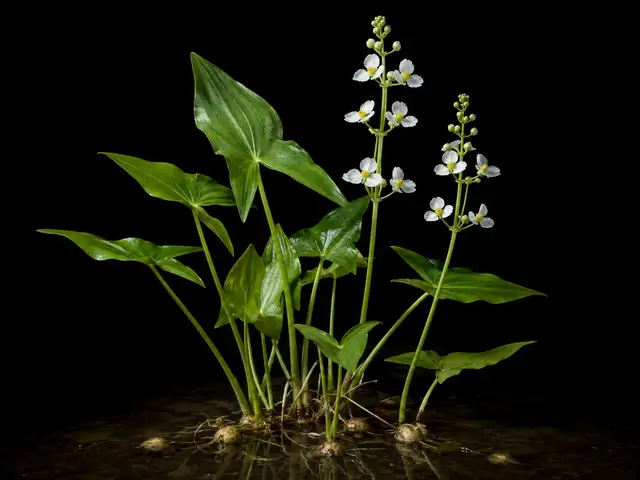
Arrowhead
Arrowhead's underwater tubers ('duck potatoes' or wapato) are a genuine, historically important food - starchy and potato-like once cooked. Eat them COOKED, not raw: raw tubers are acrid and unpleasant, and cooking (boiling or roasting) removes the acridity. Gather only with certain identification and only from clean, unpolluted water, since wetland tubers concentrate whatever is in their mud. Do not confuse young arrowhead with the toxic arrow arum or with iris; positive ID matters.
Overview
A striking native pond plant with bold arrow-shaped leaves and whorled white flowers - and, hidden in the mud, the starchy 'duck potato' tubers that were a real staple food across Indigenous North America.
Arrowhead (Sagittaria latifolia) is that rare plant that is both a handsome ornamental and a genuine food crop. Above the water it's unmistakable: bold, glossy, arrow-shaped leaves and airy stalks of pure white, three-petaled flowers arranged in tidy whorls of three, standing at a pond edge all summer. Below the water lies its secret - clusters of walnut-sized starchy tubers borne at the ends of underground runners, the famous 'duck potato' or 'wapato.'
Those tubers were a staple food for Indigenous peoples across North America, gathered from the mud in fall and cooked like potatoes, and they remain one of the best wild starches a forager can find. Ducks, muskrats, and other wildlife prize them too. Easy and hardy in shallow water, spreading into a self-renewing colony, arrowhead turns a wet margin, rain garden, or container water garden into both a pollinator planting and an edible one - grow it for beauty, for wildlife, and for the pot.
At a glance
- Sun
- Full sun · Part sun
- Water
- High
- Spacing
- 12–24 in (typ. 18)
- Mature height
- 18–48 in (typ. 30)
- Start by
- Transplant · Division · Tubers
- Frost
- Hardy
When to plant
Zone 7a typical frost: last Apr 10 · first Oct 25
Life stages
- Year 1 - rooting into the mud day 0–60 from transplant
-
Plant in mud under shallow waterArrowhead is an emergent aquatic: press a tuber or start into pond-edge muck with the crown at or just below the waterline, in up to several inches of standing water. Keep it flooded or saturated at all times - it will not grow in soil that dries out.
-
Shield new tubers from waterfowlDucks and muskrats dig arrowhead tubers eagerly (hence 'duck potato'), and will grub up newly planted starts. Use planting baskets, weight the pots, and net or cage young plants until the colony is established.
Tubers or starts grubbed up by ducks and muskratsAny drying of the mud (fatal) -
Plant in mud under shallow water
- Spring & summer growth Apr, May, Jun, Jul (yearly)
-
Keep it standing in shallow waterMaintain the water level over the roots all season; arrowhead thrives with a few inches of water over rich mud at a pond edge, in a rain garden that holds water, or in a submerged container. The distinctive arrow-shaped leaves rise fast once it's warm.
-
Let the colony run, or contain it in a basketArrowhead spreads by underground runners (stolons) that end in the food tubers, forming a colony. In a small pool, grow it in a submerged basket so you can lift the whole thing to harvest and to keep it in bounds.
Colony spreading by runners along the shallow marginLeaf beetles or aphids on lush leaves -
Keep it standing in shallow water
- Summer bloom Jul, Aug, Sep (yearly)
-
Enjoy the white whorled flowersArrowhead sends up airy stalks of three-petaled white flowers in tiers of three, above the bold arrow-shaped leaves - pretty in their own right and worked by bees and other pollinators through the summer.
-
Let it flower and set seed for wildlifeThe flowers ripen into round seed heads that feed waterfowl and songbirds; leave them to feed the pond and to self-sow. The plant is meanwhile busy building next season's food tubers underground.
Bees working the white flowersSeed heads forming for waterfowl -
Enjoy the white whorled flowers
- Tuber harvest (late fall to winter) Oct, Nov, Dec (yearly)
-
Grub tubers from the mud after the tops die backevery 10 dIn late fall and into winter, after the leaves yellow and collapse, the walnut-sized starchy tubers sit in the mud at the ends of runners, often a foot or more out from the plant. Traditionally they're loosened by treading or raking the mud so they float up to be gathered - dig or stir, then skim the tubers off the water.
-
Leave plenty of tubers to regrow the colonyHarvest only a share of the tubers and leave the rest in the mud - each one left is next year's plant. A managed patch will feed you and the ducks year after year if you never strip it bare.
Tubers floating up when the mud is stirred (the classic gathering trick)Muskrats and ducks harvesting alongside you -
Grub tubers from the mud after the tops die backevery 10 d
- Winter dormancy Jan, Feb, Mar, Dec (yearly)
-
Let it overwinter as tubers in the mudArrowhead survives winter as dormant tubers in the pond mud, fully hardy as long as they don't freeze solid. In a shallow container water garden, sink the pot below the ice line. New shoots rise from the tubers when the water warms in spring.
Tubers freezing solid in a too-shallow container (sink it deeper) -
Let it overwinter as tubers in the mud
Harvest
- Style
- Repeated picking
- Typical yield
- 10–60 tubers (typ. 25)
- By weight
- 8–64 oz (typ. 24)
- First production
- 1–2 yrs (typ. 2)
- Tops yellowed and collapsed in late fall - tubers are mature and starchy in the mud
- Walnut-sized tubers float up when the mud around the plant is stirred or trodden
- Best after the first frosts, when the plant has moved its energy into the tubers
Watch out for
Water-Level Loss (Drying Out) Disorder HighJun, Jul, Aug, Sep
Not a pest but pickerelweed's chief threat: as an emergent aquatic it wilts, browns, and collapses if the mud dries or the water level drops below its roots in a drought or a leaky pool.
Watch for: Wilting and browning leaves, collapsed flower spikes, and rapid decline when the water recedes or the mud dries.
Prevent: Site it in reliably standing water or saturated mud, keep the pond or container topped up through summer, and don't grow it in soil that dries between waterings.
Treat: Restore the water level promptly; mild wilting recovers, but prolonged drying kills the plant - keep it wet.
Muskrat Wildlife HighJan, Feb, Mar, Sep, Oct, Nov, Dec
Muskrats feed on cattail rhizomes and cut the leaves for their lodges, opening up patches of a stand - usually a benefit that helps thin the vigorous plant rather than a real problem.
Watch for: Cut and stacked leaves, feeding platforms, cleared 'eat-outs' in the stand, and muskrat lodges built of cattail.
Prevent: None needed on an established stand - muskrat grazing helps keep cattail in check and is part of a healthy marsh.
Treat: None warranted; only protect a small newly planted patch you don't want thinned, with wire or netting until it fills in.
Waterfowl Grazing Wildlife MediumApr, May, Jun, Oct, Nov
Ducks and geese graze tender new shoots and tug at newly planted starts, and can uproot young plants before their rhizomes take hold in a pond.
Watch for: Grazed or shredded new leaves, plants floating loose, and uprooted starts along the shallow margin in spring.
Prevent: Anchor new plants in planting baskets or weighted pots, tuck them firmly into the mud, and protect starts with netting or a temporary cage until they root.
Treat: Replant and re-anchor uprooted starts; established colonies easily outgrow grazing, so protection is mainly needed the first season.
Aphids Pest LowMay, Jun, Jul
Small soft-bodied sap-suckers clustering on tender tips and buds, excreting sticky honeydew.
Watch for: Colonies on new growth and flower buds, sticky residue, curling shoots, attending ants.
Prevent: Avoid excess nitrogen; encourage ladybugs and lacewings (zinnia flowers help feed them).
Treat: Hose off or use insecticidal soap. Rarely serious on vigorous zinnias.
Good & bad neighbors
Varieties · 3
The wild species and the true 'duck potato': bold arrow-shaped leaves, whorled white flowers, and clusters of walnut-sized starchy tubers in the mud. The classic edible and ornamental native for pond edges and rain gardens across most of the continent.
A related native arrowhead with narrow, grass-like leaves instead of arrowheads, for a finer-textured look in shallow water. Smaller tubers and more of a wildlife-and-ornamental plant than a food crop.
Local wild strains long favored for their larger, more abundant tubers, still grown and foraged for food (the Pacific Northwest 'wapato' among them). Grown for the pot as much as for looks; choose vigorous local stock where available.
Grow
An emergent aquatic for full to part sun: plant tubers or starts in rich mud under a few inches of shallow water at a pond edge, rain garden, or container, and keep it flooded all season.
Arrowhead is an emergent aquatic - it roots in mud with its crown under shallow water and its leaves and flowers held above. Grow it at a pond or stream edge, in a bog or rain garden that stays wet, or in a submerged container, in up to about six inches of standing water over rich, mucky soil, in full to part sun. It's a heavy feeder that loves the fertile mud of a pond bottom and grows lush and fast once the water warms.
Start it from dormant tubers pressed into the mud in spring, or from potted plants and divisions. It spreads by underground runners (stolons) that end in the food tubers, forming a colony - welcome that spread where a patch is wanted, or grow it in a submerged planting basket in a small pool, which also makes the whole plant easy to lift and harvest. The single hard rule, as with all emergents: it must never dry out.
Care
Nearly carefree in standing water: keep the level up, let the colony run (or contain it in a basket), leave flowers for wildlife, and protect a young patch from ducks and muskrats.
Standing in shallow water over rich mud, arrowhead needs very little. Keep the water level over its roots through the season - it wilts fast if the margin dries in a drought or a leaky pool - and it needs no feeding in fertile pond muck (a lean container appreciates an aquatic plant tab). It has essentially no disease problems.
The management task is spread and wildlife. Let the colony run where you want a patch, or lift and thin it (or keep it basketed) in a small pool. The chief nuisance is that ducks and especially muskrats dig the tubers - a mature colony feeds them and you both, but a young planting needs netting or caging until it's established, or the animals will grub it out before it takes hold. Leave the white flowers to bloom and set seed for waterfowl; there's nothing to deadhead.
Harvest
Grub the starchy tubers from the mud in late fall after the tops die back - stir or tread the mud and skim the floating tubers - and always leave plenty behind to regrow the colony.
The harvest is the fun part and the old skill worth learning. Arrowhead builds its tubers in the mud through summer and moves its energy into them as the season ends, so the time to dig is late fall into winter, after the leaves yellow and collapse. The tubers sit at the ends of runners, often a foot or more away from the parent stalk, which is why you don't just dig at the base. The traditional method - recorded from many Indigenous peoples - is to wade in and loosen the mud with your feet or a rake so the buoyant tubers pop free and float to the surface, where you skim them off the water.
Expect walnut-sized tubers; wash off the mud and cook them like potatoes (never eat them raw - they're acrid until cooked). The golden rule of a lasting patch: never strip it bare. Take a share and leave the rest, because every tuber left in the mud is next year's plant. Managed that way, a stand feeds you and the ducks year after year.
Storage
Store cleaned tubers cool, damp, and cool like other root crops for a few weeks, or leave them in the mud until needed; the colony banks itself as dormant tubers over winter.
Freshly gathered arrowhead tubers keep best cool and slightly damp - stored dry they shrivel like other tender roots. Brushed clean (not scrubbed) and kept in a cool, humid spot such as a fridge crisper or a bucket of damp sand in a cellar, they hold for a few weeks; for longer keeping, cook and then freeze or dry them. Some traditional foragers simply leave the tubers in the mud and gather them fresh through the winter as needed, since they store perfectly well right where they grew.
As a hardy perennial, arrowhead also stores itself: the colony overwinters as dormant tubers in the pond mud, cold-hardy as long as they don't freeze solid, and sends up new shoots when the water warms. This is why leaving tubers behind at harvest matters - they are both next year's crop and the plant's own overwintering bank.
Propagation & seed saving
Easiest from its own tubers or by spring division of the runner colony; it also self-sows from seed. A managed patch propagates itself endlessly if you leave tubers behind.
Arrowhead all but propagates itself. The simplest method is to plant its own tubers - press dormant tubers (saved from harvest or bought) into warm mud in spring and each sprouts a new plant. You can also divide the runner colony in spring, lifting and splitting the rooted mass into pieces, each of which grows on quickly.
It grows from seed too - the round seed heads ripen many small seeds that need to stay wet and germinate on moist mud - and it self-sows along a wet margin, though seedlings are slower to reach harvest size than tubers or divisions. In practice a healthy patch renews and expands itself by runners and self-sown seed every year, so the real 'propagation' is simply leaving enough tubers in the mud at harvest to keep the colony going.
Nutrition
A genuine starchy staple: the cooked tubers are potato-like, rich in carbohydrate with useful minerals - a real wild food, not a novelty - plus major value to waterfowl and pollinators.
Unlike most native ornamentals, arrowhead is a real food. Its tubers are a starchy staple comparable to the potato - rich in complex carbohydrate for energy, with useful potassium and other minerals and a modest amount of protein - and they were an important calorie source for Indigenous peoples across the continent precisely because they store well and are gathered in abundance from the mud. Cooked (boiled, roasted, or baked), they're mild, nutty, and potato-like; raw they're acrid and unpalatable, so cooking is both for flavor and to break down the acridity.
Its ecological value runs just as deep. The tubers are prime forage for ducks, geese, and muskrats (the 'duck potato' name is earned), the seeds feed waterfowl and songbirds, and the summer flowers support bees and other pollinators, while the whole plant shelters fish and aquatic life and stabilizes the shoreline. Few plants feed both people and wildlife as generously from the same wet ground.
In the kitchen
Cook the tubers like potatoes - boil, roast, or bake for a mild, nutty, potato-like starch; never eat them raw, and peel the cooked skins if they're tough.
Treat arrowhead tubers as you would small potatoes. Boiling is the classic method: simmer them until tender, then peel (the skins slip off cooked) and eat them mashed, buttered, or in soups and stews - the flesh is mild, faintly nutty, and pleasantly starchy. Roasting or baking in the coals of a fire is the old field method and gives a sweeter, chestnut-like result, as the heat converts some of the starch. They can also be dried and ground into a starchy flour for storage and baking.
The one firm rule is to always cook them - raw tubers are unpleasantly acrid and astringent, and cooking is what makes them the friendly staple they were prized as. Because they hold their shape well, cooked tubers are good in stews, hashes, and roasts anywhere you'd use a waxy potato. Gather only from clean water and with certain ID, and you have one of the finest wild starches North America offers.
History
One of the most important wild starches of Indigenous North America - 'wapato' - gathered from the mud by treading it free; recorded by Lewis and Clark and still foraged and grown today.
Arrowhead's tubers were a cornerstone food across much of Indigenous North America. Known as wapato to peoples of the Pacific Northwest and by many other names elsewhere, the tubers were harvested in quantity - famously by women who waded into the cool autumn shallows and loosened the mud with their feet so the buoyant tubers floated up to be gathered into canoes. They were a traded staple and a reliable winter starch, and the wetlands where they grew were managed and revisited for generations.
European explorers took note: Lewis and Clark recorded relying on wapato bought from Columbia River peoples during their expedition, and later botanists documented its wide use. The plant's many folk names - duck potato, Indian potato, katniss - all record its double life as human food and wildlife forage. Today arrowhead is grown as both an ornamental pond plant and a foraged and cultivated food, and it remains a favorite teaching plant for anyone learning to harvest wild wetland staples.
Troubleshooting
Most trouble is water or wildlife: it collapses if the mud dries, gets grubbed out by ducks and muskrats when young, and yields poorly if harvested only at the plant's base.
Wilting, browning, collapsing: the mud dried out or the water dropped below the roots - arrowhead is an emergent aquatic and must stay flooded or saturated; restore the water level. New planting grubbed up and gone: ducks and especially muskrats dig the tubers - net or cage a young patch and use planting baskets until the colony is well established. Few or no tubers when you dig at the base: the tubers form at the ends of runners, often a foot or more out from the stalk - stir or tread the surrounding mud and skim the tubers that float up, rather than digging only at the plant's center. Tubers taste acrid: they were eaten raw or undercooked - always cook them thoroughly, which removes the acridity. Colony spreading too far: grow it in a submerged basket and thin it in spring in a small pool. Tubers killed over winter: a shallow container froze solid - sink the pot below the ice line.
Growing across climates
Widely native and hardy across most of the U.S. (zones 4-10) wherever it can stand in shallow water; its limit is dry ground, not cold or heat.
Arrowhead is native across a huge span of North America and hardy roughly zones 4-10, with water - not climate - setting its limits. Zones 4-6: fully cold-hardy in the pond mud, dying back to dormant tubers that survive as long as they don't freeze solid; container growers should sink pots below the ice line. Zones 6-8: its comfortable heartland, growing lush and cropping well wherever the water level holds. Hot South (zones 9-10): excellent and vigorous in ponds and wet margins, often nearly evergreen and productive, though the water must be kept up through summer drought. Arid West: genuinely native along streams and marshes there, but in gardens only viable with a reliable pond or wet feature. Everywhere the story is the same: it thrives standing in shallow water and cannot grow on ground that dries out - matched to a wet edge, it's an easy, productive native from the cold North to the warm South.
Cook it
All 1 recipe →No grower tips for Arrowhead yet — yours could be the first.
Sign in to share what works in your garden.