Add it to your home screen and it opens full screen: no browser bars, one tap away, and everything stays signed in. Free, nothing to download from an app store.
- Tap the Share button in your browser
- Scroll down and choose “Add to Home Screen”
- Open GrowSomeFood from your home screen
- Open your browser’s menu
- Choose “Add to Home screen” or “Install app”
- Open GrowSomeFood from your home screen
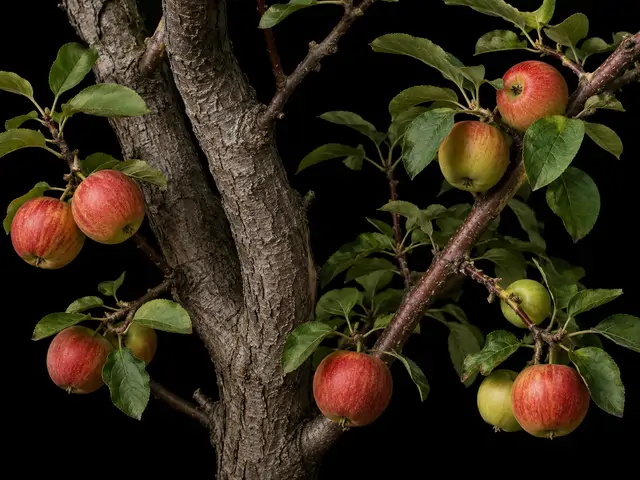
Apple
The flesh and skin are the food. Seeds contain amygdalin (a cyanogenic compound) - harmless if you accidentally swallow a few, but don't crush and eat them in quantity.
Overview
The backyard orchard classic: a long-lived pome tree that trades a few years of patience for decades of fall fruit - if you match the variety's chill needs to your winters and give it a pollen partner.
An apple tree is a multi-decade relationship. Plant a two-year-old grafted tree and you'll wait two to five years for the first real crop, but a mature tree then feeds a family - and the neighbors - every autumn for a human lifetime. Almost every apple you'll grow is a grafted tree: a chosen variety on a rootstock that controls its size, because apple seeds never come true to the parent.
Two facts drive every planting decision. First, chill hours: apples need a run of winter cold (hours below ~45°F) to bloom properly - most want 500-1,000, so a Honeycrisp will sulk in Florida and a low-chill Anna will thrive there. Second, pollination: most apples can't set fruit with their own pollen and need a second, different variety (or a crabapple) blooming nearby. Get chill and pollination right and the rest is patience.
At a glance
- Sun
- Full sun
- Water
- Medium
- Spacing
- 96–300 in (typ. 180)
- Mature height
- 96–360 in (typ. 216)
- Start by
- Transplant
- Frost
- Hardy
- Chill hours
- 100–1000 hrs (typ. 800) below 45°F
- Spread
- 96–300 in (typ. 180)
- Soil
- Well-drained
- Temperature
- Damaged below -35°F · struggles above 95°F
When to plant
Zone 7a typical frost: last Apr 10 · first Oct 25 (spring frost runs Mar 27–Apr 24 in a typical spread of years)
Life stages
- First-year establishment day 0–365 from transplant
-
Water deeply every 7-10 days the first seasonevery 8 dA newly planted tree has no root reach yet - soak the root zone, don't sprinkle. Consistent moisture the first summer is the single biggest factor in survival.
-
Mulch a 3-foot ring, kept off the trunkWood chips or straw 2-3 inches deep conserve moisture and stop grass from stealing water. Leave a few inches bare around the trunk to prevent rot and voles.
-
Guard the trunk from voles, deer, and sunscaldA white spiral tree guard or hardware-cloth cylinder stops rodent girdling in winter and buck rub. Remove or loosen guards as the trunk thickens.
-
Make only formative cuts the first winterSet the scaffold branches and remove anything broken or crossing. Heavy pruning now just delays fruiting - go light.
Graft union buried below soil (scion will root and lose dwarfing)Grass and weeds competing at the trunkWinter vole or deer damage on unguarded bark -
Water deeply every 7-10 days the first seasonevery 8 d
- Winter dormancy (accumulating chill) Jan, Feb, Dec (yearly)
-
Prune while fully dormantLate winter is the main pruning window: open the center, remove water sprouts, crossing wood, and anything diseased. Aim for a canopy sunlight and a bird can move through.
-
Scrape or remove disease mummies and cankersPull off shriveled 'mummy' fruit and cut out fire-blight strikes now - the pathogens overwinter in them.
Warm-winter zones failing to meet chill hours (poor, straggly bloom)Overwintering scab spores in fallen leaves under the tree -
Prune while fully dormant
- Bloom & pollination Apr, May (yearly)
-
Make sure a compatible pollinizer blooms nearbyMost apples need a different variety flowering at the same time within ~100 feet - a crabapple counts. A few popular apples are triploid (Jonagold, Mutsu/Crispin, Gravenstein, Winesap): their pollen is sterile, so they cannot pollinate a partner and need TWO other varieties nearby. Don't spray insecticides during bloom; you need the bees.
-
Cover or watch for late frost during bloomOpen blossoms are killed near 28°F. If a hard frost is forecast, a sheet over a small tree or overhead sprinkling can save the crop.
Late frost during open bloom (the crop's biggest annual risk)Fire blight entering through blossoms in warm, wet weatherNo pollinizer nearby (heavy bloom, almost no fruit) -
Make sure a compatible pollinizer blooms nearby
- Fruit set & sizing May, Jun, Jul (yearly)
-
Thin to one apple per cluster, 6 inches apartDo it within a few weeks of set. Thinning trades quantity for size and flavor, prevents limb breakage, and curbs biennial (every-other-year) bearing.
-
Keep water steady as fruit sizesevery 7 dDeep weekly soaking through summer builds size and prevents the stress that drops fruit and worsens bitter pit.
-
Hang codling moth traps and scout weeklyevery 7 dThe 'worm in the apple' is codling moth larva. Pheromone traps, prompt cleanup of drops, and bagging or kaolin clay all cut damage.
June drop (a normal natural thinning - don't panic)Codling moth stings and entry holesScab lesions on developing fruit -
Thin to one apple per cluster, 6 inches apart
- Harvest Aug, Sep, Oct, Nov (yearly)
-
Pick with an upward twist when ripeevery 4 dCup the apple, lift and roll it up toward the spur - a ready apple releases with the stem attached. Taste-test rather than trusting color alone; ground color shifting from green to yellow is a better cue.
-
Pick storage varieties slightly firmLong-keeping types store best harvested mature but hard. Handle like eggs - every bruise is a rot starting point.
Fruit dropping before you pick (overripe, or codling moth)Bruising from dropping into hard bucketsWasps and birds beating you to ripe fruit -
Pick with an upward twist when ripeevery 4 d
Harvest
- Style
- Repeated picking
- Typical yield
- 50–800 apples (typ. 300)
- By weight
- 320–6400 oz (typ. 1600)
- First production
- 2–5 yrs (typ. 4)
- Ground color under the blush shifts from grass-green to yellow or cream
- Fruit releases with an upward twist, stem staying on
- Seeds inside a test apple have turned brown
- Flavor is full and sweet-tart, not starchy
Watch out for
Codling Moth High
The classic 'worm in the fruit': larvae of a small gray moth tunnel in from the skin and feed at the core or kernel, packing the entry hole with sawdust-like frass and ruining the crop for keeping. The same moth works apples, pears and walnuts.
Watch for: Small entry holes ringed with brown frass, early fruit or nut drop, and a tunnel running to the seed cavity or kernel when you cut or crack a damaged one open.
Prevent: Hang pheromone traps to time any spray; gather and destroy dropped fruit and nuts promptly to break the cycle; bag individual fruits or apply kaolin clay for spray-free control.
Treat: Spinosad timed to egg hatch (the traps tell you when), or codling moth granulosis virus (CpGV) as a targeted biological. Bt does not work on codling moth - the newly hatched larva bores straight into the fruit within hours and never eats enough surface tissue to take in a dose. Use only a product labeled for the crop you are treating, follow the label exactly, and observe the pre-harvest interval before you pick. Sanitation and fruit-bagging matter more than any single spray.
Usually two to three generations a season - the first, at petal fall, is the one to stop. Bt does not control codling moth on apple: the newly hatched larva bores straight into the fruit and never eats enough surface tissue to take in a dose. Time spinosad to egg hatch, or use codling moth granulosis virus (CpGV), and lean hardest on sanitation and fruit-bagging.
Apple Scab High
The most common apple disease: a fungus that produces olive-green to brown velvety spots on leaves and fruit, causing corky scabs, leaf drop, and cracked, cosmetically ruined apples in wet springs.
Watch for: Olive-brown fuzzy blotches on new leaves, matching corky spots and cracks on the fruit, and early yellowing and leaf fall.
Prevent: Rake and destroy fallen leaves in autumn (the spores overwinter there), prune for airflow, and above all plant scab-resistant varieties like Liberty or Enterprise where springs are wet.
Treat: On susceptible trees, protective fungicide sprays from bud break through the wet spring period; there's no cure once fruit is scabbed, so prevention is the whole game.
Worst in cool, wet springs and in humid eastern climates; drier regions see far less.
Fire Blight High
A fast, destructive bacterial disease (Erwinia amylovora) of the rose family. It enters through open blossoms and soft shoot tips in warm, humid weather, then runs back down the shoot, blackening leaves and wood as though scorched and bending the tip into a telltale 'shepherd's crook'. From there it moves into limbs as dark sunken cankers, and it can kill a young tree in a single season. Apple, pear, quince, loquat, hawthorn, serviceberry and toyon are all hosts, and susceptibility varies enormously between species and between varieties.
Watch for: Sudden wilting and blackening of blossoms and shoot tips that look burned rather than diseased, shoots bent over into a hook, dark sunken cankers on limbs, and amber bacterial ooze on the bark in warm humid weather.
Prevent: Where a resistant option exists for your crop, variety choice matters more than any spray - check before you buy. Avoid heavy nitrogen and hard pruning, both of which force the soft succulent growth the bacteria enter through, and never prune or work the plant in wet weather. Keep susceptible hosts spaced apart rather than planted hard against each other, and do not prune two of them in the same wet spell.
Treat: Cut strikes out at least 8 to 12 inches below the visible damage, sterilizing the saw or pruners between every single cut, and remove and destroy the prunings rather than leaving them lying. Cut cankers out in dry dormant weather. Copper or biological sprays at bloom help in high-pressure areas - use only a product labeled for the crop you are treating, follow the label exactly, and observe the pre-harvest interval before you pick.
Explodes in warm, humid springs, and the shepherd's-crook shoot tip is the unmistakable sign. Apple is susceptible but less so than pear or quince, and resistant varieties are widely available - worth choosing where blight is common in your area.
Japanese Beetles Medium
Japanese beetles are metallic green-and-copper beetles about half an inch long that emerge in early summer and feed for six to eight weeks. They feed in aggregating masses - one beetle's feeding releases a scent that draws in more - so a plant goes from untouched to covered in a couple of days. They chew the soft tissue between the leaf veins and leave the veins standing, so the leaf ends up as a brown lace skeleton, and they shred open flowers and sometimes ripening fruit as well. They work the sunniest upper parts of a plant on warm afternoons. The white C-shaped grubs spend the rest of the year in turf and pasture soil eating grass roots, and the adults then fly in from wherever they hatched, which can be some distance away.
Watch for: Clusters of shiny metallic beetles massed together on the upper, sunniest foliage and down inside open blooms, heaviest on warm sunny afternoons from around late June. Leaves reduced to lace, with the veins left intact and the tissue between them gone - unmistakable, and quite different from the ragged chewing of a caterpillar. Ragged, chewed petals and blooms that never open properly. Beetles that let go and drop straight to the ground when you disturb the plant. Feeding damage on ripening fruit, on the plants they also take fruit from. Whole branches going brown and lacy at the top of a plant while the shaded lower growth stays untouched.
Prevent: Hand-picking is genuinely the main defense in a home garden. Go out in the cool of the morning while the beetles are sluggish, hold a tub of soapy water underneath, and knock them in - they drop when disturbed, so most fall straight into it. Do it daily through the flight: because the beetles call each other in, taking them off early stops a plant becoming a beacon. Do not put pheromone or lure traps anywhere near the garden - they demonstrably pull in far more beetles than they catch. And do not count on lawn grub control: milky spore has performed poorly and inconsistently in field trials across most of the US, and treating your own turf does not reduce the adults feeding on your plants, because they fly in from surrounding properties. Where it is practical, row cover or netting through the peak flight excludes them outright. Otherwise riding out the six-to-eight-week wave is a legitimate strategy, since most established plants absorb the damage.
Treat: Persistent morning hand-picking into soapy water is the most effective home control there is, and on a vigorous established plant the damage is usually cosmetic and needs nothing else. Neem deters feeding rather than killing, and has to be reapplied. For heavy pressure, spinosad or a targeted insecticide labeled for the plant will work - but time any spray away from bloom and apply it at dusk to protect bees, and observe the pre-harvest interval on anything you eat. On flowering plants, some gardeners simply shear the blooms off for a couple of weeks and let the plant rebloom once the wave has passed, which removes the lure as well as the damage. Young plants and young trees are the ones worth defending: a mature tree or an established vine tolerates several weeks of leaf loss without lasting harm.
A few weeks of feeding rarely hurts an established tree; young trees may need protection.
Deer (browse resistance) Medium
Deer are the largest garden problem across much of the country, and where pressure is high they set the limit on what you can grow at all. They browse at night and around dawn and dusk, taking tender shoots, leaves, buds, flowers, and fruit within about five feet of the ground, and they come back night after night to anything they have found and liked. Because they have no upper incisors they tear rather than cut, leaving ragged stem ends - that is how you tell deer damage from a rabbit's clean angled cut. In fall, bucks rub their antlers on young trunks and can strip the bark right around a stem, which kills a young tree outright. Palatability varies enormously between plants and between seasons: a herd short of food in late winter eats things it ignores in June, and no plant is truly deer-proof.
Watch for: Growth cleanly missing overnight, with the plant browsed back to a level line about as high as a deer can comfortably reach. Ragged, torn stem ends rather than the clean angled cut a rabbit leaves - the single most reliable identifier. Buds and flowers gone while the foliage below is untouched, since deer often take the best part first. Hoof prints and droppings in soft ground near the damage. Repeat visits, with fresh damage each morning once a planting has been found. On young trees, shredded and stripped bark and broken low branches in autumn - that is antler rubbing rather than feeding.
Prevent: Fencing is the only thing that reliably works. Eight feet is the standard for excluding deer, or two parallel four-foot fences a few feet apart, which they will not jump because they cannot judge the landing. Short of that, cage individual plants: a sturdy wire cage or trunk guard around every young tree, left on until the trunk is thick and the canopy is above browse height, prevents both browsing and antler rubbing and is the single highest-value thing you can do for a young tree. Repellent sprays do help at moderate pressure, but they wash off and deer habituate, so reapply after rain and rotate between different types through the season. Motion-activated sprinklers, scent deterrents, and noise devices work for a while and then stop. Siting matters too: plants close to the house, in daily traffic, and screened behind other planting get browsed less than the same plant out at the boundary.
Treat: There is no chemical fix, only exclusion and recovery. Get physical protection up immediately after the first damage, because deer return to a known meal, and reinforce or rotate whatever you were relying on before. Most plants regrow from browsing if the crown and roots are intact - feed and water a grazed plant and protect the regrowth while it comes back. What does not recover in the same season is anything whose buds or flowers have been taken, and a young tree whose bark has been rubbed right around the trunk is usually lost. Where deer pressure is genuinely heavy, the honest answer is to fence properly or to grow the plants deer leave alone, rather than to keep replacing losses.
Young trees are far more vulnerable than mature ones - the first few years are the risk window, for antler rubbing as much as for browsing.
Aphids Low
Aphids are small soft-bodied sap-suckers - green, black, gray, pink, or waxy white, and mostly wingless - that gather in dense colonies on the tenderest new growth: shoot tips, buds, and the undersides of young leaves. They breed extremely fast in mild weather, so a few can become hundreds inside a week. Their feeding curls and distorts soft growth, and the sticky honeydew they excrete coats everything below and turns black with sooty mold. Ants often farm and defend the colonies for that honeydew. A few aphids are normal on almost any plant and a healthy plant shrugs them off; only dense, persistent colonies do real damage, and some aphids also spread plant viruses as they feed.
Watch for: Dense clusters of tiny insects packed onto shoot tips, flower buds, and the undersides of young leaves. Curled, cupped, or distorted new growth that never opens properly. A sticky shine on the leaves - and on whatever sits under the plant - that later goes black with sooty mold. Tiny white cast skins left behind where a colony has been feeding. Ants running steadily up and down the stems, which is often the first thing you notice. Mottled, streaked, or misshapen leaves that do not grow out can mean a virus the aphids brought with them rather than the feeding itself.
Prevent: Go easy on nitrogen: the soft, lush growth that heavy feeding produces is exactly what aphids breed on. Check new growth once a week through spring and early summer so you catch colonies while they are still small, and rub the first few out with your fingers. Leave flowering plants nearby and skip broad-spectrum sprays - ladybugs, lacewings, hoverflies, and parasitic wasps do most of this work for free, and they only stay if there is something for them to eat. Keep ants off the plant where you can, since they protect aphids from those predators. Water steadily so plants are not stressed, and check any new plant over before you bring it home or move it indoors, since aphids usually arrive on something else.
Treat: Knock the colonies off with a hard jet of water and repeat every few days - on most plants that alone ends it. Pinch out or prune off the worst-infested tips rather than treating the whole plant. If colonies keep rebuilding, spray insecticidal soap or horticultural oil directly onto the insects, covering leaf undersides, and repeat weekly until they are gone; treat early or late in the day, and never spray a wilted or heat-stressed plant. Avoid broad-spectrum insecticides - they kill the ladybugs, lacewings, and parasitic wasps that were about to solve the problem for you, and aphid numbers usually come back worse afterward. Anything you spray must be labeled for the plant you are treating; follow that label and observe its pre-harvest interval. On anything you eat, wash leaves, heads, and buds well before use, since aphids hide down in crowns, folds, and tight growth.
Woolly apple aphid is the distinctive one here: white cottony masses on bark, pruning wounds and roots rather than open colonies on leaves. Mostly a young-tree and nursery-stock concern; mature trees shrug it off.
Good & bad neighbors
Varieties · 7
Greenish-yellow fruit with a red blush, elongated shape.
The go-to apple for warm climates: needs only about 200 chill hours, so it fruits reliably in Florida, southern California, and the Gulf where standard apples fail. Crisp, mildly sweet-tart Granny-Smith-shaped fruit as early as June. Partially self-fruitful but crops far better with low-chill Dorsett Golden or Ein Shemer nearby.
Yellow fruit with a light pink blush, resembling Golden Delicious.
A very-low-chill golden apple (roughly 100 chill hours) discovered in the Bahamas - sweet, firm, and the classic pollen partner for Anna. Together they make apples possible in nearly frost-free gardens.
Medium fruit with red-and-yellow striped skin and crisp texture.
An early-ripening University of Minnesota apple bred for northern climates - good for both fresh eating and cooking, and one of the first to ripen in late summer. Doesn't store long, so eat, sauce, or bake it soon after picking.
Large, mottled red-over-yellow fruit with coarse, pale cream flesh.
The blockbuster eating apple: explosively crisp and juicy with a balanced sweet-tart flavor, developed by the University of Minnesota and released in 1991. Excellent cold hardiness and stores for months, but it's a fussy tree - prone to bitter pit and biennial bearing, so thin diligently. High chill requirement means it needs a real winter.
Medium, dark red fruit with crisp, juicy, off-white flesh.
The premier low-spray apple: bred at Cornell for immunity to scab and strong resistance to fire blight, rust, and mildew, so it grows cleanly with little or no fungicide. Crisp, sprightly McIntosh-style flavor. The best choice for organic and humid-climate growers.
Large, rosy-pink over yellow-green, with dense pale flesh.
A very sweet, dense, ultra-crisp Japanese apple that stores exceptionally well - among the best keepers. Ripens very late and comes in both standard and low-chill strains, so check the chill rating for your zone. Needs a pollinizer.
Medium red fruit often streaked with green, firm crisp flesh.
A tough, tart Minnesota heirloom (1922) built for brutal winters, with good resistance to both fire blight and scab. Firm, tangy flesh holds its shape in pies and makes excellent cider; stores well into winter. The dependable choice for the coldest apple country.
Grow
Plant a dormant bare-root grafted tree in early spring, graft union above the soil, in full sun and well-drained ground - with a pollen partner within 100 feet.
Buy a grafted tree on a named rootstock, not a seedling: the rootstock decides whether you get an 8-foot dwarf you can prune from the ground or a 25-foot standard. Dwarf and semi-dwarf trees fruit sooner, fit small yards, and are far easier to pick and spray - the right choice for most home growers. Plant while dormant in early spring (or fall in mild zones), spreading the roots in a hole no deeper than the tree grew in the nursery, and keep the graft union (the swollen kink low on the trunk) a few inches above the soil line so the scion can't root and escape its dwarfing.
Full sun and drainage are non-negotiable - apples rot in wet feet and get diseased in shade. Set your pollinizer variety within about 100 feet - and check whether the variety you want is triploid: Jonagold, Mutsu/Crispin, Gravenstein and Winesap make sterile pollen, so they cannot pollinate anything and need two other varieties nearby to fruit properly themselves. Stake dwarf trees, whose small roots can't anchor a fruit-laden canopy, and water faithfully through the whole first season.
Care
Prune in late winter, thin the young fruit hard, water deeply through summer, and stay ahead of scab and codling moth.
The yearly rhythm is short and repeatable. Late winter: prune while dormant - open the center to light and air, remove crossing wood, water sprouts, and anything diseased. After bloom: thin the little apples to one per cluster, about a hand-width apart; this is the step home growers skip and then wonder why their apples are golf balls and the tree fruits only every other year. Summer: water deeply and evenly, and mulch to hold it.
Apples are the pest-and-disease crop, so scouting matters. Rake and destroy fallen leaves to break the scab cycle, hang codling moth traps, and clean up dropped fruit promptly. A backyard tree can be grown with minimal spray if you thin, sanitize, and pick a resistant variety - or bag individual fruits for cosmetically perfect, spray-free apples.
Harvest
Ripe when the ground color yellows and the apple twists free with the stem on - taste-test rather than trusting the blush.
Color is a trap: many apples blush red weeks before they're ripe. The reliable cues are the ground color (the background under the red, which shifts from green toward yellow), brown seeds in a cut-open test fruit, and full flavor on the tongue. To pick, cup the apple, lift and roll it upward toward the branch - a ready apple releases with its stem attached; one that fights you isn't done.
Handle every apple like it's fragile, because it is - a bruise you can't even see becomes a soft rot in storage. Pick eating apples at peak flavor, but harvest long-keeping varieties a touch firm and let them mellow in the cold. A well-managed mature dwarf can hand you 50-150 pounds a year.
Storage
Cool, humid, and dark: keeper varieties hold for months near freezing. One rotting apple spoils the barrel, so cull as you store.
Apples store better than almost any tree fruit, but the variety decides everything - a Honeycrisp or Fuji keeps for months, an early summer apple for days. Store only unblemished fruit, stems on, in a cold (32-40°F) and humid spot: a spare fridge, a root cellar, or ventilated boxes in an unheated garage that won't freeze. Keep them away from potatoes and out of the kitchen fruit bowl - apples breathe out ethylene gas that ripens (and rots) everything nearby, including each other.
The old saying is literal: one rotting apple releases enough ethylene and mold to take down its neighbors, so pack them in a single layer or wrap individually, and pull any softening fruit immediately. Beyond fresh storage, apples are the great preserving fruit - sauce, butter, dried rings, canned pie filling, and cider all bank a heavy year.
Growing across climates
Match the variety to your winter chill. North: hardy high-chill classics. Deep South: only true low-chill apples fruit at all.
Zones 3-5: apple heartland - cold-hardy, high-chill varieties (Honeycrisp, Haralson, State Fair, and the University of Minnesota lineup) thrive, and late frost during bloom is the main worry; plant on higher ground where cold air drains away. Zones 6-8: the widest choice - most varieties get enough chill; disease pressure (scab, fire blight, cedar-apple rust) rises with heat and humidity, so lean on resistant varieties like Liberty, Enterprise, and Williams' Pride. Zones 9-10: standard apples simply never accumulate their required chill and bloom sparse and straggly - success here means committing to genuine low-chill varieties (Anna, Dorsett Golden, Ein Shemer, low-chill Fuji, ~100-300 chill hours), which crop reliably where a Honeycrisp would fail entirely. Chill-hour requirement is the make-or-break number: check it against your area before you buy.
Troubleshooting
Heavy bloom but no fruit means no pollen partner or a bloom-time frost. Wormy apples are codling moth; scabby leaves and fruit are apple scab.
Flowers everywhere, almost no apples: the classic pollination failure - you need a second variety blooming at the same time nearby, or a late frost killed the open blossoms. Fruit only every other year: biennial bearing, cured by thinning hard in the 'on' years. Worm tunnels to the core: codling moth - trap, sanitize drops, and bag fruit. Olive-brown velvety spots on leaves and fruit (apple scab): rake and destroy fallen leaves, improve airflow, choose resistant varieties. Shoots that suddenly blacken and curl like a shepherd's crook (fire blight): a bacterial disease - cut 12 inches below the strike, sterilizing tools between cuts, and never over-fertilize with nitrogen. Orange spots on leaves near junipers: cedar-apple rust - remove nearby junipers or grow a resistant variety.
Nutrition
Fiber, vitamin C, and a skin full of polyphenol antioxidants - the everyday fruit behind 'an apple a day.'
An apple is about 85% water and 95 calories, but it earns its reputation: it's a solid source of dietary fiber (much of it pectin, the soluble kind linked to lower cholesterol and steadier blood sugar), vitamin C, and potassium. The real density is in the skin and just beneath it, where the polyphenol antioxidants - quercetin, catechins, chlorogenic acid - concentrate, which is why peeling an apple throws away much of its nutritional value.
The pectin that makes apples set into jelly without added thickener is the same fiber that feeds gut bacteria and slows sugar absorption. Eat them whole and unpeeled for the full benefit; a homegrown apple also skips the wax coatings and storage-gas treatments of the supermarket.
In the kitchen
Different apples for different jobs: crisp sweet-tart for eating, firm tart for pies, soft sweet for sauce, sharp tannic for cider.
The kitchen secret is that apples are not interchangeable. Eating apples (Honeycrisp, Fuji, Gala) want crunch and balanced sweet-tart flesh. Baking apples for pie need to hold their shape and stay tart under heat - Granny Smith, Braeburn, or a firm heirloom keep pies from turning to mush. Saucing and applesauce apples break down willingly and sweeten - McIntosh, Cortland, or any soft sweet variety cook down with barely any sugar. And cider is a blend, ideally including sharp, tannic 'spitter' apples that taste terrible fresh but give hard cider its backbone.
When a tree overwhelms you in October: sauce and freeze it flat in bags, dry rings for chewy snacks, cook down apple butter low and slow, or press the whole lot into cider. Sliced apples brown fast - a squeeze of lemon or a saltwater dip holds the color.
Propagation & seed saving
Apples don't come true from seed - every named variety is cloned by grafting. Learn to graft and you can top-work a whole tree of varieties.
Here's the fact that surprises everyone: plant a seed from a Honeycrisp and you will not get a Honeycrisp - you'll get a wild-card seedling, usually a small sour crabapple-ish fruit, because apples are extreme hybrids and their seeds scramble the genetics. Every named variety on earth is a graft: a cutting (scion) of the original tree joined onto a rootstock, cloning it exactly. Johnny Appleseed's seedlings famously went to cider precisely because they didn't come true.
For the home grower this is an opportunity, not a limit. Collect dormant scion wood of a variety you love in late winter, and graft it (whip-and-tongue or cleft graft) onto a compatible rootstock or an existing branch - a single tree can carry four or five varieties this way, extending your harvest and providing its own pollen partners. Grafting is a genuinely learnable skill, and it means you never have to buy that variety again.
Traditional & historical uses
No strong herbal tradition, but the proverb has some truth - the fiber and polyphenols are real, if gentle, contributors to heart and gut health.
This section records how people have traditionally used this plant, and what is known about the risks. It is history and general information — not medical advice, and not a recommendation to treat anything. Plants are not dosed like medicines, some interact with prescriptions, and some are harmful in ways that are not obvious. Talk to a clinician before using any plant medicinally.
'An apple a day keeps the doctor away' is folklore, not medicine, but it's folklore built on real chemistry. Apple pectin is a soluble fiber shown to modestly lower LDL cholesterol and feed beneficial gut bacteria, and the polyphenols in the skin are among the more-studied dietary antioxidants for cardiovascular health. Population studies do link regular apple eating with better heart and metabolic markers - though as one of many fruits in a good diet, not as a drug.
Beyond diet, apples have little classic herbal role. The one honest caution is the seeds: they contain amygdalin, which releases small amounts of cyanide when chewed - a swallowed seed or two passes harmlessly, but don't grind up cupfuls of seeds. As food-medicine goes, the apple's contribution is quietly real: eat it whole, skin on, and let the fiber do its slow work.
History
From the wild forests of Kazakhstan along the Silk Road to Roman grafting to Johnny Appleseed - the apple has traveled with humanity for millennia.
Every domestic apple descends from Malus sieversii, a wild apple still growing in the mountain forests of Kazakhstan, near Almaty (a city whose name means 'father of apples'). Traders on the Silk Road carried the best fruit west, and because apples don't come true from seed, the Romans perfected grafting to clone their favorites - the same technique still used for every apple sold today. From there the apple colonized European orchards and monastery gardens over centuries.
In North America, colonists planted seedling apples by the millions - mostly for cider, since seedlings rarely made good eating fruit. John Chapman ('Johnny Appleseed') really did spread apple seeds across the frontier, creating a vast genetic lottery from which a few great American varieties were selected and then grafted. That deep seedling diversity, much of it now lost, is why heirloom apple preservation matters: a grafted tree you plant continues an unbroken chain of cloning that reaches back thousands of years to a Kazakh hillside.
Cook it
All 7 recipes →Grower tips
No grower tips for Apple yet. Yours could be the first.
Sign in to share what works in your garden.