
Add it to your home screen and it opens full screen: no browser bars, one tap away, and everything stays signed in. Free, nothing to download from an app store.
- Tap the Share button in your browser
- Scroll down and choose “Add to Home Screen”
- Open GrowSomeFood from your home screen
- Open your browser’s menu
- Choose “Add to Home screen” or “Install app”
- Open GrowSomeFood from your home screen
Wild Strawberry
The tiny native berry that out-flavors any store strawberry - a spreading woodland-and-meadow groundcover that is the wild parent of the garden strawberry, free for the picking if you can beat the wildlife.
Safety notes Wild strawberry is a safe, delicious edible native - the small red berries are intensely flavored, and the leaves make a pleasant tea. It has no toxic look-alikes, but it IS confused with the 'mock' or 'Indian' strawberry (Potentilla / Duchesnea indica), which is edible but tasteless - not dangerous, just disappointing. The difference: true wild strawberry has WHITE flowers and nodding berries; mock strawberry has YELLOW flowers and upright, watery ones. Forage only from herbicide-free ground.
Overview
Wild strawberry (Fragaria virginiana) is a small native plant that produces some of the most intensely flavored fruit you will ever taste - berries a fraction the size of a supermarket strawberry, but packed with a concentrated, perfumed strawberry flavor that no large cultivated berry matches. It carpets meadows, woodland edges, clearings, and roadsides across most of the continent with low rosettes of three-part leaves and spreading red runners, and it is, quite literally, garden royalty: F. virginiana is one of the two wild parents from which the modern cultivated strawberry was bred.
Quick facts
- Sprouts in
- 21 daysRange: 14–40 days
- Soil temperature
- 68 °FRange: 60–75 °F
- Height
- 5 inRange: 3–8 in
- Spread
- 14 inRange: 8–24 in
- Cold
- Takes hard frostdamaged below -40°F
- Heat
- Struggles above 90°F
- Life cycle
- Perennial, lives about 5 years
- Save seeds
- About 45 days after plantingRange: 30–60 days
- Self-sows
- Yes, expect volunteers
- Soil
- Well-drained
- Water
- Medium
- Plant spacing
- 12 inRange: 8–18 in
When to plant
Nothing is open today. Spring transplanting opens 5 months, Mar 27 to May 22.
- Transplant Mar 27 – May 22 Opens in 159 daysAbout 2 weeks before to 6 weeks after your last frost (Apr 10 here)Set out plants or rooted runners in spring into sun to part shade; wild strawberry establishes fast and spreads by runners into a low native groundcover, often fruiting the first or second year.
- Direct sow Apr 10 – May 8 Opens in 173 daysAbout at to 4 weeks after your last frost (Apr 10 here)Surface-sow the tiny seed (it needs light) on moist soil in spring; germination is slow and staggered. Far more often it simply volunteers, or is moved as rooted runners.
Frost here: last around Apr 10 (Mar 27 to Apr 24 most years), first around Oct 25. Zone averages, your own yard may run a week or two either way.
Life stages
Establish, grow, repeat
Getting established and returning each season are different parts of the story.
Stage 1 of 4 · Getting established
Rooting in / spreading
Day 0 to 70 after transplanting
Care at this stage
-
Keep new plants moist to establish
Water a new patch or transplanted runners until they root in; wild strawberry is tough once established but roots shallow. It spreads on its own by runners (stolons) to form a low groundcover.
-
Recognize the plant and its runners
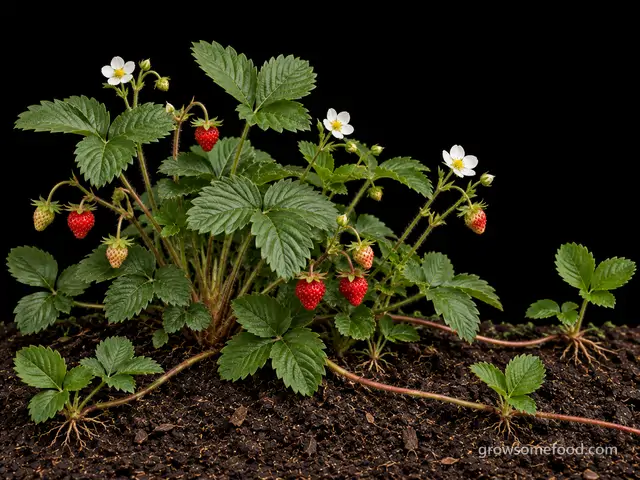
Wild strawberry forms low rosettes of three-part toothed leaves and sends out red runners that root new plantlets, carpeting the ground. It looks like a small garden strawberry - because it is one of its wild parents.
Months are typical seasonal windows; climate, variety, and plant age can shift them.
Harvest
- Small berries fully red, soft, and intensely fragrant (nodding, not upright) - the prime and brief ripe window
- White flowers earlier confirm true wild strawberry; leaves gathered any time for tea
- Pick the tiny red berries dead ripe · every 2 days
- Gather leaves for tea any time
Picking pick as they ripen
Cook with Wild Strawberry
Watch out for
3 to know. None are high-risk for Wild Strawberry. None are active in October.
Birds & WildlifeSeverity Medium WildlifeSeason: May–JulFruit disappearing from the outermost, most exposed parts of the plant first, and from the top of a tree where you cannot reach anyway.
The berries are prized by birds, chipmunks, mice, turtles, and other wildlife, which often strip a patch before a forager gathers much - a sign of the plant's ecological value as much as a nuisance. Check the patch daily at peak and pick promptly; net only a cultivated patch.
Fruit disappearing from the outermost, most exposed parts of the plant first, and from the top of a tree where you cannot reach anyway. Single neat pecks and gouges in ripening fruit, with several fruits sampled rather than one eaten through - the classic sign that it was birds rather than an animal. Heads of grain or seed going visibly lighter and emptier as they ripen, with hulls and chaff scattered underneath. Freshly sown seed vanishing off the surface of a bed before it germinates. Bird traffic in and out of the plant picking up as the crop colors, and birds waiting on nearby wires and branches. Wasps arriving at the pecked and split fruit shortly afterward.
There is no treatment once a crop is being taken - only protection and timing, so the answer is to get netting on and to pick what is ready. Reflective tape, flash ribbon, spinners, and decoy predators do work, but only for a few days at a time: birds habituate fast, so move and rotate them and never rely on them as the main defense for a crop you care about. Cut and gather grain or seed heads a little early, at firm dough, and finish drying them under cover instead of leaving them standing for the flocks. Plant a little extra, or a decoy crop the birds prefer, and accept sharing anything that crops heavily. On a wild or foraged patch, fruit going to birds and small mammals is the point of the plant rather than a problem to solve.
Net, and net early. Bird netting draped over a frame or hoops so it stands off the fruit, with the edges closed at ground level, is the only thing that reliably works at harvest scale - and it has to go on before the crop starts to color, because once birds have found the food they are far harder to displace. Keep fruit trees small enough that netting them is actually feasible; that decision gets made years earlier, at planting. Bags of mesh, organza, or paper slipped over individual heads, clusters, or prize fruit protect a small crop without netting the whole plant. Then shorten the exposure: pick promptly and completely rather than leaving ripe fruit hanging as a lure, clear split and dropped fruit that draws birds and wasps alike, and where a crop can finish off the plant, harvest a little early and ripen or dry it under cover. Rake in or cover broadcast seed so it is not lying in plain view.
Birds find ripening fruit and seed before you do. Robins, waxwings, starlings, catbirds, jays, sparrows, finches, blackbirds, and doves all work a garden, and the pressure arrives in a narrow window - the last days before harvest, when sugar rises, color changes, and the crop softens or the grain hardens. A flock can strip a small planting in a day or two, and birds that only peck rather than take whole fruit still leave wounds that rot or draw wasps. Squirrels, chipmunks, and other wildlife usually turn up on the same crop at the same time. This is competition rather than disease: the birds are not harming the plant, and a big tree or a heavy-cropping bush often has enough for everyone - but on a small planting it can be the difference between a harvest and none.
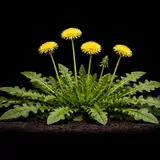
Confusion with Mock (Indian) StrawberrySeverity Low DisorderSeason: Apr–JulYELLOW flowers and UPRIGHT, watery, tasteless berries mark mock strawberry; true wild strawberry has WHITE flowers and nodding, fragrant, flavorful berries.
YELLOW flowers and UPRIGHT, watery, tasteless berries mark mock strawberry; true wild strawberry has WHITE flowers and nodding, fragrant, flavorful berries.
No harm either way (both are non-toxic); for actual flavor, gather from the white-flowered, fragrant-berried true wild strawberry.
Check flower color (white = true wild strawberry; yellow = mock) and look for fragrant, nodding, flavorful berries before investing patience in a patch.
Not a hazard (mock strawberry is harmless) but a common disappointment: wild strawberry is confused with the look-alike mock or Indian strawberry (Potentilla indica / Duchesnea indica), whose berries are edible but watery and completely flavorless.
Slugs & SnailsSeverity Low PestSeason: Apr, May, Jun, SepIrregular ragged holes chewed out of the middle of leaves and along the edges - not the clean-edged cuts a caterpillar leaves.
They chew the low berries and tender leaves, worst where the groundcover holds moisture near the soil. Harvest ripe berries promptly, and site it in enough sun and airflow to keep the foliage drier.
Irregular ragged holes chewed out of the middle of leaves and along the edges - not the clean-edged cuts a caterpillar leaves. Seedlings that vanish overnight, or that are cut off at soil level with nothing left behind. Silvery dried slime trails across leaves, soil, pots, and paving in the morning: this is the giveaway that tells you it was mollusks rather than an insect. Chewed pits in ripe fruit, especially where it rests on the ground. Damage that shows up on the lowest, dampest leaves first and gets worse after rain or evening watering. Turn over a board, an upturned pot, or a clump of dense mulch during the day and look for the animals themselves sheltering in the cool underneath.
Hand-picking works and costs nothing: go out an hour after dark with a headlamp, drop what you find into soapy water, and repeat nightly for a week or two - persistence is what wins, not any single product. Shallow beer traps sunk to soil level catch them too, but need emptying and refilling daily to be worth anything. Iron-phosphate bait is the standard control and is far lower-risk around pets and wildlife than the old metaldehyde products, but it is not harmless: many formulations include EDTA, and a dog that eats a quantity of pellets can develop iron toxicosis. Scatter it thinly per the label, never in piles, and keep dogs off a baited bed. Clear fallen foliage and debris in autumn, where the eggs are laid. In a wet climate this is a population you manage each season rather than one you eradicate - and on most established plants light grazing is cosmetic and needs nothing at all.
Take away the daytime shelter first: lift boards and upturned pots, clear piles of debris, keep dense mulch pulled back from crowns and stems, and give crowded plantings enough airflow to dry out. Water in the morning rather than the evening so the surface is dry by the time they come out. Copper tape around containers and raised beds gives them a shock they will not cross, and it is the one barrier that reliably works. Get plants past the vulnerable stage quickly - start seedlings in pots and set them out at a decent size rather than direct-sowing into a cold wet bed, since most plants stop being worth defending once the leaves toughen. Leave the ground beetles, frogs, toads, and ground-feeding birds alone, because they eat mollusks all night for free and broad-spectrum slug pellets kill them too. Where thick-leaved or resistant varieties exist for what you are growing, they take far less damage.
Slugs and snails are nocturnal mollusks that rasp ragged holes in soft leaves, shear off seedlings at ground level, and chew into ripe fruit that touches the soil. They feed at night and in the early morning and spend the day hidden under boards, pots, dense mulch, leaf litter, and low foliage, becoming active in exactly the cool, damp, shaded conditions that suit young plants. Damage is heaviest in wet spells and on tender spring growth: a single wet week can erase a row of seedlings while an established, tough-leaved plant of the same species is barely marked. They lay clusters of small pearly eggs in damp soil and under debris, so a garden with plenty of cover carries a resident population year after year rather than being invaded from outside.
Good & bad neighbors
Plant nearby
-
The cultivated garden strawberry is a hybrid bred FROM wild strawberry (F. virginiana crossed with F. chiloensis); growing the two together shows the tiny-but-intense wild parent beside its large-fruited descendant, and both share the same culture and pests.
- Traditional pairings, thin evidence
-
A classic low, nitrogen-fixing groundcover companion that knits into the same meadow and lawn edges as wild strawberry, feeding pollinators alongside the strawberry flowers and enriching the soil of a low-input edible groundcover mix.
-
Shares the same meadows and edges and flowers early for the pollinators that later set the strawberry fruit; a soft, traditional companion in a diverse edible groundcover or wild-food patch.
-
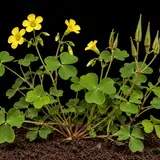
A small tangy edible often found in the same clearings and woodland edges; wood sorrel's lemony leaves and wild strawberry's sweet berries make a foraged pairing gathered on the same walk.
Varieties · 3
You pick one when you add Wild Strawberry to your garden. Its days to maturity set your harvest window.
Virginia wild strawberry (F. virginiana) 1 variety
Virginia Wild Strawberry (Fragaria virginiana)
The common North American wild strawberry: a spreading native groundcover of low three-part leaves and red runners, with white flowers and tiny, intensely flavored red berries.
Variety details for Virginia Wild Strawberry (Fragaria virginiana)
Low rosettes of toothed three-part leaves with red runners, white five-petaled flowers, and small nodding red berries.
speciesnativeediblegroundcoverOne of the wild parents of the cultivated garden strawberry; foraged and grown as an edible native groundcover.
Woodland / alpine strawberry (F. vesca) - a separate species 1 variety
Woodland Strawberry (Fragaria vesca)
A separate species, not a form of F.
Variety details for Woodland Strawberry (Fragaria vesca)
Small woodland plant with white flowers and slender, elongated, very fragrant red berries.
speciesnativeedibleeverbearingvirginiana: the circumboreal woodland strawberry, with slender, elongated fragrant berries over a much longer, often everbearing season. It is the wild plant behind cultivated alpine strawberries, comes readily from seed, and many strains make few or no runners - so treat its culture as its own rather than assuming this page's timing.
Beach strawberry (F. chiloensis) - a separate species 1 variety
Beach Strawberry (Fragaria chiloensis)
A separate species, not a form of F.
Variety details for Beach Strawberry (Fragaria chiloensis)
Low, spreading plant with thick, glossy, dark-green three-part leaves and white flowers.
speciesnativeediblecoastalvirginiana: a Pacific-coastal native with thick, glossy leaves and firm berries, adapted to sand, salt spray, and cool maritime fog. It is the OTHER wild parent (with F. virginiana) of the modern garden strawberry, and a tough edible groundcover for West Coast and cool maritime gardens - it does not perform in the humid heat of the inland South and Midwest.
Grower tips
Notes from growers, tagged with the zone they grow in. A person reads every post before it appears.
Nobody has posted about Wild Strawberry yet. The first one usually saves someone a season.
Free account. Your post shows your grower name and zone, never your email.