
Add it to your home screen and it opens full screen: no browser bars, one tap away, and everything stays signed in. Free, nothing to download from an app store.
- Tap the Share button in your browser
- Scroll down and choose “Add to Home Screen”
- Open GrowSomeFood from your home screen
- Open your browser’s menu
- Choose “Add to Home screen” or “Install app”
- Open GrowSomeFood from your home screen

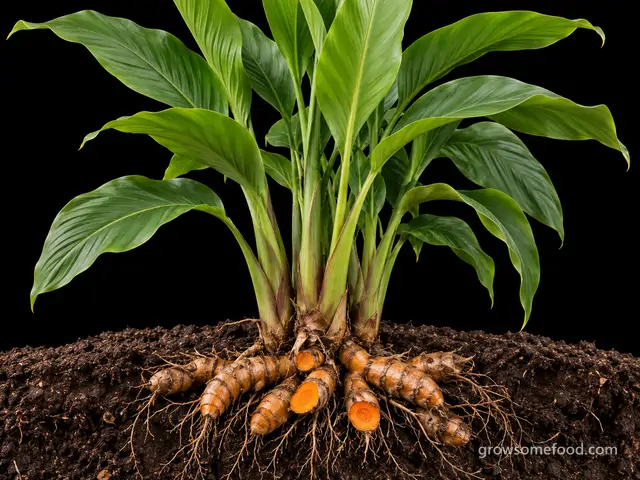
Turmeric
The golden spice: a tropical rhizome grown just like ginger but over an even longer 8-10 month season - a container crop in the North, an in-ground perennial in the tropics.
Safety notes The rhizome is the crop and is safe as food, spice, and tea. The vivid yellow-orange curcumin stains skin, cloth, and surfaces permanently - wear gloves. Plant only culinary/organic seed rhizomes. Do not confuse with unrelated ornamental Curcuma species grown only for flowers.
Overview
Turmeric is the source of the brilliant yellow-orange spice at the heart of curry powder, and a close cousin of ginger - same family, same growing method. You grow it from a piece of the rhizome: a chunk of organic seed turmeric with a couple of buds, planted shallow in warm, rich soil. It sends up broad, tropical, canna-like leaves two to four feet tall while building a knobby clump of vivid orange rhizome underground - the part you dry and grind into the familiar powder, or grate fresh.
The one thing to knowYou grow it from a piece of the rhizome: a chunk of organic seed turmeric with a couple of buds, planted shallow in warm, rich soil.
Quick facts
- Sprouts in
- 42 daysRange: 21–70 days
- Soil temperature
- 80 °FRange: 68–90 °F
- Height
- 36 inRange: 24–48 in
- Spread
- 18 inRange: 12–24 in
- Cold
- Killed by frostdamaged below 50°F
- Heat
- Struggles above 95°F
- Life cycle
- Grown as an annualBotanically a perennial
- Soil
- Well-drained
- Water
- High
- Plant spacing
- 12 inRange: 10–18 in
When to plant
Nothing is open today. Winter indoor sowing opens 2 months, Dec 31 to Feb 13.
- Start indoors Dec 31 – Feb 13 Opens in 73 daysAbout 14 weeks before to 8 weeks before your last frost (Apr 10 here)Pre-sprout seed turmeric indoors in warmth in late winter (cold zones start in January) to capture the full 8-10 month season, then grow on in large pots. In-ground overwintering is not possible here - it's a container/greenhouse crop.
- Transplant Apr 24 – May 22 Opens in 187 daysAbout 2 weeks after to 6 weeks after your last frost (Apr 10 here)Move pre-sprouted plants outdoors (large pots or ground) once soil holds above 65°F and nights stay above 55°F. The season is marginal for full maturity - protect at both ends and lift everything before frost.
Frost here: last around Apr 10 (Mar 27 to Apr 24 most years), first around Oct 25. Zone averages, your own yard may run a week or two either way.
Life stages
From the first start to harvest
Follow the growing sequence. Choose a stage to see its care and signs to watch for.
Stage 1 of 4 · The growing sequence
Sprouting (pre-sprout)
Day 0 to 50 from sowing
Care at this stage
-
Keep barely moist and very warm
Pre-sprout seed turmeric by half-burying rhizome pieces (each with 1-2 buds) in warm, barely-moist mix at 75-85°F. Turmeric is even slower than ginger to break ground - 3-10 weeks is normal. Too wet and cool means rot.
-
Cut and callus seed rhizomes before planting
Break seed turmeric into pieces with at least one bud (finger sections work well), and let the cut faces dry a day or two to reduce rot.
Stages can overlap; weather, variety, and growing conditions change the pace.
Harvest
- Foliage yellowed and dying back
- 8-10 months from planting for full color and curcumin
- Harvest before soil cools below 50°F or any frost
- Dig at 8-10 months once leaves die back, before cold
- Save firm rhizome pieces to replant
Per plant 1 clump, 8 to 40 ozPicking pull once
Cook with Turmeric
Watch out for
3 to know. 1 is high-risk: Root Rot. None are active in October.
Root RotSeverity High DiseaseSeason: Jun–SepWilting in the middle of the day on a plant whose soil is damp - the classic tell, and the reason people water a rotting plant and finish it off.
Plant firm, healthy, callused rhizome pieces into well-drained soil or fresh mix, and avoid overwatering in cool weather. No cure once the rhizome rots - discard affected plants and start clean with healthy stock next season.
Wilting in the middle of the day on a plant whose soil is damp - the classic tell, and the reason people water a rotting plant and finish it off. Leaves yellowing from the bottom up, dull off-color foliage, and growth that stalls for no visible reason. Whole shoots, or one side of the plant, collapsing while the rest still looks fine. Soft, dark, or mushy tissue at the base of the stem or at the crown, sometimes with a sour smell. Lift a failing plant and look at the roots: healthy ones are firm and pale, rotted ones are brown or black and slimy, and the outer layer slips off between your fingers leaving a thread of core behind. Seedlings that topple over at soil level are the same problem, called damping-off.
There is no cure for tissue that has already rotted, so act on the conditions rather than looking for a spray. Stop watering at once and fix the drainage - open up compacted soil, or move the plant to a raised, sharply drained position or a container. Lift a badly affected plant, cut away every soft dark root and rotted section with a clean blade back to firm pale tissue, and replant only the healthy parts into fresh free-draining soil or mix. Often the better move is to give up on the plant and save its offspring instead: cuttings, offsets, or divisions taken from firm healthy growth root readily and give you a clean start. Bin the rotted material rather than composting it, and correct the drainage before you replant, because the rot comes straight back in the same wet spot.
Drainage is the whole defense. Match the plant to the site first - something that wants sharp drainage will not survive heavy clay or a low, water-collecting spot however well you tend it. Where the ground is heavy, plant on a raised bed, berm, or slope, or grow in a container. Set plants at the depth they were already growing, since burying the crown or the root flare is a common cause of rot, and keep mulch pulled back a few inches from the stem base instead of piled against it. Water the soil rather than the calendar: check that the top inch or two is dry before watering again, cut back hard in cool weather and winter dormancy, and never leave a pot standing in a full saucer. Do not plant or dig in soggy ground, and go easy on rich amendments for plants that want it lean. Rotate annual crops, and start with clean healthy plants and fresh mix.
Root rot is not one organism but a group of soil fungi and water molds - Pythium, Phytophthora, Fusarium, Rhizoctonia and others - that sit harmlessly in most soils and only turn destructive when the ground stays saturated. Waterlogged soil drives the air out, the roots suffocate, and the weakened tissue is invaded and goes soft, brown, and stringy. Because the damage is underground you usually see it first as something that looks like drought: wilting, yellowing, stunting, a plant that does not respond to being watered. Overwatering, heavy compacted ground, a low spot that collects runoff, a pot with no drainage or a saucer left standing full, and cold wet soil in winter are the usual causes. Once roots have actually rotted there is no cure - this is a problem you prevent rather than treat.
Spider MitesSeverity Medium PestSeason: Feb–JulFine pale stippling or speckling across the upper leaf surface, as though the color had been sandblasted out of it, and later a dull bronze or rusty cast over the whole leaf.
On turmeric, spider mites are chiefly a problem during the long indoor pre-sprout and container phases in dry heated air - turmeric likes humidity anyway - and outdoor tropical turmeric rarely suffers them.
Fine pale stippling or speckling across the upper leaf surface, as though the color had been sandblasted out of it, and later a dull bronze or rusty cast over the whole leaf. Delicate webbing across leaf joints, shoot tips, and undersides - that comes with a heavy infestation and means you caught it late. Leaves that dry, curl, and drop early while the plant looks thirsty no matter how much you water it. Hold a leaf over a sheet of white paper and tap it: the specks that fall and then start walking are mites. With a hand lens, look on the undersides for the mites themselves, pale or reddish, and their round translucent eggs. Damage that shows up first on the hottest, dustiest, most sheltered side of a plant, or on a pot sitting near a radiator indoors.
Start with water. A strong jet aimed at the leaf undersides, repeated every few days for a couple of weeks, knocks populations down and breaks the cycle - on many plants that alone ends it. On anything that regrows quickly, shearing back badly infested growth resets the plant to clean foliage. If it keeps building, spray insecticidal soap or horticultural oil directly onto the undersides where the mites actually live, and repeat every five to seven days for three rounds: contact sprays do not kill the eggs, so a single application always fails. Anything you spray must be labeled for the plant you are treating - follow the label and observe its pre-harvest interval on anything you eat. Predatory mites are an effective release in a greenhouse or on an indoor plant. Above all, correct the heat, dust, and drought stress that caused it, or the mites simply come back.
Do not let plants get drought-stressed - that is the single strongest trigger, and a plant watered steadily through heat is far less likely to have a mite problem at all. Hose the foliage down, undersides included, during hot dry spells: it knocks mites off, washes away the dust they thrive in, and raises the humidity around the plant for a while. Indoors and under cover, keep the air from going hot, dry, and stagnant, wipe or rinse the leaves occasionally, and keep pots away from radiators and heating vents. Inspect any plant carefully before you bring it indoors for winter or set it among others, since mites almost always arrive on something else. Avoid broad-spectrum insecticides: they wipe out the predatory mites, lacewings, and lady beetles that do most of this work for you, and reliably leave you with a worse outbreak than you started with.
Spider mites are not insects but tiny sap-feeding arachnids, smaller than a grain of salt, and you almost always notice the damage before you notice them. They live on the undersides of leaves and drain the cells one at a time, which is why the leaf goes finely stippled with pale dots before it bronzes and dries. They breed explosively in hot, dry, dusty, still air - a generation can pass in a week at high temperature - so a barely visible population becomes a webbed, bronzed plant within a fortnight. Drought-stressed plants and plants wintered indoors in dry heated air are the classic hosts. Broad-spectrum insecticides make matters worse rather than better, because they kill the predatory mites and lady beetles that normally hold mites in check.
Root-Knot NematodesSeverity Medium PestSeason: Jun–SepStunted, yellowing, unthrifty plants that wilt in the heat even though the soil is moist, and poor yields for no obvious reason.
On turmeric the damage lands on the rhizome you are growing: galled, knotted, cracked and lumpy when dug, with the wounds inviting rhizome rot. Container growing in fresh mix largely sidesteps this pest - one more reason cold-zone growers use pots.
Stunted, yellowing, unthrifty plants that wilt in the heat even though the soil is moist, and poor yields for no obvious reason. Confirm by digging: beady swellings strung along the roots and side rootlets, and root crops that are forked, branched, cracked or knotted rather than clean.
There is no in-season cure. Pull and destroy affected plants rather than composting them, and bring that ground back over several seasons with rotation, resistant varieties and marigold cover crops. Where a crop can be grown in a container of fresh mix, that sidesteps the problem entirely.
Rotate to non-hosts, and grow resistant varieties where they exist for your crop. A French marigold cover crop grown thickly the season before and turned in genuinely lowers populations. Build organic matter and mulch heavily, which feeds the soil life that suppresses them. Plant only clean stock, never move soil from an infested bed around the garden, and solarize badly infested ground through the hottest part of summer.
Microscopic soil roundworms (Meloidogyne species) that invade roots and force them to swell into beady galls. A galled root cannot take up water and nutrients properly, so the plant stunts, yellows, wilts in heat despite watering, and yields poorly, and root and tuber crops come up forked, knobbly, hairy or cracked instead of clean. They are worst in warm, sandy soils and build up steadily wherever a susceptible crop is grown in the same ground year after year. The wounds they leave also open the way for fusarium wilt and rots.
Good & bad neighbors
Plant nearby
-
A near-identical culture (same family, same warmth, moisture, and part-shade needs) makes them natural bedmates or potmates on the same long season.
- Traditional pairings, thin evidence
-
Shares turmeric's tropical, moist, warm preferences and pairs with it in the kitchen; an easy neighbor in warm-zone beds.
-
Nitrogen-fixing legumes can share the bed and feed the long-season, hungry turmeric; keep them from shading it out.
-
Compatible warm-season heat lovers and kitchen partners; turmeric's low, part-shade habit tucks beneath taller crops.
-
Tolerates the dappled shade around turmeric and is a natural culinary partner; let some flower to draw beneficials.
Varieties · 5
You pick one when you add Turmeric to your garden. Its days to maturity set your harvest window.
Hawaiian Red
A popular, vigorous culinary turmeric with reddish-brown skin and deep orange, high-curcumin flesh - flavorful and productive, and one of the more available seed types for home growers.
Variety details for Hawaiian Red
Reddish-skinned rhizomes with vivid deep-orange interior.
orange-fleshhigh-curcuminculinarywidely-grownA strong default for cooking and drying.
White Mango
A milder, aromatic turmeric with pale yellow-to-cream flesh and a fresh, fruity, mango-like fragrance, prized for fresh eating, pickles, and teas where a gentler flavor and less staining are wanted.
Variety details for White Mango
Tan rhizomes with pale creamy-yellow, lightly aromatic flesh.
pale-fleshmildaromaticculinaryBKK (Bangkok)
A Thai-type turmeric known for productive clumps of well-colored orange rhizomes and reliable performance, favored where growers want good yields of classic cooking turmeric.
Variety details for BKK (Bangkok)
Plump rhizomes with strong orange flesh in dense clumps.
orange-fleshproductiveculinaryIndira Yellow
A vigorous yellow-fleshed turmeric that produces heavy clumps of rhizome over a full season, a dependable choice for a good main crop of cooking and drying turmeric.
Variety details for Indira Yellow
Golden-yellow-fleshed rhizomes in large, branching clumps.
yellow-fleshvigorousculinaryMadras
A classic South Indian culinary type with bright orange, well-colored flesh and the familiar earthy flavor of standard cooking turmeric - a benchmark for curry powders and dried spice.
Variety details for Madras
Bright orange-fleshed rhizomes with strong color for drying.
orange-fleshclassicculinaryhigh-color
Grower tips
Notes from growers, tagged with the zone they grow in. A person reads every post before it appears.
Nobody has posted about Turmeric yet. The first one usually saves someone a season.
Free account. Your post shows your grower name and zone, never your email.