
Add it to your home screen and it opens full screen: no browser bars, one tap away, and everything stays signed in. Free, nothing to download from an app store.
- Tap the Share button in your browser
- Scroll down and choose “Add to Home Screen”
- Open GrowSomeFood from your home screen
- Open your browser’s menu
- Choose “Add to Home screen” or “Install app”
- Open GrowSomeFood from your home screen

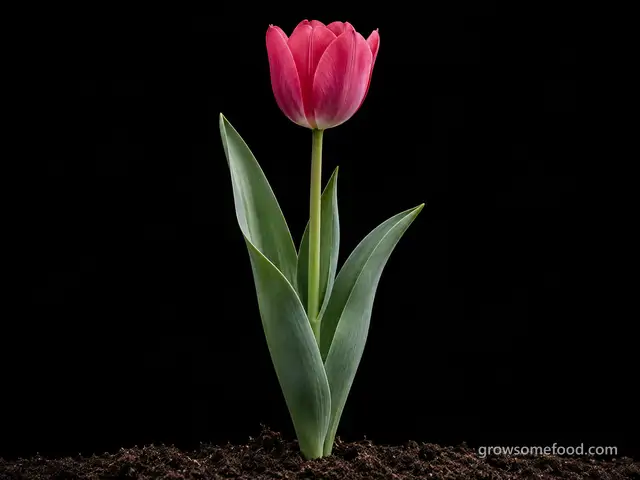
Tulip
The iconic spring bulb: plant pointy-end-up in fall, chill through winter, and get a rainbow of goblet blooms in spring - but in warm climates they need pre-chilling and are grown as one-season annuals.
Safety notes TOXIC - tulip bulbs contain tulipalin and related glycosides and must never be eaten; they have been mistaken for onions and shallots, causing poisoning, so keep them out of the kitchen and away from children and pets. Handling large quantities of bulbs can cause 'tulip fingers,' an itchy contact dermatitis - wear gloves. Bulbs and foliage are toxic to cats, dogs, and livestock.
Overview
Tulips are the signature flower of spring - sleek goblet-shaped blooms in every color but true blue, from prim single cups to frilled Parrot and Fringed forms. You plant the bulbs in fall, they root and chill through winter, and they burst into bloom from late winter to May depending on type and climate. Few plantings deliver as much color per dollar or make as classic a cut flower.
The one thing to knowYou plant the bulbs in fall, they root and chill through winter, and they burst into bloom from late winter to May depending on type and climate.
Quick facts
- Winter chill
- 2200 hours below 45°FRange: 1600–2700 hours
- Height
- 16 inRange: 6–28 in
- Spread
- 5 inRange: 3–8 in
- Cold
- Takes hard frostdamaged below -30°F
- Heat
- Struggles above 80°F
- Life cycle
- Perennial, lives about 3 years
- Soil
- Well-drained
- Water
- Medium
- Plant spacing
- 5 inRange: 4–6 in
When to plant
Nothing is open today. Fall planting opens 11 months, Sep 13 to Oct 18.
- Plant tubers Sep 13 – Oct 18 Opens in 329 daysAbout 6 weeks before to 7 days before your first frost (Oct 25 here)Plant 2-6 weeks before the ground freezes so bulbs root before winter; fall planting is the only option in cold zones. Perennializing types (Darwin Hybrids, species tulips) return best here.
Frost here: last around Apr 10 (Mar 27 to Apr 24 most years), first around Oct 25. Zone averages, your own yard may run a week or two either way.
Life stages
Establish, grow, repeat
Getting established and returning each season are different parts of the story.
Stage 1 of 5 · Getting established
Fall rooting-in
Day 0 to 40 from planting
Care at this stage
-
Water in once at planting
Plant bulbs pointy-end-up 6-8 inches deep and 4-6 inches apart in well-drained soil, and water once to settle them and trigger rooting before the ground freezes.
-
Guard against squirrels and rodents
Squirrels, voles, and chipmunks dig up and eat freshly planted tulip bulbs. Lay wire mesh over the bed, plant deeper, or interplant with daffodils (which they avoid) to deter them.
Months are typical seasonal windows; climate, variety, and plant age can shift them.
Watch out for
4 to know. 2 are high-risk: Squirrels & Rodents, Tulip Fire (Botrytis Blight). 1 is active in October.
Squirrels & RodentsSeverity High WildlifenowSeason: Mar, Apr, Sep, Oct, NovChewed husks, shells or hulls scattered under the plant, fruit and nuts vanishing as they ripen, and gnawed or half-eaten windfalls.
A leading reason a fall tulip planting simply never comes up. Tulips get eaten where daffodils do not, so interplanting with daffodils, meshing the bed and planting deeper all help; in rodent-heavy gardens, grow them in buried wire baskets or in pots. Repellents give only partial, temporary protection.
Chewed husks, shells or hulls scattered under the plant, fruit and nuts vanishing as they ripen, and gnawed or half-eaten windfalls. On new plantings: freshly dug holes and scattered soil, bulbs missing or gnawed, dug-up seed rows, vole runways under the mulch, and gaps in spring where you know you planted.
There is no rescue for what has already been eaten, so this is a prevention problem. Re-cover disturbed plantings with mesh promptly, replant losses inside cages, and trap or exclude persistent diggers where that is legal locally. On a large tree, accept that you will share the crop and concentrate on gathering promptly.
For a crop on the plant, timely and frequent harvest is the real defense - gather daily through the ripening window rather than leaving anything to hang, and pick slightly early to finish indoors where the crop allows it. Net or bag what you can reach. For bulbs and sown seed, lay wire mesh or hardware cloth over the planting, plant deeper, use buried wire baskets, and clear away the papery tunics and debris that advertise a fresh planting. Trunk baffles slow climbers on isolated trees, clearing jumping routes from nearby trees and roofs helps, and removing brush cover reduces the rodents sheltering nearby.
Squirrels, chipmunks, voles and mice are the wildlife that competes with you most directly for a crop. They take ripening nuts, seed and fruit off the plant, usually before you judge it ready, and cache what they do not eat. They also dig up freshly planted bulbs and sown seed, and voles tunnel in to gnaw bulbs and roots underground through winter. They climb anything, they know exactly when a crop is ripe, and a determined pair can clear a small tree or a new planting in a few days.
Tulip Fire (Botrytis Blight)Severity High DiseaseSeason: Mar–MayTwisted, withered, scorched-looking shoots ('fire'), brown-and-gray spotting on leaves and petals, gray fuzzy mold on buds and stems, blasted flowers that never open, especially in wet springs.
The signature, most serious tulip disease; soil-borne persistence makes crop rotation away from the infected bed essential.
Twisted, withered, scorched-looking shoots ('fire'), brown-and-gray spotting on leaves and petals, gray fuzzy mold on buds and stems, blasted flowers that never open, especially in wet springs.
No cure once a plant is infected - remove and destroy affected plants (do not compost). Preventive fungicides help in wet climates; the durable fix is clean bulbs, sharp drainage, and rotation.
Plant only clean, firm bulbs; ensure good drainage and airflow; avoid overhead watering; remove and destroy infected foliage; and rotate tulips to a fresh bed - do not replant tulips in an infected spot for 2-3 years.
A fungal disease (Botrytis tulipae) specific to tulips, thriving in cool wet spring weather. It scorches and distorts leaves and buds and coats them in gray mold, and it overwinters as sclerotia in the soil and on bulbs - so it recurs in the same bed year after year.
AphidsSeverity Medium PestSeason: Mar–MayDense clusters of tiny insects packed onto shoot tips, flower buds, and the undersides of young leaves.
On tulips the feeding matters less than what aphids carry: they spread TULIP BREAKING VIRUS from plant to plant, which is what produces the streaked and flamed 'broken' petals - beautiful, but it weakens the bulb. Rogue out any streaked plant, and check bulbs in storage, where aphids also colonise them.
Dense clusters of tiny insects packed onto shoot tips, flower buds, and the undersides of young leaves. Curled, cupped, or distorted new growth that never opens properly. A sticky shine on the leaves - and on whatever sits under the plant - that later goes black with sooty mold. Tiny white cast skins left behind where a colony has been feeding. Ants running steadily up and down the stems, which is often the first thing you notice. Mottled, streaked, or misshapen leaves that do not grow out can mean a virus the aphids brought with them rather than the feeding itself.
Knock the colonies off with a hard jet of water and repeat every few days - on most plants that alone ends it. Pinch out or prune off the worst-infested tips rather than treating the whole plant. If colonies keep rebuilding, spray insecticidal soap or horticultural oil directly onto the insects, covering leaf undersides, and repeat weekly until they are gone; treat early or late in the day, and never spray a wilted or heat-stressed plant. Avoid broad-spectrum insecticides - they kill the ladybugs, lacewings, and parasitic wasps that were about to solve the problem for you, and aphid numbers usually come back worse afterward. Anything you spray must be labeled for the plant you are treating; follow that label and observe its pre-harvest interval. On anything you eat, wash leaves, heads, and buds well before use, since aphids hide down in crowns, folds, and tight growth.
Go easy on nitrogen: the soft, lush growth that heavy feeding produces is exactly what aphids breed on. Check new growth once a week through spring and early summer so you catch colonies while they are still small, and rub the first few out with your fingers. Leave flowering plants nearby and skip broad-spectrum sprays - ladybugs, lacewings, hoverflies, and parasitic wasps do most of this work for free, and they only stay if there is something for them to eat. Keep ants off the plant where you can, since they protect aphids from those predators. Water steadily so plants are not stressed, and check any new plant over before you bring it home or move it indoors, since aphids usually arrive on something else.
Aphids are small soft-bodied sap-suckers - green, black, gray, pink, or waxy white, and mostly wingless - that gather in dense colonies on the tenderest new growth: shoot tips, buds, and the undersides of young leaves. They breed extremely fast in mild weather, so a few can become hundreds inside a week. Their feeding curls and distorts soft growth, and the sticky honeydew they excrete coats everything below and turns black with sooty mold. Ants often farm and defend the colonies for that honeydew. A few aphids are normal on almost any plant and a healthy plant shrugs them off; only dense, persistent colonies do real damage, and some aphids also spread plant viruses as they feed.
Gray Mold (Botrytis)Severity Medium DiseaseSeason: Apr–JunBrowned, collapsed flowers and buds; soft, water-soaked brown patches on leaves, stems or fruit; and a dusty gray-brown fuzz over the dead tissue.
This is ordinary gray mold on fading flowers, damaged leaves and stored bulbs - distinct from Tulip Fire, the tulip-specific Botrytis tulipae, though the two are managed the same way. Cure and store bulbs dry.
Browned, collapsed flowers and buds; soft, water-soaked brown patches on leaves, stems or fruit; and a dusty gray-brown fuzz over the dead tissue. Rot jumping between two pieces of fruit or two petals that touch is the signature, and it often shows up again in the fridge or the storage box days later.
Cut out and destroy infected tissue as soon as it appears, and bag it rather than composting it. Harvest ahead of a prolonged wet spell and store the crop dry and cold. Protective fungicides help through long damp weather, but airflow and sanitation do most of the work.
Space and prune for airflow, water at the base rather than over the top, and go easy on nitrogen, which produces the soft growth it prefers. Clear dead leaves, spent flowers and rotting fruit at every pass, since that debris is where it overwinters. Handle fruit, buds and bulbs gently, because it enters through bruises, and cure and store anything you keep dry and well ventilated.
Botrytis cinerea and its relatives - the fuzzy gray-brown mold of cool, wet, humid weather. It blights flowers and buds, rots ripening fruit, and moves into soft, aging, bruised or frost-damaged tissue through the smallest wound, coating whatever it kills in dusty gray spores. It overwinters on dead plant debris, spreads on air currents and by direct contact between touching tissue, and keeps working after harvest, which is why it also ruins fruit and bulbs in storage.
Good & bad neighbors
Plant nearby
-
The classic spring-bulb pairing with identical fall planting and overlapping bloom; daffodils' toxicity to rodents helps protect the tulip bulbs squirrels and voles love to dig.
-
Low blue muscari make a beautiful carpet beneath a stand of tulips and bloom at the same time in the same conditions.
-
Cool-season pansies underplant tulips in beds and containers, filling the ground while the tulip stems rise - a standard spring bedding combination.
- Traditional pairings, thin evidence
-
Low sweet alyssum froths around tulip bases and, unlike the tulips, draws pollinators - a soft filler for bed and container plantings.
-
Earlier-blooming small bulb that opens the spring display before tulips; same well-drained, sunny fall-planted culture.




Varieties · 10
You pick one when you add Tulip to your garden. Its days to maturity set your harvest window.
Darwin Hybrid
The most reliably PERENNIAL of the big tulips: large, classic egg-shaped blooms on tall, strong 20-28 inch stems in vivid reds, yellows, oranges, and pinks (Apeldoorn, Golden Apeldoorn, Pink Impression).
Variety details for Darwin Hybrid
Large, rounded, glossy blooms on tall sturdy stems in bright saturated colors.
darwin-hybridperennializinglarge-floweredsturdyThe best choice if you want tulips that come back for several years, and superb for cutting. Mid-spring.
Triumph
The largest and most versatile class: the quintessential tulip shape on sturdy medium stems (16-20 inches) in the widest range of colors and bicolors.
Variety details for Triumph
Classic single goblet blooms on medium stems in a huge range of colors.
triumphclassic-formmid-seasoncut-flowerThe florist's and bedding standard, blooming mid-spring; good for cutting but only moderately perennial.
Parrot
The flamboyant tulips: large blooms with twisted, curled, feather-cut petals often streaked and flamed in two or three colors, looking almost tropical.
Variety details for Parrot
Large ruffled, twisted, feather-edged petals streaked in bold color combinations.
parrotfrilledruffledshowyLate-blooming, spectacular, and dramatic in the vase; stems can be floppy, so shelter from wind.
Fringed (Crispa)
Tulips edged with a delicate crystalline fringe along the petal tops, as if dusted with sugar, in many colors.
Variety details for Fringed (Crispa)
Single blooms rimmed with a fine ice-crystal fringe along the petal edges.
fringedcrystalline-edgenoveltycut-flowerA refined, textural novelty class that's excellent and long-lasting as a cut flower.
Species / Botanical
The small wild tulips (Tulipa tarda, T.
Variety details for Species / Botanical
Small, often star-shaped or two-toned early blooms on short stems.
specieswildmost-perennializingnaturalizingclusiana, T. bakeri, greigii and kaufmanniana types): short (4-10 inch), early-blooming, star- or cup-shaped, and by far the MOST perennial and naturalizing tulips - they spread into drifts and tolerate marginal conditions better than hybrids. The choice for a permanent, low-maintenance planting and the warmest zones tulips are worth trying.
Emperor (Fosteriana)
The Fosteriana or 'Emperor' tulips (Red Emperor/Madame Lefeber, Orange Emperor, White Emperor): very large blooms on strong stems that open early and perennialize better than most big hybrids.
Variety details for Emperor (Fosteriana)
Very large single blooms on sturdy stems, opening early and wide in the sun.
fosterianalarge-earlyperennializingsturdyA good reliable early-season large tulip.
Grower tips
Notes from growers, tagged with the zone they grow in. A person reads every post before it appears.
Nobody has posted about Tulip yet. The first one usually saves someone a season.
Free account. Your post shows your grower name and zone, never your email.