
Add it to your home screen and it opens full screen: no browser bars, one tap away, and everything stays signed in. Free, nothing to download from an app store.
- Tap the Share button in your browser
- Scroll down and choose “Add to Home Screen”
- Open GrowSomeFood from your home screen
- Open your browser’s menu
- Choose “Add to Home screen” or “Install app”
- Open GrowSomeFood from your home screen

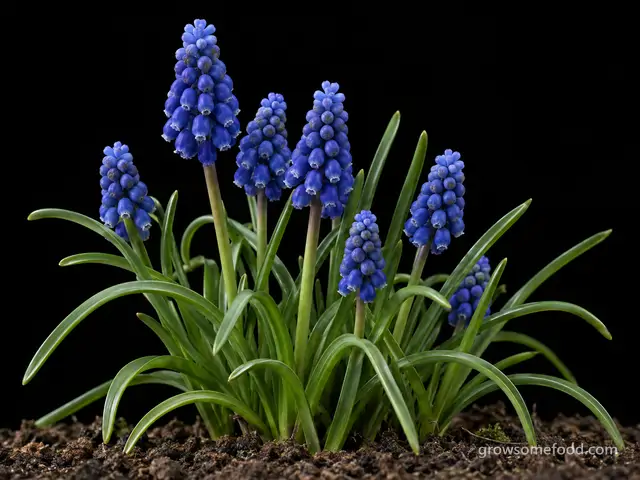
Grape Hyacinth
The little cobalt-blue spring bulb that plants itself into rivers of blue - fragrant, bee-friendly, and nearly indestructible - so easy and prolific that its main trait, self-sowing, is also its main caution.
Safety notes Grown as an ornamental spring bulb and not for eating - like other members of the family it contains saponins and is mildly toxic if ingested, and can upset pets. (The unrelated tassel hyacinth, Muscari comosum / Leopoldia, has edible bulbs eaten pickled in parts of the Mediterranean, but ordinary garden grape hyacinth is treated here as non-edible.) Handling is safe.
Overview
Grape hyacinth (Muscari) is one of spring's great small pleasures: dense little spikes of tiny urn-shaped flowers, most often a vivid cobalt blue (also white, sky blue, and purple), carrying a light grape or musky fragrance and lifting in mid-spring just as the tulips and daffodils get going. Cheap, tiny, and planted by the dozens or hundreds, muscari are the classic bulb for drifts, edging, and the famous 'blue river' plantings that snake through public gardens - and they're a valuable early nectar source for bees.
Quick facts
- Winter chill
- 450 hours below 45°FRange: 200–800 hours
- Height
- 7 inRange: 4–10 in
- Spread
- 3 inRange: 2–5 in
- Cold
- Takes hard frostdamaged below -30°F
- Heat
- Struggles above 85°F
- Life cycle
- Perennial, lives about 10 years
- Self-sows
- Yes, expect volunteers
- Soil
- Well-drained
- Water
- Low
- Plant spacing
- 3 inRange: 2–4 in
When to plant
Nothing is open today. Fall planting opens 10 months, Aug 30 to Oct 4.
- Plant tubers Aug 30 – Oct 4 Opens in 315 daysAbout 8 weeks before to 3 weeks before your first frost (Oct 25 here)Plant bulbs 3 inches deep in fall, several weeks before hard freeze, in sun to part shade and well-drained soil. Expect grassy leaves to emerge in fall and overwinter - that's normal for muscari.
Frost here: last around Apr 10 (Mar 27 to Apr 24 most years), first around Oct 25. Zone averages, your own yard may run a week or two either way.
Life stages
Establish, grow, repeat
Getting established and returning each season are different parts of the story.
Stage 1 of 4 · Getting established
Fall rooting-in
Day 0 to 45 from planting
Care at this stage
-
Plant bulbs 3 inches deep and water once
Plant grape hyacinth bulbs in fall, pointed end up, about 3 inches deep and 3 inches apart in well-drained soil. Water once to start rooting. A curious, useful trait: their grassy leaves come up in FALL and stay all winter - a normal habit, not a problem, marking where they are.
-
Don't panic at fall foliage
Unlike most spring bulbs, muscari send up leaves in autumn that persist through winter. This is normal and helps them bloom early; just leave the foliage be.
Months are typical seasonal windows; climate, variety, and plant age can shift them.
Watch out for
3 to know. None are high-risk for Grape Hyacinth. None are active in October.
Aggressive Self-Sowing & SpreadSeverity Medium DisorderSeason: Apr–JunSeedlings and new clumps appearing well beyond the original planting, muscari spreading into lawns and adjacent beds, and dense congested clumps forming over a few years.
Seedlings and new clumps appearing well beyond the original planting, muscari spreading into lawns and adjacent beds, and dense congested clumps forming over a few years.
Dig out unwanted clumps completely (small bulbs left behind resprout), keep deadheading to stop new seed, and expect to repeat - established muscari is persistent, so containment rather than eradication is the realistic goal.
Deadhead spent spikes before they set seed, plant only where a spreading drift is welcome, and lift stray clumps promptly; avoid introducing it to tidy formal beds or near wild areas.
Not a pest but the defining trait to manage: grape hyacinth multiplies by offset bulbs and self-sows heavily from seed, naturalizing into spreading sheets that colonize lawns, beds, and neighboring ground. Charming as a drift, weedy where unwanted and hard to fully remove once established.
AphidsSeverity Low PestSeason: Mar–MayDense clusters of tiny insects packed onto shoot tips, flower buds, and the undersides of young leaves.
Dense clusters of tiny insects packed onto shoot tips, flower buds, and the undersides of young leaves. Curled, cupped, or distorted new growth that never opens properly. A sticky shine on the leaves - and on whatever sits under the plant - that later goes black with sooty mold. Tiny white cast skins left behind where a colony has been feeding. Ants running steadily up and down the stems, which is often the first thing you notice. Mottled, streaked, or misshapen leaves that do not grow out can mean a virus the aphids brought with them rather than the feeding itself.
Knock the colonies off with a hard jet of water and repeat every few days - on most plants that alone ends it. Pinch out or prune off the worst-infested tips rather than treating the whole plant. If colonies keep rebuilding, spray insecticidal soap or horticultural oil directly onto the insects, covering leaf undersides, and repeat weekly until they are gone; treat early or late in the day, and never spray a wilted or heat-stressed plant. Avoid broad-spectrum insecticides - they kill the ladybugs, lacewings, and parasitic wasps that were about to solve the problem for you, and aphid numbers usually come back worse afterward. Anything you spray must be labeled for the plant you are treating; follow that label and observe its pre-harvest interval. On anything you eat, wash leaves, heads, and buds well before use, since aphids hide down in crowns, folds, and tight growth.
Go easy on nitrogen: the soft, lush growth that heavy feeding produces is exactly what aphids breed on. Check new growth once a week through spring and early summer so you catch colonies while they are still small, and rub the first few out with your fingers. Leave flowering plants nearby and skip broad-spectrum sprays - ladybugs, lacewings, hoverflies, and parasitic wasps do most of this work for free, and they only stay if there is something for them to eat. Keep ants off the plant where you can, since they protect aphids from those predators. Water steadily so plants are not stressed, and check any new plant over before you bring it home or move it indoors, since aphids usually arrive on something else.
Aphids are small soft-bodied sap-suckers - green, black, gray, pink, or waxy white, and mostly wingless - that gather in dense colonies on the tenderest new growth: shoot tips, buds, and the undersides of young leaves. They breed extremely fast in mild weather, so a few can become hundreds inside a week. Their feeding curls and distorts soft growth, and the sticky honeydew they excrete coats everything below and turns black with sooty mold. Ants often farm and defend the colonies for that honeydew. A few aphids are normal on almost any plant and a healthy plant shrugs them off; only dense, persistent colonies do real damage, and some aphids also spread plant viruses as they feed.
Bulb RotSeverity Low DiseaseSeason: Jun, Jul, Nov, DecBulbs soft, discolored, or moldy when lifted; clumps thinning or failing to emerge, worst in heavy or waterlogged soil.
Grape hyacinth is hard to kill any other way, so soggy ground is the main risk. It needs a dry summer rest; a bed that stays wet through dormancy softens the bulbs, and the clump thins or fails to reappear with the fall foliage.
Bulbs soft, discolored, or moldy when lifted; clumps thinning or failing to emerge, worst in heavy or waterlogged soil.
There is no cure once a bulb has rotted - lift and discard the affected ones, keep the firm bulbs, and replant into sharper-draining ground.
Plant into well-drained soil, avoid standing water over the dormant season, don't overwater, and discard any soft bulbs at planting time.
Soil-borne fungal and water-mold rots that destroy dormant bulbs in wet, heavy, or poorly drained ground. The bulbs soften and simply fail to sprout - usually the only way a tough bulb is lost.
Good & bad neighbors
Plant nearby
-
Both low early bulbs for the front of the border or a naturalized drift, overlapping in blues and purples; crocus opens a touch earlier and muscari carries the blue on - though both self-sow, so site where spread is welcome.
-
A classic pairing: low blue muscari underplant a drift of daffodils beautifully, blooming at the same time and echoing the yellow-and-blue spring palette; both share sun and sharp drainage.
-
The iconic combination - a carpet of cobalt muscari beneath taller tulips, both fall-planted in sun and good drainage, the muscari 'river' setting off the tulip color above.
- Traditional pairings, thin evidence
-
Lawn / Turf (naturalizing)Muscari naturalize into lawns and rough grass for a spring blue carpet - but their vigorous self-sowing means they can spread beyond the intended patch, so use where that's wanted and mow only after foliage ripens.
Varieties · 5
You pick one when you add Grape Hyacinth to your garden. Its days to maturity set your harvest window.
Armenian Grape Hyacinth (Muscari armeniacum)
The classic and most-planted muscari: dense spikes of vivid cobalt-blue urn-shaped florets rimmed in white, lightly grape-scented, blooming in mid-spring.
Variety details for Armenian Grape Hyacinth (Muscari armeniacum)
Tight spikes of cobalt-blue white-rimmed florets on 6-8 inch stems.
cobalt-bluenaturalizingfragrantclassicThe bulb behind the great 'blue river' plantings - vigorous, cheap, and the definitive naturalizer (and the readiest self-sower). 'Valerie Finnis' is a soft powder-blue selection.
White Grape Hyacinth ('Album' / M. botryoides 'Album')
The pure-white grape hyacinth: spikes of tidy white florets like tiny strings of pearls, lovely drifted among the blues or on its own for a crisp spring effect.
Variety details for White Grape Hyacinth ('Album' / M. botryoides 'Album')
Spikes of small round pure-white florets resembling strings of pearls.
whitenaturalizingfragrantclassicA little less aggressive than armeniacum but still naturalizes.
Muscari latifolium
A striking two-tone species: each spike carries dark blackish-violet fertile florets below and a topknot of bright sky-blue sterile florets above, giving a two-color 'bicolor' look.
Variety details for Muscari latifolium
Spikes with deep violet-black lower florets capped by pale sky-blue upper ones.
two-tonesingle-leafdistinctless-aggressiveBroader single leaf, more restrained spreading, and a connoisseur's muscari.
'Pink Sunrise'
An unusual soft-pink grape hyacinth, a novelty color among the sea of blues: pale pink spikes for something different in the spring drift.
Variety details for 'Pink Sunrise'
Spikes of soft pale-pink urn-shaped florets on short stems.
pinkunusual-colornoveltynaturalizingLess common and often less vigorous than the blues, but a charming surprise.
Muscari 'Ocean Magic'
A modern two-tone selection with spikes shading from deeper blue at the base to pale, almost white blue at the tips, giving each flower spike a soft gradient.
Variety details for Muscari 'Ocean Magic'
Spikes graduating from mid-blue at the bottom to nearly white-blue at the top.
two-toneblue-gradientmodernshowyA showy, slightly more refined muscari for feature drifts.
Grower tips
Notes from growers, tagged with the zone they grow in. A person reads every post before it appears.
Nobody has posted about Grape Hyacinth yet. The first one usually saves someone a season.
Free account. Your post shows your grower name and zone, never your email.