
Add it to your home screen and it opens full screen: no browser bars, one tap away, and everything stays signed in. Free, nothing to download from an app store.
- Tap the Share button in your browser
- Scroll down and choose “Add to Home Screen”
- Open GrowSomeFood from your home screen
- Open your browser’s menu
- Choose “Add to Home screen” or “Install app”
- Open GrowSomeFood from your home screen

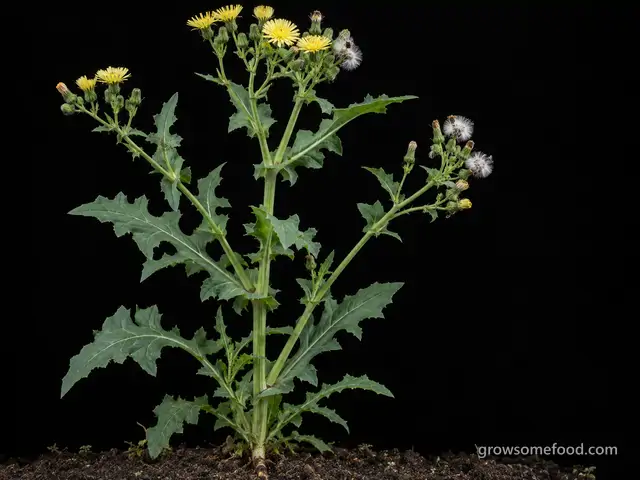
Sow Thistle
The mild, lettuce-like cousin of dandelion - a soft-prickly, milky-sapped 'weed' that is one of the gentlest foraged greens there is, free for the picking on any disturbed ground.
Safety notes Sow thistle is a safe, mild, non-toxic edible - young leaves raw or cooked (milder and more lettuce-like than dandelion), and the flower buds too. Its soft-prickly leaf edges are harmless and soften when cooked, and the MILKY SAP it exudes when cut is harmless. Distinguish it from prickly lettuce and true thistles, and from the toxic non-spiny yellow composites of the same ground, common groundsel and tansy ragwort, which have NO milky sap. Forage only from herbicide-free ground.
Overview
Sow thistle (Sonchus oleraceus) is a tall, soft-leaved daisy-family weed that most people pull from their gardens without realizing it is one of the mildest and most pleasant wild greens around. Its name is misleading: it is not a fierce spiky thistle at all - the leaf edges are only soft-prickly (harmless, and softening completely when cooked), and the plant is closer to a wild lettuce or a gentle dandelion. It is sometimes wrongly called 'milk thistle' for the white sap it bleeds, but true milk thistle is Silybum marianum, an unrelated and genuinely spiny plant; the two are not interchangeable. The young leaves and tender tips are genuinely tasty raw or cooked, milder than dandelion and without its punishing bitterness.
The one thing to knowSow thistle (Sonchus oleraceus) is a tall, soft-leaved daisy-family weed that most people pull from their gardens without realizing it is one of the mildest and most pleasant wild greens around.
Quick facts
- Sprouts in
- 10 daysRange: 5–18 days
- Soil temperature
- 65 °FRange: 50–78 °F
- Height
- 36 inRange: 12–60 in
- Spread
- 14 inRange: 8–20 in
- Cold
- Takes light frostdamaged below 5°F
- Heat
- Struggles above 95°F
- Life cycle
- Annual
- Save seeds
- About 60 days after plantingRange: 45–80 days
- Self-sows
- Yes, expect volunteers
- Soil
- Well-drained
- Water
- Medium
- Plant spacing
- 10 inRange: 6–16 in
When to plant
Nothing is open today. Spring sowing opens 5 months, Mar 27 to May 22.
- Direct sow Mar 27 – May 22 Opens in 158 daysAbout 2 weeks before to 6 weeks after your last frost (Apr 10 here)If growing on purpose, direct-sow in cool spring soil for tender mild greens; far more often it volunteers abundantly on disturbed, cultivated ground and needs no sowing.
- Direct sow Aug 30 – Oct 11 Opens in 314 daysAbout 8 weeks before to 2 weeks before your first frost (Oct 25 here)Fall sowing gives mild cool-season greens; in mild climates sow thistle grows through much of the cool season.
Frost here: last around Apr 10 (Mar 27 to Apr 24 most years), first around Oct 25. Zone averages, your own yard may run a week or two either way.
Life stages
From the first start to harvest
Follow the growing sequence. Choose a stage to see its care and signs to watch for.
Stage 1 of 3 · The growing sequence
Seedling rosette
Day 0 to 30 from sowing
Care at this stage
-
Recognize the soft, lobed rosette
Sow thistle starts as a rosette of soft, deeply lobed, dandelion-like leaves with soft-prickly (not sharp) edges, clasping bluish leaf bases, and milky sap when cut. It comes up readily on disturbed, cultivated ground. The young rosette is the best eating.
Stages can overlap; weather, variety, and growing conditions change the pace.
Harvest
- Young, tender leaves and growing tips before the plant bolts tall and flowers
- Unopened flower buds for cooking; harvest before it sets wind-borne seed
- Snip young leaves and tender tops · every 10 days
- A mild, easygoing green
Picking cut and it regrows
Cook with Sow Thistle
Watch out for
3 to know. None are high-risk for Sow Thistle. 2 are active in October.
Herbicide / Pollution ContaminationSeverity Medium DisordernowSeason: Mar, Apr, May, Sep, OctPlants growing in treated lawns, sprayed beds, pastures or croplands, along busy or polluted roadsides, or anywhere the ground around them looks suspiciously weed-free.
Sow thistle colonizes gardens, croplands and roadsides. A plant in your own untreated bed is a far better bet than one growing on a field margin.
Plants growing in treated lawns, sprayed beds, pastures or croplands, along busy or polluted roadsides, or anywhere the ground around them looks suspiciously weed-free. Yellowed, twisted or distorted growth on neighboring plants is a sign something has been sprayed recently.
Do not harvest a contaminated plant - there is no washing this off, and no way to tell by looking. The plant itself is fine, so the answer is simply to choose a different site.
Only forage from ground you know has not been treated with herbicides or pesticides, and stay well back from busy roadsides. Ask before harvesting on land you do not manage. If you are not sure, grow your own patch, or gather only from a clean site you have watched across a full season.
A risk to the forager rather than to the plant. This species grows in lawns, gardens, pastures, croplands, field margins, paths and roadsides - exactly the places that get sprayed with herbicides and lawn chemicals, or that collect road pollution and runoff. The plant itself is harmless; what can make it unsafe to eat is where it has been growing.
Look-Alike ConfusionSeverity Medium DisordernowSeason: Mar, Apr, May, Jun, Sep, OctGroundsel: small cylindrical RAYLESS flower heads with black-tipped bracts, softly hairy non-clasping leaves, no milky sap.
Groundsel: small cylindrical RAYLESS flower heads with black-tipped bracts, softly hairy non-clasping leaves, no milky sap. Ragwort: larger biennial rosette with finely dissected, ruffled leaves and a rank smell, no milky sap; a listed noxious weed in many states. Sow thistle: soft lobed leaves with clasping bluish bases, branched clusters of small yellow RAY flowers, and milky sap. Perennial sow thistle (Sonchus arvensis) belongs to the same edible group but spreads by creeping roots, stands taller, and carries larger, showier flowers - forage it, but never plant or move it, as it is a listed noxious weed across much of the West and upper Midwest.
No sap, no meal - if a cut stem does not bleed milky white, do not eat it. A mix-up among the sow thistles and lettuces is harmless; a mix-up with groundsel or ragwort is not, and there is no antidote for pyrrolizidine liver injury, so if you have been eating unidentified rosettes see a doctor.
Cut a stem or leaf and look for MILKY WHITE SAP - sow thistle, dandelion, and the wild lettuces all bleed it; groundsel and ragwort do not. Confirm clasping bluish leaf bases and ray-flowered heads as well. White sap alone does not prove a plant is edible (spurges and milkweeds bleed white too), but no white sap rules sow thistle out.
Sow thistle's edible look-alikes (prickly lettuce, wild lettuce, other sow thistles) are harmless, but two genuinely toxic yellow composites share the same cultivated, disturbed ground: common groundsel (Senecio vulgaris) and tansy ragwort (Jacobaea vulgaris). Both form lobed rosettes and both contain pyrrolizidine alkaloids, which cause cumulative, irreversible liver damage. Neither is spiny, so 'avoid the prickly ones' will not catch them.
AphidsSeverity Low PestSeason: May–AugDense clusters of tiny insects packed onto shoot tips, flower buds, and the undersides of young leaves.
Sow thistle is a notable aphid host, which does the plant little harm and feeds beneficial predators. If you are eating the tips, harvest before heavy colonies build and rinse well.
Dense clusters of tiny insects packed onto shoot tips, flower buds, and the undersides of young leaves. Curled, cupped, or distorted new growth that never opens properly. A sticky shine on the leaves - and on whatever sits under the plant - that later goes black with sooty mold. Tiny white cast skins left behind where a colony has been feeding. Ants running steadily up and down the stems, which is often the first thing you notice. Mottled, streaked, or misshapen leaves that do not grow out can mean a virus the aphids brought with them rather than the feeding itself.
Knock the colonies off with a hard jet of water and repeat every few days - on most plants that alone ends it. Pinch out or prune off the worst-infested tips rather than treating the whole plant. If colonies keep rebuilding, spray insecticidal soap or horticultural oil directly onto the insects, covering leaf undersides, and repeat weekly until they are gone; treat early or late in the day, and never spray a wilted or heat-stressed plant. Avoid broad-spectrum insecticides - they kill the ladybugs, lacewings, and parasitic wasps that were about to solve the problem for you, and aphid numbers usually come back worse afterward. Anything you spray must be labeled for the plant you are treating; follow that label and observe its pre-harvest interval. On anything you eat, wash leaves, heads, and buds well before use, since aphids hide down in crowns, folds, and tight growth.
Go easy on nitrogen: the soft, lush growth that heavy feeding produces is exactly what aphids breed on. Check new growth once a week through spring and early summer so you catch colonies while they are still small, and rub the first few out with your fingers. Leave flowering plants nearby and skip broad-spectrum sprays - ladybugs, lacewings, hoverflies, and parasitic wasps do most of this work for free, and they only stay if there is something for them to eat. Keep ants off the plant where you can, since they protect aphids from those predators. Water steadily so plants are not stressed, and check any new plant over before you bring it home or move it indoors, since aphids usually arrive on something else.
Aphids are small soft-bodied sap-suckers - green, black, gray, pink, or waxy white, and mostly wingless - that gather in dense colonies on the tenderest new growth: shoot tips, buds, and the undersides of young leaves. They breed extremely fast in mild weather, so a few can become hundreds inside a week. Their feeding curls and distorts soft growth, and the sticky honeydew they excrete coats everything below and turns black with sooty mold. Ants often farm and defend the colonies for that honeydew. A few aphids are normal on almost any plant and a healthy plant shrugs them off; only dense, persistent colonies do real damage, and some aphids also spread plant viruses as they feed.
Good & bad neighbors
All of these are traditional pairings. The evidence is thin, so treat them as a nudge, not a rule.
Plant nearby
-
Another edible Asteraceae of the same disturbed, sunny ground; chicory's strong bitterness and sow thistle's mildness make a good foraged contrast, and both turn up together on cultivated and waste ground.
-
Sow thistle's bold cousin - both edible daisy-family greens with milky sap and yellow flowers, but sow thistle is mild and lettuce-like where dandelion is bitter; foraged together they cover the daisy-family flavor range from gentle to bold.
-
A fellow mild, tender, cool-season garden weed foraged as a spinach-like green; sow thistle and lambs quarters volunteer in the same worked beds and make a gentle mixed pot of free greens.

Varieties · 2
You pick one when you add Sow Thistle to your garden. Its days to maturity set your harvest window.
Common Sow Thistle (Sonchus oleraceus)
The common annual sow thistle: a fast cool-season weed with soft, deeply lobed, dandelion-like leaves with clasping bluish bases, milky sap, and branched clusters of small yellow flowers.
Variety details for Common Sow Thistle (Sonchus oleraceus)
Rosette then branched leafy stalk of soft lobed leaves with clasping bases, small yellow dandelion-like flowers, and puffball seed heads.
speciesannualmildedibleA mild, lettuce-like foraged green, gentler than dandelion, eaten raw or cooked.
Prickly Sow Thistle (Sonchus asper)
A close relative with glossier leaves and stiffer, more prickly (but still soft) edges and rounded clasping leaf 'ears.
Variety details for Prickly Sow Thistle (Sonchus asper)
Glossy, stiffer lobed leaves with rounded clasping bases and pricklier edges; similar small yellow flowers.
speciesannualediblespinier' Edible and foraged the same way, best young and cooked to soften the pricklier margins; an equally common weed of the same ground.
Grower tips
Notes from growers, tagged with the zone they grow in. A person reads every post before it appears.
Nobody has posted about Sow Thistle yet. The first one usually saves someone a season.
Free account. Your post shows your grower name and zone, never your email.