Add it to your home screen and it opens full screen: no browser bars, one tap away, and everything stays signed in. Free, nothing to download from an app store.
- Tap the Share button in your browser
- Scroll down and choose “Add to Home Screen”
- Open GrowSomeFood from your home screen
- Open your browser’s menu
- Choose “Add to Home screen” or “Install app”
- Open GrowSomeFood from your home screen
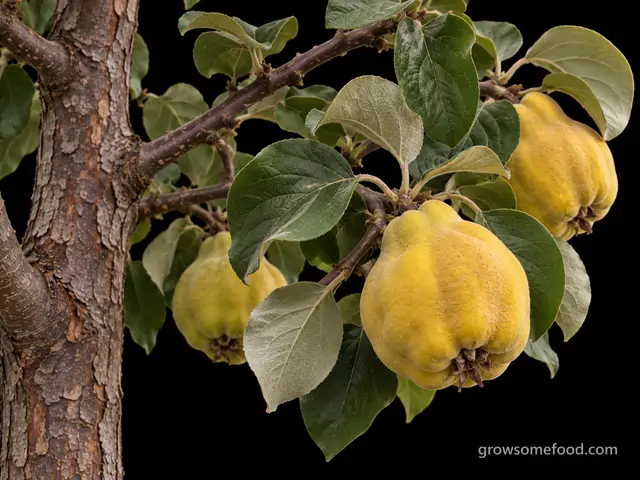
Quince
A small, self-fertile, late-blooming orchard tree that hands you hard golden fruit no supermarket sells: astringent raw, transformed by cooking into something fragrant, pink and full of pectin. Easy to grow, easy to prune wrong, and vulnerable to fire blight.
The cooked flesh is the food. Most varieties are rock-hard and mouth-puckeringly astringent raw - unpleasant rather than dangerous - and only a few low-astringency types are worth eating fresh. The seeds, like all pome and stone-fruit seeds, contain cyanogenic compounds: swallowing one whole is harmless, but never crush, grind or brew them. Cut the very hard fruit on a stable board with a heavy knife, taking cheeks off around the core - a slipped blade is the usual quince injury.
Overview
Quince is the fruit tree American gardens forgot. It is small (a 15-foot tree, often a multi-stemmed shrub), it is self-fertile so a single tree crops on its own, and it blooms two or three weeks after apple with big solitary pink-white flowers - late enough to sail through the spring frosts that ruin apricots. In October it hands you heavy, downy, golden fruit that perfume an entire room from a bowl on the counter.
What it will not do is let you eat it off the tree. Nearly all quinces are hard and astringent raw - not harmful, just unpleasant, like biting a green persimmon. Cooked slowly with sugar, the same fruit turns tender, fragrant, and often a startling deep pink, and because quince carries more pectin than almost any other fruit it sets jelly and paste (Spanish membrillo) without any help. A handful of modern low-astringency varieties can be eaten fresh when dead ripe; treat that as a bonus rather than the plan.
Two things to know before you plant. First, fire blight: quince is as susceptible as pear, and light pruning, low nitrogen and a dry site matter more than any spray. Second, the name: the red-flowered thorny shrub sold as “flowering quince” is Chaenomeles, a different genus. Its small hard fruit is usable in jelly, but it is not this plant - if you want fruit, buy Cydonia oblonga by its botanical name.
Quick facts
- Winter chill
- 300 hours below 45°F100 to 500
- Life cycle
- Perennial, lives about 40 years
- Height
- 15 ft8 to 20
- Spread
- 13 ft8 to 18
- Cold
- Takes hard frostdamaged below -15°F
- Heat
- Struggles above 100°F
Full sun · medium water · consistently moist soil · 15 ft apart (12 to 20) · transplant or cuttings
When to plant
Nothing is open today. Fall transplanting opens 3 weeks, Oct 15 to Dec 15.
- Transplant Oct 15 – Dec 15 Opens in 24 daysFall planting also works in these mild zones; roots settle over winter before growth starts.
- Transplant Jan 15 – Mar 15 Opens in 116 daysLate winter, while fully dormant, is the ideal window. This is quince country - the long warm autumn ripens the fruit properly - but fire blight is the limiting factor, so keep nitrogen low and pruning light.
Frost here: last around Apr 10 (Mar 27 to Apr 24 most years), first around Oct 25. Zone averages, your own yard may run a week or two either way.
Life stages
One stage to settle in, then four that repeat each year. Windows are typical; your zone and weather move them.
First-year establishment
The first year after planting- WaterWater deeply every 7-10 days the first seasonQuince roots are shallow and fibrous, so a new tree dries out faster than a deep-rooted apple. Soak the whole root zone rather than sprinkling, and keep it up through the first summer - steady water in year one is the single biggest factor in establishment.
- MulchMulch a 3-foot ring, kept off the trunkTwo to three inches of wood chips or straw hold the moisture those shallow roots depend on and stop grass from stealing it. Leave a few bare inches around the trunk so the bark stays dry and voles have nowhere to hide.
- PruneTrain an open framework - and cut as little as possibleSet three to five well-spaced scaffold limbs as a low open vase or a modified leader, then stop. Quince fruits on the tips of the current season's shoots, so heavy heading cuts remove next year's crop, and the soft regrowth they force is exactly what fire blight enters.
- PruneRub off suckers from the basemonthlyQuince suckers freely from the roots and crown. Rub or cut them off at the base a few times each season - left alone they turn a tree into a thicket, and on a grafted tree they are rootstock, not your variety.
- ProtectGuard the trunk from voles, rabbits and deerA hardware-cloth cylinder or spiral guard stops winter girdling and buck rub on a thin-barked young tree. Loosen it as the trunk thickens.
Watch for- Graft union buried below soil on a grafted tree
- Fire blight striking soft new growth in a warm wet first summer
- Root suckers turning the tree into a thicket
- Drought stress - shallow roots dry out fast
Winter dormancy (accumulating chill)
Dec to Feb, every year- PrunePrune lightly in late winter - thin, do not headTake out dead, crossing and crowded wood and open the center to light. Thin whole branches back to a junction rather than shortening every shoot: the fruit forms at the tips of this year's new growth, so shearing the tree over is how people end up with a healthy quince that never fruits.
- InspectCut out fire-blight cankers while the tree is dormant and drySunken, cracked, dark patches on limbs are overwintering fire blight and the source of next spring's infection. Remove them well below the margin in dry, cold weather, sterilizing the saw between every cut, and burn or bin the prunings.
- WeedClear and destroy last season's fallen leavesQuince leaf blight overwinters in the fallen leaves under the tree. Raking them up and removing them - not composting them in place - is the cheapest and most effective thing you can do about it.
Watch for- Overwintering fire-blight cankers on limbs
- Fallen leaves left under the tree (quince leaf blight inoculum)
- Vole runs under mulch and snow
Bloom (late, and self-fertile)
Apr to May, every year- PollinateNo partner needed - just leave the bees aloneQuince is self-fertile: one tree sets a crop on its own, which is the main reason it is easier than apple or pear in a small yard. The big solitary pink-white flowers open two to three weeks after apple bloom, late enough to dodge most spring frosts. Do not spray insecticide during bloom - fruit set still improves with bee visits.
- InspectWatch for blossom blight in warm, wet bloom weatherFire blight enters through open flowers. In a warm, humid spell during bloom, check daily for blossom clusters that suddenly wilt, blacken and stay hanging on the tree, and cut those spurs out well below the damage as soon as you see them.
Watch for- Blossoms blackening and hanging on (fire-blight blossom strike)
- A late hard frost in an unusually early spring
- Orange spots forming on young fruit and twigs (cedar-quince rust)
Fruit set & sizing
May to Aug, every year- ThinThin to one fruit per cluster on a heavy setQuince sets in small clusters and a young tree will happily overload itself. Thin to one fruit per cluster, roughly 6 inches apart, within a few weeks of set - you trade a lot of small hard fruit for fewer large fragrant ones and take the strain off the limbs.
- WaterKeep water steady through summerweeklyShallow roots mean quince feels drought before its neighbours do, and a dry August is the usual reason fruit drops early or stays small and woody. A deep weekly soak plus mulch through the dry months carries the crop.
- InspectScout for blight strikes, leaf spotting and rustweeklyCheck weekly for shoot tips that blacken and hook over (fire blight - cut them out at once), for dark spots spreading across the leaves ahead of an early leaf drop (quince leaf blight), and for orange, raised, spiny growths on fruit and twigs (cedar-quince rust).
Watch for- Blackened, hooked shoot tips (fire blight)
- Dark leaf spots and midsummer defoliation (quince leaf blight)
- Distorted fruit with orange spiny growths (cedar-quince rust)
- Fruit dropping in a dry spell
Harvest
Sep to Nov, every year- HarvestPick when the fruit turns full gold - and before a hard freezeevery 5 daysQuince ripens late and slowly. Wait until the green has gone completely and the skin is an even deep gold, the grey down rubs off easily with a thumb, and the tree smells of quince from several feet away. Pick before the first hard freeze - frozen fruit browns inside and will not keep.
- HarvestHandle them like eggsQuinces look indestructible and bruise like pears. Every knock becomes a brown patch that rots in storage, so lift and twist each fruit off by hand, lay them in a single layer rather than piling them into a bucket, and keep the stalk on where you can.
Watch for- Fruit still green-gold in late October (not ripe - leave it)
- A hard freeze forecast with fruit still on the tree
- Bruises and knocks from rough picking
- Windfalls, which will not store and should be cooked first
Harvest
- Skin has gone from green to an even, deep gold with no green left
- The grey wool on the skin rubs off easily under your thumb
- You can smell the tree from several feet away - the perfume is the ripeness cue
- Seeds in a cut test fruit have turned dark brown
- Picked before the first hard freeze, whatever the color says
- Pick when the fruit turns full gold - and before a hard freeze · every 5 days
- Handle them like eggs
Per plant 20 to 200 quinces, 10 to 100 lbPicking pick as they ripen
Cook with quinces
Watch out for
5 to know. 2 are high-risk: Fire Blight, Quince Leaf Blight. None are active in September.
Fire BlightSeverity High DiseaseQuince is as susceptible as pear, and there are no resistant quince varieties to fall back on - so the whole defense is cultural.
Keep nitrogen low, prune lightly and only in dry dormant weather, cut cankers out in winter, and remove blossom strikes the day you see them. Warm, humid springs in the South and East are the dangerous window.
Sudden wilting and blackening of blossoms and shoot tips that look burned rather than diseased, shoots bent over into a hook, dark sunken cankers on limbs, and amber bacterial ooze on the bark in warm humid weather.
Cut strikes out at least 8 to 12 inches below the visible damage, sterilizing the saw or pruners between every single cut, and remove and destroy the prunings rather than leaving them lying. Cut cankers out in dry dormant weather. Copper or biological sprays at bloom help in high-pressure areas - use only a product labeled for the crop you are treating, follow the label exactly, and observe the pre-harvest interval before you pick.
Where a resistant option exists for your crop, variety choice matters more than any spray - check before you buy. Avoid heavy nitrogen and hard pruning, both of which force the soft succulent growth the bacteria enter through, and never prune or work the plant in wet weather. Keep susceptible hosts spaced apart rather than planted hard against each other, and do not prune two of them in the same wet spell.
A fast, destructive bacterial disease (Erwinia amylovora) of the rose family. It enters through open blossoms and soft shoot tips in warm, humid weather, then runs back down the shoot, blackening leaves and wood as though scorched and bending the tip into a telltale 'shepherd's crook'. From there it moves into limbs as dark sunken cankers, and it can kill a young tree in a single season. Apple, pear, quince, loquat, hawthorn, serviceberry and toyon are all hosts, and susceptibility varies enormously between species and between varieties.
Quince Leaf BlightSeverity High DiseaseThe disease you will actually see most years on quince in a humid climate, and the reason autumn leaf raking is a real job under this tree rather than a tidiness habit.
Hot dry summers largely suppress it; cool wet maritime summers can defoliate a tree by August.
Numerous small dark reddish-brown to near-black spots scattered across the upper leaf surface from late spring, spreading and merging into larger blotches. Leaves yellowing around the spots and dropping early, with heavy leaf fall from midsummer in a wet year. Small dark cracked spots on the fruit skin. Twig dieback and a thin, poorly furnished canopy after several bad seasons in a row.
There is no cure for infected leaves; remove and destroy badly spotted foliage and, above all, clear the fallen leaves. In regions with wet springs, protective fungicide programs beginning at bud break are used commercially - a home grower is usually better served by sanitation, airflow and accepting some defoliation. Use only a product labeled for this crop, follow the label exactly, and observe the pre-harvest interval before you pick.
Rake up and remove every fallen leaf in autumn and dispose of it away from the tree rather than composting it under the canopy - the overwintered leaves are the entire source of next year's infection. Prune to open the canopy so leaves dry quickly after rain, water at the base rather than overhead, and give the tree an open, airy, sunny site when you plant it. Avoid heavy nitrogen, which produces the soft dense growth the disease thrives in.
The defining foliage disease of quince (Diplocarpon mespili, also called Fabraea leaf spot, which likewise attacks pear and hawthorn). Small dark red-brown spots appear on the leaves in late spring, multiply and merge through a wet summer, and can strip a tree bare by August. Repeated defoliation years in a row weakens the tree, cuts the crop, and leaves shoots dying back. It can also spot and crack the fruit. The fungus overwinters in fallen infected leaves and on infected twigs, and each spring's rain splashes the spores back up into the new canopy - which is why sanitation matters so much more here than spraying.
Cedar-Quince RustSeverity Medium DiseaseQuince is one of this rust's named primary hosts and is hit harder than apple, because it deforms and hollows the fruit rather than just spotting the leaves.
Severity here is conditional: with no juniper or eastern red cedar within a few hundred yards you may never see it, and surrounded by red cedar you should expect to lose fruit most years. Plan the tree's position accordingly.
Developing fruit that swells lopsidedly, distorts, and grows tufts or fine tubes of orange fungal tissue - unmistakable once seen and quite different from the flat orange leaf spots of cedar-apple rust. Swollen, cankered areas on young twigs and on thorns, sometimes girdling and killing the shoot beyond. Bright orange gelatinous horns emerging from woody galls on nearby junipers and red cedars during warm wet spells in spring - that is the spore source, and finding it tells you where the problem lives. Fruit dropping early in numbers, or coming off the tarp misshapen and hollow.
There is no cure for an infected fruit or a cankered twig - remove and destroy them. On the juniper side, cutting out the woody galls in late winter before they produce spore horns reduces local pressure. Where the disease is severe and the cedars cannot be removed, protectant fungicide programs timed to bloom and early fruit development are used commercially, but they must start before infection and be repeated through the wet spring window; on a home tree the honest answer is usually siting and tolerance rather than a spray schedule.
Site the tree away from junipers and eastern red cedar. That single decision does more than everything else combined, because the fungus cannot complete its life cycle without both hosts, and spore travel drops off sharply with distance - a few hundred yards is a meaningful buffer even though spores can carry further. Where you own the junipers, removing them is the definitive fix; where a neighbor's cedar line is the source, distance and variety choice are what you have. Keep the canopy open so it dries quickly after spring rain, since infection needs extended wetness. Clean up and destroy infected fruit and prunings rather than leaving them under the tree.
Cedar-quince rust (Gymnosporangium clavipes) is one of the Gymnosporangium rusts that alternate between a juniper host and a rose-family host, and it is the most damaging of them because of WHERE it attacks. Where cedar-apple rust mainly spots leaves, cedar-quince rust goes for the fruit, and on hawthorn, quince, and mayhaw it swells, distorts, and hollows out developing fruit, covering it in tufted orange-fungal growth and rendering the crop unusable. It also attacks twigs and thorns, causing swollen cankers that can girdle small wood. The fungus overwinters as a perennial gall or swelling on juniper and eastern red cedar; in wet spring weather those galls produce gelatinous orange horns that release spores, which blow to the rose-family host. It cannot spread host to host - it must have both. Distance from junipers is therefore the whole control, and a few hundred yards makes a large difference.
Codling MothSeverity Medium PestQuince is a genuine host and is hit hardest where it grows alongside apples.
Because quince is cooked and cut up anyway, light damage is easy to trim out - but tunnelled fruit will not store, so pick those out and use them first.
Small entry holes ringed with brown frass, early fruit or nut drop, and a tunnel running to the seed cavity or kernel when you cut or crack a damaged one open.
Spinosad timed to egg hatch (the traps tell you when), or codling moth granulosis virus (CpGV) as a targeted biological. Bt does not work on codling moth - the newly hatched larva bores straight into the fruit within hours and never eats enough surface tissue to take in a dose. Use only a product labeled for the crop you are treating, follow the label exactly, and observe the pre-harvest interval before you pick. Sanitation and fruit-bagging matter more than any single spray.
Hang pheromone traps to time any spray; gather and destroy dropped fruit and nuts promptly to break the cycle; bag individual fruits or apply kaolin clay for spray-free control.
The classic 'worm in the fruit': larvae of a small gray moth tunnel in from the skin and feed at the core or kernel, packing the entry hole with sawdust-like frass and ruining the crop for keeping. The same moth works apples, pears and walnuts.
AphidsSeverity Low PestMostly a young-tree problem on quince, and worst on the soft growth that follows heavy pruning or a nitrogen feed - which is another reason to go easy on both.
Mature trees shrug it off.
Dense clusters of tiny insects packed onto shoot tips, flower buds, and the undersides of young leaves. Curled, cupped, or distorted new growth that never opens properly. A sticky shine on the leaves - and on whatever sits under the plant - that later goes black with sooty mold. Tiny white cast skins left behind where a colony has been feeding. Ants running steadily up and down the stems, which is often the first thing you notice. Mottled, streaked, or misshapen leaves that do not grow out can mean a virus the aphids brought with them rather than the feeding itself.
Knock the colonies off with a hard jet of water and repeat every few days - on most plants that alone ends it. Pinch out or prune off the worst-infested tips rather than treating the whole plant. If colonies keep rebuilding, spray insecticidal soap or horticultural oil directly onto the insects, covering leaf undersides, and repeat weekly until they are gone; treat early or late in the day, and never spray a wilted or heat-stressed plant. Avoid broad-spectrum insecticides - they kill the ladybugs, lacewings, and parasitic wasps that were about to solve the problem for you, and aphid numbers usually come back worse afterward. Anything you spray must be labeled for the plant you are treating; follow that label and observe its pre-harvest interval. On anything you eat, wash leaves, heads, and buds well before use, since aphids hide down in crowns, folds, and tight growth.
Go easy on nitrogen: the soft, lush growth that heavy feeding produces is exactly what aphids breed on. Check new growth once a week through spring and early summer so you catch colonies while they are still small, and rub the first few out with your fingers. Leave flowering plants nearby and skip broad-spectrum sprays - ladybugs, lacewings, hoverflies, and parasitic wasps do most of this work for free, and they only stay if there is something for them to eat. Keep ants off the plant where you can, since they protect aphids from those predators. Water steadily so plants are not stressed, and check any new plant over before you bring it home or move it indoors, since aphids usually arrive on something else.
Aphids are small soft-bodied sap-suckers - green, black, gray, pink, or waxy white, and mostly wingless - that gather in dense colonies on the tenderest new growth: shoot tips, buds, and the undersides of young leaves. They breed extremely fast in mild weather, so a few can become hundreds inside a week. Their feeding curls and distorts soft growth, and the sticky honeydew they excrete coats everything below and turns black with sooty mold. Ants often farm and defend the colonies for that honeydew. A few aphids are normal on almost any plant and a healthy plant shrugs them off; only dense, persistent colonies do real damage, and some aphids also spread plant viruses as they feed.
Good & bad neighbors
First rule: keep Juniper and eastern red cedar apart. Cedar-quince rust needs a juniper to complete its life cycle, and quince is hit harder by it than apple or pear.
Plant nearby
-
A living clover understory fixes a little nitrogen, feeds pollinators, and beats out the grass that competes hard with quince's shallow roots for water.
-
A ring of daffodils around the trunk deters voles and rabbits from gnawing the thin bark of a young quince, and they bloom before the tree does.
- Traditional pairings, thin evidence
-
Underplanted alliums are traditionally credited with discouraging aphids around fruit trees; the evidence is anecdotal but they share the space harmlessly.
-
A classic orchard-guild plant whose flat flower heads draw in the lacewings, ladybugs and parasitic wasps that hold down aphids.
Keep apart
-
Juniper and eastern red cedarCedar-quince rust needs a juniper to complete its life cycle, and quince is hit harder by it than apple or pear. Plant as far from junipers and eastern red cedar as your property allows - this is a siting decision you only get to make once.
-
Grass (turf under the tree)Turf growing right to the trunk competes strongly for water with quince's shallow root system and stunts young trees - keep a mulched, grass-free ring.
Varieties · 7
You pick one when you add Quince to your garden. Its days to maturity set your harvest window.
Cooking quince (astringent until cooked) 5 varieties
Orange
Round to slightly apple-shaped, deep gold, lightly downy, with pale orange-tinted flesh.
heirloomearlyreliableThe standard American quince and the one most nurseries sell: round, apple-shaped golden fruit with orange-tinted flesh, ripening earlier than most, which matters in a short season. Heavy, dependable cropper and excellent for jelly and paste. Susceptible to fire blight like the rest of the species.
Smyrna
Very large, oblong to pear-shaped, pale lemon-gold with light down.
large-fruitaromaticturkishThe great Turkish variety - very large, lemon-yellow, intensely fragrant fruit with tender flesh that cooks beautifully. A vigorous tree with large leaves. Ripens late, so it wants a long warm autumn; best in zones 7-9 and marginal where fall comes early.
Pineapple
Round, smooth, bright gold fruit with white flesh that cooks pink.
aromaticburbankcaliforniaA Luther Burbank introduction from California, named for the pineapple note in its aroma and flavor. Round golden fruit, tender when cooked, and one of the better varieties for jelly. Does best in warm, dry-summer climates; less happy in humid heat.
Fresh-eating quince (low-astringency) 2 varieties
Aromatnaya
Large, round to slightly ribbed, lemon-gold, with a strong citrus perfume.
low-astringencycold-hardyrussianA Russian variety and the best known of the low-astringency quinces: large, round-ribbed, lemon-gold fruit with a strong citrus-pineapple aroma that can be sliced and eaten raw when fully ripe. Among the hardiest quinces and a good choice for zone 5. Raw, it is mild and aromatic rather than sweet - most of the crop still ends up cooked.
Karp's Sweet
Medium-large, smooth golden fruit with less down than a cooking quince.
low-astringencycaliforniarareA California selection distributed through rare-fruit circles as a genuinely eat-fresh quince: firm, aromatic, and low in astringency when fully ripe on the tree. It needs a long hot summer to develop that quality, so it is a Western and Southern variety rather than a northern one, and it can be hard to find - expect to order from a specialist.
Grower tips
Notes from growers, tagged with the zone they grow in. A person reads every post before it appears.
Nobody has posted about Quince yet. The first one usually saves someone a season.
Free account. Your post shows your grower name and zone, never your email.