Add it to your home screen and it opens full screen: no browser bars, one tap away, and everything stays signed in. Free, nothing to download from an app store.
- Tap the Share button in your browser
- Scroll down and choose “Add to Home Screen”
- Open GrowSomeFood from your home screen
- Open your browser’s menu
- Choose “Add to Home screen” or “Install app”
- Open GrowSomeFood from your home screen
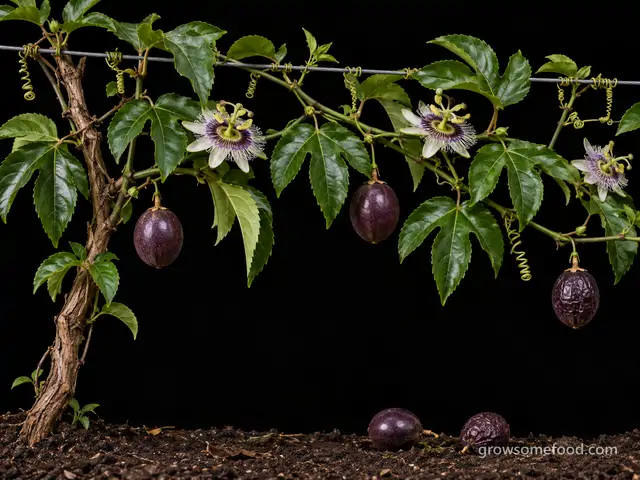
Passionfruit
The tropical passionfruit of the supermarket: a fast, heavy-cropping vine that fruits in its first or second year and tells you the fruit is ripe by dropping it on the ground. Frost-tender, short-lived, and worth replanting every five or six years.
Only the ripe pulp is food. Green fruit, the rind, the leaves and the roots of this species all contain cyanogenic compounds, so never eat an unripe passionfruit and never brew its leaves as tea. The calming herb sold as passionflower is a different plant - the hardy native maypop, Passiflora incarnata - and its cautions belong on that page, not this one.
Overview
This is the passionfruit people mean when they say passionfruit - the wrinkled purple or golden egg with a spoonful of intensely perfumed, seedy pulp inside. Passiflora edulis is a fast, vigorous, frost-tender vine that will cover a fence in one season, flower through half the year, and give you fruit in its first or second summer. It is genuinely easy where it is warm enough, and completely impossible where it is not: it is damaged around 30°F and killed by a real freeze, which puts reliable outdoor growing in zones 9b through 11, with a warm wall and some luck in 9a.
Three facts shape everything about growing it. It fruits on new growth, so it needs a hard annual prune or it becomes a tangle that fruits only at the tips. It tells you when the fruit is ripe by dropping it - there is no picking judgement to make, only the habit of gathering windfalls every day or two. And it is short-lived: five to seven productive years is normal before soil disease, nematodes and virus catch up with it, so a passionfruit is a plant you renew rather than inherit.
One thing to be clear about before you buy: the hardy maypop (Passiflora incarnata) is a different plant with its own catalog entry - a native, root-hardy to about -5°F, and the source of the herbal passionflower used for anxiety and sleep. This species is neither hardy nor medicinal. Cultivars sold as Frederick and Purple Possum belong here, on the tender tropical page, not with the maypop, and they will not pollinate one.
Quick facts
- Sprouts in
- 21 days10 to 80
- Soil to sprout
- 82 °F70 to 90
- Start indoors
- 12 weeks before transplant8 to 16
- Life cycle
- Perennial, lives about 6 years
- Height
- 15 ft8 to 20
- Spread
- 20 ft10 to 40
- Support
- Grows better on a trellis or stake
- Cold
- Killed by frostdamaged below 28°F
- Heat
- Struggles above 100°F
- Self-sows
- Yes, expect volunteers
Full sun or part sun · medium water · well-drained soil · 10 ft apart (8 to 15) · direct sow or transplant or cuttings
When to plant
No planting window on record for this zone. Nearest zone with one: 8a.
Frost here: last around Apr 10 (Mar 27 to Apr 24 most years), first around Oct 25. Zone averages, your own yard may run a week or two either way.
Life stages
One stage to settle in, then five that repeat each year. Windows are typical; your zone and weather move them.
Planting & first-year establishment
Day 0 to 180- SupportPut the trellis up before the vine goes inA mature passionfruit carries a great deal of weight in wet foliage and fruit, and it climbs by tendrils that grab whatever they touch. Give it a fence, arbour, or wire trellis of real substance at planting - a flimsy support pulled over by a loaded vine in a summer storm is the most common regret.
- WaterWater steadily through the first seasonevery 4 daysPassionfruit roots are shallow and it never really becomes drought-hardy the way a fig does. Keep the root zone evenly moist through the first summer, watering deeply rather than often, and let the surface dry a little between waterings - the vine wants moisture but rots in standing water.
- MulchMulch the shallow roots, but keep it off the collarA wide mulch ring holds moisture over the surface roots and keeps the soil cool. Pull it back a few inches from the base: collar rot at the soil line is one of the commonest ways a young passionfruit dies.
- FertilizeFeed lightly and often, not heavily and rarelyevery 42 daysThis is a fast, hungry vine, but high nitrogen gives you fifteen feet of leaf and nothing else. Use a balanced or slightly potassium-leaning feed in small doses through the warm months, and stop feeding as autumn comes on so the wood hardens before cold.
Watch for- Tendrils grabbing anything within reach - guide them onto the support early
- Soft, dark rot at the soil line (collar rot) on a young plant
- Wind and cold burn on tender new growth
Winter rest & the late-winter prune
Dec to Feb, every year- PrunePrune hard in late winter - fruit comes on new woodPassionfruit flowers and fruits on the current season's growth, so an unpruned vine turns into a tangle that fruits only at the tips. In late winter, before growth restarts, shorten the previous year's laterals back to a few buds and keep a permanent framework of main arms along the trellis. Cutting a third to a half of the growth away each year is normal and is what forces the fruiting shoots.
- ProtectCover the crown where frost is possibleThe vine is damaged around 30°F and killed outright by a hard freeze, though an established purple passionfruit will often resprout from the crown after a light one. Mound mulch over the base, and throw frost cloth over the framework on the nights that matter.
Watch for- Frost burn on leaves and shoot tips
- A vine that survived at the crown but died back above - cut back to live wood
- Tangled unpruned growth that will fruit only at the far ends
Spring flush & training
Mar to May, every year- SupportTrain the new shoots along the wiresSpread the season's new shoots out along the support rather than letting them bunch. Light and air reaching the whole framework is what gives you flowers along the length of the vine instead of a fruiting fringe at the top.
- FertilizeStart the feeding cycle as growth restartsevery 42 daysResume light, regular feeding once the vine is actively growing. Passionfruit is a heavy potassium user; a citrus or fruiting-plant fertiliser suits it well.
- WeedKeep grass and weeds off the surface rootsThe feeding roots sit in the top few inches, so competition at the base costs you real growth. Weed by hand or smother with mulch rather than digging around the crown.
Watch for- Fast, soft growth that aphids like - check shoot tips weekly
- Suckers from below a graft union, if your plant is grafted onto yellow passionfruit rootstock
- Shoots bunching at the top of the trellis instead of spreading
Bloom & pollination
Apr to Sep, every year- PollinateKnow whether your vine needs a partnerPurple passionfruit is usually self-fertile and sets on its own. Yellow (golden) passionfruit is largely self-incompatible - a lone vine will flower spectacularly and set almost nothing, so it needs a second, genetically different vine nearby. Seedlings differ from one another, which is exactly what you want for cross-pollination.
- PollinateHand-pollinate the day a flower opensThe pollen is heavy and sticky and honeybees are poor at moving it - carpenter bees are the real pollinator. If set is poor, brush pollen from the anthers onto the three sticky stigmas of a different vine's flower on the same day it opens. Purple flowers open in the morning, yellow around midday, and the pollen is only good for a few hours.
- WaterDo not let the vine dry out while it is floweringevery 4 daysDrought during bloom drops flowers and small fruit outright. Keep moisture steady from the first buds through fruit set - this is the point in the season where irregular watering costs you the crop.
Watch for- Masses of flowers but no fruit - a self-incompatible yellow vine with no partner, or too few carpenter bees
- Flower drop in a dry spell
- Ants and aphids working the flower buds
Fruit filling (about 10-12 weeks)
Jun to Oct, every year- WaterKeep water even as the fruit sizesevery 4 daysA passionfruit takes roughly 70 to 85 days from flower to ripe. Even moisture through that stretch fills the fruit; a drought-then-deluge cycle gives you small, thin-pulped fruit and premature drop.
- FertilizeLean on potassium, not nitrogen, once fruit is onevery 42 daysOnce the vine is carrying fruit, keep nitrogen modest and potassium up. Too much nitrogen at this point pushes leafy growth and can drop young fruit.
- InspectCheck for shrivelled, hard, or lumpy fruitSmall, hard, misshapen fruit that never fills usually means poor pollination or the woodiness virus; badly deformed fruit on a stunted, mottled vine is the virus and the vine should be replaced.
Watch for- Young fruit dropping in dry weather
- Wrinkled, thick-walled fruit with little pulp (poor pollination or virus)
- Fruit sunburning where the canopy is thin
Harvest (the fruit falls when it is ready)
Jul to Nov, every year- HarvestCollect the windfalls every day or twoA passionfruit does not need picking - it colours up, abscises, and drops, and a fruit found on the ground is a ripe fruit. Gather every day or two so the drops do not sit and sour, and rinse them before you cut them. Fruit picked while still fully green will never develop proper flavour.
- DoLet picked fruit wrinkle before you eat itFully coloured fruit picked from the vine, or fresh windfalls, improve on the counter over a week or so as the skin wrinkles and the pulp concentrates. A smooth-skinned passionfruit is good; a wrinkled one is better. Refrigerate once it is where you want it.
Watch for- Windfalls left to ferment and mould on the ground
- Rats, possums and birds working the drops overnight in warm regions
- Fruit shrivelling on the vine instead of dropping (usually drought)
Harvest
- Skin has coloured fully - deep purple on purple types, strong even gold on yellow ones
- The fruit has fallen from the vine on its own (windfalls are ripe fruit)
- The skin has begun to wrinkle, which concentrates the pulp and deepens the flavour
- The fruit feels heavy for its size and the pulp sloshes slightly when shaken
- Collect the windfalls every day or two
- Let picked fruit wrinkle before you eat it
Per plant 20 to 300 fruits, 2.5 to 37.5 lbPicking pick as they ripen
Cook with passionfruits
Watch out for
7 to know. 2 are high-risk: Passionfruit Woodiness Virus, Root Rot. 5 are active in September.
Passionfruit Woodiness VirusSeverity High DiseasenowSuspect this whenever an established passionfruit starts producing hard, thick-rinded fruit with little pulp on mottled, puckered new growth - it is far more often the virus than a nutrient issue.
New leaves coming out small, puckered, and mottled light and dark green, with the leaf edges distorted or crinkled. Fruit that stays small and hard, with an unusually thick rind and only a smear of pulp inside. A vine that has cropped well for years losing vigour and producing progressively worse fruit. Aphid colonies on the shoot tips, which are how it arrives. Symptoms are often worst on the newest growth and can be mistaken for herbicide drift or a nutrient problem.
None. There is no spray, no cure, and no recovery. Remove and destroy an infected vine rather than leaving it to infect its neighbours, and plant the replacement somewhere else in the garden with clean stock. Controlling aphids after symptoms appear does not help the infected plant, though it protects the ones around it.
Buy clean nursery stock and never propagate from a vine showing mottled or distorted leaves. Control aphids on and around the vine, and avoid planting passionfruit downwind of an old, declining vine. Disinfect secateurs between plants - the sap carries the virus, and a single unsanitised cut spreads it down a row. Remove abandoned or wild passionflower vines nearby that act as reservoirs. Since infection is cumulative in a district, plan to replace vines every five to seven years rather than nursing an old one along.
An aphid-transmitted potyvirus and the most serious disease of passionfruit worldwide. Infected vines lose vigour, their leaves go small, mottled, puckered and distorted, and the fruit becomes small, hard and misshapen with a thick woody rind and almost no pulp - the symptom that names the disease. It is spread by aphids feeding briefly on an infected vine and moving on, and it also travels in cuttings and on pruning tools. There is no cure and no treatment: an infected vine stays infected, declines, and acts as a reservoir for every other passionfruit nearby. It is one of the main reasons a passionfruit vine is a five-to-seven-year plant rather than a permanent one.
Root RotSeverity High DiseaseThe number-one killer of home passionfruit, and it usually shows up as collar rot at the soil line rather than deep in the roots: a dark, sunken, rotted band right at the base, caused by mulch piled against the stem or a planting site that sits wet.
Plant on a mound in heavy soil, keep mulch a few inches clear of the stem, and never replant a new vine into the hole where one collapsed.
Wilting in the middle of the day on a plant whose soil is damp - the classic tell, and the reason people water a rotting plant and finish it off. Leaves yellowing from the bottom up, dull off-color foliage, and growth that stalls for no visible reason. Whole shoots, or one side of the plant, collapsing while the rest still looks fine. Soft, dark, or mushy tissue at the base of the stem or at the crown, sometimes with a sour smell. Lift a failing plant and look at the roots: healthy ones are firm and pale, rotted ones are brown or black and slimy, and the outer layer slips off between your fingers leaving a thread of core behind. Seedlings that topple over at soil level are the same problem, called damping-off.
There is no cure for tissue that has already rotted, so act on the conditions rather than looking for a spray. Stop watering at once and fix the drainage - open up compacted soil, or move the plant to a raised, sharply drained position or a container. Lift a badly affected plant, cut away every soft dark root and rotted section with a clean blade back to firm pale tissue, and replant only the healthy parts into fresh free-draining soil or mix. Often the better move is to give up on the plant and save its offspring instead: cuttings, offsets, or divisions taken from firm healthy growth root readily and give you a clean start. Bin the rotted material rather than composting it, and correct the drainage before you replant, because the rot comes straight back in the same wet spot.
Drainage is the whole defense. Match the plant to the site first - something that wants sharp drainage will not survive heavy clay or a low, water-collecting spot however well you tend it. Where the ground is heavy, plant on a raised bed, berm, or slope, or grow in a container. Set plants at the depth they were already growing, since burying the crown or the root flare is a common cause of rot, and keep mulch pulled back a few inches from the stem base instead of piled against it. Water the soil rather than the calendar: check that the top inch or two is dry before watering again, cut back hard in cool weather and winter dormancy, and never leave a pot standing in a full saucer. Do not plant or dig in soggy ground, and go easy on rich amendments for plants that want it lean. Rotate annual crops, and start with clean healthy plants and fresh mix.
Root rot is not one organism but a group of soil fungi and water molds - Pythium, Phytophthora, Fusarium, Rhizoctonia and others - that sit harmlessly in most soils and only turn destructive when the ground stays saturated. Waterlogged soil drives the air out, the roots suffocate, and the weakened tissue is invaded and goes soft, brown, and stringy. Because the damage is underground you usually see it first as something that looks like drought: wilting, yellowing, stunting, a plant that does not respond to being watered. Overwatering, heavy compacted ground, a low spot that collects runoff, a pot with no drainage or a saucer left standing full, and cold wet soil in winter are the usual causes. Once roots have actually rotted there is no cure - this is a problem you prevent rather than treat.
Leaf Spot & Fungal DiseaseSeverity Medium DiseasenowWorse on a vine left unpruned, because the dense interior tangle never dries.
The annual late-winter prune that gives you fruiting wood also happens to be the best leaf-spot control you have.
Small brown or dark spots on the older, lower, shaded leaves first, spreading upward and enlarging into blotches with tan or pale centres and sometimes a yellow halo. Leaves yellowing and dropping from the base of the vine in prolonged humid, rainy spells. Sunken brown lesions on the fruit, particularly on fruit resting against foliage or the ground. A dense mat of tangled growth in the middle of the vine that never dries out after rain or dew - that is where it always starts.
Usually no spray is warranted - remove badly affected leaves, thin the growth to open it up, and clear the debris beneath. In a wet season on a valuable crop, a copper-based or general garden fungicide applied preventively at the start of the humid period slows spread, though it will not cure spotted leaves already on the plant. Anything you spray must be labeled for the crop and its pre-harvest interval observed. The durable fix is structural: prune properly, space well, and stop overhead watering.
Airflow does most of the work. Train the vine along its support rather than letting it mat, prune annually to open the framework and remove the interior tangle, and keep the base clear so air moves through. Water at the roots rather than over the leaves, and water in the morning so foliage dries. Rake up and remove fallen leaves and dropped fruit, since the fungi overwinter there. Avoid heavy nitrogen, which produces the soft crowded growth these diseases prefer, and space plants generously in humid regions.
Passionflower vines of every species pick up a group of fungal leaf and fruit spots in warm, wet, humid weather - brown spot (Alternaria), septoria spot, and anthracnose among them. They begin as small brown or dark spots on the leaves that enlarge into blotches with pale centres, and in a bad season they run together, yellow the foliage and strip a vine of leaves from the bottom up. On a fruiting vine the same fungi can spot the fruit, producing sunken lesions that let rot in and cause early drop. On a vigorous, well-spaced plant this is usually cosmetic and self-limiting; on a matted, crowded vine in a wet summer it can cost real crop, and repeated defoliation weakens the plant over years.
AphidsSeverity Medium PestRated Medium here not for the feeding damage, which is trivial on a vigorous vine, but because aphids are the vector for passionfruit woodiness virus - keeping colonies off the new growth is genuinely protective.
Check for fritillary caterpillars before spraying anything.
Dense clusters of tiny insects packed onto shoot tips, flower buds, and the undersides of young leaves. Curled, cupped, or distorted new growth that never opens properly. A sticky shine on the leaves - and on whatever sits under the plant - that later goes black with sooty mold. Tiny white cast skins left behind where a colony has been feeding. Ants running steadily up and down the stems, which is often the first thing you notice. Mottled, streaked, or misshapen leaves that do not grow out can mean a virus the aphids brought with them rather than the feeding itself.
Knock the colonies off with a hard jet of water and repeat every few days - on most plants that alone ends it. Pinch out or prune off the worst-infested tips rather than treating the whole plant. If colonies keep rebuilding, spray insecticidal soap or horticultural oil directly onto the insects, covering leaf undersides, and repeat weekly until they are gone; treat early or late in the day, and never spray a wilted or heat-stressed plant. Avoid broad-spectrum insecticides - they kill the ladybugs, lacewings, and parasitic wasps that were about to solve the problem for you, and aphid numbers usually come back worse afterward. Anything you spray must be labeled for the plant you are treating; follow that label and observe its pre-harvest interval. On anything you eat, wash leaves, heads, and buds well before use, since aphids hide down in crowns, folds, and tight growth.
Go easy on nitrogen: the soft, lush growth that heavy feeding produces is exactly what aphids breed on. Check new growth once a week through spring and early summer so you catch colonies while they are still small, and rub the first few out with your fingers. Leave flowering plants nearby and skip broad-spectrum sprays - ladybugs, lacewings, hoverflies, and parasitic wasps do most of this work for free, and they only stay if there is something for them to eat. Keep ants off the plant where you can, since they protect aphids from those predators. Water steadily so plants are not stressed, and check any new plant over before you bring it home or move it indoors, since aphids usually arrive on something else.
Aphids are small soft-bodied sap-suckers - green, black, gray, pink, or waxy white, and mostly wingless - that gather in dense colonies on the tenderest new growth: shoot tips, buds, and the undersides of young leaves. They breed extremely fast in mild weather, so a few can become hundreds inside a week. Their feeding curls and distorts soft growth, and the sticky honeydew they excrete coats everything below and turns black with sooty mold. Ants often farm and defend the colonies for that honeydew. A few aphids are normal on almost any plant and a healthy plant shrugs them off; only dense, persistent colonies do real damage, and some aphids also spread plant viruses as they feed.
3 more, low risk
Scale & Sooty MoldSeverity Low PestnowBuilds up in the shaded interior of an unpruned vine and on container plants overwintered indoors.
The annual hard prune removes most of it; check for fritillary caterpillars before applying oil, since it will kill them too.
Rows of small brown, tan, black, white, or waxy bumps along stems, twigs, leaf midribs, and leaf undersides that do not brush off but can be scraped loose with a fingernail. A sticky shine on the leaves - and on the floor, table, or path beneath the plant - that later turns black with sooty mold. Ants running steadily up and down the stems, since they farm and defend scale for that honeydew; often the first sign anything is wrong. Yellowing leaves, weak thin growth, and dieback of individual branches or canes that are heavily encrusted. On fruit crops, scale covers and sooty mold directly on the fruit. Check the leaf undersides and the shaded inner wood, which is where colonies build up unseen.
Horticultural oil is the main control: it works by smothering, so it has to coat the insects thoroughly - stems, twigs, and leaf undersides - and it usually needs repeating, because the waxy covering shields them and no single pass reaches everything. On deciduous woody plants a dormant-season oil smothers the overwintering stage while the leaves are out of the way, and timing a growing-season spray to the crawler stage, when the young are mobile and uncovered, is far more effective than spraying settled adults. On a small plant or a light infestation, scrub or wipe the scales off by hand, or dab them with a cotton swab of rubbing alcohol. Prune out and destroy badly encrusted wood rather than trying to save it. Wash off the sooty mold once the scale is gone - it lives on the honeydew, not on the plant, and stops once the supply does. Anything you spray must be labeled for the plant, and oils can burn delicate foliage, so test first.
Inspect. Look over leaf undersides and stems regularly - on a crop you pick, every harvest is a scouting chance - and check every new plant thoroughly before you buy it, plant it, or set it beside anything else, because scale almost always arrives on a plant rather than flying in. Quarantine new houseplants for a few weeks. Keep plants unstressed and not over-fertilized, since soft, forced growth is what populations build on. Prune for airflow and light to open up the shaded inner growth where scale hides, and prune out heavily infested wood as routine maintenance - on anything that gets a hard annual pruning, that alone removes most of any buildup. Leave the lady beetles, lacewings, and parasitic wasps alone, since they normally keep scale down to nothing, and keep ants off the plant where you can, because ants protect the colonies from those predators. Indoors, avoid hot, dry, still winter air.
Scale insects are sap-suckers that spend most of their lives immobile, fixed to a stem, twig, or leaf underside beneath a waxy or shell-like cover. They look far more like bumps, blisters, or crusty encrustations than like insects, which is why an infestation is usually well established before anyone notices it. Soft scales excrete large amounts of sticky honeydew that drips onto everything below and grows a black sooty mold - and those blackened leaves are often the first thing a gardener actually sees. Armored scales produce no honeydew but sit under a hard shield that protects them from most sprays. They spread as tiny mobile crawlers in the weeks after hatching, which is the only stage that moves and the only stage that is easy to kill. Populations build on stressed plants, on crowded shaded growth, and above all on plants kept indoors in dry, still air over winter.
Gulf Fritillary & Longwing CaterpillarsSeverity Low PestnowListed for completeness, but on passionfruit this is a benefit rather than a pest: the same vine that gives you fruit is the sole host plant for several of the most striking butterflies in the warm US.
Check the foliage for caterpillars before you spray anything at all, including for aphids.
Bright orange caterpillars with soft black branching spines feeding openly on the leaves, often several to a shoot. Small yellow eggs laid singly on new leaves and tendrils. Chewed, ragged, sometimes skeletonised foliage, worst on the youngest growth. Chrysalises that look convincingly like a curled dead leaf hanging from a stem. Orange fritillary or striped zebra longwing butterflies patrolling the vine, which is the signal that eggs are already on it.
No treatment recommended. A vigorous vine regrows the chewed foliage within weeks and fruits normally. If a young plant is genuinely being stripped, hand-move the caterpillars to a larger, better-established vine rather than killing them, and shade or water the stripped plant while it releafs. Damage is cosmetic and seasonal - the caterpillars finish, pupate, and the vine flushes back.
None wanted on an established plant - this is the point of growing a passionflower, and the caterpillars are the reason the butterflies exist at all. If you want both a butterfly host and an unbroken crop, grow more vine than you need, or grow a second plant purely for the caterpillars. Protect only genuinely vulnerable plants: a first-year vine or a small potted one can be netted or have caterpillars moved to a larger plant. Above all, avoid broad-spectrum insecticides and Bt on passionflower foliage - both kill these larvae outright, and reaching for a spray on a plant you chose partly for butterflies defeats the purpose.
Gulf fritillary, variegated fritillary, zebra longwing and Julia butterflies lay their eggs on passionflower vines and nowhere else - the entire group depends on Passiflora as its only larval food, cultivated species included. The spiny orange caterpillars can chew a surprising amount of leaf and will strip a small or newly planted vine, but an established, vigorous plant simply outgrows them and the foliage they take costs no measurable fruit. The spines look alarming and are harmless to handle. For most gardeners this is the most rewarding thing about growing a passionflower: plant one and within a season or two you are running a butterfly nursery, which is why it belongs in the threat list mainly so nobody reaches for a spray.
Spider MitesSeverity Low PestnowA hot, dry-summer and greenhouse problem on passionfruit, and a common one on vines overwintered indoors in a pot.
Hosing the leaf undersides during heat waves usually settles it without any spray.
Fine pale stippling or speckling across the upper leaf surface, as though the color had been sandblasted out of it, and later a dull bronze or rusty cast over the whole leaf. Delicate webbing across leaf joints, shoot tips, and undersides - that comes with a heavy infestation and means you caught it late. Leaves that dry, curl, and drop early while the plant looks thirsty no matter how much you water it. Hold a leaf over a sheet of white paper and tap it: the specks that fall and then start walking are mites. With a hand lens, look on the undersides for the mites themselves, pale or reddish, and their round translucent eggs. Damage that shows up first on the hottest, dustiest, most sheltered side of a plant, or on a pot sitting near a radiator indoors.
Start with water. A strong jet aimed at the leaf undersides, repeated every few days for a couple of weeks, knocks populations down and breaks the cycle - on many plants that alone ends it. On anything that regrows quickly, shearing back badly infested growth resets the plant to clean foliage. If it keeps building, spray insecticidal soap or horticultural oil directly onto the undersides where the mites actually live, and repeat every five to seven days for three rounds: contact sprays do not kill the eggs, so a single application always fails. Anything you spray must be labeled for the plant you are treating - follow the label and observe its pre-harvest interval on anything you eat. Predatory mites are an effective release in a greenhouse or on an indoor plant. Above all, correct the heat, dust, and drought stress that caused it, or the mites simply come back.
Do not let plants get drought-stressed - that is the single strongest trigger, and a plant watered steadily through heat is far less likely to have a mite problem at all. Hose the foliage down, undersides included, during hot dry spells: it knocks mites off, washes away the dust they thrive in, and raises the humidity around the plant for a while. Indoors and under cover, keep the air from going hot, dry, and stagnant, wipe or rinse the leaves occasionally, and keep pots away from radiators and heating vents. Inspect any plant carefully before you bring it indoors for winter or set it among others, since mites almost always arrive on something else. Avoid broad-spectrum insecticides: they wipe out the predatory mites, lacewings, and lady beetles that do most of this work for you, and reliably leave you with a worse outbreak than you started with.
Spider mites are not insects but tiny sap-feeding arachnids, smaller than a grain of salt, and you almost always notice the damage before you notice them. They live on the undersides of leaves and drain the cells one at a time, which is why the leaf goes finely stippled with pale dots before it bronzes and dries. They breed explosively in hot, dry, dusty, still air - a generation can pass in a week at high temperature - so a barely visible population becomes a webbed, bronzed plant within a fortnight. Drought-stressed plants and plants wintered indoors in dry heated air are the classic hosts. Broad-spectrum insecticides make matters worse rather than better, because they kill the predatory mites and lady beetles that normally hold mites in check.
Good & bad neighbors
Plant nearby
-
French marigolds suppress root-knot nematodes, which are one of the real reasons a passionfruit vine declines after a few years. Worth interplanting in the root zone rather than as decoration.
- Traditional pairings, thin evidence
-
Draws the large bees that actually pollinate passionfruit - honeybees handle the heavy pollen poorly, and anything that keeps carpenter and bumblebees working the area helps fruit set.
-
A living clover understory around the base fixes nitrogen, holds moisture over the vine's shallow surface roots, and keeps bare soil covered without competing for the trellis. Keep it back from the stem itself so the collar stays dry.
-
A sprawling edible groundcover at the foot of the trellis that shades the soil and draws hoverflies and other aphid predators up onto the vine. Harmless, useful, and it will not climb into the framework.

Keep apart
- Traditional pairings, thin evidence
-
Fennel's root exudates inhibit many neighbouring plants; keep it well away from a vine whose feeding roots run through the top few inches of soil.

Varieties · 7
You pick one when you add Passionfruit to your garden. Its days to maturity set your harvest window.
Purple passionfruit 5 varieties
Frederick
Large, oval fruit ripening deep purple with a reddish blush; orange pulp.
self-fertilecold-tolerantlarge-fruitproductiveThe most widely planted home passionfruit in California and the mild South: a vigorous, self-fertile purple-red type with unusually large, tart-sweet fruit and heavy crops over a long season. Among the more cold-tolerant selections, though still killed by a hard freeze. Note that Frederick is a Passiflora edulis cultivar despite being sold in some catalogs alongside hardy maypops - it will not survive a maypop's winter and will not pollinate one.
Possum Purple
Round to oval deep purple fruit with sweet, deep orange pulp.
self-fertilevigorousflorida-adaptedsweetA Florida selection prized for sweetness and reliability in humid heat: vigorous, self-fertile, and heavy-bearing, with sweeter pulp than most purple types and less of the sharp acidity. Popular through the Gulf states and the warm Southeast, where straight purple passionfruit often struggles. Sometimes sold as Purple Possum.
Black Knight
Small, near-black purple fruit on a compact, restrained vine.
self-fertilecompactcontainer-friendlygreenhouseThe container passionfruit: a compact, less rampant purple type that fruits young and stays manageable on a tripod or small trellis, making it the practical choice for gardeners outside zone 9 who overwinter a pot indoors. Small, very dark, richly flavoured fruit. Self-fertile, though hand-pollination indoors improves set considerably.
Yellow (golden) passionfruit 2 varieties
Nancy Garrison
Round, deep yellow fruit on a very vigorous vine with showy flowers.
vigorouscalifornia-adaptedheavy-bearingA yellow-fruited selection with a long record in coastal and inland California: extremely vigorous, ornamental in flower, and capable of enormous crops of tart golden fruit. Like most yellow passionfruit it sets far better with a second, genetically different vine nearby, so plant a partner or plan to hand-pollinate. Needs room - this one covers a fence.
Panama Gold
Large, rounded, bright golden fruit with juicy, sharply tart pulp.
heat-toleranthumidity-tolerantlarge-fruitneeds-cross-pollinationA large-fruited golden type bred for hot, humid growing: strong disease tolerance, heavy crops, and big tart fruit that juices beautifully. The type to grow in Florida, the Gulf Coast, south Texas and Hawaii where purple passionfruit falls to soil disease. Plant two different seedlings or cultivars - a single vine sets poorly.
Grower tips
Notes from growers, tagged with the zone they grow in. A person reads every post before it appears.
Nobody has posted about Passionfruit yet. The first one usually saves someone a season.
Free account. Your post shows your grower name and zone, never your email.