
Add it to your home screen and it opens full screen: no browser bars, one tap away, and everything stays signed in. Free, nothing to download from an app store.
- Tap the Share button in your browser
- Scroll down and choose “Add to Home Screen”
- Open GrowSomeFood from your home screen
- Open your browser’s menu
- Choose “Add to Home screen” or “Install app”
- Open GrowSomeFood from your home screen

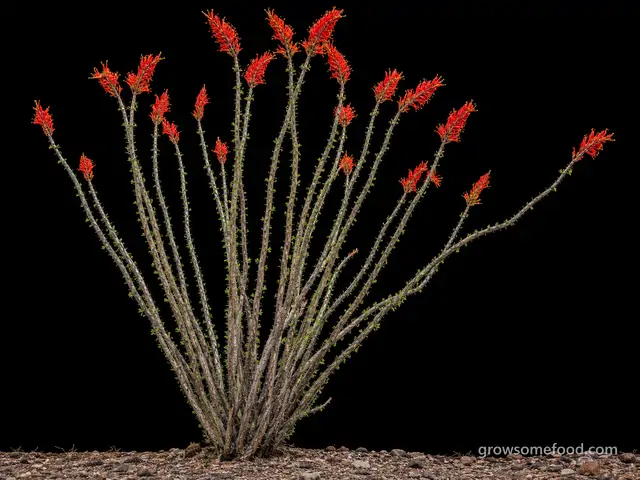
Ocotillo
Not a cactus but a dramatic desert shrub - a fountain of tall, thorny, whip-like canes that leaf out within days of rain and blaze with red hummingbird flowers at their tips each spring; a sculptural, drought-proof xeriscape signature with edible, nectar-rich blooms.
Safety notes Ocotillo is NOT a cactus - a desert shrub whose whip-like canes are lined with stiff, sharp thorns, so handle bare canes with thick gloves. The red tubular flowers are edible: suck the nectar, steep them into a drink, or scatter them on salads. Bark and roots have a folk medicinal use, not a casual edible. LEGAL: ocotillo is protected under Arizona's native plant law and California's Desert Native Plants Act - buy nursery-grown or permit-tagged salvaged canes; digging wild plants is an offense.
Overview
Ocotillo (Fouquieria splendens) is one of the most dramatic and distinctive plants of the American desert - and, despite the spines, it is not a cactus but a member of its own family, the Fouquieriaceae. From a short base it throws up a spreading fountain of tall, slender, woody whip-like canes - often 10 to 20 feet - lined with stiff thorns, giving it names like 'coachwhip' and 'candlewood.' Native across the Sonoran and Chihuahuan Deserts, it is a signature silhouette of the Southwest.
The one thing to knowOcotillo (Fouquieria splendens) is one of the most dramatic and distinctive plants of the American desert - and, despite the spines, it is not a cactus but a member of its own family, the Fouquieriaceae.
Quick facts
- Sprouts in
- 21 daysRange: 10–60 days
- Soil temperature
- 80 °FRange: 70–90 °F
- Height
- 15 ftRange: 8–20 ft
- Spread
- 10 ftRange: 5–15 ft
- Cold
- Takes light frostdamaged below 10°F
- Heat
- Struggles above 118°F
- Life cycle
- Perennial, lives about 60 years
- Save seeds
- About 70 days after plantingRange: 45–120 days
- Self-sows
- Yes, expect volunteers
- Soil
- Well-drained
- Water
- Low
- Plant spacing
- 8 ftRange: 5–12 ft
When to plant
No planting window on record for this zone. Nearest zone with one: 8a.
Frost here: last around Apr 10 (Mar 27 to Apr 24 most years), first around Oct 25. Zone averages, your own yard may run a week or two either way.
Life stages
Establish, grow, repeat
Getting established and returning each season are different parts of the story.
Stage 1 of 4 · Getting established
Rooting in (the slow, tricky year)
The first year after planting
Care at this stage
-
Mist the canes and water lightly to establish
Ocotillo is notoriously slow to root, especially bare-root transplants and cane cuttings. Keep the soil lightly moist (not wet) during establishment, and traditionally MIST the canes regularly, which seems to help them take. Once rooted it is drought-proof. Patience is essential - it can look dead for many months before leafing out.
-
Plant bare-root canes at the right depth, orient as grown
Set bare-root or cutting canes upright and firmly, at the depth they grew, in full sun and sharply drained soil; stake if needed. Keep the original orientation. Do not overwater - rot is the main failure. Many transplants fail from impatience and overwatering, not cold.
Months are typical seasonal windows; climate, variety, and plant age can shift them.
Harvest
- Flame-red tubular flowers fully open in dense clusters at the cane tips, in spring
- Nectar sweet when a flower is pulled and sucked
- Harvest some flowers, leaving plenty for hummingbirds and to set seed
- Harvest the sweet-nectar red flowers · every 5 days
- A key hummingbird nectar source
Picking pick as they ripen
Watch out for
3 to know. 2 are high-risk: Root Rot, Transplant / Establishment Failure. None are active in October.
Root RotSeverity High DiseaseSeason: Jan, Feb, Jul, Aug, Nov, DecWilting in the middle of the day on a plant whose soil is damp - the classic tell, and the reason people water a rotting plant and finish it off.
The classic ocotillo failure is overwatering a bare, slow-to-root new plant. Keep the soil only lightly moist while it establishes, dry once rooted, and withhold water in winter. Once the base rots the plant is usually lost.
Wilting in the middle of the day on a plant whose soil is damp - the classic tell, and the reason people water a rotting plant and finish it off. Leaves yellowing from the bottom up, dull off-color foliage, and growth that stalls for no visible reason. Whole shoots, or one side of the plant, collapsing while the rest still looks fine. Soft, dark, or mushy tissue at the base of the stem or at the crown, sometimes with a sour smell. Lift a failing plant and look at the roots: healthy ones are firm and pale, rotted ones are brown or black and slimy, and the outer layer slips off between your fingers leaving a thread of core behind. Seedlings that topple over at soil level are the same problem, called damping-off.
There is no cure for tissue that has already rotted, so act on the conditions rather than looking for a spray. Stop watering at once and fix the drainage - open up compacted soil, or move the plant to a raised, sharply drained position or a container. Lift a badly affected plant, cut away every soft dark root and rotted section with a clean blade back to firm pale tissue, and replant only the healthy parts into fresh free-draining soil or mix. Often the better move is to give up on the plant and save its offspring instead: cuttings, offsets, or divisions taken from firm healthy growth root readily and give you a clean start. Bin the rotted material rather than composting it, and correct the drainage before you replant, because the rot comes straight back in the same wet spot.
Drainage is the whole defense. Match the plant to the site first - something that wants sharp drainage will not survive heavy clay or a low, water-collecting spot however well you tend it. Where the ground is heavy, plant on a raised bed, berm, or slope, or grow in a container. Set plants at the depth they were already growing, since burying the crown or the root flare is a common cause of rot, and keep mulch pulled back a few inches from the stem base instead of piled against it. Water the soil rather than the calendar: check that the top inch or two is dry before watering again, cut back hard in cool weather and winter dormancy, and never leave a pot standing in a full saucer. Do not plant or dig in soggy ground, and go easy on rich amendments for plants that want it lean. Rotate annual crops, and start with clean healthy plants and fresh mix.
Root rot is not one organism but a group of soil fungi and water molds - Pythium, Phytophthora, Fusarium, Rhizoctonia and others - that sit harmlessly in most soils and only turn destructive when the ground stays saturated. Waterlogged soil drives the air out, the roots suffocate, and the weakened tissue is invaded and goes soft, brown, and stringy. Because the damage is underground you usually see it first as something that looks like drought: wilting, yellowing, stunting, a plant that does not respond to being watered. Overwatering, heavy compacted ground, a low spot that collects runoff, a pot with no drainage or a saucer left standing full, and cold wet soil in winter are the usual causes. Once roots have actually rotted there is no cure - this is a problem you prevent rather than treat.
Transplant / Establishment FailureSeverity High DisorderSeason: Mar–JunA transplanted cane that never leafs out, gradually shrivels, and browns through to the core (scratch test shows no green).
A transplanted cane that never leafs out, gradually shrivels, and browns through to the core (scratch test shows no green).
None once a cane has died; improve odds next time with correct planting, misting, restraint on water, and patience, or start from seed.
Plant firmly at the right depth and orientation in spring; keep soil lightly moist (not wet) and mist the canes; be patient for many months; consider seed, which often establishes more reliably.
Not a pest but the defining difficulty: bare-root ocotillo canes are notoriously slow and unreliable to root, and a large fraction of transplants fail - usually from overwatering (rot) or from impatience when the plant stays bare and 'dead-looking' for months.
Frost Damage (young plants)Severity Medium DisorderSeason: Dec–FebBlackened, scarred, water-soaked, or collapsing tissue and cracked skin following a hard or extended freeze, especially at the growing tip.
Blackened, scarred, water-soaked, or collapsing tissue and cracked skin following a hard or extended freeze, especially at the growing tip.
Leave lightly frost-scarred tissue in place (it hardens off); watch scarred areas for secondary rot and cut out any soft, spreading lesions. Severely frozen young plants may not recover.
Grow within its warm range (roughly zones 8-11); protect young plants with frost cloth on hard-freeze nights; keep soil dry going into cold; use a warm, sheltered microclimate.
Cold injury during hard or prolonged freezes, worst on young plants near the cool edge of its range (it is hardy only to about the low 20s F). Established plants tolerate light frost and often resprout from the base if top-killed.
Good & bad neighbors
Plant nearby
-
The solid low barrel and the airy tall ocotillo canes make a strong form contrast, both drought-proof desert natives wanting identical dry, sunny, sharply drained conditions.
-
Brittlebush's silvery mounds and spring yellow daisies fill the ground beneath an ocotillo, blooming at the same season and sharing its dry, sunny, low-water needs.
-
Both are premier hummingbird plants that bloom in the desert spring - penstemon spikes below, ocotillo flowers above - a strong nectar pairing on the same lean, sunny terms.
-
A classic Sonoran Desert pairing: the tall arm-raised saguaro and the spreading fountain of ocotillo canes are the two signature silhouettes of the desert, sharing full sun and sharp drainage.


Varieties · 3
You pick one when you add Ocotillo to your garden. Its days to maturity set your harvest window.
Ocotillo (Fouquieria splendens)
The classic species: a fountain of tall, thorny, whip-like woody canes from a short base, drought-deciduous (leafing within days of rain), tipped each spring with flaming red tubular hummingbird flowers.
Variety details for Ocotillo (Fouquieria splendens)
Spreading fan of tall thorny canes, green-leaved after rain, with clusters of red flowers at the tips.
speciesnativewhip-canesred-flowerNative across the Sonoran and Chihuahuan Deserts; also planted as a living fence. Slow to establish, then nearly indestructible.
Living-Fence Ocotillo (rooted cane rows)
Not a botanical variety but the traditional use: fresh ocotillo canes set in a close row to root (variably) into a thorny, impenetrable, flowering living fence - a beautiful regional barrier still seen around old Southwestern homesteads.
Variety details for Living-Fence Ocotillo (rooted cane rows)
A row of upright thorny canes knitting into a living, red-flowering hedge.
traditional-useliving-fencebarriercuttingsUse legally sourced or nursery canes; rooting success varies.
Boojum Tree (Fouquieria columnaris)
A famous Baja California relative in the same genus: a bizarre, tapering, columnar 'upside-down carrot' of a tree with short lateral branches, beloved by collectors.
Variety details for Boojum Tree (Fouquieria columnaris)
Pale, tapering, unbranched-looking column with short twiggy side branches - unmistakable.
related-speciescollectorbizarrebajaSlow, tender, and a striking specimen for frost-free warm gardens - a curiosity showing the strangeness of the ocotillo family.
Grower tips
Notes from growers, tagged with the zone they grow in. A person reads every post before it appears.
Nobody has posted about Ocotillo yet. The first one usually saves someone a season.
Free account. Your post shows your grower name and zone, never your email.