Add it to your home screen and it opens full screen — no browser bars, one tap away, and everything stays signed in. Free, nothing to download from an app store.
- Tap the Share button in your browser
- Scroll down and choose “Add to Home Screen”
- Open GrowSomeFood from your home screen
- Open your browser’s menu
- Choose “Add to Home screen” or “Install app”
- Open GrowSomeFood from your home screen
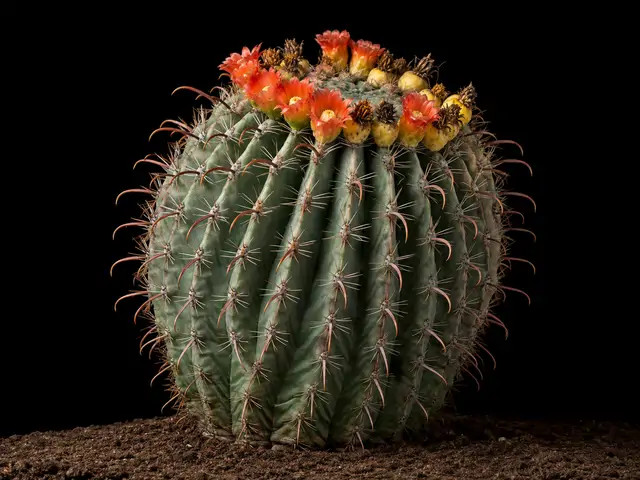
Barrel Cactus
The barrel cactus is a valuable ornamental with an edible bonus: the yellow fruit, its seeds, and the flower buds are all edible (the fruit is tart, the seeds nutty). The hazard is entirely physical - stout, sharp, curved 'fishhook' spines that can hook and tear skin and are hard to back out. Handle only with thick leather gloves and tongs, and site it away from paths and children. Not to be confused with drinkable 'water' - the pulp is bitter and mildly purgative, not a survival water source.
Overview
The classic squat, ribbed, fishhook-spined desert cactus - tough, sculptural, and slow - that crowns itself with orange-yellow flowers and persistent yellow fruit, offering an easy xeriscape centerpiece and a genuine (if minor) edible harvest.
The barrel cactus (Ferocactus wislizeni) is the quintessential squat, ribbed, barrel-shaped cactus of the American Southwest — a solid green cylinder armored with stout, curved 'fishhook' spines, native across the Sonoran and Chihuahuan Deserts of Arizona, New Mexico, and West Texas. Slow-growing and long-lived, it reaches two to four feet (occasionally much taller with great age) and makes one of the most reliable, sculptural, and easy-care cacti for a desert garden.
It earns its keep ornamentally with a ring of funnel-shaped flowers — yellow, orange, or red — that open around the crown in late summer, followed by bright yellow, pineapple-shaped fruits that persist for months. Those fruits, their nutty seeds, and the flower buds are all edible, giving a real if modest desert harvest (the fruit was historically candied into 'cactus candy'). It is also famous for two habits: leaning south as the 'compass barrel,' and its myth as a 'barrel of water' — in truth the bitter pulp is no survival drink. Give it full sun and sharp drainage and it practically grows itself.
At a glance
- Sun
- Full sun
- Water
- Low
- Spacing
- 24–60 in (typ. 36)
- Mature height
- 24–96 in (typ. 48)
- Start by
- Direct sow · Transplant
- Frost
- SemiHardy
- Germination
- 14–60 days (typ. 30) @ 70–92 °F (typ. 82)
When to plant
No planting window on record for this zone.
Life stages
- Rooting in (year 1) day 0–120 from transplant
-
Water lightly to establish, then let it dryGive a newly planted barrel occasional deep watering during warm months to root in, always letting the gritty soil dry fully between. Once established it needs almost no water. Wet, poorly drained soil is the main killer - dry is always safer than wet.
-
Ease it into full sun and protect from hard frostPlant into full sun and sharply drained soil; if moving a shaded nursery plant, harden it to strong sun gradually to avoid sunscald. Protect young plants from hard freezes with frost cloth in the coldest part of its range.
Rot at the base from wet soilSunscald (pale, yellowed patch) on the sun-facing side of a newly exposed plantFrost scarring on young plants -
Water lightly to establish, then let it dry
- Slow, steady growth Apr, May, Jun, Sep, Oct (yearly)
-
Watch it lean south - the 'compass barrel'Barrel cacti often grow leaning toward the south or southwest (faster shaded-side growth tilts them sun-ward), earning the name 'compass barrel.' A slow but steady grower, it needs no pruning or feeding - just full sun and sharp drainage.
-
Water rarely once establishedAn established barrel stores water in its ribbed body and needs watering only in prolonged drought during the hottest months, if at all. Never water in winter. Overwatering is the classic mistake.
Soft, dark, or sunken spots (rot)Cochineal scale (white cottony masses)Leaning strongly south (normal 'compass' habit) -
Watch it lean south - the 'compass barrel'
- Crown of flowers (late summer) Jul, Aug, Sep (yearly)
-
A ring of orange-yellow flowers at the topIn late summer, often timed to the monsoon, a ring of showy funnel-shaped flowers in yellow, orange, or red opens around the crown, drawing bees and other pollinators. These become the fruit. Just enjoy the display.
-
Flower buds are edible tooBefore they open, the flower buds can be picked (with tongs, de-spined) and cooked as a traditional desert vegetable - though leaving most to bloom and set fruit is usually the better choice on a garden plant.
Bees and native pollinators on the crown flowersPoor bloom on young or heavily shaded plants -
A ring of orange-yellow flowers at the top
- Yellow fruit (fall into winter) Jan, Sep, Oct, Nov, Dec (yearly)
-
Twist off the persistent yellow fruitevery 14 dBright yellow, pineapple-shaped fruits ring the crown after flowering and persist for months, even through winter. Twist them off with tongs when plump; the tart pulp and nutty black seeds are edible (the seeds were traditionally dried and ground). Always de-spine and handle with gloves - never bare-handed.
-
Leave plenty for wildlifeBirds, javelina, and other desert wildlife relish the fruit, so a garden plant can share - take a few fruits and leave the rest as forage and for self-seeding.
Javelina, birds, and rodents taking the fruitFruit dropping and self-sown seedlingsFishhook spines when reaching in (use tongs and gloves) -
Twist off the persistent yellow fruitevery 14 d
- Winter rest Jan, Feb, Dec (yearly)
-
Keep dry, shield young plants from hard frostWithhold water entirely in winter - cold plus wet soil is what rots a barrel cactus. Established plants in the low and mid desert take light frost, but protect young or borderline plants from hard freezes with frost cloth.
Rot from cold, wet soilFrost scarring after a hard freeze -
Keep dry, shield young plants from hard frost
Harvest
- Style
- Repeated picking
- First production
- 4–15 yrs (typ. 8)
- Yellow fruit plump and easily twisted off, ringing the crown in fall and persisting into winter
- Flower buds picked before opening for the traditional cooked vegetable
- All spines and glochids removed before eating anything
Watch out for
Root Rot Disease HighJan, Feb, Jul, Aug, Nov, Dec
Soil-borne rots that kill yarrow kept in wet, heavy, or poorly drained soil - the main way to lose an otherwise indestructible plant, since yarrow is adapted to dry, lean ground.
Watch for: Wilting, blackening, and collapse despite (or because of) moist soil; soft dark roots; sudden decline after a wet spell or in soggy winter ground.
Prevent: Sharp drainage is everything - lean gritty soil, full sun, minimal water, no rich amendments; raised beds or slopes in wet sites.
Treat: None once the roots rot - remove affected plants, take divisions from healthy outer growth, and replant into far sharper-draining conditions.
Cochineal Scale Pest LowMay, Jun, Jul, Aug, Sep
The famous dye insect: a scale that lives on prickly pear pads under a protective white cottony wax, sucking sap. Light infestations are cosmetic, but heavy ones weaken and disfigure pads. Crushing the white masses releases the deep crimson dye that made cochineal historically valuable.
Watch for: Fluffy white cottony masses clustered on the pads (crimson-red liquid when crushed), yellowing or weakening of heavily infested pads.
Prevent: Inspect new plants, give good airflow and full sun, and knock small infestations off early before they build.
Treat: Blast off with a strong jet of water (the simplest control), or use insecticidal soap or horticultural oil on heavy infestations; remove badly infested pads.
Sunscald & Corky Scab Disorder LowMay, Jun, Jul, Aug
Corky, tan, or yellowed scarring of the skin from sunscald - often after abrupt exposure of a shaded plant to intense low-desert sun. Cosmetic but permanent.
Watch for: Pale, corky, tan or yellow patches on the sun-facing side, especially on newly moved plants in the hottest desert.
Prevent: Give light afternoon shade in the fiercest low desert, harden shaded plants to full sun gradually, and avoid keeping the surface wet in intense sun.
Treat: None needed - the scarring is cosmetic and permanent; prevent further scald with gradual sun exposure and light afternoon shade.
Good & bad neighbors
Varieties · 3
The classic species: a solid ribbed barrel to 2-4 feet (taller with age) armored in stout curved fishhook spines, with a late-summer ring of orange-to-yellow flowers and persistent yellow fruit. Often leans south as the 'compass barrel.' Native to the Sonoran and Chihuahuan Deserts.
A closely related western barrel of the Sonoran and Mojave Deserts (Arizona, California, Nevada), often taller and more cylindrical with reddish spines and yellow flowers. Similar culture and equally drought-tough; a good choice for California desert gardens.
A striking Baja California barrel prized ornamentally for its dense, bright red spines that seem to glow against the green body, with red-and-yellow flowers. Slightly more tender; a favorite for warm-climate collectors and dramatic xeriscape accents.
Grow
Full sun and fast-draining gritty soil are the whole recipe - it rots in wet ground, not from cold. Plant nursery-raised barrels in spring, keep the original south side facing south, water sparingly, and expect slow, steady growth.
Barrel cactus is one of the easiest cacti to grow where winters are mild. Give it full sun and sharply drained, gritty or rocky soil — that is essentially the entire requirement. Like most desert cacti, its enemy is not cold so much as wet feet: it rots quickly in poorly drained or overwatered soil. Plant nursery-raised barrels in spring as the soil warms; when you set one in, note and preserve its original south-facing orientation (that side is toughened to sun) to avoid sunscald, and stake a tall plant until its roots anchor.
Water a new plant occasionally through its first warm season to establish, always letting the soil dry completely, then taper off — an established barrel needs watering only in prolonged summer drought, if at all, and none in winter. Skip fertilizer. Expect slow, steady growth and a plant that leans gradually southward (the 'compass' habit). It is hardy to roughly the mid-teens Fahrenheit (about zones 8-11); in the colder end of that range, protect young plants from hard freezes and grow it in the ground only where winters stay mild, or in a pot to move under cover.
Care
Almost nothing: no feeding, little to no water, no pruning. The real tasks are keeping it dry (especially in winter), protecting young plants from frost, and handling it safely - those fishhook spines are unforgiving.
An established barrel cactus is close to zero-maintenance. It wants no fertilizer, no pruning, and little to no supplemental water — rainfall usually suffices, and the reliable way to kill it is to overwater it or plant it in soil that stays wet. Withhold water entirely in winter, when cold-plus-wet soil causes rot. The body swelling in the wet season and contracting in drought is normal.
The genuine 'care' is about safe handling and frost protection of young plants. Those stout, curved fishhook spines hook into skin and clothing and are painful and hard to back out, so always work around the plant with thick leather gloves and long tongs, and site it well away from paths, doorways, and play areas. In the colder parts of its range, cover young or borderline plants with frost cloth on hard-freeze nights. Watch occasionally for cochineal scale (white cottony masses, easily hosed off) and for any soft, dark, sunken spots that signal rot. Otherwise, leave it be.
Nutrition
A minor but real desert food: the tart yellow fruit offers a little vitamin C and moisture, the small black seeds are notably nutritious (oil- and protein-rich, traditionally ground into meal), and the buds are a cooked vegetable - all eaten in modest amounts.
Barrel cactus is grown mainly as an ornamental, but it delivers a genuine, if minor, desert food. The bright yellow fruit is tart and only lightly juicy, contributing some vitamin C and moisture; it is eaten fresh in small amounts and was historically boiled with sugar into 'cactus candy,' a Southwestern confection. The many small black seeds are the more nutritious part — rich in oils and protein — and were traditionally dried and ground into a meal or added to other foods by desert peoples. The unopened flower buds are eaten as a cooked vegetable.
A word on the plant's most persistent myth: the barrel is not a reliable emergency water source. Its inner tissue holds moisture, but the pulp is bitter and mildly purgative and can cause nausea, so slicing one open to drink is both a poor survival strategy and destructive to a slow-growing native — and in Arizona these cacti are also protected. Enjoy the fruit and seeds as a small foraged treat from your own garden plant, and treat the 'water barrel' idea as folklore rather than fact.
History
A long-used desert plant of the Sonoran and Chihuahuan peoples - source of candied fruit, ground seed meal, and cooked buds, its curved spines even serving as fishhooks - and a modern xeriscape staple and enduring 'barrel of water' legend.
The barrel cactus has a long, practical history with the peoples of the Sonoran and Chihuahuan Deserts. Its fruit was gathered and candied, its oily seeds ground into meal, and its flower buds cooked as a vegetable; the stout curved spines were even used as fishhooks and awls, which is one story behind the 'fishhook' name. The plant also carried the enduring reputation as a 'barrel of water' — a supposed emergency drink for lost travelers — a legend that persists in survival lore despite the pulp being bitter and mildly sickening rather than a safe water source.
Its scientific name honors the 19th-century naturalist and surveyor Frederick Adolph Wislizenus, who documented plants of the Southwest and northern Mexico. In the modern era the barrel cactus has become a xeriscape and desert-landscape staple across the low deserts, valued for its bold form, easy care, late-summer flowers, and long-lasting fruit — and, like the saguaro, it is protected from wild collection in Arizona, so garden plants come from nurseries. It remains one of the most recognizable and characterful cacti of the American desert.
Troubleshooting
Rot from wet soil is the top killer; sunscald, frost scarring, and cochineal scale are the other issues; slow growth and a southward lean are normal, not problems; and the spines make careful handling essential.
Soft, dark, sunken, or mushy spots; the plant collapsing or smelling foul: rot from wet, poorly drained soil or overwatering — the number-one killer. Stop watering, improve drainage, cut out small early rot with a clean tool, and keep it bone dry, especially in winter. Pale, yellowed, corky patch on the sun-facing side: sunscald, usually from moving a shaded plant abruptly into full sun or from the wrong orientation — keep the original south side facing south and harden plants to sun gradually; the scar is cosmetic. Blackened or scarred tissue after winter: frost damage — grow only where winters are mild enough, protect young plants with frost cloth, and never water into cold wet soil. White cottony masses on the ribs: cochineal scale — blast off with a strong water jet or treat with insecticidal soap/horticultural oil. It's leaning strongly to the south: normal 'compass barrel' behavior, not a problem (a very tall old plant may eventually topple from the lean — then it can be reset). Barely growing / not flowering: barrels are naturally slow and bloom only once well established — give it full sun and time. And always handle with gloves and tongs — the fishhook spines are the most common 'problem' of all.
Growing across climates
A warm-desert plant for roughly zones 8-11: superbly heat- and drought-adapted and a touch hardier than the saguaro, but limited by hard freezes and, above all, by wet or poorly drained soil, so it thrives only where winters are mild and drainage is sharp.
Barrel cactus is a plant of the hot low and mid deserts, and its climate range reflects that. It excels across the Sonoran and Chihuahuan Deserts (roughly zones 8-11), thriving on blazing heat, intense sun, and the sharp drainage of rocky desert soil, and shrugging off drought by storing water in its ribbed body. It is somewhat hardier than the saguaro, tolerating brief cold into the mid-teens Fahrenheit, which lets it grow a bit farther into the cooler edges of the desert and into protected spots in warm-temperate gardens.
Its limits are the usual desert-cactus pair: hard cold and wet soil. Prolonged or severe freezes damage or kill it (young plants most of all), so in the colder end of its range give it a warm microclimate and frost protection when young. And like all barrels it cannot abide soggy, humid, or poorly drained conditions — in wet-winter or heavy-soil climates it rots, so gardeners outside the arid Southwest do best growing it in a fast-draining pot they can keep dry and shelter from cold. Give it heat, full sun, and sharp drainage, and it is one of the toughest, most trouble-free cacti you can grow.
No grower tips for Barrel Cactus yet — yours could be the first.
Sign in to share what works in your garden.