
Add it to your home screen and it opens full screen: no browser bars, one tap away, and everything stays signed in. Free, nothing to download from an app store.
- Tap the Share button in your browser
- Scroll down and choose “Add to Home Screen”
- Open GrowSomeFood from your home screen
- Open your browser’s menu
- Choose “Add to Home screen” or “Install app”
- Open GrowSomeFood from your home screen
Mulberry
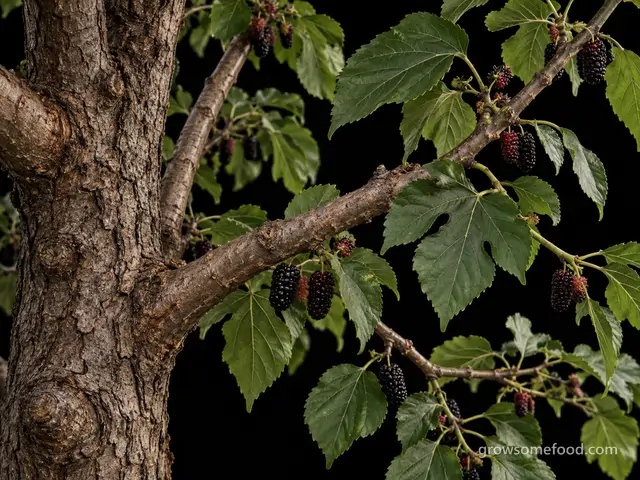
A fast, tough, nearly carefree fruit tree that bears in a year or two and drops sweet berries for weeks - most types self-fruitful. The two things to know going in: the fruit stains everything, and birds love it (which you can turn to your advantage).
Safety notes Ripe fruit is safe and delicious. Unripe (white/green) berries and the milky sap of leaves and stems can cause vomiting, diarrhea and, in quantity, central-nervous-system effects including hallucinations; the sap also irritates skin and mouth. Eat only fully ripe fruit, and tell children not to graze green berries. Young leaves are edible cooked only (a traditional green and the food of silkworms) or dried for tea - never eat raw mulberry leaves.
Overview
The mulberry is one of the easiest, fastest, and most generous fruit trees you can plant - vigorous, adaptable, largely pest-free, and bearing sweet berries in just a year or two on a tree that can live for generations. Most named varieties are self-fruitful (many even set fruit with no pollination), so one tree crops on its own. The catch is abundance: a mature mulberry buries you in fruit that ripens over a long window and drops when ready, so you harvest by laying a sheet and shaking rather than picking berry by berry.
The one thing to knowMost named varieties are self-fruitful (many even set fruit with no pollination), so one tree crops on its own.
Quick facts
- Winter chill
- 350 hours below 45°FRange: 100–500 hours
- Height
- 30 ftRange: 8–60 ft
- Spread
- 25 ftRange: 8–45 ft
- Cold
- Takes hard frostdamaged below -25°F
- Heat
- Struggles above 105°F
- Life cycle
- Perennial, lives about 75 years
- Self-sows
- Yes, expect volunteers
- Soil
- Well-drained
- Water
- Medium
- Plant spacing
- 25 ftRange: 15–40 ft
When to plant
Nothing is open today. Spring transplanting opens 5 months, Mar 13 to May 10.
- Transplant Mar 13 – May 10 Opens in 145 daysAbout 4 weeks before to 4 weeks after your last frost (Apr 10 here)The broad sweet spot for mulberries. Plant in early spring; the whole range of hardy hybrids and reds thrives here.
- Transplant Aug 26 – Oct 4 Opens in 311 daysAbout 9 weeks before to 3 weeks before your first frost (Oct 25 here)Fall planting lets roots establish over a mild winter before spring growth.
Frost here: last around Apr 10 (Mar 27 to Apr 24 most years), first around Oct 25. Zone averages, your own yard may run a week or two either way.
Life stages
Establish, grow, repeat
Getting established and returning each season are different parts of the story.
Stage 1 of 5 · Getting established
First-year establishment
The first year after planting
Care at this stage
-
Water regularly through the first season
Keep the root zone evenly moist the first summer to establish the roots. Mulberries become notably drought-tolerant once established, but a young tree needs steady water to root in.
-
Site it FAR from patios, walks, driveways, and cars
This is the decision you can't undo: ripe mulberries drop and their juice stains concrete, decks, siding, and paintwork a deep purple that's nearly impossible to remove - and birds spread it further. Plant well away from anything you don't want stained, and over lawn or mulch, not paving.
-
Mulch to hold moisture and suppress weeds
A wide mulch ring conserves moisture for the young tree and keeps mowers and string trimmers off the trunk. Keep mulch a few inches back from the bark.
-
Set the scaffold and keep it low for easy picking
Mulberries grow fast and tall. Head back the leader and select well-spaced scaffold branches in the first year or two to keep the tree at a pickable height - a full-size mulberry can reach 30-60 feet, far above where you can harvest.
Months are typical seasonal windows; climate, variety, and plant age can shift them.
Harvest
- Berry is fully colored for the variety (deep purple-black, red, or - for white types - creamy or blush)
- Fruit is soft and yields to a gentle touch
- Ripe berries detach at the lightest touch and drop when shaken
- The fruit is sweet and juicy, not tart or crunchy
- Lay a sheet and shake - don't try to pick each berry · every 2 days
- Net small trees or accept sharing with the birds
Per plant 5 to 100 lbPicking pick as they ripen
Cook with mulberries
Watch out for
4 to know. 1 is high-risk: Birds & Wildlife. None are active in October.
Birds & WildlifeSeverity High WildlifeSeason: May–AugFruit disappearing from the outermost, most exposed parts of the plant first, and from the top of a tree where you cannot reach anyway.
The one mulberry pest that is often a feature rather than a bug: the tree's heavy cropping and bird-magnet appeal make it a classic decoy tree for drawing birds off other fruit. On a large tree, harvest the reachable fruit by sheet-shaking and let the birds have the top.
Fruit disappearing from the outermost, most exposed parts of the plant first, and from the top of a tree where you cannot reach anyway. Single neat pecks and gouges in ripening fruit, with several fruits sampled rather than one eaten through - the classic sign that it was birds rather than an animal. Heads of grain or seed going visibly lighter and emptier as they ripen, with hulls and chaff scattered underneath. Freshly sown seed vanishing off the surface of a bed before it germinates. Bird traffic in and out of the plant picking up as the crop colors, and birds waiting on nearby wires and branches. Wasps arriving at the pecked and split fruit shortly afterward.
There is no treatment once a crop is being taken - only protection and timing, so the answer is to get netting on and to pick what is ready. Reflective tape, flash ribbon, spinners, and decoy predators do work, but only for a few days at a time: birds habituate fast, so move and rotate them and never rely on them as the main defense for a crop you care about. Cut and gather grain or seed heads a little early, at firm dough, and finish drying them under cover instead of leaving them standing for the flocks. Plant a little extra, or a decoy crop the birds prefer, and accept sharing anything that crops heavily. On a wild or foraged patch, fruit going to birds and small mammals is the point of the plant rather than a problem to solve.
Net, and net early. Bird netting draped over a frame or hoops so it stands off the fruit, with the edges closed at ground level, is the only thing that reliably works at harvest scale - and it has to go on before the crop starts to color, because once birds have found the food they are far harder to displace. Keep fruit trees small enough that netting them is actually feasible; that decision gets made years earlier, at planting. Bags of mesh, organza, or paper slipped over individual heads, clusters, or prize fruit protect a small crop without netting the whole plant. Then shorten the exposure: pick promptly and completely rather than leaving ripe fruit hanging as a lure, clear split and dropped fruit that draws birds and wasps alike, and where a crop can finish off the plant, harvest a little early and ripen or dry it under cover. Rake in or cover broadcast seed so it is not lying in plain view.
Birds find ripening fruit and seed before you do. Robins, waxwings, starlings, catbirds, jays, sparrows, finches, blackbirds, and doves all work a garden, and the pressure arrives in a narrow window - the last days before harvest, when sugar rises, color changes, and the crop softens or the grain hardens. A flock can strip a small planting in a day or two, and birds that only peck rather than take whole fruit still leave wounds that rot or draw wasps. Squirrels, chipmunks, and other wildlife usually turn up on the same crop at the same time. This is competition rather than disease: the birds are not harming the plant, and a big tree or a heavy-cropping bush often has enough for everyone - but on a small planting it can be the difference between a harvest and none.
Spotted Wing DrosophilaSeverity Medium PestSeason: Jun–AugSoft, sunken, weeping fruit that collapses under light pressure, and tiny egg-laying scars on otherwise perfect ripening berries.
Because mulberries ripen over weeks and drop heavily, the dropped fruit is a major SWD breeding source - clearing windfalls matters as much for this pest as for staining and wasps.
Soft, sunken, weeping fruit that collapses under light pressure, and tiny egg-laying scars on otherwise perfect ripening berries. To confirm, crush or float suspect fruit in salt water (1-2 teaspoons per cup) and look for small white maggots floating out. In an apple-cider-vinegar or yeast-sugar trap, the males carry a distinct dark spot at each wingtip.
There is no rescue for infested fruit. Control is relentless sanitation plus trap-based monitoring to time any spray: bag or freeze culls rather than leaving them, never drop them on the ground, and use vinegar or yeast-sugar traps to tell you when the flies have arrived. Well-timed targeted sprays such as spinosad are used where pressure is high - use only a product labeled for the crop you are treating, follow the label exactly, and observe its pre-harvest interval.
Pick short and often - every two or three days through the ripening window - and remove ALL overripe and dropped fruit, because culls left on the plant or the ground breed the next generation. Cool the harvest to about 35°F promptly, which stops larvae developing in fruit you have already picked. Fine mesh under 1 mm excludes the fly where pressure is high.
An invasive vinegar fly (Drosophila suzukii). Unlike ordinary fruit flies, which need damaged or overripe fruit, the female has a saw-edged ovipositor that cuts into sound, intact, ripening fruit to lay her eggs. The larvae feed inside, so the fruit softens, sinks, weeps and collapses just as you were about to pick it. It has become the dominant pest of soft fruit across the country, and the old rule that fruit flies only bother spoiled fruit no longer applies.
Scale & Sooty MoldSeverity Low PestSeason: Apr–AugRows of small brown, tan, black, white, or waxy bumps along stems, twigs, leaf midribs, and leaf undersides that do not brush off but can be scraped loose with a fingernail.
Several scale species use mulberry, including the notable white mulberry scale. Light infestations rarely need action on a vigorous tree; a dormant horticultural-oil spray smothers overwintering scale where it does build up.
Rows of small brown, tan, black, white, or waxy bumps along stems, twigs, leaf midribs, and leaf undersides that do not brush off but can be scraped loose with a fingernail. A sticky shine on the leaves - and on the floor, table, or path beneath the plant - that later turns black with sooty mold. Ants running steadily up and down the stems, since they farm and defend scale for that honeydew; often the first sign anything is wrong. Yellowing leaves, weak thin growth, and dieback of individual branches or canes that are heavily encrusted. On fruit crops, scale covers and sooty mold directly on the fruit. Check the leaf undersides and the shaded inner wood, which is where colonies build up unseen.
Horticultural oil is the main control: it works by smothering, so it has to coat the insects thoroughly - stems, twigs, and leaf undersides - and it usually needs repeating, because the waxy covering shields them and no single pass reaches everything. On deciduous woody plants a dormant-season oil smothers the overwintering stage while the leaves are out of the way, and timing a growing-season spray to the crawler stage, when the young are mobile and uncovered, is far more effective than spraying settled adults. On a small plant or a light infestation, scrub or wipe the scales off by hand, or dab them with a cotton swab of rubbing alcohol. Prune out and destroy badly encrusted wood rather than trying to save it. Wash off the sooty mold once the scale is gone - it lives on the honeydew, not on the plant, and stops once the supply does. Anything you spray must be labeled for the plant, and oils can burn delicate foliage, so test first.
Inspect. Look over leaf undersides and stems regularly - on a crop you pick, every harvest is a scouting chance - and check every new plant thoroughly before you buy it, plant it, or set it beside anything else, because scale almost always arrives on a plant rather than flying in. Quarantine new houseplants for a few weeks. Keep plants unstressed and not over-fertilized, since soft, forced growth is what populations build on. Prune for airflow and light to open up the shaded inner growth where scale hides, and prune out heavily infested wood as routine maintenance - on anything that gets a hard annual pruning, that alone removes most of any buildup. Leave the lady beetles, lacewings, and parasitic wasps alone, since they normally keep scale down to nothing, and keep ants off the plant where you can, because ants protect the colonies from those predators. Indoors, avoid hot, dry, still winter air.
Scale insects are sap-suckers that spend most of their lives immobile, fixed to a stem, twig, or leaf underside beneath a waxy or shell-like cover. They look far more like bumps, blisters, or crusty encrustations than like insects, which is why an infestation is usually well established before anyone notices it. Soft scales excrete large amounts of sticky honeydew that drips onto everything below and grows a black sooty mold - and those blackened leaves are often the first thing a gardener actually sees. Armored scales produce no honeydew but sit under a hard shield that protects them from most sprays. They spread as tiny mobile crawlers in the weeks after hatching, which is the only stage that moves and the only stage that is easy to kill. Populations build on stressed plants, on crowded shaded growth, and above all on plants kept indoors in dry, still air over winter.
WhitefliesSeverity Low PestSeason: May–SepClouds of tiny white insects rising when you shake the plant, flat scale-like nymphs stuck to the leaf undersides, a sticky shine on the leaves below them, black sooty mold over that, and yellowing, weakened growth.
Mulberry whitefly and a few related species build up on mulberry, but the damage is cosmetic on an established tree and predators usually settle it without help.
Clouds of tiny white insects rising when you shake the plant, flat scale-like nymphs stuck to the leaf undersides, a sticky shine on the leaves below them, black sooty mold over that, and yellowing, weakened growth.
Hose off light infestations, then spray insecticidal soap or horticultural oil onto the leaf undersides where they actually sit. Sprays do not kill the eggs, so repeat every few days for two or three weeks or the population simply rebuilds. Yellow sticky traps knock back the adults, and outdoors natural enemies usually finish the job.
Inspect the undersides of any new plant before it joins the others, and quarantine anything you are bringing under cover or indoors for winter. Avoid crowding and heavy nitrogen feeding, which produce the soft growth they prefer. Hang yellow sticky traps early to catch the build-up while it is still small, and encourage lacewings, ladybugs and parasitic wasps outdoors.
Tiny white sap-sucking insects that cluster on leaf undersides and lift off in a cloud when the foliage is brushed. They weaken growth, and the honeydew they excrete coats the leaves below in a sticky film that blackens with sooty mold. Some species also transmit plant viruses. They breed fast in warm, still, sheltered air, which is why they are far more trouble under cover and on plants overwintered indoors than on the same plant outside.
Good & bad neighbors
Plant nearby
-
CherryThe classic 'decoy tree' pairing: a fruiting mulberry near cherries (or blueberries) lures birds to the mulberries - which they prefer and which crop heavily - sparing your more prized, harder-to-net fruit. A genuinely useful, if unconventional, companion tactic.
-
Same decoy logic: birds hitting a heavy-cropping mulberry leave the blueberries alone. Keep the mulberry far enough that its staining drop and shade don't fall on the acid-loving blueberry bed.
- Traditional pairings, thin evidence
-
A living-mulch groundcover under the tree fixes some nitrogen, feeds pollinators, and cushions dropped fruit; keeps mowers off the trunk.
-
ComfreyA classic deep-rooted 'dynamic accumulator' under fruit trees - draws up nutrients, and its chopped leaves make a mulch/mineral top-dress. Traditional permaculture guild plant.
Keep apart
- Traditional pairings, thin evidence
-
WalnutBlack walnut's juglone inhibits many plants; keep a mulberry clear of the walnut's root zone to be safe, though mulberries are more juglone-tolerant than many fruit trees.
Varieties · 10
You pick one when you add Mulberry to your garden. Its days to maturity set your harvest window.
White x red hybrid (Morus alba x rubra) 4 varieties
Illinois Everbearing
The home-garden classic and the mulberry most people should start with: a white x red (M.
Variety details for Illinois Everbearing
Long (1+ inch), deep purple-black, very sweet, nearly seedless berries.
hybridself-fertilecold-hardyeverbearingResists Cold (to about -20°F)
alba x rubra) hybrid that's widely adaptable, very cold-hardy (to about −20°F - zone 5, and zone 4b in sheltered sites), heavy-bearing, and self-fertile. Long, sweet, nearly seedless dark purple-black berries ripen over an extended 'everbearing' window. The dependable default. Note: somewhat prone to popcorn disease in the humid South.
Dwarf Everbearing (Issai)
A true dwarf (often 4-8 ft) that fruits while young and small and even bears in a large container - the pick for patios, small yards, and cold-zone growers who overwinter pots.
Variety details for Dwarf Everbearing (Issai)
Medium, dark purple-black sweet berries on a compact 4-8 ft plant.
dwarfself-fertilecontainer-friendlyeverbearingSelf-fertile and everbearing, ripening dark berries over a long season. Sold widely as 'Dwarf Everbearing' or the related 'Issai'. The compact, low-fuss choice.
White mulberry (Morus alba) 3 varieties
Weeping (Morus alba 'Pendula')
A weeping-form white mulberry grown as much for its cascading, umbrella-like ornamental habit as for fruit - a small landscape tree with trailing branches.
Variety details for Weeping (Morus alba 'Pendula')
Cascading, weeping branches; fruiting forms bear dark or white sweet berries.
weepingornamentalself-fertilecompactFruiting forms give sweet berries; some sold forms are fruitless males chosen for landscaping (confirm before buying if you want fruit - and note that fruitless male mulberry is the heavy pollen shedder the desert-Southwest city bans were written against). A decorative dual-purpose tree.
Kokuso (Korean Mulberry)
A hardy Korean M.
Variety details for Kokuso (Korean Mulberry)
Medium, sweet, dark berries; large tender edible leaves.
cold-hardyself-fertileproductivegood-leavesResists Cold (hardy)
alba selection valued for both good fruit and excellent, tender leaves (long grown for silkworms and as an edible green). Cold-hardy, productive, and self-fertile, with sweet dark berries. A strong choice if you want the leaf crop as well as the fruit.
Red mulberry (Morus rubra) 1 variety
Red Mulberry (Morus rubra)
The native eastern-North-American mulberry - a large forest tree bearing sweet, dark red-to-purple berries prized by wildlife and people alike.
Variety details for Red Mulberry (Morus rubra)
Medium, dark red-to-purple, sweet berries on a large native tree.
nativeself-fertileeast-adaptedwildlifeWell adapted to the humid East (zones 5-9) and valuable for native plantings and wildlife, though slower and larger than the garden hybrids. The heritage American species. It is state-listed as threatened or endangered in parts of its range and is being genetically swamped by hybridization with white mulberry, so buy nursery-grown stock and never dig one from the wild.
Black mulberry (Morus nigra) 1 variety
Black Beauty (Morus nigra)
A true black mulberry (M.
Variety details for Black Beauty (Morus nigra)
Medium, plump, intensely flavored deep black berries on a compact tree.
black-mulberrybest-flavorself-fertilewarm-climatenigra) - the connoisseur's mulberry, with the richest, most complex, wine-like flavor of any mulberry and a naturally compact habit good for small gardens. The trade-off is tenderness: reliably hardy only in zones 7-10 and best in mild, dry-summer climates. Worth the fuss for the flavor.
Other varieties 1 variety
Pakistan
Famous for spectacularly long fruit - deep red to purple-black berries reaching 3-4 inches, firm, sweet, and superb fresh.
Variety details for Pakistan
Very long (3-4 inch), firm, deep red-to-black, sweet berries.
long-fruitself-fertilewarm-climatefresh-eatingA warm-climate mulberry that needs a long hot season and mild winters (best zones 7-10); less cold-hardy than the hybrids. A showpiece fresh-eating variety for the South and West.
Grower tips
Notes from growers, tagged with the zone they grow in. A person reads every post before it appears.
Nobody has posted about Mulberry yet. The first one usually saves someone a season.
Free account. Your post shows your grower name and zone, never your email.