
Add it to your home screen and it opens full screen: no browser bars, one tap away, and everything stays signed in. Free, nothing to download from an app store.
- Tap the Share button in your browser
- Scroll down and choose “Add to Home Screen”
- Open GrowSomeFood from your home screen
- Open your browser’s menu
- Choose “Add to Home screen” or “Install app”
- Open GrowSomeFood from your home screen

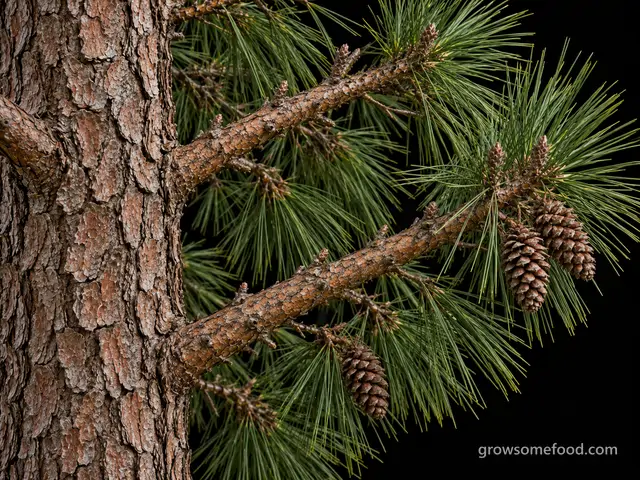
Loblolly Pine
The fast-growing workhorse pine of the South - the most planted timber tree in the United States, colonizing old fields, giving quick evergreen shade and screening, and forming much of the region's second-growth forest.
Safety notes Loblolly pine is safe to grow and handle - it's a fast-growing evergreen timber, shade, and wildlife tree, not a food plant. Its needles ('pine straw') are widely raked as garden mulch. The main practical considerations are its large size, fast soft wood that can drop limbs and lean in storms, and its acidic needle litter - site it for the long term rather than for any safety concern.
Overview
Loblolly pine (Pinus taeda) is the great workhorse of the Southern forest - a fast-growing, adaptable evergreen that has become the most planted timber tree in the United States. Reaching 60-90 feet (sometimes over 100), with needles in bundles of three (occasionally two), 6-9 inches long, and spiny cones, it grows quickly to a tall, straight tree with a high, open, rounded crown. Its name comes from 'loblolly,' an old word for a wet mudhole - a nod to its habit of springing up in low, moist, disturbed ground.
The one thing to knowLoblolly pine (Pinus taeda) is the great workhorse of the Southern forest - a fast-growing, adaptable evergreen that has become the most planted timber tree in the United States.
Quick facts
- Sprouts in
- 21 daysRange: 14–35 days
- Soil temperature
- 75 °FRange: 65–85 °F
- Height
- 85 ftRange: 60–110 ft
- Spread
- 35 ftRange: 25–45 ft
- Cold
- Takes hard frostdamaged below -10°F
- Heat
- Struggles above 105°F
- Life cycle
- Perennial, lives about 200 years
- Save seeds
- About 180 days after plantingRange: 150–210 days
- Self-sows
- Yes, expect volunteers
- Soil
- Well-drained
- Water
- Medium
- Plant spacing
- 30 ftRange: 15–50 ft
When to plant
Fall transplanting is open for 26 more days. Next: winter, Jan 1 to Mar 15.
- Transplant Sep 10 – Nov 15 Open now · 26 days leftAbout 6 weeks before to 3 weeks after your first frost (Oct 25 here)Fall planting also works in the mild South, letting roots settle before spring growth; water through establishment.
- Direct sow Oct 11 – Nov 15 Open now · 26 days leftAbout 2 weeks before to 3 weeks after your first frost (Oct 25 here)Sow fresh seed on exposed mineral soil in full sun in fall for spring germination; loblolly self-seeds readily into old fields and openings. Seedlings and containers are more reliable for a planned planting.
- Transplant Jan 1 – Mar 15 Opens in 73 daysPlant seedlings or container trees in the cool, moist late-winter months into full sun and well-drained soil; loblolly establishes fast and is planted by the millions for timber and reforestation in this window.
Frost here: last around Apr 10 (Mar 27 to Apr 24 most years), first around Oct 25. Zone averages, your own yard may run a week or two either way.
Life stages
Establish, grow, repeat
Getting established and returning each season are different parts of the story.
Stage 1 of 3 · Getting established
Years 1-2 - fast-starting seedling
About the first 1.5 years after planting
Care at this stage
-
Water regularly while establishing
Water a young loblolly regularly through its first year or two, especially in drought. Unlike longleaf, loblolly has no grass stage - it grows fast from the start, often several feet a year once rooted in, so keep it moist while it takes off.
-
Mulch the root zone
A wide mulch ring conserves moisture and reduces grass competition on the fast-growing seedling; keep it back from the trunk. Loblolly readily colonizes old fields and disturbed ground, so it establishes easily.
-
Site it with room for a big, fast tree
Loblolly becomes a large (60-90+ foot) evergreen quickly. Give it full sun and plenty of room away from buildings and power lines - and remember its fast, relatively soft wood makes it more storm- and lean-prone than the slow hardwoods, so keep it clear of targets.
Months are typical seasonal windows; climate, variety, and plant age can shift them.
Watch out for
3 to know. 1 is high-risk: Southern Pine Beetle. None are active in October.
Southern Pine BeetleSeverity High PestSeason: Apr–SepPopcorn-like white or reddish pitch tubes on the trunk, fading yellow-then-red crowns, S-shaped galleries under the bark, and expanding 'spots' of dying trees.
Popcorn-like white or reddish pitch tubes on the trunk, fading yellow-then-red crowns, S-shaped galleries under the bark, and expanding 'spots' of dying trees.
There's no home cure for an infested tree - promptly remove and destroy attacked trees to slow spread, and consult a forester for stand-level outbreaks. Healthy, well-spaced, unstressed trees are the best defense.
Keep trees vigorous and unstressed, avoid wounding trunks, don't overcrowd, and thin dense stands to reduce competition stress - stand density is the single biggest factor you control.
The most destructive insect pest of Southern pines: a tiny bark beetle that bores through the bark and constructs S-shaped galleries in the inner bark, girdling and killing trees. It attacks stressed, crowded, or wounded pines and can spread rapidly through a stand in outbreak years. Susceptibility varies by pine species and, more than anything, by how crowded and stressed the stand is.
Fusiform RustSeverity Medium DiseaseSeason: Mar–MayElongated, spindle-shaped swellings (galls) on branches and stems, sometimes oozing orange spores in spring; branch dieback beyond galls and stem cankers on young trees.
Elongated, spindle-shaped swellings (galls) on branches and stems, sometimes oozing orange spores in spring; branch dieback beyond galls and stem cankers on young trees.
Prune out branch galls before they reach the trunk; trees with trunk galls near the base are often best removed, as the galls weaken and can kill young stems. Resistance and siting are the main controls.
Plant rust-resistant improved stock and match the species to the site in high-rust regions, avoid heavy oak cover next to susceptible young pines, and remove branch galls where practical.
A native rust fungus that alternates between pines and oaks and forms spindle-shaped swelling galls on pine branches and trunks. Susceptibility differs sharply between Southern pine species; where the rust is common, the choice of species and of rust-resistant improved planting stock decides how much damage a stand takes.
Nantucket Pine Tip MothSeverity Low PestSeason: Apr–JulBrowning, dying, or hollowed-out shoot tips on young trees in spring and summer, webbing and pitch at the tips, and crooked or bushy growth from lost leaders.
Browning, dying, or hollowed-out shoot tips on young trees in spring and summer, webbing and pitch at the tips, and crooked or bushy growth from lost leaders.
Usually not warranted on landscape trees - the damage is cosmetic and outgrown; heavily attacked nursery or plantation seedlings can be treated with timed insecticide, but home trees rarely need it.
Vigorous growth helps young trees outgrow the damage; avoid stressing seedlings, and encourage the parasitic wasps that control the moth.
A small moth whose larvae bore into and kill the tips of new shoots on young pines, causing dead, browning shoot tips and bushy, forked growth; mainly an issue on young loblolly and other hard pines, rarely a threat to established trees.
Good & bad neighbors
Plant nearby
-
Native blueberries relish the acidic, well-drained soil beneath pines - a natural understory pairing, since pine needle litter keeps the ground acidic just as blueberries like it.
-
A classic Southern pine-woods understory tree that blooms in the light shade beneath tall loblolly pines - the natural dogwood-under-pine layering of Southeastern second-growth forest.
-
Two Southern pines with opposite strategies - fast generalist loblolly and slow, fire-specialized longleaf; in restoration, fast loblolly is sometimes used for quick cover while longleaf and its savanna are re-established, though loblolly can also crowd out the keystone longleaf.
- Traditional pairings, thin evidence
-
A native bunchgrass for the sunny edges and openings of an open-grown pine planting, adding ground-layer structure and wildlife value where enough light reaches the ground.


Varieties · 2
You pick one when you add Loblolly Pine to your garden. Its days to maturity set your harvest window.
Loblolly Pine (Pinus taeda)
The wild species: a fast-growing (60-90+ foot) Southern evergreen with 6-9 inch needles and spiny cones, colonizing old fields and thriving on a wide range of sites.
Variety details for Loblolly Pine (Pinus taeda)
Tall, straight pine with a high rounded crown, long needles in bundles of three (occasionally two), and spiny cones.
speciesnativefast-growingadaptableThe most planted timber tree in the U.S. and a quick native shade, screen, and windbreak tree.
Improved timber selections
Genetically improved loblolly stock bred over generations for faster growth, straighter stems, and fusiform-rust resistance - the standard planting stock for Southern timber plantations and reforestation, and a good choice where fast, disease-resistant growth is the goal.
Variety details for Improved timber selections
Vigorous, straight, uniform loblolly with improved growth rate and rust resistance.
cultivarfast-growingrust-resistantstraight-stemmed
Grower tips
Notes from growers, tagged with the zone they grow in. A person reads every post before it appears.
Nobody has posted about Loblolly Pine yet. The first one usually saves someone a season.
Free account. Your post shows your grower name and zone, never your email.