Add it to your home screen and it opens full screen: no browser bars, one tap away, and everything stays signed in. Free, nothing to download from an app store.
- Tap the Share button in your browser
- Scroll down and choose “Add to Home Screen”
- Open GrowSomeFood from your home screen
- Open your browser’s menu
- Choose “Add to Home screen” or “Install app”
- Open GrowSomeFood from your home screen
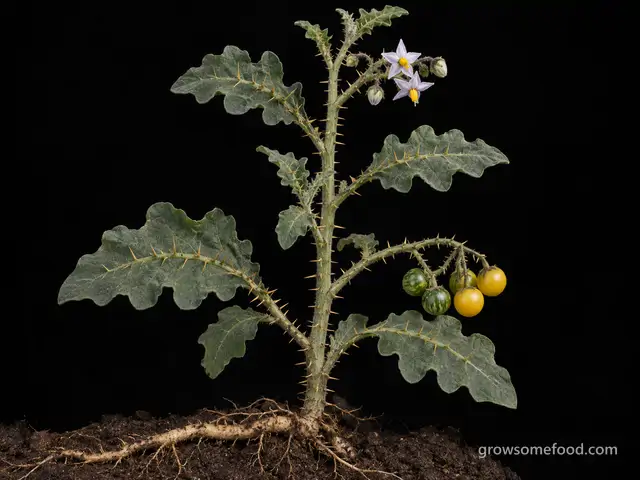
Horsenettle
Not a nettle - a nightshade, and a hard one. Horsenettle hangs yellow berries that look like tiny tomatoes at child height, and comes back from roots three feet down that make a new plant from every piece a tiller cuts. This entry is for identifying it and getting rid of it.
Every part is toxic, and the yellow berries are the dangerous part because they look like small tomatoes at knee height. They carry solanine-type glycoalkaloids: vomiting, cramping stomach pain, diarrhoea and drowsiness, and in quantity slowed breathing and heart-rhythm changes. Children and pets are the usual cases; livestock are poisoned mostly by berries baled into hay. Call poison control for any ingestion, and a vet for an animal. Wear gloves - the prickles are sharp.
Overview
The one thing to knowIt is a nightshade - a close relative of tomato, potato and eggplant - and the prickles that earned it the name do not sting, they just draw blood.
Horsenettle is not a nettle. It is a nightshade - a close relative of tomato, potato and eggplant - and the prickles that earned it the name do not sting, they just draw blood. What actually matters about this plant is two things, and both of them catch people out.
The first is the fruit. From late summer it hangs glossy yellow berries about half an inch across, on bare stalks, at knee height, in lawns and paddocks and along the edges of vegetable beds. They look like small tomatoes and they are toxic, and the classic case in the poison-control literature is a child who ate a handful. Every part of the plant carries solanine-type glycoalkaloids, but the berries are what get eaten.
The second is the root. Horsenettle is a deep, creeping perennial whose fleshy roots run several feet sideways and two to three feet down, with buds all along them. That is why the two things everyone tries first both fail: pulling snaps the root and prunes the plant, and rototilling chops one plant into fifty. Getting rid of it is a two-to-four-year job of never letting it rebuild its reserves, and the timing of when you cut matters more than the tool you use.
It is genuinely native to the southeastern United States, which occasionally gets it treated as a wildflower - and bumblebees really do buzz-pollinate its flowers. But it was carried across the continent in hay, seed and livestock, and in a lawn, a hayfield or a vegetable garden it is a weed with a hazard attached. Learn the prickled leaf midrib, watch for the yellow berry, and start on the roots.
Quick facts
For identification. Not a growing guide.
- Life cycle
- Perennial, lives about 10 years
- Where it grows
- Full sun · Part sun, well-drained soil
- Height
- 24 in12 to 48
- Spread
- 30 in12 to 60
- Cold
- Takes hard frostdamaged below -25°F
- Heat
- Struggles above 110°F
- Self-sows
- Yes. Never let it set seed.
Through the year
How to recognize it in each season.
Spring shoots from the root system (find it now)
Apr to Jun, every year- Recognize it: prickles on the stems AND along the leaf midribsShoots come up late, well after the first spring weeds, from roots rather than from seed - so they appear in the same spots as last year, often in a rough line. Look for straight yellowish prickles on the stem and, crucially, on the midrib of the leaf on both surfaces. Leaves are alternate, oblong, 2 to 6 inches, with a few wavy lobes down each side, and feel like fine sandpaper from a coat of tiny star-shaped hairs. Nothing else in a lawn or bed is armed on the leaf vein like this.
- Dig small plants out whole - and never rototill a patchA young, isolated shoot can be forked out if the soil is moist and loose and you follow the root down and sideways until it ends. Get every piece: a fragment under an inch long, with one bud on it, makes a new plant. Do NOT pull - the root snaps and you have simply pruned it. Do NOT till or rotovate a horsenettle patch: chopping the root system is how one plant becomes fifty, and it is the single most common way gardeners make this weed worse.
Key signs- Late-emerging shoots in the same places as last year
- Prickles on the leaf midribs, not just the stems
- Any resprout after digging - remove it the week it appears
White to pale-violet star flowers (the control window)
Jun to Sep, every year- A tomato flower on a prickly stalkFlowers are five-pointed stars about an inch across, white to pale violet, with a protruding cone of bright yellow anthers - unmistakably a nightshade flower, and near-identical to a potato or eggplant bloom. They come in small clusters off the side of the stem from early summer into autumn, and bumblebees buzz-pollinate them. Once you have seen the flower there is no doubt what the plant is.
- Cut or treat at full bloom, not beforeThis is the moment worth knowing. At full bloom and early fruit, and again on fall regrowth, the plant is moving sugars DOWN into its roots - so anything systemic goes down with them. Cutting or treating in May, while it is still pushing growth upward, mostly wastes the effort. If you are mowing to exhaust it, cut every 2 to 4 weeks from first shoots until frost; one annual mowing achieves nothing at all.
- Do not let it fruit where children, pets or hay areEverything that follows the flower is the hazard. In a lawn, play area, paddock or hayfield, cut the plants down before the berries form rather than waiting for a convenient day. It is far easier to remove flowers than to police ripe berries later, and berries cut into hay are the classic route to livestock poisoning.
Key signs- White or pale-violet star flowers with a yellow anther cone
- Plants flowering below mowing height in short turf
- Flowers in a hayfield - cut before the fruit sets
Yellow berries - the poisoning risk
Aug to Nov, every year- Strip and bag the berries before anyone else finds themFruit starts green with pale marbling, like a tiny watermelon, and ripens to a smooth glossy yellow ball about half an inch across on a bare stalk. That is what a small child sees as a tomato, and it sits at knee height. Wearing gloves, strip the berries into a bag and put them in the trash - never the compost, where the seed survives and the fruit is still findable. Then deal with the plant.
- Check hay, paddocks and anywhere animals feedGrazing animals normally leave the growing plant alone because of the prickles, so pasture poisoning is uncommon. The real risk is hay: berries baled with the crop lose their spines and their bitterness cues and get eaten with everything else. Walk hayfields before cutting and check bought-in hay for the shrivelled orange-tan berries and prickly stem pieces.
Key signs- Glossy yellow berries about half an inch across at child height
- Berries dropping into a lawn or play area
- Prickly stems and dried berries in baled hay
Winter: dead stalks, shrivelled berries, living roots
Nov to Mar, every year- Dead stems still hold fruit all winterFrost kills the top growth, but the stalks stand through winter with wrinkled orange-tan berries still attached - which is both a hazard and a gift, because a dormant garden is the easiest place in the year to see exactly where every plant is. Walk the ground, mark or flag each stem, and bag the old fruit.
- The roots are alive two to three feet downNothing above ground reflects what is below it. Horsenettle overwinters as thick, fleshy, creeping roots that run several feet sideways and two to three feet deep, carrying buds along their whole length, and they resprout regardless of what happened to the top. Winter is for planning a two-to-four-year campaign and for keeping the tiller away from marked ground, not for a quick dig.
Key signs- Standing dead stems with shrivelled berries
- Marked patches to keep out of spring tillage
- New shoots appearing late the following spring
Watch out for
4 to know. 2 are high-risk: Regrowth from Deep Creeping Roots, Toxic Yellow Berries. 4 are active in September.
Regrowth from Deep Creeping RootsSeverity High DisordernowShoots reappearing in the same places each spring, often in rough lines; a clump of several shoots where one plant was pulled; a sudden scatter of new plants across a bed that was rotovated last season.
Shoots reappearing in the same places each spring, often in rough lines; a clump of several shoots where one plant was pulled; a sudden scatter of new plants across a bed that was rotovated last season.
Dig rather than pull, following each root to its end in moist loose soil, then check the spot every two to three weeks and remove each resprout the week it appears. In larger areas, cut every two to four weeks from first shoots until frost. Systemic herbicide works only if timed to full bloom or fall regrowth, when sugars move downward; use a product whose label lists the site and follow that label. Expect two to four years.
Never rototill ground carrying horsenettle - mark the patches and keep the machine out. Do not move soil, hay or manure from an infested area to a clean one, and knock the mud off tillage equipment. Remove isolated new plants while they are small and single-stemmed.
Why horsenettle beats most gardeners. Its fleshy creeping roots run several feet sideways and two to three feet down, carry dormant buds along their whole length, and hold enough stored energy to rebuild the top growth repeatedly. A root fragment about an inch long, with one bud, makes a new plant. So pulling snaps the root and prunes the plant, tilling chops one plant into dozens and spreads them evenly through the bed, and a single mowing each year achieves nothing at all.
Toxic Yellow BerriesSeverity High HazardnowGlossy yellow berries at child height in lawns, play areas, paddocks and bed edges; berries dropped into turf; prickly stems and dried orange berries in bought-in hay; dead winter stalks still holding fruit.
Glossy yellow berries at child height in lawns, play areas, paddocks and bed edges; berries dropped into turf; prickly stems and dried orange berries in bought-in hay; dead winter stalks still holding fruit.
Call poison control for any ingestion by a person, and a veterinarian for an animal, without waiting for symptoms; photograph the plant. Remove the fruit and then work on the plant. There is no preparation that makes any part of this plant safe to eat.
Cut plants down before the fruit sets rather than policing ripe berries later. Where children, pets or animals have access, strip the berries into a bag and put them in the trash - never the compost. Walk hayfields before cutting and check hay you buy in.
The berries are the hazard that makes this plant more than a nuisance. Round, about half an inch, glossy yellow, on bare stalks at knee height from late summer until they shrivel to orange-tan on the winter stems - they look like small tomatoes, and the standard case is a child who ate several. All parts of the plant carry solanine-type glycoalkaloids, but the fruit is what gets eaten. Poisoning presents as nausea, vomiting, cramping abdominal pain, diarrhoea and drowsiness; in larger doses, depressed breathing and heart-rhythm changes are documented. Livestock are usually poisoned not in the pasture, where the prickles put them off, but from berries baled into hay.
Prickles (Handling and Machinery)Severity Medium DisordernowPrickles on the leaf midrib as well as the stem - this is also the identifying feature.
Prickles on the leaf midrib as well as the stem - this is also the identifying feature. Dried prickly stem pieces in baled hay and in raked-up garden debris.
Clean puncture wounds promptly and watch them; see a clinician for anything that stays painful, swells or discharges. Bag prickly debris rather than leaving it where people or animals walk.
Wear thick gloves and long sleeves for any work on this plant, and rake cut material rather than gathering it by hand. Keep tetanus cover current if you garden regularly on ground carrying it.
Not a sting - a mechanical hazard. Stiff yellowish prickles up to a quarter inch arm the stems, the leaf stalks and the midribs of the leaves on both surfaces, so there is no comfortable way to grasp the plant. Punctures from soil-borne prickles are dirty wounds, they are easy to collect while weeding barehanded or picking up cut stems, and dried prickly stems in hay are unpleasant for both handlers and livestock.
Reservoir for Tomato & Potato ProblemsSeverity Medium DiseasenowColorado potato beetle adults or larvae feeding on horsenettle at a bed edge; flea beetle shot-holing on its leaves; a nightshade crop hit hard in a garden where the rotation should have broken the cycle.
Colorado potato beetle adults or larvae feeding on horsenettle at a bed edge; flea beetle shot-holing on its leaves; a nightshade crop hit hard in a garden where the rotation should have broken the cycle.
Remove the plants and bag the debris rather than composting it. Treat the crop problem on its own terms, but expect it to return each year while a horsenettle stand remains within reach of the bed.
Clear horsenettle out of and around beds intended for tomatoes, potatoes, peppers and eggplant a season ahead, by hand rather than by tilling, and count any nearby stand as part of the same rotation group.
As a perennial wild relative of tomato, potato, pepper and eggplant, horsenettle is a documented alternate host for Colorado potato beetle and flea beetles and for several nightshade viruses and diseases. Because it is a perennial with a living root, it holds those problems through the winter in a way an annual weed cannot, so a stand at the edge of a vegetable garden quietly undoes the crop rotation you were relying on.
Good & bad neighbors
First rule: keep Potato apart. A genuine conflict, not folklore.
Keep apart
-
A genuine conflict, not folklore. Horsenettle is a wild Solanum and a documented host for Colorado potato beetle and for nightshade viruses and diseases, so a stand of it at the edge of a potato bed carries them from one season to the next and quietly cancels your rotation. It also makes the bed impossible to till without multiplying the weed. Clear horsenettle out of and around potato ground before you plant, by hand rather than with a rotovator.
-
Same family, same problems. Horsenettle hosts pests and diseases shared with tomato and overwinters as a living root right beside the bed, so it acts as a bridge between seasons. There is also a practical hazard: its yellow berries hang at picking height next to ripening tomatoes, in a bed people reach into without looking. Remove it from tomato ground first.
-
Eggplant is the closest crop relative of all, and horsenettle is a favoured alternate host for flea beetles and Colorado potato beetle that move straight onto it. Keep eggplant beds clear of horsenettle for at least a season before planting, and count any nearby stand as part of the same rotation group.
-
Another nightshade sharing horsenettle's pests and viruses. The bigger issue in a pepper bed is mechanical: peppers want regular cultivation, and cultivating around horsenettle chops its roots into new plants. Clear it out first, then plant.
Grower tips
Notes from growers, tagged with the zone they grow in. A person reads every post before it appears.
Nobody has posted about Horsenettle yet.
Free account. Your post shows your grower name and zone, never your email.