Add it to your home screen and it opens full screen: no browser bars, one tap away, and everything stays signed in. Free, nothing to download from an app store.
- Tap the Share button in your browser
- Scroll down and choose “Add to Home Screen”
- Open GrowSomeFood from your home screen
- Open your browser’s menu
- Choose “Add to Home screen” or “Install app”
- Open GrowSomeFood from your home screen
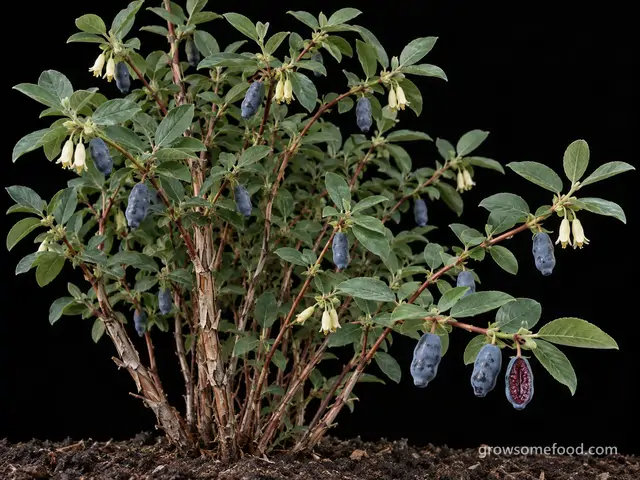
Honeyberry
The first fruit of the year and the toughest berry you can plant: hardy to around -40 degrees, no acid soil required, and ripe weeks before strawberries - as long as you plant two compatible varieties.
The fruit is safe, and this is a genuine edible honeysuckle - but it is the only one. The red and orange berries of ornamental and invasive bush honeysuckles (Tatarian, Amur, Morrow's) are not food and cause vomiting and diarrhea, especially in children. Eat only plump BLUE, oblong berries from a plant you bought as honeyberry or haskap, and teach children the same rule.
Overview
The one thing to knowHoneyberry - sold just as often as haskap - is an edible honeysuckle from the boreal north, and it is the earliest fruit most gardens will ever produce.
Honeyberry - sold just as often as haskap - is an edible honeysuckle from the boreal north, and it is the earliest fruit most gardens will ever produce. Oblong blue berries with a flavor somewhere between blueberry, raspberry and black currant ripen two to four weeks ahead of strawberries, on a bush that is hardy to roughly -40°F and whose flowers shrug off a frost that would wipe out a peach. For cold-climate gardeners it is one of the few genuinely reliable fruits.
It has two enormous practical advantages over a blueberry: it does not need acid soil (ordinary garden ground at pH 5 to 7 is fine), and it needs almost no spraying. It has one absolute requirement in exchange: honeyberry cannot pollinate itself. You must plant at least two different named varieties whose bloom overlaps, or you will get a healthy bush covered in flowers and not one berry. Nearly every disappointed honeyberry owner made that one mistake at the checkout.
Quick facts
- Life cycle
- Perennial, lives about 30 years
- Height
- 5 ft3 to 7
- Spread
- 4.5 ft3 to 6
- Cold
- Takes hard frostdamaged below -40°F
- Heat
- Struggles above 85°F
Full sun or part sun · medium water · well-drained soil · 5 ft apart (3 to 6) · transplant or cuttings
When to plant
Fall transplanting is open for 13 more days.
- Transplant Aug 16 – Oct 4 Open now · 13 days leftAbout 10 weeks before to 3 weeks before your first frost (Oct 25 here)Zone 7 is the warm edge and only works with genuinely cool summers - give afternoon shade, deep mulch and steady water. In the hot humid Southeast honeyberry generally fails regardless of zone number.
Frost here: last around Apr 10 (Mar 27 to Apr 24 most years), first around Oct 25. Zone averages, your own yard may run a week or two either way.
Life stages
One stage to settle in, then four that repeat each year. Windows are typical; your zone and weather move them.
Settling in (years 1-3)
Day 0 to 240 after transplanting- DoPlant TWO different varieties that bloom togetherHoneyberry cannot pollinate itself, and a lone bush flowers heavily and sets nothing. Plant at least two different named varieties from the same bloom group, within about 15 feet of each other. This is the single decision that makes or breaks the crop - make it at purchase, not later.
- WaterKeep the root zone evenly moistevery 3 daysThe roots are shallow and fibrous, so a young bush dries out fast and sulks. Water so the top few inches never go bone dry through the first two summers.
- MulchMulch 3-4 inches with wood chips or leavesMulch is doing real work here: it keeps the shallow roots cool and damp, which is exactly what this boreal shrub wants and exactly what a hot open bed denies it.
- PruneDo not prune for the first three yearsYoung honeyberries look scruffy and grow slowly above ground while they build roots. Leave them alone - there is nothing to fix, and pruning only sets them back.
Watch for- A bush that stays small for two seasons (normal - they accelerate in year three)
- Leaf edges scorching in a hot open site
- Rabbits browsing young stems in winter
Winter and pruning
Nov to Feb, every year- PruneRenewal-prune while fully dormant, from year fourTake out dead and broken wood, open the middle for light and air, and cut about a quarter of the oldest stems right down to the base to force young productive wood. Never shear the outside of the bush into a ball - honeyberry fruits on last year's growth.
- ProtectExpect it to wake absurdly earlyHoneyberry breaks dormancy before almost anything else in the garden - buds swell in late winter. That is normal and not a mistake you have made; the wood is hardy to around -40°F and the flowers to about 20°F.
Watch for- Deer and rabbit browsing on dormant stems
- Buds swelling in a midwinter warm spell (normal for this plant)
Bloom (earliest in the garden)
Mar to May, every year- PollinateCheck that both varieties are actually in bloom togetherCross-pollination only happens if the two bushes have open flowers at the same time. If your partner variety consistently blooms a week after the first has finished, it is the wrong partner - add a third variety from the matching bloom group.
- InspectLeave the bumblebees to itBumblebees do most of the work, because they fly in the cold, drizzly weather that honeyberry blooms in. Do not spray anything at bloom, and it helps to have early flowers nearby for them.
Watch for- Pale yellow tubular flowers opening in cold weather (correct)
- Heavy bloom on a solitary bush - flowers with no partner will simply drop
- A hard freeze below about 20°F while flowers are open
Green fruit sizing
Apr to Jun, every year- WaterWater steadily while the berries fillevery 4 daysFruit is mostly water and the roots are shallow. An inch to an inch and a half a week during sizing sets berry size and stops the bush shedding fruit.
- ProtectGet the netting on BEFORE any color showsBirds find honeyberries first, partly because nothing else is ripe yet. Net over a frame with the edges closed at ground level, and do it while the fruit is still green - once birds have found the bush they are very hard to displace.
Watch for- Fruit dropping in a dry spell
- Birds beginning to work the bush
- Leaves scorching in an early heat wave
Picking
May to Jul, every year- HarvestWait two to three weeks AFTER the berries turn blueevery 5 daysThis is the mistake everyone makes once. The skin colors long before the fruit sweetens, so a just-blue honeyberry is mouth-puckeringly sour. Cut one open: green flesh inside means wait, deep purple-red flesh means pick.
- HarvestPick over several passes, or shake onto a sheetevery 5 daysBerries do not all ripen at once. Take the ones that release with a light touch, or spread a sheet under the bush and shake it - the truly ripe fruit falls and the rest stays put.
- ProtectKeep the net closed and clear dropped fruitLeave the netting up until the last picking, and clear fallen berries at each pass so you are not baiting birds and wasps back to the bush.
Watch for- Sour fruit (picked too early - the commonest complaint about this plant)
- Soft berries splitting in wet weather
- Birds getting under a loose net edge
Harvest
- Fully deep blue with a dusty bloom, and left another two to three weeks after that
- Cut one open - the flesh inside is deep purple-red, not green
- Berries release with a light touch, and taste sweet rather than sharply sour
- Wait two to three weeks AFTER the berries turn blue · every 5 days
- Pick over several passes, or shake onto a sheet · every 5 days
- Keep the net closed and clear dropped fruit
Per plant 1 to 10 lbPicking pick as they ripen
Cook with honeyberries
Watch out for
4 to know. 1 is high-risk: Birds & Wildlife. 2 are active in September.
Birds & WildlifeSeverity High WildlifeThe number-one honeyberry problem, and worse here than on other berries because this is the first fruit of the year - the birds have nothing else to eat and they know when it is ripe before you do.
The netting has to go on while the fruit is still green, and the wait-two-weeks-past-blue rule means the crop sits temptingly ripe for far longer than a blueberry does.
Fruit disappearing from the outermost, most exposed parts of the plant first, and from the top of a tree where you cannot reach anyway. Single neat pecks and gouges in ripening fruit, with several fruits sampled rather than one eaten through - the classic sign that it was birds rather than an animal. Heads of grain or seed going visibly lighter and emptier as they ripen, with hulls and chaff scattered underneath. Freshly sown seed vanishing off the surface of a bed before it germinates. Bird traffic in and out of the plant picking up as the crop colors, and birds waiting on nearby wires and branches. Wasps arriving at the pecked and split fruit shortly afterward.
There is no treatment once a crop is being taken - only protection and timing, so the answer is to get netting on and to pick what is ready. Reflective tape, flash ribbon, spinners, and decoy predators do work, but only for a few days at a time: birds habituate fast, so move and rotate them and never rely on them as the main defense for a crop you care about. Cut and gather grain or seed heads a little early, at firm dough, and finish drying them under cover instead of leaving them standing for the flocks. Plant a little extra, or a decoy crop the birds prefer, and accept sharing anything that crops heavily. On a wild or foraged patch, fruit going to birds and small mammals is the point of the plant rather than a problem to solve.
Net, and net early. Bird netting draped over a frame or hoops so it stands off the fruit, with the edges closed at ground level, is the only thing that reliably works at harvest scale - and it has to go on before the crop starts to color, because once birds have found the food they are far harder to displace. Keep fruit trees small enough that netting them is actually feasible; that decision gets made years earlier, at planting. Bags of mesh, organza, or paper slipped over individual heads, clusters, or prize fruit protect a small crop without netting the whole plant. Then shorten the exposure: pick promptly and completely rather than leaving ripe fruit hanging as a lure, clear split and dropped fruit that draws birds and wasps alike, and where a crop can finish off the plant, harvest a little early and ripen or dry it under cover. Rake in or cover broadcast seed so it is not lying in plain view.
Birds find ripening fruit and seed before you do. Robins, waxwings, starlings, catbirds, jays, sparrows, finches, blackbirds, and doves all work a garden, and the pressure arrives in a narrow window - the last days before harvest, when sugar rises, color changes, and the crop softens or the grain hardens. A flock can strip a small planting in a day or two, and birds that only peck rather than take whole fruit still leave wounds that rot or draw wasps. Squirrels, chipmunks, and other wildlife usually turn up on the same crop at the same time. This is competition rather than disease: the birds are not harming the plant, and a big tree or a heavy-cropping bush often has enough for everyone - but on a small planting it can be the difference between a harvest and none.
Deer (browse resistance)Severity Medium WildlifenowThe risk window is winter and very early spring, when a honeyberry is one of the first things with swelling buds and deer are hungriest.
Browsing off the early buds costs you that year's flowers and therefore that year's fruit, so cage young bushes through their first few winters.
Growth cleanly missing overnight, with the plant browsed back to a level line about as high as a deer can comfortably reach. Ragged, torn stem ends rather than the clean angled cut a rabbit leaves - the single most reliable identifier. Buds and flowers gone while the foliage below is untouched, since deer often take the best part first. Hoof prints and droppings in soft ground near the damage. Repeat visits, with fresh damage each morning once a planting has been found. On young trees, shredded and stripped bark and broken low branches in autumn - that is antler rubbing rather than feeding.
There is no chemical fix, only exclusion and recovery. Get physical protection up immediately after the first damage, because deer return to a known meal, and reinforce or rotate whatever you were relying on before. Most plants regrow from browsing if the crown and roots are intact - feed and water a grazed plant and protect the regrowth while it comes back. What does not recover in the same season is anything whose buds or flowers have been taken, and a young tree whose bark has been rubbed right around the trunk is usually lost. Where deer pressure is genuinely heavy, the honest answer is to fence properly or to grow the plants deer leave alone, rather than to keep replacing losses.
Fencing is the only thing that reliably works. Eight feet is the standard for excluding deer, or two parallel four-foot fences a few feet apart, which they will not jump because they cannot judge the landing. Short of that, cage individual plants: a sturdy wire cage or trunk guard around every young tree, left on until the trunk is thick and the canopy is above browse height, prevents both browsing and antler rubbing and is the single highest-value thing you can do for a young tree. Repellent sprays do help at moderate pressure, but they wash off and deer habituate, so reapply after rain and rotate between different types through the season. Motion-activated sprinklers, scent deterrents, and noise devices work for a while and then stop. Siting matters too: plants close to the house, in daily traffic, and screened behind other planting get browsed less than the same plant out at the boundary.
Deer are the largest garden problem across much of the country, and where pressure is high they set the limit on what you can grow at all. They browse at night and around dawn and dusk, taking tender shoots, leaves, buds, flowers, and fruit within about five feet of the ground, and they come back night after night to anything they have found and liked. Because they have no upper incisors they tear rather than cut, leaving ragged stem ends - that is how you tell deer damage from a rabbit's clean angled cut. In fall, bucks rub their antlers on young trunks and can strip the bark right around a stem, which kills a young tree outright. Palatability varies enormously between plants and between seasons: a herd short of food in late winter eats things it ignores in June, and no plant is truly deer-proof.
Powdery MildewSeverity Medium DiseasenowVery common on honeyberry, and almost always AFTER the crop is picked - the fruit is long gone by the time the white coating shows up in late summer.
Treat it as cosmetic on an established bush: open the middle at the dormant prune, keep the roots watered, and rake up fallen leaves. It matters more on a first- or second-year plant that needs every leaf to build roots.
Round white powdery spots on the upper leaf surfaces that spread and merge until whole leaves look dusted. It usually starts on the oldest, lowest, most shaded leaves and works upward, so check there first. Look at the undersides too, and at stems, buds, and flower stalks, which get coated as it advances. Leaves that yellow, brown, curl, or go crisp and drop early under the coating. New growth that opens small, crumpled, or twisted where the fungus has reached the shoot tips. On plants where it gets onto the fruit, a dull gray film, russeted or scarred skin, and cracking. Late in the season, tiny dark specks scattered through the white felt - that is the fungus setting up to overwinter on the debris.
Start early: sprays protect healthy tissue, they do not clean up leaves that are already coated. Pick off and bin the worst leaves as soon as you see them, and open the plant up by thinning or pruning so air moves through. On anything that regrows quickly, shearing the whole plant back forces a clean flush and beats spraying. If it keeps spreading, potassium bicarbonate, horticultural oil, or neem applied weekly will hold it - cover both leaf surfaces. Sulfur also works, but it burns the foliage of some plants, should never go on in heat, and must not be mixed with or applied close behind an oil spray. Whatever you use must be labeled for the plant you are treating: follow that label and observe its pre-harvest interval on anything you eat. Do not compost badly infected material. Late-season mildew on a plant that is finishing anyway is usually cosmetic; on a crop still filling out it is worth acting on.
Give plants room. Crowding and still air are the biggest single driver, so space at the full recommended distance, thin seedlings properly, and divide or prune out congested growth until air moves through the plant. Full sun and an open position help; deep shade and a still corner against a wall are where it always starts. Water at the base rather than overhead, and water early in the day so nothing stays damp overnight. Keep plants evenly watered - drought stress at the roots leaves them far more susceptible, even though the fungus itself likes dry air. Go easy on nitrogen, since soft lush growth is the most vulnerable. Where resistant varieties exist for what you are growing, choosing one is the single most effective thing you can do on a plant that mildews every year. Clear infected leaves and stems away at the end of the season rather than composting them.
Powdery mildew is a fungal disease that coats leaves - and often stems, buds, and fruit - in a white-to-gray powder that looks like spilled talcum. It is not one fungus but a large family of them, each fairly specialised to its own group of plants, which is why mildew on one crop rarely jumps to an unrelated one beside it. Unlike most leaf diseases it does not need wet leaves: it thrives on warm dry days followed by humid nights, and it takes hold fastest where plants stand crowded in still air or in shade. The coating blocks light, so heavily covered leaves yellow, brown, and drop early. On many plants that is mostly disfiguring and arrives late enough not to matter; where it strips away the leaves a crop still needed to finish, it costs you size, sweetness, and quality.
AphidsSeverity Low PestHoneysuckle aphids curl and cluster the new shoot tips in spring.
On an established honeyberry this is cosmetic and the predators catch up; on a young bush still building its framework, hose the colonies off so the leader growth is not distorted.
Dense clusters of tiny insects packed onto shoot tips, flower buds, and the undersides of young leaves. Curled, cupped, or distorted new growth that never opens properly. A sticky shine on the leaves - and on whatever sits under the plant - that later goes black with sooty mold. Tiny white cast skins left behind where a colony has been feeding. Ants running steadily up and down the stems, which is often the first thing you notice. Mottled, streaked, or misshapen leaves that do not grow out can mean a virus the aphids brought with them rather than the feeding itself.
Knock the colonies off with a hard jet of water and repeat every few days - on most plants that alone ends it. Pinch out or prune off the worst-infested tips rather than treating the whole plant. If colonies keep rebuilding, spray insecticidal soap or horticultural oil directly onto the insects, covering leaf undersides, and repeat weekly until they are gone; treat early or late in the day, and never spray a wilted or heat-stressed plant. Avoid broad-spectrum insecticides - they kill the ladybugs, lacewings, and parasitic wasps that were about to solve the problem for you, and aphid numbers usually come back worse afterward. Anything you spray must be labeled for the plant you are treating; follow that label and observe its pre-harvest interval. On anything you eat, wash leaves, heads, and buds well before use, since aphids hide down in crowns, folds, and tight growth.
Go easy on nitrogen: the soft, lush growth that heavy feeding produces is exactly what aphids breed on. Check new growth once a week through spring and early summer so you catch colonies while they are still small, and rub the first few out with your fingers. Leave flowering plants nearby and skip broad-spectrum sprays - ladybugs, lacewings, hoverflies, and parasitic wasps do most of this work for free, and they only stay if there is something for them to eat. Keep ants off the plant where you can, since they protect aphids from those predators. Water steadily so plants are not stressed, and check any new plant over before you bring it home or move it indoors, since aphids usually arrive on something else.
Aphids are small soft-bodied sap-suckers - green, black, gray, pink, or waxy white, and mostly wingless - that gather in dense colonies on the tenderest new growth: shoot tips, buds, and the undersides of young leaves. They breed extremely fast in mild weather, so a few can become hundreds inside a week. Their feeding curls and distorts soft growth, and the sticky honeydew they excrete coats everything below and turns black with sooty mold. Ants often farm and defend the colonies for that honeydew. A few aphids are normal on almost any plant and a healthy plant shrugs them off; only dense, persistent colonies do real damage, and some aphids also spread plant viruses as they feed.
Good & bad neighbors
Plant nearby
-
The natural bed-mate: another cold-hardy soft-fruit shrub with the same tolerance for ordinary soil, part shade and cool summers. Grouping them makes one mulched, netted, easily managed berry patch.
-
Same culture, same climate, same netting job, and it ripens after honeyberry so the two spread the season rather than competing for your attention.
- Traditional pairings, thin evidence
-
A living mulch that keeps the root zone cool, fixes a little nitrogen, and brings bees to a bush that blooms in cold, unpromising weather when few pollinators are flying.
-
A low living mulch under the bushes that shades the shallow honeyberry roots; keep it thinned so it does not compete for water, which honeyberry has no reserve for.
Keep apart
-
Not a growth conflict but a safety one: Tatarian, Amur and Morrow's honeysuckles are invasive shrubs whose RED and ORANGE berries are inedible and cause vomiting and diarrhea. Growing them beside an edible blue-berried honeysuckle invites exactly the confusion you do not want children making. Keep them out of the same garden.
- Traditional pairings, thin evidence
-
Juglone sensitivity is not documented for honeyberry either way, but a walnut's root zone is dry, shaded and heavily competitive - poor ground for a shallow-rooted shrub that needs steady moisture. Plant well outside it.
Varieties · 8
You pick one when you add Honeyberry to your garden. Its days to maturity set your harvest window.
Early to Mid Blooming 6 varieties
Aurora
Large oblong deep-blue berries with a heavy silvery bloom.
early-mid-bloomlarge-fruithigh-yieldgreat-flavorThe variety most often recommended first: large, firm, well-flavored berries, heavy yields, and a vigorous bush. It is also the standard pollen partner for Tundra, Borealis and Honey Bee, so it earns its place twice. If you are buying two plants, one of them is usually this.
Honey Bee
Medium, elongated blue berries on a tall spreading bush.
early-mid-bloomhigh-yieldtartpollinator-varietyA vigorous, very productive variety bred largely as a pollen partner for the Tundra and Borealis generation, with a long bloom that overlaps most of the early group. The fruit is noticeably tarter than Aurora or Borealis, which makes it a better jam and baking berry than a fresh-eating one.
Tundra
Medium, firm, oval blue berries that hang well on the bush.
early-mid-bloomfirmreliableholds-on-bushA dependable workhorse from the first University of Saskatchewan release: firm berries that hold their shape, stay on the bush without dropping, and handle picking and freezing well. Flavor is good rather than outstanding, and reliability is the point. Usually paired with Aurora or Honey Bee.
Late Blooming 2 varieties
Boreal Beauty
Large, firm, deep blue berries ripening after the main crop.
late-bloomlarge-fruitgreat-flavorextends-seasonA later-generation Saskatchewan variety with large, well-flavored berries that ripen after the early group, stretching the honeyberry season. It blooms late, so it needs Boreal Beast (or another late variety) as its partner - pairing it with Tundra or Aurora is the classic way to get no fruit.
Boreal Beast
Firm, medium-large blue berries with a strong tangy-sweet flavor.
late-bloomfirmtart-sweetpollinator-varietyThe dedicated partner for Boreal Beauty, bred to bloom at the same late time. Firm, tangy-sweet berries that hold well on the bush and pick cleanly. Buy the two together; separately, each one is a bush that flowers and sets nothing.
Grower tips
Notes from growers, tagged with the zone they grow in. A person reads every post before it appears.
Nobody has posted about Honeyberry yet. The first one usually saves someone a season.
Free account. Your post shows your grower name and zone, never your email.