Add it to your home screen and it opens full screen: no browser bars, one tap away, and everything stays signed in. Free, nothing to download from an app store.
- Tap the Share button in your browser
- Scroll down and choose “Add to Home Screen”
- Open GrowSomeFood from your home screen
- Open your browser’s menu
- Choose “Add to Home screen” or “Install app”
- Open GrowSomeFood from your home screen
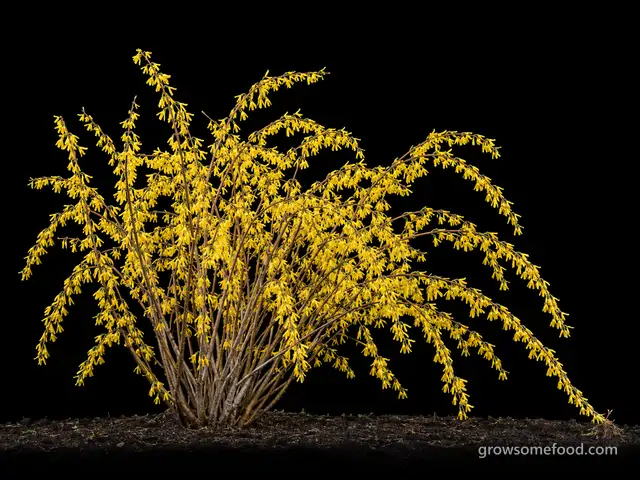
Forsythia
The two weeks of yellow that open the gardening year across most of the country - fast, cheap, tough, and almost unkillable. Its two problems are self-inflicted: it is nearly always planted somewhere too small and then sheared, and it is pruned in spring, which removes the flowers it formed the summer before.
Forsythia is not toxic to people, dogs, or cats, and there is nothing on it worth eating. The dried fruit of one Asian species, Forsythia suspensa, is a long-standing Chinese medicine called lian qiao; garden hybrids rarely fruit at all, identity and dose matter, and a landscape shrub is not a place to source it. The practical cautions are ordinary ones - wear eye protection when cutting out old canes, because the thin wood whips back.
Overview
Forsythia is the shrub that ends winter. For about two weeks in March or April, before it has a single leaf, the whole plant turns into a fountain of hard yellow - and then it is a green shrub for the rest of the year. It is fast, cheap, hardy, and close to unkillable, which is why it lines so many American driveways, and it has one further use no other shrub matches: branches cut in late winter will bloom indoors weeks before the garden does.
Both of forsythia's bad reputations are earned by how it is treated rather than by the plant. It is a fountain 8 to 10 feet wide, routinely planted in a four-foot gap and then sheared into a green box - which removes the flowering wood and produces the twiggy, sparse-flowering meatball everyone has seen. And it blooms on wood that grew the previous summer, so the tidy early-spring haircut that suits most shrubs cuts off the flowers. Give it room, prune it with loppers in the month after it blooms, and it asks nothing else. Be honest with yourself about one thing first, though: this is a two-week plant with very little to offer wildlife, so it earns a spot at the back of a border rather than the best position in a small garden.
Quick facts
- Life cycle
- Perennial, lives about 30 years
- Height
- 96 in24 to 144
- Spread
- 9 ft3 to 14
- Cold
- Takes hard frostdamaged below -25°F
- Heat
- Struggles above 95°F
Full sun or part sun · medium water · well-drained soil · 7 ft apart (4 to 12) · transplant or cuttings or division
When to plant
Fall transplanting is open for 6 more days. Next: spring, Mar 13 to May 22.
- Transplant Aug 16 – Sep 27 Closes in 6 daysAbout 10 weeks before to 4 weeks before your first frost (Oct 25 here)Early fall planting into warm soil roots the shrub before winter. Water until the ground freezes. Do not prune at planting - the flower buds for spring are already on the wood.
- Transplant Mar 13 – May 22 Opens in 173 daysAbout 4 weeks before to 6 weeks after your last frost (Apr 10 here)The main window. Plant into full sun or light shade in almost any soil that drains, allowing 8-10 feet of width. Water weekly through the first summer, then leave it alone.
Frost here: last around Apr 10 (Mar 27 to Apr 24 most years), first around Oct 25. Zone averages, your own yard may run a week or two either way.
Life stages
One stage to settle in, then three that repeat each year. Windows are typical; your zone and weather move them.
Year 1 - rooting in
Day 0 to 120- DoGive it the ten feet it is going to takeA border forsythia grows fast into an arching fountain 8 to 10 feet tall and wider than it is high. Almost every ugly forsythia in America is one planted in a four-foot space and then sheared into a box for the rest of its life. Measure the mature width before you dig, keep it off paths and away from the house, and if the space is genuinely small buy a compact cultivar instead of promising yourself you will keep it trimmed.
- WaterWater weekly the first season, then largely stopweeklyA deep soak once a week through the first summer is all a new forsythia needs, and after the first year it is close to drought-tolerant. This is an undemanding shrub in almost any soil that drains - it tolerates clay, poor ground, and urban conditions that finish off fussier plants.
- MulchMulch 2-3 inches, kept off the stemsMulch holds moisture through the first season and keeps the string trimmer away from the base. Keep it a few inches clear of the stems. Skip heavy feeding entirely - forsythia grows fast enough without help, and high nitrogen only makes more of the whippy growth you will later have to cut out.
Watch for- A planting spot narrower than the shrub's mature width - the root cause of every sheared forsythia meatball
- Branch tips resting on soil, which root within a season and start a new plant
Very early spring bloom
Mar to Apr, every year- HarvestCut armloads while it is blooming - it does not mindForsythia is one of the few shrubs you can cut hard for the vase without hurting it, because cutting a flowering branch is simply pruning at exactly the right moment. Take long arching stems back to a junction rather than snipping tips, cut in the cool morning, and split the woody stem end so it drinks. Expect a week or so indoors.
- PrunePrune within a month of the last flower - and never shearForsythia flowers on wood that grew the summer before, so every bud is already formed by the time winter arrives. Prune in the few weeks after bloom and at no other point in the year. And prune with loppers, one cane at a time, not with a hedge trimmer: shearing removes the flowering wood, destroys the fountain shape, and produces the dense twiggy meatball with flowers only around the outside.
- InspectUse the bloom as a garden calendarForsythia in full flower is one of the most reliable phenological cues in the American garden. It marks the moment to prune roses at bud-break, and the soil temperature it tracks - about 55F - is the trigger for crabgrass germination, so a crabgrass pre-emergent goes down as forsythia blooms and drops, never after. Plants read the season better than the calendar does.
Watch for- Flowers only on the lower stems, up to an obvious line - winter killed the buds above the snow
- Bloom only at the outside of a dense twiggy shell - the shrub has been sheared
Spring and summer growth
Apr to Aug, every year- PruneRenew a third of the oldest canes to the groundThis is how a forsythia stays a fountain instead of becoming a thicket. Right after bloom, cut a third of the oldest, thickest, darkest canes clean off at ground level and leave the rest alone. Repeat each year and the shrub is permanently rebuilt from young arching wood, which is also the wood that flowers best. An overgrown shrub can be cut to 4-6 inches all over in early spring, which sacrifices one year of bloom and resets it completely.
- WeedSever the tips that have rooted themselvesevery 60 daysForsythia layers itself: any arching branch whose tip rests on soil roots there within a season and starts a new plant, which is how a single shrub becomes a spreading thicket and how it escapes into hedgerows and stream banks. Walk the drip line once or twice a season, lift the tips, and cut off any that have rooted. Each rooted tip is also a free plant if you want one.
- InspectCheck new leaves for four-lined plant bug damage in early summerSmall dark sunken spots appearing in rows on new leaves in late May and June are four-lined plant bug feeding. The bright greenish-yellow bugs are fast and drop when disturbed, and the damage looks like a disease but is not. It is cosmetic on a shrub this vigorous, the insects are gone by midsummer, and the growth that follows is clean.
Watch for- Rooted branch tips at the edge of the shrub
- Rows of small sunken dark spots on new leaves in early summer (four-lined plant bug, cosmetic)
- Knobby woody swellings on older stems (stem gall - prune them out)
Late fall and winter
Nov to Feb, every year- HarvestCut branches from mid-February and force them indoorsOnce the buds have had roughly six weeks below 40F - in most of the country that means any time from mid-February - cut branches on a mild day, recut the ends at an angle, split the bottom inch, and stand them in a bucket of cool water in a bright but cool room. They open in one to three weeks, earlier as the season advances. Cut a few stems every fortnight and you can run flowers indoors from February to the outdoor bloom.
- DoDo not prune now - the flowers are already on the shrubEvery fat bud along those bare stems is a flower formed last summer. A winter or early-spring tidy-up, which is exactly when most shrubs get one, is the single most common reason a forsythia does not bloom. Dead and broken wood can come out at any time; nothing else should until the flowers have finished.
- ProtectIn cold zones, protect the buds or plant bud-hardy stockThe stems of a border forsythia survive well below -20F but the flower buds die at roughly -10 to -15F. That mismatch is why northern gardens get a shrub that leafs out beautifully and flowers only along the bottom foot, where snow insulated it. A sheltered spot out of desiccating wind helps a little; the actual fix is a flower-bud-hardy cultivar such as 'Meadowlark' or 'Northern Gold'.
Watch for- Bare branches carrying visible fat buds - that is next spring's bloom, so leave the pruners alone
- Sub-zero cold snaps after a warm spell, which kill buds that had started to deharden
Watch out for
4 to know. 1 is high-risk: Winter Flower-Bud Kill. None are active in September.
Winter Flower-Bud KillSeverity High DisorderThis is the reason so many northern gardeners believe their forsythia is 'dying' when it is perfectly healthy.
Ask when the flowers stop and where - a sharp line at snow height is diagnostic.
Flowers only on the bottom foot or two of the shrub, with a startlingly sharp horizontal line above which the stems stay bare - the snow line from the coldest night of the winter. A shrub that leafs out normally and vigorously afterwards, proving the wood is fine. A spectacular bloom in a year with deep early snow and nothing the following year. In the mid-Atlantic and upper South, a green year following a warm February and a late hard freeze.
None; the buds are gone for that season and the shrub is otherwise unharmed, so leave it alone and it will bloom again after a kinder winter. Do not prune in response, since that removes the buds that did survive. If it happens most years, the plant is simply wrong for the site: replace it with a bud-hardy cultivar rather than continuing to hope. It is worth noting that branches cut and forced indoors in late winter dodge the problem entirely, which is a real consolation in a cold garden.
Choose a flower-bud-hardy cultivar in zones 3-5 - 'Meadowlark', 'Northern Gold' and 'New Hampshire Gold' hold buds to around -30F, which is the only reliable answer. Site out of desiccating winter wind and away from frost pockets, and use the shelter of a building or an evergreen windbreak where you can. Avoid late-summer nitrogen feeding and late-season pruning, both of which push soft growth that hardens poorly. Do not clear snow away from the base of the shrub in cold regions - it is doing useful work.
The single most common forsythia failure in the northern half of the country, and not a disease at all. Stems and leaf buds of the border forsythia are hardy well below -20F, but its flower buds are killed at roughly -10 to -15F. The result is a shrub that leafs out perfectly every spring and flowers only along the lowest foot or two, where snow insulated the buds through the cold snap, stopping at a sharp horizontal line. A second version of the same problem hits milder regions: a warm midwinter spell dehardens the buds, and a hard freeze afterwards kills them even though the temperature never reached anything unusual.
Deer (browse resistance)Severity Low WildlifeForsythia is one of the more deer-tolerant flowering shrubs and is usually rated as seldom severely damaged - which is not the same as deer-proof.
In a hard late winter with heavy pressure, deer strip dormant stems and take the flower buds with them, and rabbits gnaw the bark of young stems at snow height. On an established shrub the browsing is cosmetic and it regrows; on a first-year plant it is worth a wire cage.
Growth cleanly missing overnight, with the plant browsed back to a level line about as high as a deer can comfortably reach. Ragged, torn stem ends rather than the clean angled cut a rabbit leaves - the single most reliable identifier. Buds and flowers gone while the foliage below is untouched, since deer often take the best part first. Hoof prints and droppings in soft ground near the damage. Repeat visits, with fresh damage each morning once a planting has been found. On young trees, shredded and stripped bark and broken low branches in autumn - that is antler rubbing rather than feeding.
There is no chemical fix, only exclusion and recovery. Get physical protection up immediately after the first damage, because deer return to a known meal, and reinforce or rotate whatever you were relying on before. Most plants regrow from browsing if the crown and roots are intact - feed and water a grazed plant and protect the regrowth while it comes back. What does not recover in the same season is anything whose buds or flowers have been taken, and a young tree whose bark has been rubbed right around the trunk is usually lost. Where deer pressure is genuinely heavy, the honest answer is to fence properly or to grow the plants deer leave alone, rather than to keep replacing losses.
Fencing is the only thing that reliably works. Eight feet is the standard for excluding deer, or two parallel four-foot fences a few feet apart, which they will not jump because they cannot judge the landing. Short of that, cage individual plants: a sturdy wire cage or trunk guard around every young tree, left on until the trunk is thick and the canopy is above browse height, prevents both browsing and antler rubbing and is the single highest-value thing you can do for a young tree. Repellent sprays do help at moderate pressure, but they wash off and deer habituate, so reapply after rain and rotate between different types through the season. Motion-activated sprinklers, scent deterrents, and noise devices work for a while and then stop. Siting matters too: plants close to the house, in daily traffic, and screened behind other planting get browsed less than the same plant out at the boundary.
Deer are the largest garden problem across much of the country, and where pressure is high they set the limit on what you can grow at all. They browse at night and around dawn and dusk, taking tender shoots, leaves, buds, flowers, and fruit within about five feet of the ground, and they come back night after night to anything they have found and liked. Because they have no upper incisors they tear rather than cut, leaving ragged stem ends - that is how you tell deer damage from a rabbit's clean angled cut. In fall, bucks rub their antlers on young trunks and can strip the bark right around a stem, which kills a young tree outright. Palatability varies enormously between plants and between seasons: a herd short of food in late winter eats things it ignores in June, and no plant is truly deer-proof.
Forsythia Stem GallSeverity Low DiseaseVery common and almost always overreacted to.
On a shrub that is renewal-pruned every year, the galls go out with the old canes and never become an issue.
Rounded, rough, woody knobs and swellings on stems, most often on older wood and frequently several on the same cane. Galls that persist and enlarge slowly year after year rather than appearing suddenly. Weak, sparse growth and light flowering on the most heavily galled canes. Distinguish these from the swollen leaf-bud clusters that are normal on forsythia wood, and from the smooth callus that forms over an old pruning cut.
There is nothing to spray. Cut affected canes out at ground level during the after-bloom pruning window, taking the opportunity to renew the oldest wood at the same time, and dispose of the prunings. A shrub with a few galls needs nothing done at all; one riddled with them is a candidate for a hard renewal cut to 4-6 inches in early spring, which costs a season of bloom and regrows clean.
Prune out galled wood as part of the annual renewal cut and destroy it rather than composting it. Disinfect pruning blades with rubbing alcohol between cuts, since the tools appear to move it around. Avoid unnecessary wounding of stems, keep mowers and trimmers away from the base, and buy plants with clean stems - the problem usually arrives on nursery stock rather than starting in your garden.
Rough, knobby, woody swellings that form on forsythia stems, often clustered along older wood and sometimes an inch or more across. The cause has never been settled - bacteria, fungi, and simple wound response have all been implicated - and it behaves more like a chronic blemish than an infection. Galled stems keep growing and flowering, though heavily galled old wood tends to be weak and unproductive. It is common enough on forsythia to be considered almost normal, and it is not a reason to remove a healthy shrub.
Four-Lined Plant BugSeverity Low PestOn forsythia this is a nuisance and nothing more.
The shrub grows fast enough to bury the damage within weeks, and the spotting is worth recognising mainly so that nobody sprays a fungicide at it.
Small round dark spots, roughly an eighth of an inch across, appearing in loose rows or patches on the newest leaves in late spring. Spots that later dry, turn pale, and drop out, leaving small holes - so the damage keeps changing appearance and looks like several different problems in succession. Bright yellow-green striped bugs, and their smaller bright red wingless nymphs, on the leaf undersides, dropping or running to the far side of the stem the instant you approach. Damage confined to the newest growth and stopping abruptly by midsummer.
On a shrub, do nothing - the bugs leave by midsummer and the following flush is clean. On a herb or perennial where the marked leaves are the point, insecticidal soap or a labelled pyrethrin reaches the nymphs if applied early and directly to the undersides, but the adults are so quick that sprays usually miss them, and the timing window is short. Pinching off the worst-marked leaves tidies things faster than spraying does. Do not treat this with a fungicide - it is not a disease, however much the spotting looks like one.
Very little is warranted, because the damage is cosmetic on established plants and the insect is present for only a few weeks. Cutting back and removing old stems in fall or early spring destroys the overwintering eggs, which are laid in slits in the previous season's wood, and that is the most useful single step. Keep plants growing vigorously so new leaves quickly outgrow the marked ones, and leave the beneficial insects alone.
A fast-moving bright greenish-yellow bug about a quarter inch long, marked with four black stripes down its back, that feeds for a few weeks in late spring on the new growth of a very wide range of shrubs and herbaceous plants. It injects a toxin as it feeds, so each puncture leaves a small dark sunken spot that looks far more like a leaf-spot disease than insect damage - which is why it is so often misdiagnosed and sprayed with fungicide. There is a single generation a year: the adults are gone by midsummer, the eggs overwinter in slits cut into last year's stems, and the growth that follows the feeding is clean.
Good & bad neighbors
Plant nearby
-
The defining early-spring pairing: daffodils open at the forsythia's bare feet in exactly the same fortnight and the same yellow, then the shrub leafs out and hides their dying foliage. Daffodils are genuinely deer-proof and forsythia is seldom badly browsed, so the pairing survives most gardens.
- Traditional pairings, thin evidence
-
Crocus carpets the ground a couple of weeks before the forsythia opens, extending the show at almost no cost, and finishes before the shrub's shade closes over. Plant them well out toward the drip line.
-
Blue muscari under yellow forsythia is the loudest colour pairing in the spring garden and the cheapest to achieve - the bulbs naturalise happily in the dry, root-filled ground under an established shrub.
-
Worth planting nearby as the native counterweight: spicebush flowers in the same soft yellow at the same moment, hosts spicebush swallowtail caterpillars, and feeds birds in fall - all things a forsythia does not do.


Varieties · 9
You pick one when you add Forsythia to your garden. Its days to maturity set your harvest window.
Border Forsythia 2 varieties
Lynwood Gold
Upright arching shrub with bare stems lined evenly in deep golden-yellow bells.
border-forsythiaold-woodlargeclassicThe standard American forsythia and still the benchmark: rich golden flowers held all the way along upright-arching 8-10 foot stems, more evenly distributed than the older sorts. Found as a sport in a garden in Northern Ireland in the 1930s. Superb for cutting and forcing, and it needs the full 10-12 feet of width it will take.
Spectabilis
Broad spreading shrub smothered in clustered deep-yellow flowers on bare arching wood.
border-forsythiaold-woodlargeheirloomThe heavy-flowering 1906 introduction that made forsythia a garden staple: masses of deep yellow bells, often several to a bud, on a big spreading shrub. Slightly more arching and more sprawling than 'Lynwood Gold' and every bit as vigorous - the classic old hedge-row forsythia of American yards.
Northern Bud-Hardy 3 varieties
Meadowlark
Large arching shrub covered top to bottom in soft clear-yellow bells even after a hard winter.
bud-hardyvery-hardylargeold-woodThe northern gardener's forsythia: a joint release from the North Dakota, South Dakota and Minnesota programmes with flower buds hardy to roughly -30F, so it blooms over the entire shrub in zone 3 rather than only below the snow line. Vigorous, 8-10 feet, with clear light-yellow flowers. If you garden north of zone 5, buy this or one of its peers rather than a standard border forsythia.
Northern Gold
Upright 7-9 foot shrub with golden-yellow flowers along the full height of the stems.
bud-hardyvery-hardyuprightold-woodAn Agriculture Canada selection with strong flower-bud hardiness and a noticeably more upright, less sprawling habit than most border forsythias, which suits a narrower bed. Golden-yellow flowers over the whole plant in cold-zone gardens where ordinary forsythia blooms only at the base.
Compact and Groundcover 3 varieties
Show Off Sugar Baby
Low tidy mound completely covered in bright yellow flowers on very short stems.
small-gardenheavy-bloomold-woodmodernA genuinely small forsythia - typically 1.5 to 2.5 feet tall and wide - with flowers packed so densely along short stems that the wood disappears. The right answer for a foundation bed or a container where a border forsythia would have to be sheared forever. Needs essentially no pruning.
Gold Tide (Maree d Or)
Low spreading carpet of arching stems studded with yellow flowers in early spring.
groundcoverbank-coverold-wooderosion-controlA groundcovering forsythia: 12-20 inches tall and spreading 3-4 feet wide, used to hold banks and slopes where its layering habit is an advantage rather than a nuisance. Flowers thickly for its size, and it takes the hard, dry, awkward positions that defeat most shrubs.
Weeping (Forsythia suspensa) 1 variety
Weeping Forsythia (Forsythia suspensa)
Long pendulous stems cascading from a wall or bank, hung with pale yellow bells in early spring.
self-layeringspecieswall-covermedicinal-historyOne of the two parents of the garden hybrid, and a completely different plant in use: very long, thin, trailing stems that pour over a wall or bank, with paler and more thinly spaced flowers. It roots wherever the tips land, so it colonises unless you cut them off. This is the species whose dried fruit is the classic Chinese herb lian qiao - a matter of history rather than an invitation to brew a landscape shrub.
Grower tips
Notes from growers, tagged with the zone they grow in. A person reads every post before it appears.
Nobody has posted about Forsythia yet. The first one usually saves someone a season.
Free account. Your post shows your grower name and zone, never your email.