
Add it to your home screen and it opens full screen: no browser bars, one tap away, and everything stays signed in. Free, nothing to download from an app store.
- Tap the Share button in your browser
- Scroll down and choose “Add to Home Screen”
- Open GrowSomeFood from your home screen
- Open your browser’s menu
- Choose “Add to Home screen” or “Install app”
- Open GrowSomeFood from your home screen

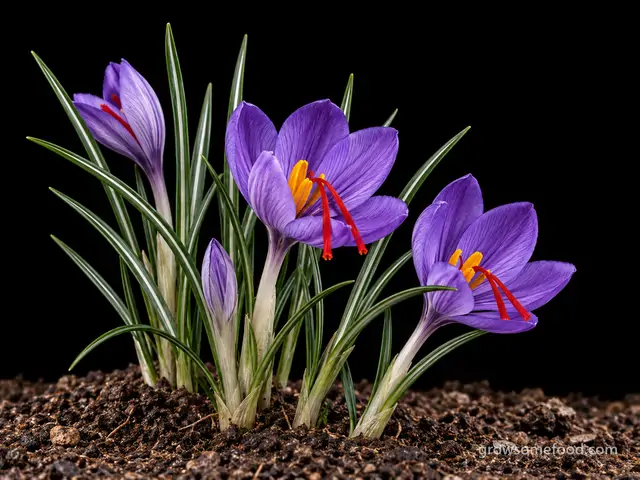
Crocus
The first flower of the year - goblets of purple, gold, and white that push through the last snow, feed the first bees, and naturalize into spreading sheets from a plant-once-forget corm; plus its famous autumn cousin, the source of saffron.
Safety notes Ordinary garden crocus (Crocus) is grown as an ornamental and is not for eating - its parts are mildly toxic if ingested and can upset pets. The ONE culinary exception is saffron crocus (Crocus sativus), whose dried red stigmas are the spice saffron, from that species only. CRITICAL: do NOT confuse either with autumn crocus / meadow saffron (Colchicum autumnale), a LETHALLY poisonous look-alike in a different family - never eat 'saffron' unless you can positively identify C. sativus.
Overview
Crocus are the flowers that announce winter is ending. Pushing up through the last snow in late winter, their goblet-shaped cups of purple, gold, white, and feathered stripes open flat in the sun weeks before almost anything else - and they're not just cheerful, they're ecologically important, offering the first nectar and pollen to the season's earliest bees. Planted once as corms in fall, they return and multiply on their own, naturalizing into spreading sheets in beds, under trees, and (magnificently) scattered through lawns.
Quick facts
- Winter chill
- 500 hours below 45°FRange: 200–900 hours
- Height
- 4 inRange: 3–6 in
- Spread
- 3 inRange: 2–4 in
- Cold
- Takes hard frostdamaged below -30°F
- Heat
- Struggles above 80°F
- Life cycle
- Perennial, lives about 8 years
- Self-sows
- Yes, expect volunteers
- Soil
- Well-drained
- Water
- Low
- Plant spacing
- 3 inRange: 2–4 in
When to plant
Nothing is open today. Summer planting opens 10 months, Aug 1 to Sep 15.
- Plant tubers Aug 1 – Sep 15 Opens in 286 daysThe saffron crocus (Crocus sativus) is a FALL bloomer: plant its corms in late summer (Aug-Sep) 4-5 inches deep in full sun and very sharp drainage for October flowers and the saffron harvest. It performs best in zones 6-9 with hot dry summers.
- Plant tubers Aug 30 – Oct 4 Opens in 315 daysAbout 8 weeks before to 3 weeks before your first frost (Oct 25 here)Plant spring-blooming crocus corms 3-8 weeks before the ground freezes so they root before winter, 3-4 inches deep in sun and sharp-draining soil. Fall planting is the only real option in cold zones.
Frost here: last around Apr 10 (Mar 27 to Apr 24 most years), first around Oct 25. Zone averages, your own yard may run a week or two either way.
Life stages
Establish, grow, repeat
Getting established and returning each season are different parts of the story.
Stage 1 of 4 · Getting established
Fall rooting-in
Day 0 to 45 from planting
Care at this stage
-
Plant corms 3-4 inches deep and water once
Plant crocus corms in fall, pointed end up, about 3-4 inches deep and 2-3 inches apart in well-drained soil and sun. Water once to trigger rooting before the ground freezes; after that they need no attention.
-
Deter squirrels from digging the corms
Squirrels, chipmunks, and voles dig and eat crocus corms - the most common cause of no-shows in spring. Lay wire mesh over new plantings, plant a bit deeper, or interplant with corm they dislike; daffodils nearby help mask them.
Months are typical seasonal windows; climate, variety, and plant age can shift them.
Watch out for
3 to know. 1 is high-risk: Squirrels & Rodents. 1 is active in October.
Squirrels & RodentsSeverity High WildlifenowSeason: Feb, Mar, Apr, Sep, Oct, NovChewed husks, shells or hulls scattered under the plant, fruit and nuts vanishing as they ripen, and gnawed or half-eaten windfalls.
The number-one crocus problem. Corms are apparently delicious to rodents, unlike toxic daffodils, and a fall planting that simply never appears in spring has usually been eaten. Interplant with daffodils, choose the less appetizing snow crocus and 'Tommies', mesh over new plantings, and plant extra.
Chewed husks, shells or hulls scattered under the plant, fruit and nuts vanishing as they ripen, and gnawed or half-eaten windfalls. On new plantings: freshly dug holes and scattered soil, bulbs missing or gnawed, dug-up seed rows, vole runways under the mulch, and gaps in spring where you know you planted.
There is no rescue for what has already been eaten, so this is a prevention problem. Re-cover disturbed plantings with mesh promptly, replant losses inside cages, and trap or exclude persistent diggers where that is legal locally. On a large tree, accept that you will share the crop and concentrate on gathering promptly.
For a crop on the plant, timely and frequent harvest is the real defense - gather daily through the ripening window rather than leaving anything to hang, and pick slightly early to finish indoors where the crop allows it. Net or bag what you can reach. For bulbs and sown seed, lay wire mesh or hardware cloth over the planting, plant deeper, use buried wire baskets, and clear away the papery tunics and debris that advertise a fresh planting. Trunk baffles slow climbers on isolated trees, clearing jumping routes from nearby trees and roofs helps, and removing brush cover reduces the rodents sheltering nearby.
Squirrels, chipmunks, voles and mice are the wildlife that competes with you most directly for a crop. They take ripening nuts, seed and fruit off the plant, usually before you judge it ready, and cache what they do not eat. They also dig up freshly planted bulbs and sown seed, and voles tunnel in to gnaw bulbs and roots underground through winter. They climb anything, they know exactly when a crop is ripe, and a determined pair can clear a small tree or a new planting in a few days.
Bulb RotSeverity Medium DiseaseSeason: Jan, May, Jun, Jul, Nov, DecSoft, discolored, or moldy corms; corms that fail to emerge; brown or sunken lesions on lifted corms, worst after wet spells or in heavy soil.
Soft, discolored, or moldy corms; corms that fail to emerge; brown or sunken lesions on lifted corms, worst after wet spells or in heavy soil.
None in-ground - remove and destroy rotted corms and improve drainage; replant healthy corms elsewhere or in far better-draining conditions.
Plant in sharply drained soil (raised beds or gritty soil in wet sites), don't overwater, keep the bed dry through summer dormancy, and discard any soft corms before planting.
Fungal rots (Fusarium and others) that attack crocus corms in wet, poorly drained, or warm soggy soil - during winter in cold zones and during the summer dormancy in warm ones - causing corms to soften and fail to sprout.
Deer (browse resistance)Severity Low WildlifeSeason: Feb–AprGrowth cleanly missing overnight, with the plant browsed back to a level line about as high as a deer can comfortably reach.
Deer and rabbits browse the early flowers and foliage in late winter and spring, when little else is green - a nuisance nibbling rather than a serious threat, and less damaging than the corm-eating rodents. The corms are unharmed and bloom again next year, so the loss is cosmetic for the season. Planting in larger drifts dilutes the browsing.
Growth cleanly missing overnight, with the plant browsed back to a level line about as high as a deer can comfortably reach. Ragged, torn stem ends rather than the clean angled cut a rabbit leaves - the single most reliable identifier. Buds and flowers gone while the foliage below is untouched, since deer often take the best part first. Hoof prints and droppings in soft ground near the damage. Repeat visits, with fresh damage each morning once a planting has been found. On young trees, shredded and stripped bark and broken low branches in autumn - that is antler rubbing rather than feeding.
There is no chemical fix, only exclusion and recovery. Get physical protection up immediately after the first damage, because deer return to a known meal, and reinforce or rotate whatever you were relying on before. Most plants regrow from browsing if the crown and roots are intact - feed and water a grazed plant and protect the regrowth while it comes back. What does not recover in the same season is anything whose buds or flowers have been taken, and a young tree whose bark has been rubbed right around the trunk is usually lost. Where deer pressure is genuinely heavy, the honest answer is to fence properly or to grow the plants deer leave alone, rather than to keep replacing losses.
Fencing is the only thing that reliably works. Eight feet is the standard for excluding deer, or two parallel four-foot fences a few feet apart, which they will not jump because they cannot judge the landing. Short of that, cage individual plants: a sturdy wire cage or trunk guard around every young tree, left on until the trunk is thick and the canopy is above browse height, prevents both browsing and antler rubbing and is the single highest-value thing you can do for a young tree. Repellent sprays do help at moderate pressure, but they wash off and deer habituate, so reapply after rain and rotate between different types through the season. Motion-activated sprinklers, scent deterrents, and noise devices work for a while and then stop. Siting matters too: plants close to the house, in daily traffic, and screened behind other planting get browsed less than the same plant out at the boundary.
Deer are the largest garden problem across much of the country, and where pressure is high they set the limit on what you can grow at all. They browse at night and around dawn and dusk, taking tender shoots, leaves, buds, flowers, and fruit within about five feet of the ground, and they come back night after night to anything they have found and liked. Because they have no upper incisors they tear rather than cut, leaving ragged stem ends - that is how you tell deer damage from a rabbit's clean angled cut. In fall, bucks rub their antlers on young trunks and can strip the bark right around a stem, which kills a young tree outright. Palatability varies enormously between plants and between seasons: a herd short of food in late winter eats things it ignores in June, and no plant is truly deer-proof.
Good & bad neighbors
Plant nearby
-
The classic early-spring bulb pairing: crocus open the season just before daffodils, share sun and sharp drainage, and the rodent-proof daffodils nearby help mask and protect the crocus corms squirrels love to dig.
-
Both low early bulbs for the front of the border or a lawn drift, overlapping in bloom in blues and purples for an easy naturalizing carpet - though muscari self-sows aggressively, so site accordingly.
-
Same fall planting and sunny well-drained site; crocus carpet the ground and bloom weeks earlier, handing the spring show off to the taller, later tulips.
- Traditional pairings, thin evidence
-
Lawn / Turf (naturalizing)Snow crocus and 'Tommies' famously naturalize into lawns for a spring flower carpet - the key is delaying the first mow of that area until the crocus foliage dies back.

Varieties · 5
You pick one when you add Crocus to your garden. Its days to maturity set your harvest window.
Dutch Crocus (Crocus vernus)
The big, showy spring crocus of most gardens: robust goblet flowers in rich purple, white, and purple-and-white feathered stripes ('Pickwick', 'Remembrance', 'Jeanne d'Arc'), blooming a bit later than the snow crocus.
Variety details for Dutch Crocus (Crocus vernus)
Large rounded cups in purple, white, or striped, on 4-6 inch stems.
large-floweredspringpurple-white-stripednaturalizingThe classic mass-display and lawn crocus.
Snow Crocus (Crocus chrysanthus)
The earliest crocus, often blooming through snow weeks before the Dutch types: smaller, prolific flowers in gold, cream, blue, bronze, and bicolors ('Blue Pearl', 'Cream Beauty', 'Snow Bunting'), multiplying fast and feeding the first bees.
Variety details for Snow Crocus (Crocus chrysanthus)
Small early cups in gold, cream, and blue, often several per corm.
small-floweredvery-earlymulti-colornaturalizingSeveral flowers per corm.
Tommasinianus 'Tommies' (Crocus tommasinianus)
The best crocus for naturalizing and the most squirrel-resistant: slender early lavender-to-purple flowers that self-sow and multiply into wide carpets in lawns and under trees.
Variety details for Tommasinianus 'Tommies' (Crocus tommasinianus)
Slim silvery-lavender to purple flowers that carpet ground over the years.
speciesearlylavendernaturalizing'Ruby Giant' and 'Barr's Purple' are richer-colored selections. The connoisseur's lawn crocus.
Saffron Crocus (Crocus sativus)
The spice crocus: a FALL-blooming lilac-purple crocus whose three long red stigmas per flower are hand-harvested and dried into saffron.
Variety details for Saffron Crocus (Crocus sativus)
Lilac-purple autumn flowers with three vivid crimson stigmas protruding from the center.
fall-bloomingculinarysaffronsterileSterile (increases only by cormels), needing hot dry summers, cold winters, full sun, and very sharp drainage. A genuine home spice crop - not to be confused with poisonous Colchicum.
Golden Yellow (Crocus flavus 'Golden Yellow')
The bright golden-yellow large crocus that lights up early spring beds - a vigorous sterile hybrid (also sold as 'Dutch Yellow' or 'Yellow Mammoth') that won't self-sow but bulks up by cormels.
Variety details for Golden Yellow (Crocus flavus 'Golden Yellow')
Deep golden-yellow goblet flowers on short sturdy stems.
large-floweredspringgoldsterileThe reliable pure-gold in the spring crocus palette.
Grower tips
Notes from growers, tagged with the zone they grow in. A person reads every post before it appears.
Nobody has posted about Crocus yet. The first one usually saves someone a season.
Free account. Your post shows your grower name and zone, never your email.