Add it to your home screen and it opens full screen: no browser bars, one tap away, and everything stays signed in. Free, nothing to download from an app store.
- Tap the Share button in your browser
- Scroll down and choose “Add to Home Screen”
- Open GrowSomeFood from your home screen
- Open your browser’s menu
- Choose “Add to Home screen” or “Install app”
- Open GrowSomeFood from your home screen
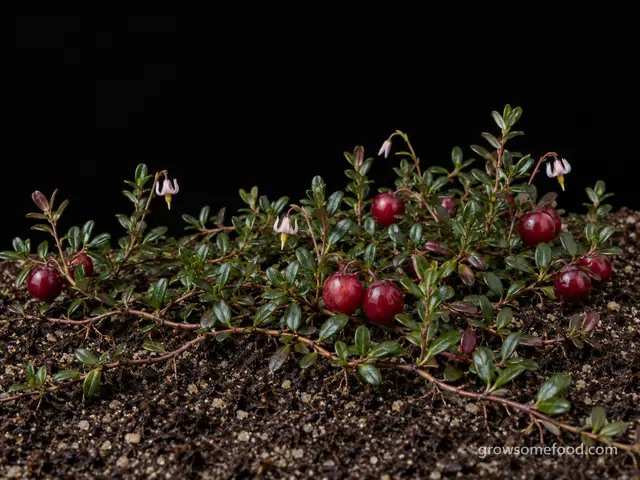
Cranberry
The true cranberry: a low evergreen native vine that carpets acid, peaty, permanently damp ground - and no, you do not need a bog to grow it.
The berries are safe raw or cooked - just very tart, so nearly everyone cooks them with sweetening. No part of the plant is toxic. Two things worth knowing. Highbush cranberry is an unrelated Viburnum shrub, not this plant, so check which one a recipe or nursery label means. And if you take warfarin, ask your doctor before daily cranberry juice or concentrated supplements - regular heavy intake has been reported to raise INR. An occasional serving of sauce is not the concern.
Overview
The one thing to knowInstead of a bush it makes a low evergreen mat, two to six inches high, of wiry trailing runners that root as they go and send up short vertical shoots called uprights.
The cranberry (Vaccinium macrocarpon) is a true native North American fruit and a close relative of the blueberry, but it grows nothing like one. Instead of a bush it makes a low evergreen mat, two to six inches high, of wiry trailing runners that root as they go and send up short vertical shoots called uprights. The flowers and fruit come on those uprights, and the plant spreads outward indefinitely, so a healthy bed behaves like a fruiting groundcover.
The single most useful thing to know is that you do not need a bog. Commercial growers flood their beds to float the fruit off at harvest and to protect the vines in winter, not because the plants want to live underwater. What cranberries actually need is acid soil (pH 4.0-5.5), constant moisture and full sun - which a home gardener supplies with a sunken bed of peat and sand, in a tub, or in a raised frame that never dries out. Give them that and a mature bed produces tart red fruit every fall for decades, on a plant that is hardy to about -35°F and stays green all winter. One naming note: highbush cranberry is an unrelated Viburnum shrub that borrowed the name for its tart red fruit - this is the real thing.
Quick facts
- Life cycle
- Perennial, lives about 50 years
- Height
- 6 in2 to 8
- Spread
- 36 in12 to 72
- Cold
- Takes hard frostdamaged below -35°F
- Heat
- Struggles above 90°F
Full sun or part sun · high water · consistently moist soil · 12 in apart (6 to 18) · transplant or cuttings
When to plant
Fall transplanting is open for 13 more days. Next: spring, Mar 13 to May 1.
- Transplant Aug 26 – Oct 4 Open now · 13 days leftAbout 9 weeks before to 3 weeks before your first frost (Oct 25 here)Fall planting gives roots a cool, damp establishment period; mulch the bed after the ground chills.
- Transplant Mar 13 – May 1 Opens in 173 daysAbout 4 weeks before to 3 weeks after your last frost (Apr 10 here)
- Transplant Apr 10 – May 25 Opens in 201 daysAbout at to 6 weeks after your last frost (Apr 10 here)Unrooted vine cuttings, the way commercial beds are planted: press 6-8 inch pieces of runner into damp sand so a few inches stay above the surface, and keep the bed constantly wet until they root.
Frost here: last around Apr 10 (Mar 27 to Apr 24 most years), first around Oct 25. Zone averages, your own yard may run a week or two either way.
Life stages
One stage to settle in, then five that repeat each year. Windows are typical; your zone and weather move them.
Years 1-2 - running vines
The first year after planting- WaterNever let the bed dry outevery 2 daysCranberries are shallow-rooted wetland plants with no drought reserve. Keep the peat bed evenly moist at all times in the first two years - damp like a wrung-out sponge, not flooded. A single hot dry week can kill young vines outright.
- WeedHand-weed relentlessly for the first two yearsThis is the whole job of a young cranberry bed. The vines are two inches tall and cannot out-compete anything, so every grass and weed seedling has to come out by hand while it is small. Once the vines knit into a closed mat they largely defend themselves.
- DoDo not lime, everCranberries need soil pH between about 4.0 and 5.5. Lime, wood ash, hard alkaline water and ordinary garden fertilizer all push the pH up and slowly starve the plants. Use rainwater where you can and an acid (ammonium-based) fertilizer if you feed at all.
Watch for- Bed drying out (the fastest way to lose young vines)
- Weeds outgrowing the low vines
- Yellowing between leaf veins - pH creeping up
Runners and uprights
Apr to Jun, every year- FertilizeFeed lightly, and only with an acid fertilizerCranberries are adapted to poor, acid, low-nitrogen ground. Too much nitrogen produces a beautiful carpet of long runners and almost no fruiting uprights - the classic reason a home bed never crops. A light spring feed of an ammonium-based or azalea formula is plenty.
- MulchSand the bed every 2-3 yearsSpread about half an inch of clean coarse sand over the vines in late winter or early spring. This is the one traditional practice worth copying from commercial bogs: it buries runners so they root and throw new uprights, suppresses weeds, and disrupts pests.
Watch for- All runners and no upright shoots (too much nitrogen)
- Mat thinning or bare patches
- Weeds rooting through the mat
Pink crane-neck bloom
Jun to Jul, every year- PollinateLet the bees work - and skip insecticides in bloomEach fruiting upright carries a few small pale-pink flowers whose swept-back petals and long style look like a crane's head - the origin of the old name craneberry. Bumblebees are the best pollinators; anything sprayed during bloom costs you fruit.
- ProtectCover for late frost while in bloomOpen flowers and young fruit are frost-tender even though the plant is hardy to about -35°F when dormant. Throw a row cover or old sheet over the bed on a late frost night.
Watch for- Late frost blackening open flowers
- Few flowers (usually a nitrogen or shade problem, or too young a bed)
Berries sizing and coloring
Jul to Sep, every year- WaterKeep water steady while the fruit sizesevery 3 daysBerries are mostly water, and the shallow root mat has nothing in reserve. Even moisture through August and September sets berry size; a drought-then-soak cycle gives small fruit and splitting.
- InspectWatch for fruit rot in warm wet spellsWarm, humid, still weather while the berries color is when the fruit-rot fungi move. Pick out and bin soft, tan or collapsing berries as you see them rather than leaving them in the mat.
Watch for- Soft, tan or shriveled berries (fruit rot)
- Webbed clusters of berries hollowed out (cranberry fruitworm)
- Birds starting on the coloring fruit
Picking (fall)
Sep to Nov, every year- HarvestPick when berries are deep red inside as well as outweeklySkin color runs ahead of ripeness. Cut one open: fully ripe fruit is red or pink through the flesh with brown seeds, and a ripe berry bounces if you drop it on a hard surface. Comb the fruit off with your fingers or a wide-toothed berry scoop.
- HarvestTake the crop before a hard freezeLight frosts do no harm and often improve color, but berries caught by a hard freeze on the vine turn soft and will not store. In a cold snap, cover the bed or pick early.
Watch for- Berries pale inside despite red skin (not ready)
- Hard freeze forecast on unpicked fruit
- Birds working the ripe mat
Winter
Dec to Mar, every year- ProtectMulch the bed once the ground has chilledCranberry vines are evergreen and dry out in cold winter wind when the soil is frozen and cannot resupply them. In zones without dependable snow cover, lay 2-4 inches of pine needles, straw or evergreen boughs over the bed after the ground has chilled and rake it off in early spring.
- DoLet the bed take its full winterCranberries need a real dormant chilling period to flower properly the following summer. This is a northern plant; do not try to protect it from cold, only from drying wind and bare-ground freeze-thaw.
Watch for- Bronzed or scorched evergreen foliage after a dry, snowless cold spell
- Vines heaving out of the soil in freeze-thaw cycles
Harvest
- Deep red through the flesh, not just on the skin, with brown seeds inside
- A dropped berry bounces on a hard surface - the traditional ripeness test
- Fruit firm; picked before any hard freeze
- Pick when berries are deep red inside as well as out · weekly
- Take the crop before a hard freeze
Per plant 4 to 48 ozPicking pick as they ripen
Cook with cranberries
Watch out for
5 to know. 2 are high-risk: Weed Invasion of the Vine Mat, Cranberry Fruit Rot. 3 are active in September.
Weed Invasion of the Vine MatSeverity High DisordernowBudget the weeding time before you build the bed.
The first two years decide whether you end up with a closed fruiting mat or a patch of lawn with cranberries in it.
Grass blades or broadleaf seedlings coming up through the mat, especially along the bed edges nearest lawn. Bare or thinning patches where weeds have shaded the vines out. Sedges and rushes appearing in the wettest corners. Tree and shrub seedlings taking hold in an established bed that has stopped being inspected.
Hand-pulling is the only tool that will not damage the vines, and grass rooted through an established mat has to be teased out patiently rather than yanked. On a badly overrun bed the realistic option is to lift healthy runners as cuttings, clear and rebuild the bed, and replant - which is faster than several seasons of losing ground. Never use a broadleaf lawn herbicide anywhere near cranberries.
Hand-weed the bed weekly through the first two growing seasons, taking everything out while the seedlings are small enough to lift cleanly. Edge the bed hard against any lawn, or grow the whole thing in a raised frame or container where invasion has to come over a barrier. Sand the bed every two to three years - the half-inch top-dressing smothers germinating weed seed as well as encouraging uprights. Do not mulch a cranberry bed with bark or compost, which brings weed seed and raises fertility.
The most common reason a home cranberry bed fails, and it is a management problem rather than a pest. Cranberry vines are two to six inches tall, shallow-rooted and slow to knit together, so for the first two or three years they cannot compete with anything - grass, sedge, sorrel, moss and tree seedlings all establish faster in the same damp acid peat. Grass invading from an adjoining lawn is the worst case, because its roots weave through the vine mat and cannot be pulled without tearing the crop out with them. A weedy bed does not just look untidy; the vines thin, uprights stop forming, and the planting quietly stops fruiting.
Cranberry Fruit RotSeverity High DiseasenowThe main reason a home cranberry crop disappoints in a warm humid fall.
Dry-picked, promptly refrigerated fruit keeps far better than fruit left sitting in a bucket.
Berries turning soft, tan, pink-blotched or shriveled while others in the same cluster ripen normally. Fruit that collapses when squeezed and thuds instead of bouncing when dropped. Rot showing up worst in the densest, least ventilated parts of the mat and after a warm wet spell. Picked fruit going soft within days in storage, spreading from one berry outward.
Rotted fruit cannot be saved and there is no home cure once berries are infected. Remove and bin affected berries, sort carefully at harvest using the bounce test, and refrigerate the sound fruit promptly and dry, since cool storage stops the rot spreading. Commercial growers use timed fungicide programs at bloom; a home bed is better served by spacing, sanding, low nitrogen and prompt culling.
Airflow and sanitation do most of the work in a home bed. Keep the mat from getting excessively thick, sand every two to three years, and avoid heavy nitrogen, which produces dense soft growth that stays wet. Water at the base early in the day rather than overhead in the evening. Pick out and remove soft and rotting berries whenever you see them instead of leaving them in the vines, and clear fallen fruit at the end of the season. Choose a variety with better rot tolerance - Stevens is notably better than Early Black - where warm humid falls are normal.
Not one disease but a complex of fungi that infect cranberry flowers and young fruit and then rot the berries as they ripen, either on the vine (field rot) or after picking (storage rot). Warm, humid, still weather during and after bloom is what drives it, which is why it is the dominant cranberry disease in the Northeast and the mid-Atlantic and much less of a problem in cool coastal beds. Infected berries look sound for weeks and then go soft, tan or blotchy in the last stretch before harvest, and a single rotten berry left in a picked container spreads to the fruit around it.
Birds & WildlifeSeverity Medium WildlifenowLess pressure than on a blueberry bush, because the fruit sits low in a dense mat and stays very tart, but robins and waxwings will work a small ripe bed.
Netting laid over hoops just before the fruit colors is easy on something this low.
Fruit disappearing from the outermost, most exposed parts of the plant first, and from the top of a tree where you cannot reach anyway. Single neat pecks and gouges in ripening fruit, with several fruits sampled rather than one eaten through - the classic sign that it was birds rather than an animal. Heads of grain or seed going visibly lighter and emptier as they ripen, with hulls and chaff scattered underneath. Freshly sown seed vanishing off the surface of a bed before it germinates. Bird traffic in and out of the plant picking up as the crop colors, and birds waiting on nearby wires and branches. Wasps arriving at the pecked and split fruit shortly afterward.
There is no treatment once a crop is being taken - only protection and timing, so the answer is to get netting on and to pick what is ready. Reflective tape, flash ribbon, spinners, and decoy predators do work, but only for a few days at a time: birds habituate fast, so move and rotate them and never rely on them as the main defense for a crop you care about. Cut and gather grain or seed heads a little early, at firm dough, and finish drying them under cover instead of leaving them standing for the flocks. Plant a little extra, or a decoy crop the birds prefer, and accept sharing anything that crops heavily. On a wild or foraged patch, fruit going to birds and small mammals is the point of the plant rather than a problem to solve.
Net, and net early. Bird netting draped over a frame or hoops so it stands off the fruit, with the edges closed at ground level, is the only thing that reliably works at harvest scale - and it has to go on before the crop starts to color, because once birds have found the food they are far harder to displace. Keep fruit trees small enough that netting them is actually feasible; that decision gets made years earlier, at planting. Bags of mesh, organza, or paper slipped over individual heads, clusters, or prize fruit protect a small crop without netting the whole plant. Then shorten the exposure: pick promptly and completely rather than leaving ripe fruit hanging as a lure, clear split and dropped fruit that draws birds and wasps alike, and where a crop can finish off the plant, harvest a little early and ripen or dry it under cover. Rake in or cover broadcast seed so it is not lying in plain view.
Birds find ripening fruit and seed before you do. Robins, waxwings, starlings, catbirds, jays, sparrows, finches, blackbirds, and doves all work a garden, and the pressure arrives in a narrow window - the last days before harvest, when sugar rises, color changes, and the crop softens or the grain hardens. A flock can strip a small planting in a day or two, and birds that only peck rather than take whole fruit still leave wounds that rot or draw wasps. Squirrels, chipmunks, and other wildlife usually turn up on the same crop at the same time. This is competition rather than disease: the birds are not harming the plant, and a big tree or a heavy-cropping bush often has enough for everyone - but on a small planting it can be the difference between a harvest and none.
Winter Desiccation & Frost InjurySeverity Medium DisorderAlmost entirely preventable with a winter mulch and a sheet on frost nights.
Snow cover does the job for free where you can count on it, which is why zone 3 beds under deep snow often come through better than zone 6 beds in a bare, windy winter.
Leaves bronzing hard and then browning and crisping over winter, worst on exposed edges and in beds with no snow cover. Vines heaved partly out of the soil after repeated freeze-thaw. In spring, blackened flowers or shriveled young fruit the morning after a late frost, on otherwise healthy vines.
Desiccated vines often push new growth from the crown in spring - wait and see before replacing anything, keep the bed well watered, and trim out what is clearly dead. Frost-killed flowers cannot be recovered; the bed will simply crop lightly that year and be normal the next. Neither injury calls for feeding, which only makes soft growth.
After the ground has chilled in late fall, lay 2-4 inches of pine needles, straw or evergreen boughs over the bed and rake it off in early spring - this is the home equivalent of a winter flood. Keep the bed watered late into fall so vines go into winter fully hydrated. During bloom, throw a row cover or old sheet over the bed on nights forecast to frost, and take it off in the morning. A bed in a container is more exposed than one in the ground and needs more protection, not less.
Cranberry vines are evergreen, and evergreen foliage keeps losing water all winter. When the soil is frozen and the plant cannot resupply it - especially in a cold, dry, snowless spell with wind - the leaves brown and the vines can die back. This is why commercial growers flood their beds in winter and why gardeners in cold zones mulch. The related risk sits at the other end of dormancy: the plant survives about -35°F while dormant, but open flowers and young fruit in June are frost-tender, and a late spring frost can take the season's crop off a bed that came through January untouched.
Cranberry FruitwormSeverity Medium PestRarely enough to ruin a home crop, but the webbed clusters and premature red berries are unmistakable once you know them.
Hand-picking the webs is usually the whole control.
Small clusters of berries webbed together with fine silk, often with sawdust-like frass caught in it. Berries that turn red noticeably ahead of everything around them. Hollow, light berries with a small entry hole near the stem end. Fruit collapsing when picked.
Remove and destroy webbed berry clusters rather than dropping them in the bed. Bacillus thuringiensis (Bt) or spinosad timed to egg hatch after bloom will control a heavy infestation; both must be labeled for the crop and applied per the label, and spinosad is acutely toxic to bees while wet, so never apply it during bloom and treat at dusk. There is no rescue for berries already hollowed.
Clean up in the off-season: the larvae overwinter in leaf litter and trash on the bed floor, so raking debris and sanding the bed disrupts them. Monitor from just after bloom and pick out webbed clusters by hand as soon as they appear - on a home-scale bed hand-removal is genuinely effective. Avoid a thick unmanaged mat, which gives them cover.
A small moth (Acrobasis vaccinii) whose larvae are the classic cranberry and blueberry fruit pest. The moth lays eggs on developing berries just after bloom; each larva bores in, hollows out the fruit, and then moves on to web several neighboring berries together with silk and frass, so one caterpillar can ruin a whole cluster. Damaged berries color prematurely - a patch of early-red fruit in a green mat is often the first thing a grower notices.
Good & bad neighbors
Plant nearby
-
The same family and nearly the same soil chemistry - acid pH, low fertility, ammonium nitrogen - so building and maintaining one acid bed serves both. Site blueberries on the drier side and cranberries on the wetter side of it, since blueberries will not tolerate constant saturation.
-
LingonberryAnother low, evergreen, acid-loving Vaccinium of similar height and culture; the two knit together into a mixed fruiting groundcover and want the same peat bed, sun and moisture. Lingonberry tolerates slightly drier ground, so put it around the edge.
- Traditional pairings, thin evidence
-
Sphagnum mossLiving sphagnum is the natural bedfellow of wild cranberry and helps hold acidity and moisture at the surface of a peat bed. It is a moisture manager rather than a plant partner, and it will need thinning if it starts to grow up through the vines.
Keep apart
-
Lawn grassesGrass running in from an adjoining lawn is the single most common way a home cranberry bed is lost - it roots through the mat, cannot be pulled cleanly, and thrives on any lawn feed that drifts across. Edge the bed hard, or set it in a container.
-
Mint loves exactly the permanently damp ground a cranberry bed provides and roots straight through the mat, and pulling it out of a low, shallow-rooted carpet without wrecking the vines is close to impossible. Keep it out of the bed entirely.
- Traditional pairings, thin evidence
-
Stands in for the whole limed-and-fed vegetable garden: heavy feeders that want near-neutral pH and rich nitrogen are the opposite of what cranberries need, and lime or fertilizer drifting into the bed slowly kills it. Keep a clear buffer between the two.
Varieties · 7
You pick one when you add Cranberry to your garden. Its days to maturity set your harvest window.
Stevens
Large, deep-red, oval berries on vigorous, densely upright vines.
midseasonhigh-yieldlarge-fruitvigorousResists False Blossom
The most widely planted cranberry in North America and the sensible default for a home bed: vigorous vines, heavy crops of large, deep-red, firm berries, and better tolerance of fruit rot than most older varieties. A USDA hybrid of McFarlin and Potter that has dominated new plantings for decades.
Early Black
Small, nearly black-red berries on fine, low vines.
earlycold-hardysmall-fruitheirloomAn old Massachusetts selection and the best pick for short or cold seasons: small, very dark red, intensely colored berries that ripen well ahead of most varieties. Yields are lower than modern hybrids and it is prone to fruit rot in warm damp falls, but nothing beats it for reliability in the far North.
Howes
Medium, firm, glossy bright-red berries.
latestoragefirmheirloomThe classic Cape Cod keeper, selected around 1843 and still grown for its exceptional storage life - firm, bright red, slightly smaller berries that hold in the refrigerator longer than any other variety. Late-ripening, so it needs a long enough fall; the traditional choice if you want fresh cranberries at Christmas.
Ben Lear
Large, dark red berries that color early and soften fast.
very-earlycold-hardyjuicesoft-fruitA very early Wisconsin selection that colors up weeks before the main crop - valuable where fall is short. The berries are large and deeply colored but soften quickly, so they are best used straight away for sauce and juice rather than stored.
Pilgrim
Very large, dark red berries with a purple blush.
latevery-large-fruitornamentalGrown for size: among the largest cranberries available, glossy and dark red with a purple blush, on handsome vigorous vines that also make an attractive evergreen groundcover. Late-ripening and best in zones with a long fall.
Crimson Queen
Large, uniformly deep-crimson berries on productive vines.
midseasonhigh-yieldmoderndeep-colorA modern Rutgers release bred for high yield and intense color, ripening a little earlier than Stevens with excellent fruit quality. A good choice where you want a lot of fruit from a small bed and can find plants; availability to home gardeners varies.
Grower tips
Notes from growers, tagged with the zone they grow in. A person reads every post before it appears.
Nobody has posted about Cranberry yet. The first one usually saves someone a season.
Free account. Your post shows your grower name and zone, never your email.