
Add it to your home screen and it opens full screen: no browser bars, one tap away, and everything stays signed in. Free, nothing to download from an app store.
- Tap the Share button in your browser
- Scroll down and choose “Add to Home Screen”
- Open GrowSomeFood from your home screen
- Open your browser’s menu
- Choose “Add to Home screen” or “Install app”
- Open GrowSomeFood from your home screen
Chuparosa
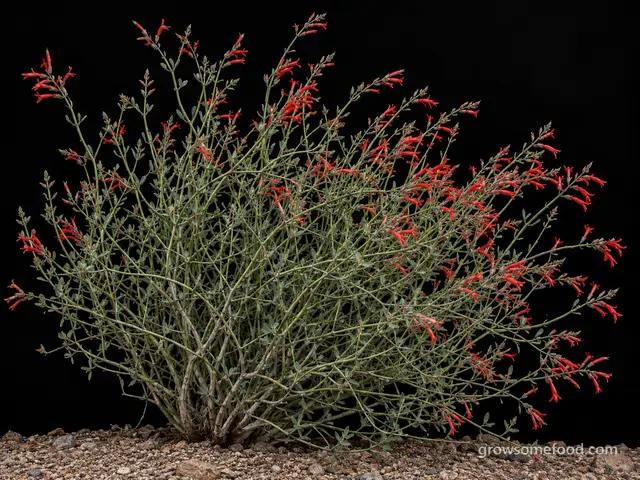
A cheerful, easygoing Sonoran Desert shrub - a rounded mound of green, nearly leafless stems that covers itself in red-orange tubular flowers through the mild desert winter, feeding hummingbirds when little else blooms. Edible nectar, tough as nails, and far easier than ocotillo.
Safety notes Chuparosa is non-toxic, spineless, and safe to handle. Its red-orange tubular flowers are edible - sip the sweet nectar from a bloom or scatter flowers on salads for a mild cucumber note. Make sure of the plant first: Anisacanthus thurberi, the true desert honeysuckle, is a same-family Sonoran shrub with similar red-orange tubular flowers, and this guidance is not written for it. Harvest lightly - the winter-spring flowers are a keystone hummingbird nectar source.
Overview
Chuparosa (Justicia californica) is one of the most rewarding small shrubs of the low Sonoran and Colorado Deserts. Its Spanish name means 'hummingbird' (literally 'rose-sucker'), and that says everything about it: through the mild desert winter and into spring, when almost nothing else is in flower, this rounded mound of slender green stems covers itself in red-orange, two-lipped tubular blossoms that hummingbirds and carpenter bees work all day.
The one thing to knowChuparosa (Justicia californica) is one of the most rewarding small shrubs of the low Sonoran and Colorado Deserts.
Quick facts
- Sprouts in
- 28 daysRange: 14–60 days
- Soil temperature
- 80 °FRange: 70–95 °F
- Height
- 48 inRange: 24–72 in
- Spread
- 5 ftRange: 3–7 ft
- Cold
- Takes light frostdamaged below 20°F
- Heat
- Struggles above 118°F
- Life cycle
- Perennial, lives about 20 years
- Save seeds
- About 60 days after plantingRange: 40–90 days
- Self-sows
- Yes, expect volunteers
- Soil
- Well-drained
- Water
- Low
- Plant spacing
- 5 ftRange: 3–7 ft
When to plant
No planting window on record for this zone. Nearest zone with one: 8b.
Frost here: last around Apr 10 (Mar 27 to Apr 24 most years), first around Oct 25. Zone averages, your own yard may run a week or two either way.
Life stages
Establish, grow, repeat
Getting established and returning each season are different parts of the story.
Stage 1 of 4 · Getting established
Rooting in (first season)
Day 0 to 240 after transplanting
Care at this stage
-
Water to establish, then taper off
Chuparosa establishes far more easily than ocotillo. Water a new plant deeply about weekly through its first warm season to settle the roots, then taper toward the low-water regime it prefers. Plant into full sun and sharply drained soil; it resents wet feet.
-
Site in warmth and sharp drainage
Give it a warm, sunny spot with fast-draining, even lean soil - it thrives in rocky washes and along desert slopes. Avoid heavy, wet, or rich ground. In the cooler edge of its range choose a sheltered microclimate against frost.
Months are typical seasonal windows; climate, variety, and plant age can shift them.
Harvest
- Red-orange two-lipped tubular flowers open along the stems, mainly late winter into spring
- Nectar sweet when a flower is pulled and sucked
- Harvest a few flowers, leaving most for hummingbirds
- Sip the sweet nectar; add flowers to salads · every 5 days
- A winter lifeline for hummingbirds
Picking pick as they ripen
Watch out for
3 to know. 1 is high-risk: Root Rot. None are active in October.
Root RotSeverity High DiseaseSeason: Jan, Jun, Jul, Aug, Sep, DecWilting in the middle of the day on a plant whose soil is damp - the classic tell, and the reason people water a rotting plant and finish it off.
Sharply drained, even gritty soil and low water once established - the mistake is watering it through summer heat as though it were a border shrub. Advanced base rot is fatal, so take cuttings from healthy growth to replace a failing plant.
Wilting in the middle of the day on a plant whose soil is damp - the classic tell, and the reason people water a rotting plant and finish it off. Leaves yellowing from the bottom up, dull off-color foliage, and growth that stalls for no visible reason. Whole shoots, or one side of the plant, collapsing while the rest still looks fine. Soft, dark, or mushy tissue at the base of the stem or at the crown, sometimes with a sour smell. Lift a failing plant and look at the roots: healthy ones are firm and pale, rotted ones are brown or black and slimy, and the outer layer slips off between your fingers leaving a thread of core behind. Seedlings that topple over at soil level are the same problem, called damping-off.
There is no cure for tissue that has already rotted, so act on the conditions rather than looking for a spray. Stop watering at once and fix the drainage - open up compacted soil, or move the plant to a raised, sharply drained position or a container. Lift a badly affected plant, cut away every soft dark root and rotted section with a clean blade back to firm pale tissue, and replant only the healthy parts into fresh free-draining soil or mix. Often the better move is to give up on the plant and save its offspring instead: cuttings, offsets, or divisions taken from firm healthy growth root readily and give you a clean start. Bin the rotted material rather than composting it, and correct the drainage before you replant, because the rot comes straight back in the same wet spot.
Drainage is the whole defense. Match the plant to the site first - something that wants sharp drainage will not survive heavy clay or a low, water-collecting spot however well you tend it. Where the ground is heavy, plant on a raised bed, berm, or slope, or grow in a container. Set plants at the depth they were already growing, since burying the crown or the root flare is a common cause of rot, and keep mulch pulled back a few inches from the stem base instead of piled against it. Water the soil rather than the calendar: check that the top inch or two is dry before watering again, cut back hard in cool weather and winter dormancy, and never leave a pot standing in a full saucer. Do not plant or dig in soggy ground, and go easy on rich amendments for plants that want it lean. Rotate annual crops, and start with clean healthy plants and fresh mix.
Root rot is not one organism but a group of soil fungi and water molds - Pythium, Phytophthora, Fusarium, Rhizoctonia and others - that sit harmlessly in most soils and only turn destructive when the ground stays saturated. Waterlogged soil drives the air out, the roots suffocate, and the weakened tissue is invaded and goes soft, brown, and stringy. Because the damage is underground you usually see it first as something that looks like drought: wilting, yellowing, stunting, a plant that does not respond to being watered. Overwatering, heavy compacted ground, a low spot that collects runoff, a pot with no drainage or a saucer left standing full, and cold wet soil in winter are the usual causes. Once roots have actually rotted there is no cure - this is a problem you prevent rather than treat.
Frost Damage (young plants)Severity Medium DisorderSeason: Dec–FebBlackened, scarred, water-soaked, or collapsing tissue and cracked skin following a hard or extended freeze, especially at the growing tip.
Blackened, scarred, water-soaked, or collapsing tissue and cracked skin following a hard or extended freeze, especially at the growing tip.
Leave lightly frost-scarred tissue in place (it hardens off); watch scarred areas for secondary rot and cut out any soft, spreading lesions. Severely frozen young plants may not recover.
Grow within its warm range (roughly zones 8-11); protect young plants with frost cloth on hard-freeze nights; keep soil dry going into cold; use a warm, sheltered microclimate.
Cold injury during hard or prolonged freezes, worst on young plants near the cool edge of its range (it is hardy only to about the low 20s F). Established plants tolerate light frost and often resprout from the base if top-killed.
Overwatering & Rich-Soil DeclineSeverity Medium DisorderSeason: May–SepLush but weak, sprawling growth; few flowers; leaves staying on in heat when the plant should be resting; onset of rot.
Lush but weak, sprawling growth; few flowers; leaves staying on in heat when the plant should be resting; onset of rot.
Cut back on water, withhold fertilizer, improve drainage, and shear lightly to rebuild a compact habit; bloom and vigor recover under leaner treatment.
Plant in lean, fast-draining soil; water low and infrequently once established; do not fertilize; let it go summer-dry.
Too much water or overly rich soil produces soft, floppy, disease-prone growth and poor bloom, and pushes the plant toward rot - a common mistake with a plant that expects lean, dry desert conditions.
Good & bad neighbors
Plant nearby
-
The solid barrel form and the airy red-flowering chuparosa mound make a strong desert-bed contrast, both wanting full sun and fast drainage with almost no water.
-
Brittlebush's silver mounds and spring yellow daisies contrast the red chuparosa flowers, both low-water desert natives blooming in the cool season on identical lean, sunny terms.
-
Mexican honeysuckle (Justicia spicigera)A different species in the same genus, often planted alongside chuparosa: a lusher, greener-leaved shrub with orange tubular flowers that takes part shade and a bit more water. Use it for the shadier, richer corners where true chuparosa wants more sun and sharper drainage - it is a separate plant with its own needs, not a chuparosa variety, so don't apply this page's timeline to it.
-
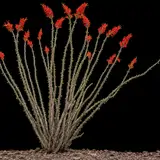
A natural Sonoran pairing: ocotillo's tall red-tipped canes above and chuparosa's red-flowering mound below bloom in the same season and both feed hummingbirds, sharing full sun and sharp drainage.
-
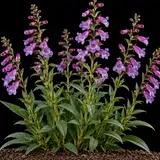
Both are premier desert hummingbird plants; penstemon's spring nectar spikes extend the hummingbird buffet that chuparosa starts in winter, on the same dry, sunny ground.
Varieties · 2
You pick one when you add Chuparosa to your garden. Its days to maturity set your harvest window.
Chuparosa (Justicia californica)
The classic species: a rounded mound of slender gray-green photosynthetic stems that flowers red-orange through the mild desert winter and spring, feeding hummingbirds when little else blooms.
Variety details for Chuparosa (Justicia californica)
Green, nearly leafless arching stems in a mound, studded with two-lipped red-orange tubular flowers.
speciesnativered-flowerhummingbirdNative to the low Sonoran and Colorado Deserts; tough, quick to establish, and edible-flowered.
Yellow chuparosa (Justicia californica, yellow-flowered form)
A naturally occurring and cultivated yellow-flowered form of the same species, offering the same tough, drought-proof, winter-blooming habit with clear yellow rather than red-orange flowers.
Variety details for Yellow chuparosa (Justicia californica, yellow-flowered form)
Same green-stemmed mound with butter-yellow tubular flowers instead of red-orange.
color-formyellow-floweruncommonhummingbirdGrown occasionally as a color variant; still a strong hummingbird plant.
Grower tips
Notes from growers, tagged with the zone they grow in. A person reads every post before it appears.
Nobody has posted about Chuparosa yet. The first one usually saves someone a season.
Free account. Your post shows your grower name and zone, never your email.