Add it to your home screen and it opens full screen: no browser bars, one tap away, and everything stays signed in. Free, nothing to download from an app store.
- Tap the Share button in your browser
- Scroll down and choose “Add to Home Screen”
- Open GrowSomeFood from your home screen
- Open your browser’s menu
- Choose “Add to Home screen” or “Install app”
- Open GrowSomeFood from your home screen

Chicory
Chicory is a safe, non-toxic edible - young leaves as a bitter green, the taproot roasted as a caffeine-free coffee substitute, and the blue flowers as a garnish. It is the same species as radicchio, sugarloaf and Belgian endive; the closely related endive and escarole are its sister species Cichorium endivia. The milky sap and bitterness are harmless. People sensitive to other Asteraceae may react, and the inulin-rich root can cause gas in quantity. Forage only from herbicide-free ground.
Overview
The sky-blue flower of midsummer roadsides - a tough foraged plant that gives bitter salad greens, edible flowers, and the roasted taproot behind classic chicory coffee.
Chicory (Cichorium intybus) is one of the most recognizable wild plants in the country: the tall, wiry, nearly leafless stalks studded with ragged, sky-blue flowers that line midsummer roadsides and fields (and famously close by midday). Beneath that familiar bloom is a genuinely useful three-part food plant. Its young leaves are a bitter salad green, its deep taproot roasts into the caffeine-free coffee substitute that flavors New Orleans coffee, and its blue flowers are a pretty edible garnish.
Chicory is also a plant most gardeners already eat without knowing it: it is the same species as cultivated radicchio, sugarloaf, and Belgian endive, all bred from this tough roadside weed for milder, blanched, or forced leaves — while the closely related endive and escarole are its sister species, Cichorium endivia. Those cultivated leaf chicories have their own entry in this catalog (chicories), with the midsummer sowing dates, blanching timeline, and root-forcing protocol they need; grow them from there rather than from this wild-foraging page. A hardy, deep-taprooted perennial, wild chicory shrugs off drought, cold, and poor ground, greening up early in spring and blooming all summer. It self-sows freely and is usually a volunteer, but a rewarding one - free bitter greens in the cool seasons, a roasted-root drink in fall, and one of the cheeriest blue flowers of the roadside summer.
At a glance
- Sun
- Full sun · Part sun
- Water
- Low
- Spacing
- 6–16 in (typ. 10)
- Mature height
- 12–60 in (typ. 36)
- Start by
- Direct sow
- Frost
- Hardy
- Germination
- 7–21 days (typ. 14) @ 55–75 °F (typ. 65)
- Spread
- 8–20 in (typ. 14)
- Soil
- Well-drained
- Temperature
- Damaged below -30°F · struggles above 100°F
- Seed ready
- 90–150 days (typ. 120) (for saving)
- Self-sows
- Yes — expect volunteers
When to plant
Zone 7a typical frost: last Apr 10 · first Oct 25 (spring frost runs Mar 27–Apr 24 in a typical spread of years)
Life stages
- Seedling rosette day 0–60 from sowing
-
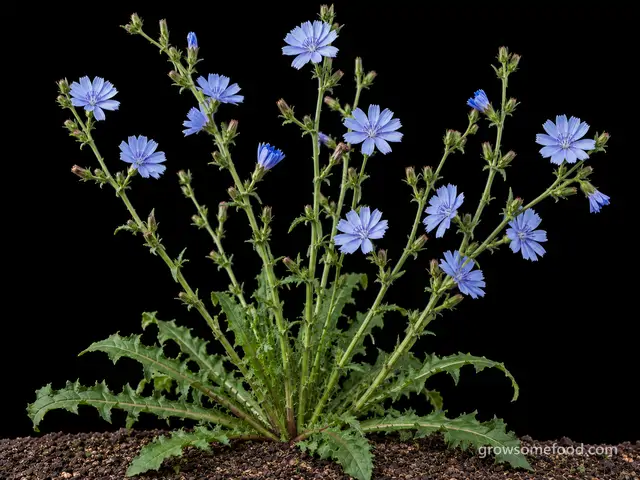
Recognize the dandelion-like rosetteChicory begins as a flat rosette of jagged, dandelion-like leaves over a deep taproot, in sun on lean, disturbed, often gravelly ground. The young rosette leaves are the best for eating. It is deeply taprooted and tough once established, needing no care.
-
Keep young sowings moist for tender leavesIf growing it on purpose, steady moisture keeps the young leaves milder and more tender; drought and heat drive up the bitterness. Once established it is very drought-tolerant.
Bitterness rising with heat and drought (water or blanch for milder greens)Deep taproot making it hard to pull once established -
Recognize the dandelion-like rosette
- Leaf rosette (harvest) Mar, Apr, May, Sep, Oct (yearly)
-
Pick young leaves before floweringevery 7 dHarvest the young rosette leaves in the cool seasons, before the plant bolts and flowers, for the mildest bitter green - eat raw in small amounts or cooked like other bitter greens. Cut-and-come-again: take outer leaves and the crown keeps producing. Bitterness climbs sharply once the tall flower stalk rises.
-
Blanch for milder greensCover the rosette with a pot or board for a week or two before harvest to blanch it - the pale leaves are far less bitter, the same trick used for cultivated radicchio and Belgian endive (chicory's tamed forms, which have their own entry in this catalog).
Leaves turning punishingly bitter with heat, age, or bolting (harvest young or blanch) -
Pick young leaves before floweringevery 7 d
- Blue roadside flowers Jun, Jul, Aug, Sep (yearly)
-
Pick the blue flowers; watch the clockChicory's sky-blue, ragged-edged flowers open on a wiry, nearly leafless stalk and famously close by midday - pick them in the morning as a pretty (mildly bitter) edible garnish. The plant is not eaten as a leaf at this stage (too bitter); this is the flower-and-seed stage.
-
The unmistakable blue of summer roadsidesTall, wiry, blue-flowered chicory lining midsummer roadsides is one of the most recognizable wild plants in the country. It self-sows freely from these flowers and feeds pollinators.
Flowers closing by midday (normal - pick in the morning)Heavy self-seeding from the flower stalksBees working the blue flowers -
Pick the blue flowers; watch the clock
- Root harvest (fall) Oct, Nov (yearly)
-
Dig the taproot in fall for 'chicory coffee'Dig the deep taproot in fall after a full season - loosen deeply with a fork, since it runs down like a parsnip. Scrub, chop, roast until dark and fragrant, then grind for the classic caffeine-free coffee substitute (the New Orleans coffee tradition) or use as a bitter root vegetable.
Taproot snapping off short (loosen deeply; fragments regrow a new plant) -
Dig the taproot in fall for 'chicory coffee'
- Winter dormancy Jan, Feb, Dec (yearly)
-
Rests as a taprooted perennialChicory dies back and overwinters as its hardy taproot, resuming with a fresh rosette of leaves early in spring - among the first bitter greens available. No winter care needed.
Overwintering taproots ready to send up early-spring rosettes -
Rests as a taprooted perennial
Harvest
- Style
- Cut and come again
- First production
- 1–1 yrs (typ. 1)
- Young rosette leaves in the cool seasons, before bolting - the mildest bitter greens
- Blue flowers picked in the morning; taproot dug in fall for roasting
Watch out for
Herbicide / Pollution Contamination Medium
A risk to the forager rather than to the plant. This species grows in lawns, gardens, pastures, croplands, field margins, paths and roadsides - exactly the places that get sprayed with herbicides and lawn chemicals, or that collect road pollution and runoff. The plant itself is harmless; what can make it unsafe to eat is where it has been growing.
Watch for: Plants growing in treated lawns, sprayed beds, pastures or croplands, along busy or polluted roadsides, or anywhere the ground around them looks suspiciously weed-free. Yellowed, twisted or distorted growth on neighboring plants is a sign something has been sprayed recently.
Prevent: Only forage from ground you know has not been treated with herbicides or pesticides, and stay well back from busy roadsides. Ask before harvesting on land you do not manage. If you are not sure, grow your own patch, or gather only from a clean site you have watched across a full season.
Treat: Do not harvest a contaminated plant - there is no washing this off, and no way to tell by looking. The plant itself is fine, so the answer is simply to choose a different site.
The main real caution for chicory. It is a roadside and field-margin plant by habit, so the roots and leaves most easily reached are often the most exposed. Dig roots from clean ground, or grow your own patch.
Aphids Low
Aphids are small soft-bodied sap-suckers - green, black, gray, pink, or waxy white, and mostly wingless - that gather in dense colonies on the tenderest new growth: shoot tips, buds, and the undersides of young leaves. They breed extremely fast in mild weather, so a few can become hundreds inside a week. Their feeding curls and distorts soft growth, and the sticky honeydew they excrete coats everything below and turns black with sooty mold. Ants often farm and defend the colonies for that honeydew. A few aphids are normal on almost any plant and a healthy plant shrugs them off; only dense, persistent colonies do real damage, and some aphids also spread plant viruses as they feed.
Watch for: Dense clusters of tiny insects packed onto shoot tips, flower buds, and the undersides of young leaves. Curled, cupped, or distorted new growth that never opens properly. A sticky shine on the leaves - and on whatever sits under the plant - that later goes black with sooty mold. Tiny white cast skins left behind where a colony has been feeding. Ants running steadily up and down the stems, which is often the first thing you notice. Mottled, streaked, or misshapen leaves that do not grow out can mean a virus the aphids brought with them rather than the feeding itself.
Prevent: Go easy on nitrogen: the soft, lush growth that heavy feeding produces is exactly what aphids breed on. Check new growth once a week through spring and early summer so you catch colonies while they are still small, and rub the first few out with your fingers. Leave flowering plants nearby and skip broad-spectrum sprays - ladybugs, lacewings, hoverflies, and parasitic wasps do most of this work for free, and they only stay if there is something for them to eat. Keep ants off the plant where you can, since they protect aphids from those predators. Water steadily so plants are not stressed, and check any new plant over before you bring it home or move it indoors, since aphids usually arrive on something else.
Treat: Knock the colonies off with a hard jet of water and repeat every few days - on most plants that alone ends it. Pinch out or prune off the worst-infested tips rather than treating the whole plant. If colonies keep rebuilding, spray insecticidal soap or horticultural oil directly onto the insects, covering leaf undersides, and repeat weekly until they are gone; treat early or late in the day, and never spray a wilted or heat-stressed plant. Avoid broad-spectrum insecticides - they kill the ladybugs, lacewings, and parasitic wasps that were about to solve the problem for you, and aphid numbers usually come back worse afterward. Anything you spray must be labeled for the plant you are treating; follow that label and observe its pre-harvest interval. On anything you eat, wash leaves, heads, and buds well before use, since aphids hide down in crowns, folds, and tight growth.
On foraged or cut greens the practical step is rinsing before you eat; a vigorous wild chicory shrugs the feeding off.
Heat & Bolting Bitterness Low
A quality issue rather than a plant problem: heat, drought, age, and bolting turn chicory's leaves punishingly bitter and tough, disappointing foragers who pick at the wrong time.
Watch for: Leaves from tall, bolted, summer plants tasting harshly bitter and feeling tough compared to cool-season rosette leaves.
Prevent: Harvest young rosette leaves in the cool seasons before bolting, keep plants watered, and blanch the rosette under a cover for milder leaves.
Treat: Cook bitter leaves with fat, salt, and acid to mellow them, or switch to the cool-season rosettes and the fall root harvest; wait for the next flush of tender growth.
Good & bad neighbors
Varieties · 1
Rosette of jagged leaves and tall, nearly leafless wiry stalks studded with ragged sky-blue flowers.
The tough wild chicory of roadsides: a deep-taprooted perennial with a rosette of dandelion-like bitter leaves and tall wiry stalks of sky-blue flowers. Young leaves as bitter greens, blue flowers as garnish, and the roasted taproot as a caffeine-free coffee substitute.
Grow
A tough, deep-taprooted perennial of lean, sunny, disturbed ground; it volunteers along roadsides and needs no care, though you can sow it for greens and a fall root crop.
Chicory thrives on exactly the lean, sunny, disturbed ground most crops dislike - roadsides, field edges, gravelly waste places, and poor soils - where its deep taproot mines water and minerals and makes it very drought-tolerant. It is a hardy perennial that greens up early in spring, blooms all summer, and dies back to its taproot for winter, returning reliably year after year.
You almost never plant wild chicory - it volunteers abundantly from self-sown seed. To grow it deliberately (for kitchen greens and a fall root harvest, or as forage), direct-sow it in cool spring or late-summer soil in full sun; keep young sowings moist for milder, more tender leaves, since heat and drought sharpen the bitterness. For salad-quality greens, borrow the endive grower's trick and blanch the rosette under a cover. Because it self-sows freely and its taproot resprouts from fragments, site it where its spread and persistence are welcome - it is far easier to establish than to remove.
Harvest
Take young rosette leaves in the cool seasons (blanch for milder greens), pick blue flowers in the morning, and dig the taproot in fall to roast for chicory coffee.
Chicory is a rolling harvest across the whole plant. Take the young rosette leaves in the cool seasons - early spring and fall - before the plant bolts, when they are least bitter; eat them raw in small amounts or, better, cooked like other bitter greens (they mellow with heat, and pair well with fat, salt, and acid). Blanching the rosette under a pot for a week or two gives much milder leaves, exactly as cultivated Belgian endive and radicchio are grown. Cut outer leaves and the crown keeps producing.
In summer, pick the blue flowers in the morning (they close by midday) for a mildly bitter edible garnish. And in fall, after a full season has fattened the taproot, loosen it deeply with a fork (it runs down like a parsnip), then scrub, chop, roast until dark and fragrant, and grind it for the classic caffeine-free chicory coffee - or cook it as a bitter root vegetable. As with any roadside plant, forage only from ground free of herbicides and away from polluted roadsides, since chicory's favorite habitat is exactly the roadside.
In the kitchen
Bitter greens raw or braised, the taproot roasted into chicory coffee, and the blue flowers as garnish - plus its tamed forms, radicchio and Belgian endive, which have their own catalog entry.
Chicory is a versatile bitter plant, and the key to cooking it is treating the bitterness as a feature. The young leaves go into salads in small amounts (classic with a warm dressing, bacon, or a sweet-sour vinaigrette that tames the bite) or are braised and sauteed like other bitter greens, mellowing with fat, salt, and acid. Blanched or forced, the same species becomes the pale, tender Belgian endive and the red-and-white radicchio of the produce aisle (the frisee and escarole beside them are the sister species Cichorium endivia). Those cultivated chicories are grown quite differently from the wild plant — midsummer sowing, blanching, and for witloof a dark root-forcing stage — so follow the separate chicories entry in this catalog if you want to raise them.
The signature use, though, is the roasted root: dried, roasted dark, and ground, chicory root makes a rich, bitter, caffeine-free brew, used on its own or blended with coffee to stretch and deepen it - the tradition behind New Orleans coffee. The blue flowers add color and a mild bitterness to salads. Because chicory offers greens in the cool seasons and a roasted-root drink in fall, one tough roadside plant quietly covers a lot of culinary ground - just pair its bitterness with richness and acidity and it shines.
Nutrition
A nutritious bitter green rich in vitamins and minerals, and a taproot high in inulin - a prebiotic fiber that feeds gut bacteria and gives chicory coffee its body.
Chicory greens are a genuinely nutritious bitter leaf, supplying vitamins A, C, and K, folate, and minerals, plus the beneficial bitter compounds that stimulate digestion and appetite (the whole point of bitter greens in traditional diets). Eaten young and cooked, they add real nutrition to cool-season meals when garden vegetables are scarce.
The taproot brings something different and valuable: it is rich in inulin, a prebiotic fiber that feeds beneficial gut bacteria - which is why chicory root is both a traditional digestive tonic and a modern commercial source of inulin fiber. Inulin also gives roasted chicory coffee its body and mild sweetness. A note of moderation: because inulin is a fermentable fiber, large amounts of the root can cause gas in some people, so build up gradually. Between vitamin-rich bitter greens, a prebiotic root, and edible flowers, chicory packs a lot of honest nutrition into a plant most people mow down as a weed - and, of course, it is the wild parent of several familiar salad vegetables.
Traditional & historical uses
Chicory has been a medicinal plant since antiquity. Its bitter leaves and especially its taproot are used as a digestive bitter and a traditional liver and gallbladder tonic, and the inulin-rich root is a prebiotic fiber with real, growing evidence for gut health. Food-safe and gentle, though the root can cause gas and medicinal doses have some cautions. Educational only, not medical advice.
This section records how people have traditionally used this plant, and what is known about the risks. It is history and general information — not medical advice, and not a recommendation to treat anything. Plants are not dosed like medicines, some interact with prescriptions, and some are harmful in ways that are not obvious. Talk to a clinician before using any plant medicinally.
Chicory - the wild parent of radicchio and Belgian endive - has been eaten as a medicine as well as a food since antiquity, valued by the Greeks, Romans, and Egyptians as a bitter tonic for the digestion and the liver.
Traditional uses: the bitter leaves and root are a classic digestive bitter, stimulating appetite and digestion, and the root has a long tradition as a gentle liver and gallbladder ('hepatic') tonic and cholagogue, as well as a mild diuretic and laxative. The bitterness comes from sesquiterpene lactones (such as lactucin and lactucopicrin). The taproot's other key constituent is inulin, a prebiotic fiber that feeds beneficial gut bacteria - a use with real and growing modern evidence, and the reason chicory root is now a major commercial source of inulin fiber.
Honest caveats: chicory is a safe, non-toxic food, and its gentle bitter-tonic use is well within ordinary herbal tradition. But because inulin is a fermentable fiber, large amounts of the root can cause gas and bloating - build up gradually. People allergic to other Asteraceae (ragweed, daisies) may react, and as a traditional bitter and cholagogue it is best used cautiously by those with gallstones and avoided in medicinal doses during pregnancy (an old emmenagogue caution). Educational information, not medical advice.
History
An ancient Mediterranean food and medicine, tamed into radicchio and Belgian endive, and famous as the roasted-root coffee stretcher that flavors New Orleans coffee to this day.
Chicory has been eaten and used medicinally around the Mediterranean since antiquity - the Greeks, Romans, and Egyptians all valued it as a bitter tonic green and a liver-and-digestion remedy - and its cultivated forms, radicchio, sugarloaf, and Belgian endive, were bred from this same wild plant over centuries of selection for milder, blanched, and forced leaves (the frisee and escarole of the salad aisle come from its sister species, Cichorium endivia). As a roadside weed, it followed European settlement across North America and now lines summer roadsides nearly everywhere.
Its most famous chapter is the roasted root. Chicory root roasted and ground has long been used to stretch or replace coffee, especially in hard times - during coffee shortages and blockades in Europe and the American South, chicory 'coffee' kept the cup full. In New Orleans, that wartime necessity became a beloved tradition: chicory-blended coffee, served with beignets, is still a signature of the city. So the plant carries a double heritage - the refined salad vegetables of European kitchens and the frugal, resilient roasted-root drink of hard times - all from the tough blue-flowered weed of the roadside.
Troubleshooting
Punishing bitterness comes from heat, age, or bolting (harvest young or blanch); the deep taproot resists pulling and resprouts; forage clean roadsides only.
The greens are unbearably bitter: you picked them in heat, from an old plant, or after it bolted - take young rosette leaves in the cool seasons, cook them (bitterness mellows with heat and fat), or blanch the rosette under a cover for much milder leaves. The flowers closed up: normal - chicory's blue flowers open in the morning and close by midday, so pick them early. I cannot pull it out: chicory has a deep, tough taproot (like a parsnip) and resprouts from root fragments - dig deep to get the whole root, or accept it as a persistent perennial. My chicory coffee is weak or harsh: roast the chopped root dark and fragrant (not burnt), and grind it fresh; blend with coffee to taste. The root gave me gas: the inulin is a fermentable prebiotic fiber - build up amounts gradually. Is it safe? Yes - non-toxic and easily identified; the only real caution is its roadside habitat, so forage from ground free of herbicides and pollution. Pests and diseases: few of note - it is a tough survivor.
Growing across climates
A hardy, drought-tolerant plant adapted across nearly the whole country (zones 3-9); cool-season greens everywhere, with the harvest window shifting from spring/fall in the North to winter in the South.
Chicory is remarkably adaptable, hardy and naturalized across nearly all of North America, roughly zones 3-9, and thriving on lean, dry, disturbed ground that defeats fussier plants. Its leaves are always best in the cool seasons, so the harvest window shifts by climate. Cold northern zones (3-6): a hardy perennial that greens up early for spring greens, blooms all summer, and gives a fall root harvest before dying back to its taproot for winter. Temperate zones (6-8): its easy heartland, with spring and fall leaf harvests and abundant summer bloom. Warm southern zones (8-9): grow it for greens through the cool months of fall, winter, and spring, since intense summer heat makes the leaves punishingly bitter and pushes it to bolt - though it still flowers and sets a fall root.
Everywhere, the flavor rule holds: cool weather and steady moisture make milder chicory; heat and drought make bitter chicory. Because it is so widely adapted and so drought- and cold-tolerant, chicory is available as a foraged plant - blue flowers in summer, bitter greens in the cool seasons, roasted root in fall - across essentially the entire country, wherever there is a sunny, disturbed patch of ground for it to colonize.
Cook it
All 1 recipe →Grower tips
No grower tips for Chicory yet. Yours could be the first.
Sign in to share what works in your garden.