Add it to your home screen and it opens full screen: no browser bars, one tap away, and everything stays signed in. Free, nothing to download from an app store.
- Tap the Share button in your browser
- Scroll down and choose “Add to Home Screen”
- Open GrowSomeFood from your home screen
- Open your browser’s menu
- Choose “Add to Home screen” or “Install app”
- Open GrowSomeFood from your home screen
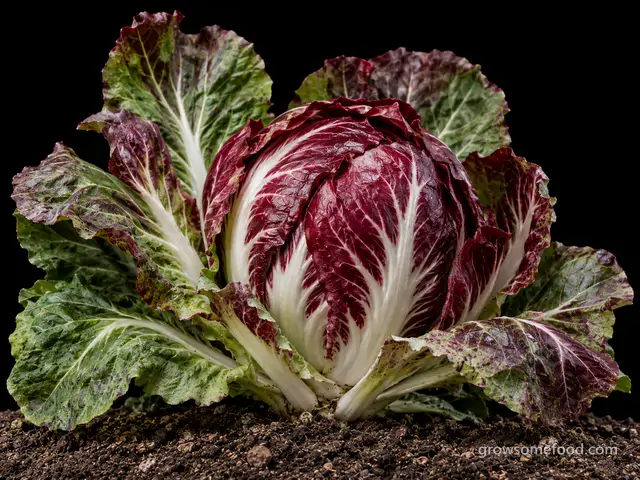
Chicories
The bitter-salad family - radicchio, endive, escarole, frisee, and forced Belgian endive - and the fall garden's signature salad crop, sown in midsummer to head up as the nights turn cold.
All chicories are safe, non-toxic salad vegetables; the bitterness (from harmless sesquiterpene-lactone sap) is the whole point and mellows with cold, blanching, or cooking. Belgian endive chicons must be forced in the dark - light turns them green and punishingly bitter, though not harmful. The wild roadside chicory is its own plant in this catalog.
Overview
The one thing to knowUnder one banner sit the ruby heads of Italian radicchio, the frilly frisee and broad escarole of the endive branch, the tall pale sugarloaf, and the ivory forced spears of Belgian endive (witloof).
The chicories are the bitter side of the salad bowl, and the fall garden's answer to summer lettuce. Under one banner sit the ruby heads of Italian radicchio, the frilly frisee and broad escarole of the endive branch, the tall pale sugarloaf, and the ivory forced spears of Belgian endive (witloof). Nearly all are cool-season crops sown in midsummer to mature as the nights turn cold - frost doesn't hurt them, it sweetens them, mellowing the bitterness and deepening radicchio's wine-red color. Where lettuce quits in the cold, chicory is just getting good.
They come in two species. Cichorium intybus gives the heading radicchios, the sugarloaf types, and the root grown for forcing into Belgian endive; Cichorium endivia gives frisee (curly endive) and escarole. Both were bred over centuries from the tough blue-flowered wild chicory of the roadside - which is its own plant in this catalog - selected for milder, blanched, and forced leaves. What makes this a single crop worth learning is that its kinds diverge most exactly where it matters: at harvest. A radicchio is a firm head you cut; escarole is a rosette you blanch and cut; and Belgian endive is a root you dig, store, and force in the dark all winter.
Quick facts
- Sprouts in
- 10 days5 to 14
- Soil to sprout
- 65 °F45 to 80
- Start indoors
- 4 weeks before transplant3 to 6
- Life cycle
- Biennial, grown as an annual
- Seed to save
- About 150 days after planting120 to 180
- Height
- 12 in8 to 16
- Spread
- 12 in8 to 16
- Cold
- Takes hard frostdamaged below 15°F
- Heat
- Struggles above 80°F
Full sun or part sun · medium water · well-drained soil · 10 in apart (8 to 12) · direct sow or transplant
When to plant
Nothing is open today. Spring sowing opens 6 months, Mar 27 to May 1.
- Direct sow Mar 27 – May 1 Opens in 187 daysAbout 2 weeks before to 3 weeks after your last frost (Apr 10 here)Frisee and other quick C. endivia types can be squeezed in from an early-spring sowing for a baby-leaf cut. Escarole and every heading type bolt from spring sowings - summer-sow those for a fall crop instead.
- Direct sow May 10 – Jun 24 Opens in 231 daysAbout 4 weeks after to 11 weeks after your last frost (Apr 10 here)Witloof (Belgian endive) is sown late spring to early summer for a long season of root growth, then dug after frost and forced indoors through winter.
- Direct sow Jul 27 – Aug 26 Opens in 309 daysAbout 13 weeks before to 9 weeks before your first frost (Oct 25 here)The signature window: sow radicchio, sugarloaf, endive, and escarole in midsummer so heads mature and firm as nights cool. Radicchio and sugarloaf sweeten and color with light frost.
- Transplant Aug 1 – Aug 26 Opens in 314 daysAbout 12 weeks before to 9 weeks before your first frost (Oct 25 here)Set out midsummer-started transplants for fall heads where a direct-sown stand is hard to keep moist in heat.
Frost here: last around Apr 10 (Mar 27 to Apr 24 most years), first around Oct 25. Zone averages, your own yard may run a week or two either way.
Life stages
Five stages, about 10 weeks from sowing to the first pull. Windows are typical; your zone and weather move them.
Germination
Day 0 to 10 from sowing- WaterKeep the seedbed evenly moistdailySow shallow, about 1/4 inch, and never let the surface crust over. Midsummer sowings go into warm soil that dries fast - mist often, and a little shade over the row helps.
- ProtectSow midsummer for the fall cropThe signature timing: sow chicories in the heat of midsummer so heads mature and firm as the nights cool. Spring sowings of heading types usually bolt before they head.
Watch for- Crusted soil blocking emergence
- Warm-soil sowings drying out (shade and mist)
Seedling
Day 10 to 30 from sowing- ThinThin to 8-12 inches apartCrowded chicories make loose, leafy heads that never firm. Give every plant room to build a solid heart; eat the thinnings as a bitter micro-green.
- ProtectGuard young plants from slugsevery 4 daysSlugs and snails shred tender chicory seedlings overnight in damp weather. Bait, trap, or patrol from the day they emerge.
Watch for- Slug feeding on tender seedlings
- Flea-beetle shot-holes on young leaves
Rosette, heading & blanching
Day 30 to 65 from sowing- WaterWater steadily for tender, less-bitter leavesevery 3 daysEven moisture keeps chicories milder and heads firm; drought and heat sharpen the bitterness and push plants to bolt. Aim for about an inch a week.
- ProtectBlanch endive and escarole to tame the biteevery 10 daysblanch onlyOne to two weeks before cutting, gather the outer leaves up over the heart and tie them (dry weather only, to avoid rot), or cover each plant with a plate or pot. The pale, light-starved center grows sweet and tender.
- FertilizeFeed lightly for steady growthA modest nitrogen feeding keeps growth quick and heads filling; too rich and you get leafy sprawl that won't firm into a head.
Watch for- Loose, leafy heads that won't firm (heat, or too much nitrogen)
- Tipburn - brown inner-leaf edges from moisture swings
- Aphids tucked deep in the heart
Harvest
Day 55 to 90 to the first pull from sowing, picking to about day 100- HarvestCut heads at the base once firmevery 5 daysSqueeze a head like a small cabbage - cut when it firms up. Radicchio's outer wrapper leaves often look ragged; peel them back to the tight, colored jewel inside. Morning-cut heads are crispest.
- HarvestWitloof: dig roots after frost, then force in the darkwitloof onlyThe wholesale-different one: grow all season for the ROOT, dig after a hard frost or two, trim the tops to about an inch, then pack the roots upright in a box of damp sand or soil and hold in COMPLETE DARKNESS at 50-60°F. In 3-4 weeks each root sprouts a pale chicon - your winter salad.
Watch for- Heads splitting or rotting if left too long past firm
- Chicons greening in stray light (keep witloof forcing pitch-dark)
Bolting (end of the leaf crop)
Day 95 to 140 from sowing- DoPull bolted plants - or leave one to flowerSpring-sown heading chicories often bolt to a bitter, wiry flower stalk before they head - which is why midsummer sowing for fall is the rule. As a biennial, a plant left in the ground flowers its second year, opening the same sky-blue chicory flowers and setting seed for pollinators.
Watch for- A central stalk rising instead of a firm head (bolting)
- Second-year plants sending up blue flower stalks
Harvest
- Head firm to a squeeze, like a small cabbage
- Radicchio colored deep wine-red, deepening after cool nights and light frost
- Endive and escarole hearts pale and tender if blanched, before a stalk rises
- Witloof chicon 4-6 inches, tight, and creamy-white with yellow tips
- Cut heads at the base once firm · every 5 days
- Witloof: dig roots after frost, then force in the dark
Per plant 1 head, 4 to 20 ozPicking pick as they ripen
Cook with Chicories
Watch out for
5 to know. 1 is high-risk: Slugs & Snails. 3 are active in September.
Slugs & SnailsSeverity High PestnowThe chief early-season threat to chicory seedlings, worst on the damp fall-sown stands; established heads mostly outgrow them, so protect the vulnerable seedling weeks.
Irregular ragged holes chewed out of the middle of leaves and along the edges - not the clean-edged cuts a caterpillar leaves. Seedlings that vanish overnight, or that are cut off at soil level with nothing left behind. Silvery dried slime trails across leaves, soil, pots, and paving in the morning: this is the giveaway that tells you it was mollusks rather than an insect. Chewed pits in ripe fruit, especially where it rests on the ground. Damage that shows up on the lowest, dampest leaves first and gets worse after rain or evening watering. Turn over a board, an upturned pot, or a clump of dense mulch during the day and look for the animals themselves sheltering in the cool underneath.
Hand-picking works and costs nothing: go out an hour after dark with a headlamp, drop what you find into soapy water, and repeat nightly for a week or two - persistence is what wins, not any single product. Shallow beer traps sunk to soil level catch them too, but need emptying and refilling daily to be worth anything. Iron-phosphate bait is the standard control and is far lower-risk around pets and wildlife than the old metaldehyde products, but it is not harmless: many formulations include EDTA, and a dog that eats a quantity of pellets can develop iron toxicosis. Scatter it thinly per the label, never in piles, and keep dogs off a baited bed. Clear fallen foliage and debris in autumn, where the eggs are laid. In a wet climate this is a population you manage each season rather than one you eradicate - and on most established plants light grazing is cosmetic and needs nothing at all.
Take away the daytime shelter first: lift boards and upturned pots, clear piles of debris, keep dense mulch pulled back from crowns and stems, and give crowded plantings enough airflow to dry out. Water in the morning rather than the evening so the surface is dry by the time they come out. Copper tape around containers and raised beds gives them a shock they will not cross, and it is the one barrier that reliably works. Get plants past the vulnerable stage quickly - start seedlings in pots and set them out at a decent size rather than direct-sowing into a cold wet bed, since most plants stop being worth defending once the leaves toughen. Leave the ground beetles, frogs, toads, and ground-feeding birds alone, because they eat mollusks all night for free and broad-spectrum slug pellets kill them too. Where thick-leaved or resistant varieties exist for what you are growing, they take far less damage.
Slugs and snails are nocturnal mollusks that rasp ragged holes in soft leaves, shear off seedlings at ground level, and chew into ripe fruit that touches the soil. They feed at night and in the early morning and spend the day hidden under boards, pots, dense mulch, leaf litter, and low foliage, becoming active in exactly the cool, damp, shaded conditions that suit young plants. Damage is heaviest in wet spells and on tender spring growth: a single wet week can erase a row of seedlings while an established, tough-leaved plant of the same species is barely marked. They lay clusters of small pearly eggs in damp soil and under debris, so a garden with plenty of cover carries a resident population year after year rather than being invaded from outside.
Downy Mildew (Chicory)Severity Medium DiseasenowTight radicchio and blanched endive hearts trap moisture, so the cool wet weather that suits the crop also suits the mildew - airflow and morning base-watering matter most in a wet fall.
Yellow angular blotches bounded by the leaf veins, with a gray-white downy fuzz on the underside in morning humidity, and rot creeping into the heart of tight heads.
Remove affected leaves promptly, harvest ahead of a prolonged wet spell, and peel the outer leaves off heading types; copper protects new growth under heavy pressure.
Water at the base in the morning, space for airflow, avoid overhead watering, rotate out of chicory and endive ground, and choose resistant varieties where falls are wet.
Cool, damp-weather disease of chicory and endive: pale yellow angular patches on the upper leaf with a downy gray-white growth beneath, disfiguring the leaves and opening rot pathways into dense heads.
AphidsSeverity Medium PestnowOn heading chicories aphids hide deep in the folding heart where they escape notice until you cut the head open - soak heads before serving and check the crown.
Dense clusters of tiny insects packed onto shoot tips, flower buds, and the undersides of young leaves. Curled, cupped, or distorted new growth that never opens properly. A sticky shine on the leaves - and on whatever sits under the plant - that later goes black with sooty mold. Tiny white cast skins left behind where a colony has been feeding. Ants running steadily up and down the stems, which is often the first thing you notice. Mottled, streaked, or misshapen leaves that do not grow out can mean a virus the aphids brought with them rather than the feeding itself.
Knock the colonies off with a hard jet of water and repeat every few days - on most plants that alone ends it. Pinch out or prune off the worst-infested tips rather than treating the whole plant. If colonies keep rebuilding, spray insecticidal soap or horticultural oil directly onto the insects, covering leaf undersides, and repeat weekly until they are gone; treat early or late in the day, and never spray a wilted or heat-stressed plant. Avoid broad-spectrum insecticides - they kill the ladybugs, lacewings, and parasitic wasps that were about to solve the problem for you, and aphid numbers usually come back worse afterward. Anything you spray must be labeled for the plant you are treating; follow that label and observe its pre-harvest interval. On anything you eat, wash leaves, heads, and buds well before use, since aphids hide down in crowns, folds, and tight growth.
Go easy on nitrogen: the soft, lush growth that heavy feeding produces is exactly what aphids breed on. Check new growth once a week through spring and early summer so you catch colonies while they are still small, and rub the first few out with your fingers. Leave flowering plants nearby and skip broad-spectrum sprays - ladybugs, lacewings, hoverflies, and parasitic wasps do most of this work for free, and they only stay if there is something for them to eat. Keep ants off the plant where you can, since they protect aphids from those predators. Water steadily so plants are not stressed, and check any new plant over before you bring it home or move it indoors, since aphids usually arrive on something else.
Aphids are small soft-bodied sap-suckers - green, black, gray, pink, or waxy white, and mostly wingless - that gather in dense colonies on the tenderest new growth: shoot tips, buds, and the undersides of young leaves. They breed extremely fast in mild weather, so a few can become hundreds inside a week. Their feeding curls and distorts soft growth, and the sticky honeydew they excrete coats everything below and turns black with sooty mold. Ants often farm and defend the colonies for that honeydew. A few aphids are normal on almost any plant and a healthy plant shrugs them off; only dense, persistent colonies do real damage, and some aphids also spread plant viruses as they feed.
CutwormsSeverity Medium PestMainly a risk to young spring-set transplants; midsummer direct sowings for the fall crop face less pressure.
Seedlings and transplants toppled at the soil line overnight, or shoots chewed and notched near the base, with the severed tops left lying beside the stumps. Dig an inch down within a few inches of the damage and you will usually find the culprit: a plump, dull gray-brown caterpillar that curls into a C when touched.
Dig around each fallen plant and destroy the caterpillar - left alone, one cutworm will fell another plant every night. Replant the gaps with collars fitted. Hand-picking after dark with a flashlight works well on a small bed, and a fast-growing crop soon outgrows the vulnerable stage.
Push a cardboard, foil or tin-can collar an inch into the soil around each seedling and transplant so the stem cannot be reached. Cultivate the bed a couple of weeks before planting to expose the larvae to birds and drying, and clear grassy weeds and debris, which is where the moths lay their eggs.
The soil-dwelling larvae of night-flying moths. They spend the day curled just under the surface and come out after dark to chew through young stems at soil level, felling seedlings and transplants outright - a toppled plant lying beside its own stump is the signature. Some species also climb to gouge and notch emerging shoots and spears. They are worst in freshly worked ground, in beds that were weedy or grassy the year before, and on the first plantings of spring.
TipburnSeverity Medium DisorderShows up on the inner leaves of heading radicchio and blanched endive, where fast growth in a tight head strains calcium delivery; even watering is the fix.
Brown, dry edges on the newest inner leaves, especially during warm spells after rain.
Trim affected edges (the rest is fine to eat) and smooth out the watering rhythm - new growth will be clean.
Steady, even watering and mulch; avoid the feast-famine moisture cycle; some varieties resist it markedly.
Not a disease: browning, papery leaf edges caused by a calcium-delivery hiccup during fast growth and moisture swings - lettuce's version of blossom end rot.
Good & bad neighbors
Plant nearby
-
The other cool-season salad crop, on the same calendar and care - interplant for a mixed bitter-and-mild salad bed, lettuce in the warm shoulders and chicory into the cold.
-
Fast radishes mark the slow chicory rows and break soil crust for the seedlings, then are pulled long before the chicory needs the room.
- Traditional pairings, thin evidence
-
Traditional cool-season row-mate; carrots work the deeper soil layer while chicory heads above, with no real competition and staggered harvests.
-
Allium scent is traditionally credited with discouraging aphids, which love to hide deep in a folding chicory heart.




Keep apart
-
Fennel's root exudates inhibit most garden vegetables; give it its own corner well away from the salad bed.

Varieties · 10
You pick one when you add Chicories to your garden. Its days to maturity set your harvest window.
Radicchio & heading chicory (C. intybus) 6 varieties
Palla Rossa
Round, cabbage-like heads of deep burgundy leaves veined bright white.
chioggiaheadingreditalianThe classic round Chioggia-type radicchio and the standard the others are measured against: softball-size heads of tight, deep wine-red leaves with crisp white ribs, coloring up as the fall nights cool. Dependable, widely sold, and the one to start with. Sow in midsummer; spring sowings bolt.
Chioggia Red Preco
Round red heads, slightly smaller and earlier than standard Chioggia types.
chioggiaheadingredearlyAn earlier, faster round radicchio for shorter seasons and impatient growers: it hearts up and colors weeks ahead of the standard Palla Rossa, still giving those tight burgundy Chioggia heads. A good first radicchio where the fall closes in quickly.
Rossa di Treviso
Upright, torpedo-shaped heads of long, pointed deep-red leaves with white ribs.
trevisoheadingreditalianThe elegant elongated radicchio of Treviso: tall, narrow heads of pointed wine-red leaves with striking white midribs, more cold-hardy than the round types and the classic choice for grilling and risotto. Its flavor and color peak after real cold, so it is the last, best radicchio of the fall.
Endive & Escarole (C. endivia) 2 varieties
Batavian Full Heart
Large rosettes of broad, wavy green leaves around a blanched creamy heart.
escarolebatavianbroad-leafheirloomThe standard broad-leaved escarole: big, full rosettes of wavy green outer leaves folding around a naturally self-blanching, pale, tender heart. Sweeter and less bitter than curly endive, and the classic choice for wilting with garlic and simmering into escarole-and-bean soup. Best from a summer sowing for fall.
Tres Fine Maraichere
Low, dense rosettes of very finely cut, curly green leaves with a blanched center.
friseecurly-endivefine-cutfrenchA fine French frisee (curly endive) with finely cut, ruffly leaves and a pale self-blanching heart - the salad-bowl frisee for warm bacon-and-egg salads.
Witloof / Belgian Endive (forced) 2 varieties
Witloof de Bruxelles
Long parsnip-like roots the first season; forced into 4-6 inch creamy-white chicons.
belgian-endiveforcingheirloomThe traditional Belgian endive for forcing: sown late spring for a season of root growth, dug after frost, then forced in the dark into tight, pale, torpedo-shaped chicons through winter. The heirloom standard for home forcing - grow it for the root, and the salad comes from a dark box months later.
Totem
Uniform forcing roots yielding tight, smooth, creamy chicons.
belgian-endiveforcinghybriduniformAn improved F1 witloof selected for uniform, reliable chicons that force well without a covering layer of soil - a more forgiving choice for a first attempt at home forcing.
Grower tips
Notes from growers, tagged with the zone they grow in. A person reads every post before it appears.
Nobody has posted about Chicories yet. The first one usually saves someone a season.
Free account. Your post shows your grower name and zone, never your email.