Add it to your home screen and it opens full screen: no browser bars, one tap away, and everything stays signed in. Free, nothing to download from an app store.
- Tap the Share button in your browser
- Scroll down and choose “Add to Home Screen”
- Open GrowSomeFood from your home screen
- Open your browser’s menu
- Choose “Add to Home screen” or “Install app”
- Open GrowSomeFood from your home screen
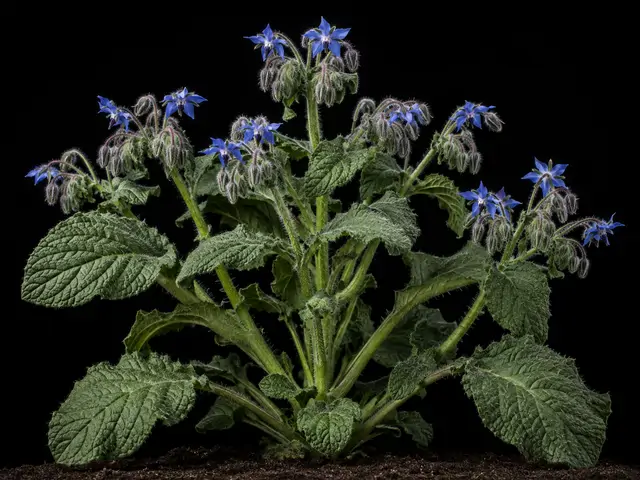
Borage
Flowers and young leaves are edible in moderation. Borage contains trace pyrrolizidine alkaloids (potentially liver-toxic in large, sustained amounts), so treat the leaves and flowers as an occasional garnish and food, not a daily staple or heavy tea. Avoid borage leaf and flower entirely if pregnant, nursing, or living with liver disease. The mature leaves are also bristly-hairy and best cooked.
Overview
The pollinator magnet of the herb garden: a big, easygoing self-seeding annual covered in edible blue star flowers that bees can't resist - and that lift fruit set on everything nearby.
Borage is the plant you grow for the bees first and everything else second. From early summer to frost it throws out hundreds of brilliant blue, five-pointed star flowers, and it refills their nectar in as little as two to five minutes — so honeybees, bumblebees, and native bees work it nonstop. Tucked among vegetables, that steady buzz of pollinators measurably improves fruit set on squash, cucumbers, tomatoes, and strawberries, which is why borage is one of the classic companion plants.
It is also almost comically easy: a hardy annual you direct-sow once and, thanks to enthusiastic self-seeding, likely never sow again. The star flowers and young leaves taste of cool cucumber and make a beautiful edible garnish. Give it a defined sunny spot (it grows into a sprawling 2-3 foot plant), and it rewards you with months of bloom, a swarm of beneficial insects, and volunteers next spring.
At a glance
- Sun
- Full sun · Part sun · Part shade
- Water
- Medium
- Spacing
- 12–24 in (typ. 18)
- Mature height
- 18–36 in (typ. 30)
- Start by
- Direct sow
- Frost
- SemiHardy
- Germination
- 5–14 days (typ. 10) @ 55–80 °F (typ. 70)
- Spread
- 12–24 in (typ. 18)
- Soil
- Well-drained
- Temperature
- Damaged below 28°F · struggles above 90°F
- Seed ready
- 80–110 days (typ. 95) (for saving)
- Self-sows
- Yes — expect volunteers
When to plant
Zone 7a typical frost: last Apr 10 · first Oct 25 (spring frost runs Mar 27–Apr 24 in a typical spread of years)
Life stages
- Germination day 0–10 from sowing
-
Sow deep and keep evenly moistevery 2 dBorage has a deep taproot and resents transplanting, so direct-sow 1/2 inch deep where it will grow. It germinates readily in cool soil and even in darkness.
-
Watch seedlings for slugsFresh borage seedlings are a slug favorite; ring them with bait or patrol at dusk until they toughen up.
Slug damage on tender seedlingsCrowded stands (thin early - borage gets big) -
Sow deep and keep evenly moistevery 2 d
- Seedling day 10–28 from sowing
-
Thin to 12-18 inchesBorage grows into a big, sprawling plant 2-3 feet tall and wide. Thin generously so plants have room and airflow, and eat the thinnings' young leaves.
-
Water while young, then ease offKeep seedlings moist to establish; once the taproot is down, borage is fairly drought-tolerant and needs little supplemental water.
Overcrowding (invites powdery mildew later)Aphids beginning to gather on new growth -
Thin to 12-18 inches
- Bushing out day 28–50 from sowing
-
Pick young leaves for the kitchen nowThe small, tender leaves have the cleanest cucumber flavor and the least bristle - use them before the plant coarsens. Older leaves get hairy and are better cooked.
-
Give it a defined spotBorage self-seeds enthusiastically. Keep it to a corner or edge where volunteers are welcome, and it will reappear for years.
Japanese beetles skeletonizing leaves in early summerPowdery mildew starting on lower leaves in humidity -
Pick young leaves for the kitchen now
- Bloom (the pollinator show) day 55–150 from sowing
-
Pick the star-shaped flowers as they openevery 3 dPluck the bright blue five-pointed flowers just as they open, pinching off the black center if you like. They keep coming for months - the more you pick, the more it blooms.
-
Let the bees have itBorage is one of the best pollinator plants you can grow: it refills its nectar in minutes, so bees work it constantly. A few plants noticeably lift fruit set on nearby squash, tomatoes, and strawberries.
-
Deadhead if you want to limit self-seedingLeft alone, borage drops abundant seed and returns everywhere. Shear off spent flowers before they set seed to keep it contained - or let it run and enjoy the volunteers.
Flowers setting seed and dropping (self-sows freely)Aphids massing on stems and buds (borage draws them - often away from other crops) -
Pick the star-shaped flowers as they openevery 3 d
- Seed set / self-sow day 95–150 from sowing
-
Collect a few seeds, let the rest dropThe large seeds ripen and fall quickly from nodding seedheads. Catch some by bagging a few heads for deliberate sowing, and let the rest self-sow a free patch for next year.
-
Pull tired plants to the compostOnce a plant flops and finishes, pull it - the deep taproot and lush growth make excellent compost and mulch, and pulling spent plants tidies the bed.
Seedheads shattering (collect before they drop if you want the seed)Plants flopping and self-seeding as they finish -
Collect a few seeds, let the rest drop
Harvest
- Style
- Continuous through the season
- Typical yield
- 50–400 flowers (typ. 150)
- Bright blue (or white) star-shaped flowers fully open
- Young leaves small, tender, and cucumber-scented (before they turn bristly)
- Continuous bloom from early summer to frost - pick often to keep it going
Watch out for
Aphids Medium
Aphids are small soft-bodied sap-suckers - green, black, gray, pink, or waxy white, and mostly wingless - that gather in dense colonies on the tenderest new growth: shoot tips, buds, and the undersides of young leaves. They breed extremely fast in mild weather, so a few can become hundreds inside a week. Their feeding curls and distorts soft growth, and the sticky honeydew they excrete coats everything below and turns black with sooty mold. Ants often farm and defend the colonies for that honeydew. A few aphids are normal on almost any plant and a healthy plant shrugs them off; only dense, persistent colonies do real damage, and some aphids also spread plant viruses as they feed.
Watch for: Dense clusters of tiny insects packed onto shoot tips, flower buds, and the undersides of young leaves. Curled, cupped, or distorted new growth that never opens properly. A sticky shine on the leaves - and on whatever sits under the plant - that later goes black with sooty mold. Tiny white cast skins left behind where a colony has been feeding. Ants running steadily up and down the stems, which is often the first thing you notice. Mottled, streaked, or misshapen leaves that do not grow out can mean a virus the aphids brought with them rather than the feeding itself.
Prevent: Go easy on nitrogen: the soft, lush growth that heavy feeding produces is exactly what aphids breed on. Check new growth once a week through spring and early summer so you catch colonies while they are still small, and rub the first few out with your fingers. Leave flowering plants nearby and skip broad-spectrum sprays - ladybugs, lacewings, hoverflies, and parasitic wasps do most of this work for free, and they only stay if there is something for them to eat. Keep ants off the plant where you can, since they protect aphids from those predators. Water steadily so plants are not stressed, and check any new plant over before you bring it home or move it indoors, since aphids usually arrive on something else.
Treat: Knock the colonies off with a hard jet of water and repeat every few days - on most plants that alone ends it. Pinch out or prune off the worst-infested tips rather than treating the whole plant. If colonies keep rebuilding, spray insecticidal soap or horticultural oil directly onto the insects, covering leaf undersides, and repeat weekly until they are gone; treat early or late in the day, and never spray a wilted or heat-stressed plant. Avoid broad-spectrum insecticides - they kill the ladybugs, lacewings, and parasitic wasps that were about to solve the problem for you, and aphid numbers usually come back worse afterward. Anything you spray must be labeled for the plant you are treating; follow that label and observe its pre-harvest interval. On anything you eat, wash leaves, heads, and buds well before use, since aphids hide down in crowns, folds, and tight growth.
Borage is a notable aphid magnet, and that is mostly useful: it pulls aphids off nearby vegetables and draws in the predators that then patrol the whole bed. Leave it alone unless a plant is genuinely overwhelmed - that draw is part of borage's companion value.
Japanese Beetles Medium
Japanese beetles are metallic green-and-copper beetles about half an inch long that emerge in early summer and feed for six to eight weeks. They feed in aggregating masses - one beetle's feeding releases a scent that draws in more - so a plant goes from untouched to covered in a couple of days. They chew the soft tissue between the leaf veins and leave the veins standing, so the leaf ends up as a brown lace skeleton, and they shred open flowers and sometimes ripening fruit as well. They work the sunniest upper parts of a plant on warm afternoons. The white C-shaped grubs spend the rest of the year in turf and pasture soil eating grass roots, and the adults then fly in from wherever they hatched, which can be some distance away.
Watch for: Clusters of shiny metallic beetles massed together on the upper, sunniest foliage and down inside open blooms, heaviest on warm sunny afternoons from around late June. Leaves reduced to lace, with the veins left intact and the tissue between them gone - unmistakable, and quite different from the ragged chewing of a caterpillar. Ragged, chewed petals and blooms that never open properly. Beetles that let go and drop straight to the ground when you disturb the plant. Feeding damage on ripening fruit, on the plants they also take fruit from. Whole branches going brown and lacy at the top of a plant while the shaded lower growth stays untouched.
Prevent: Hand-picking is genuinely the main defense in a home garden. Go out in the cool of the morning while the beetles are sluggish, hold a tub of soapy water underneath, and knock them in - they drop when disturbed, so most fall straight into it. Do it daily through the flight: because the beetles call each other in, taking them off early stops a plant becoming a beacon. Do not put pheromone or lure traps anywhere near the garden - they demonstrably pull in far more beetles than they catch. And do not count on lawn grub control: milky spore has performed poorly and inconsistently in field trials across most of the US, and treating your own turf does not reduce the adults feeding on your plants, because they fly in from surrounding properties. Where it is practical, row cover or netting through the peak flight excludes them outright. Otherwise riding out the six-to-eight-week wave is a legitimate strategy, since most established plants absorb the damage.
Treat: Persistent morning hand-picking into soapy water is the most effective home control there is, and on a vigorous established plant the damage is usually cosmetic and needs nothing else. Neem deters feeding rather than killing, and has to be reapplied. For heavy pressure, spinosad or a targeted insecticide labeled for the plant will work - but time any spray away from bloom and apply it at dusk to protect bees, and observe the pre-harvest interval on anything you eat. On flowering plants, some gardeners simply shear the blooms off for a couple of weeks and let the plant rebloom once the wave has passed, which removes the lure as well as the damage. Young plants and young trees are the ones worth defending: a mature tree or an established vine tolerates several weeks of leaf loss without lasting harm.
Borage is vigorous enough to outgrow the damage and keep flowering right through the few-week flight.
Powdery Mildew Medium
Powdery mildew is a fungal disease that coats leaves - and often stems, buds, and fruit - in a white-to-gray powder that looks like spilled talcum. It is not one fungus but a large family of them, each fairly specialised to its own group of plants, which is why mildew on one crop rarely jumps to an unrelated one beside it. Unlike most leaf diseases it does not need wet leaves: it thrives on warm dry days followed by humid nights, and it takes hold fastest where plants stand crowded in still air or in shade. The coating blocks light, so heavily covered leaves yellow, brown, and drop early. On many plants that is mostly disfiguring and arrives late enough not to matter; where it strips away the leaves a crop still needed to finish, it costs you size, sweetness, and quality.
Watch for: Round white powdery spots on the upper leaf surfaces that spread and merge until whole leaves look dusted. It usually starts on the oldest, lowest, most shaded leaves and works upward, so check there first. Look at the undersides too, and at stems, buds, and flower stalks, which get coated as it advances. Leaves that yellow, brown, curl, or go crisp and drop early under the coating. New growth that opens small, crumpled, or twisted where the fungus has reached the shoot tips. On plants where it gets onto the fruit, a dull gray film, russeted or scarred skin, and cracking. Late in the season, tiny dark specks scattered through the white felt - that is the fungus setting up to overwinter on the debris.
Prevent: Give plants room. Crowding and still air are the biggest single driver, so space at the full recommended distance, thin seedlings properly, and divide or prune out congested growth until air moves through the plant. Full sun and an open position help; deep shade and a still corner against a wall are where it always starts. Water at the base rather than overhead, and water early in the day so nothing stays damp overnight. Keep plants evenly watered - drought stress at the roots leaves them far more susceptible, even though the fungus itself likes dry air. Go easy on nitrogen, since soft lush growth is the most vulnerable. Where resistant varieties exist for what you are growing, choosing one is the single most effective thing you can do on a plant that mildews every year. Clear infected leaves and stems away at the end of the season rather than composting them.
Treat: Start early: sprays protect healthy tissue, they do not clean up leaves that are already coated. Pick off and bin the worst leaves as soon as you see them, and open the plant up by thinning or pruning so air moves through. On anything that regrows quickly, shearing the whole plant back forces a clean flush and beats spraying. If it keeps spreading, potassium bicarbonate, horticultural oil, or neem applied weekly will hold it - cover both leaf surfaces. Sulfur also works, but it burns the foliage of some plants, should never go on in heat, and must not be mixed with or applied close behind an oil spray. Whatever you use must be labeled for the plant you are treating: follow that label and observe its pre-harvest interval on anything you eat. Do not compost badly infected material. Late-season mildew on a plant that is finishing anyway is usually cosmetic; on a crop still filling out it is worth acting on.
Common on big, aging borage plants late in the season, once they are crowded and floppy. Pulling a spent, heavily infected plant is usually the right call - self-sown replacements are generally already coming up behind it.
Slugs & Snails Low
Slugs and snails are nocturnal mollusks that rasp ragged holes in soft leaves, shear off seedlings at ground level, and chew into ripe fruit that touches the soil. They feed at night and in the early morning and spend the day hidden under boards, pots, dense mulch, leaf litter, and low foliage, becoming active in exactly the cool, damp, shaded conditions that suit young plants. Damage is heaviest in wet spells and on tender spring growth: a single wet week can erase a row of seedlings while an established, tough-leaved plant of the same species is barely marked. They lay clusters of small pearly eggs in damp soil and under debris, so a garden with plenty of cover carries a resident population year after year rather than being invaded from outside.
Watch for: Irregular ragged holes chewed out of the middle of leaves and along the edges - not the clean-edged cuts a caterpillar leaves. Seedlings that vanish overnight, or that are cut off at soil level with nothing left behind. Silvery dried slime trails across leaves, soil, pots, and paving in the morning: this is the giveaway that tells you it was mollusks rather than an insect. Chewed pits in ripe fruit, especially where it rests on the ground. Damage that shows up on the lowest, dampest leaves first and gets worse after rain or evening watering. Turn over a board, an upturned pot, or a clump of dense mulch during the day and look for the animals themselves sheltering in the cool underneath.
Prevent: Take away the daytime shelter first: lift boards and upturned pots, clear piles of debris, keep dense mulch pulled back from crowns and stems, and give crowded plantings enough airflow to dry out. Water in the morning rather than the evening so the surface is dry by the time they come out. Copper tape around containers and raised beds gives them a shock they will not cross, and it is the one barrier that reliably works. Get plants past the vulnerable stage quickly - start seedlings in pots and set them out at a decent size rather than direct-sowing into a cold wet bed, since most plants stop being worth defending once the leaves toughen. Leave the ground beetles, frogs, toads, and ground-feeding birds alone, because they eat mollusks all night for free and broad-spectrum slug pellets kill them too. Where thick-leaved or resistant varieties exist for what you are growing, they take far less damage.
Treat: Hand-picking works and costs nothing: go out an hour after dark with a headlamp, drop what you find into soapy water, and repeat nightly for a week or two - persistence is what wins, not any single product. Shallow beer traps sunk to soil level catch them too, but need emptying and refilling daily to be worth anything. Iron-phosphate bait is the standard control and is far lower-risk around pets and wildlife than the old metaldehyde products, but it is not harmless: many formulations include EDTA, and a dog that eats a quantity of pellets can develop iron toxicosis. Scatter it thinly per the label, never in piles, and keep dogs off a baited bed. Clear fallen foliage and debris in autumn, where the eggs are laid. In a wet climate this is a population you manage each season rather than one you eradicate - and on most established plants light grazing is cosmetic and needs nothing at all.
Only the seedling stage is really at risk: established borage is bristly enough to be left alone. Protect the young plants in damp spring weather and stop worrying after that.
Good & bad neighbors
Varieties · 3
Sprawling 2-3 foot plant with bristly gray-green leaves and drooping clusters of vivid blue star flowers with black centers.
The classic species (Borago officinalis) with brilliant sky-blue, five-pointed star flowers and cucumber-flavored leaves. The default garden borage - a top pollinator plant, easy self-sower, and the one nearly all seed packets contain.
Gray-green leaves heavily marbled with cream and white, with blue star flowers.
A more ornamental selection with leaves splashed and marbled in creamy white, topped by the usual blue star flowers. Grown as much for its striking foliage as for its edible flowers and pollinator value; less common but fully usable in the kitchen.
Same bristly, sprawling plant as common borage but with clean white star-shaped flowers.
A pure-white-flowered form, identical in growth, flavor, and pollinator appeal to the blue but with crisp white star flowers. Lovely in a white garden or where the blue would clash, and equally edible.
Grow
Direct-sow where it will grow - the taproot resents transplanting - thin generously, and give it room and sun.
Always direct-sow borage: it forms a deep taproot and dislikes being moved, so sow seed about 1/2 inch deep right where you want it, around your last frost. It germinates easily — even in darkness — in a week or two, and seedlings handle a light frost. Choose a sunny to partly shaded spot with average, well-drained soil; borage isn't fussy and even grows in poor ground, though richer soil makes a bigger plant.
The main thing is to give it space. A mature plant sprawls 2-3 feet tall and wide, so thin seedlings to 12-18 inches apart for airflow (crowding invites powdery mildew) and eat the thinnings. Once the taproot is established it is fairly drought-tolerant and needs little care. Put it near squash, tomatoes, or strawberries and let its flowers pull in pollinators for the whole bed.
Care
Nearly hands-off: water young plants, keep it in its corner, pick flowers often, and stake or let it sprawl.
Borage is one of the lowest-maintenance plants in the garden. Water it while young to establish the taproot, then ease off — it tolerates dry spells well. It rarely needs feeding, and heavy fertilizing just makes floppy growth. The one management decision is containment: borage self-seeds abundantly, so if you want to limit volunteers, shear off spent flowers before they set seed; if you don't mind a self-renewing patch, let it run.
A big plant loaded with flowers can flop, so give it a corner where sprawl is fine, or push in a few twiggy supports. Pick the flowers often — it keeps the plant blooming and tidy. When a plant finishes and collapses in late summer, pull it for the compost; its lush, deep-rooted growth is excellent green material and mulch. Watch for Japanese beetles and aphids, both of which favor it.
Harvest
Pick the star flowers as they open and young leaves before they toughen - the more you pick, the more it blooms.
Flowers are the main harvest: pluck the bright blue stars just as they open, pinching them from the fuzzy calyx (some people remove the small black center stamens, though they're edible). They keep coming for months, and frequent picking encourages more — a single plant yields hundreds over a season. Use them the same day for the best look, or freeze them.
Young leaves are best picked small, when they're tender and most cucumber-flavored and before the plant's characteristic bristly hairs set in; older leaves are prickly and are better cooked. Harvest both in the morning. Remember the moderation note: borage's flowers and leaves are a lovely occasional food and garnish, not something to eat in large daily quantities.
Storage
Best used fresh; freeze flowers into ice cubes for a showstopper, or candy them - leaves don't store well.
Borage is a fresh-picked herb and doesn't keep long, but the flowers have one brilliant storage trick: freeze them into ice cubes. Set a flower in each compartment of an ice tray, fill with water, and freeze — the blue stars suspended in ice are stunning in summer drinks and lemonade, and you can put up dozens at peak bloom. Flowers can also be candied with egg white and fine sugar for cake decorating, keeping for weeks in a tin.
Fresh flowers hold a day or two in the fridge in a covered container; fresh leaves wilt fast and are best used the day you pick them. Borage doesn't dry well — the flowers lose their color and the leaves lose their flavor — so freezing and candying are the ways to carry the harvest forward.
Propagation & seed saving
The definition of a self-sower: let a few seedheads drop and borage plants itself forever - collect a pinch of seed for control.
Borage is one of the easiest plants to keep going, because it does the work itself. Left to flower and seed, a plant scatters its large seeds around it, and next spring a fresh crop of volunteers comes up on its own — many gardeners sow borage exactly once and have it forever after. It is open-pollinated and comes true from seed.
For a managed patch rather than a wild one, collect seed deliberately: the seeds ripen and fall quickly, so watch the nodding seedheads and either bag a few heads or shake ripe seed into your hand before it drops. The seeds are large and easy to handle, and stay viable several years stored cool and dry. Between deliberate collection and generous self-sowing, you will never need to buy borage seed again — the harder job is keeping it where you want it.
Nutrition
Low-calorie leaves with vitamin C, minerals, and the same cucumber-cool taste; the seed is a notable source of GLA omega-6 oil.
Borage leaves are eaten in modest amounts, but they carry real nutrition: they supply vitamin C, vitamin A, and minerals including calcium, potassium, and iron, along with the mucilage that gives cooked borage its slightly slippery, cucumber-cool quality. Because you eat it fresh and in small amounts — both for flavor and because of the moderation note below — treat it as a garnish and a light cooked green rather than a dietary staple.
The plant's most noted nutritional feature is in the seed: borage seed oil (starflower oil) is one of the richest plant sources of gamma-linolenic acid (GLA), an omega-6 fatty acid taken as a supplement for skin and inflammatory conditions. That's a pressed-oil product rather than something you get from eating the leaves, but it's why borage has a place in the supplement aisle as well as the garden.
In the kitchen
Cool cucumber flavor in a blue star: flowers to garnish and freeze, young leaves for salads and soups, always in moderation.
Borage tastes like fresh cucumber, and the star-shaped flowers are its best-loved edible: scatter them over salads and desserts, float them in Pimm's cups, lemonade, and gin drinks, freeze them into ice cubes, or candy them for cakes. Their mild sweet-cucumber flavor and vivid blue make them one of the prettiest edible flowers you can grow.
The young leaves bring the same cucumber note to green salads, chilled soups, yogurt dips, and cream cheese; in parts of Europe (notably the German 'Frankfurt green sauce' and Italian fillings like pansotti) borage leaves are a traditional cooked green and pasta stuffing. Pick leaves small, before the bristly hairs set in — older leaves need cooking to soften them. Enjoy borage as a fresh garnish and occasional green rather than a bulk vegetable, keeping the moderation note in mind.
Traditional & historical uses
A real folk tradition as a mood-lifter and the seed as a GLA source - paired with an honest caution: the leaves and flowers contain liver-affecting pyrrolizidine alkaloids, so keep them occasional.
This section records how people have traditionally used this plant, and what is known about the risks. It is history and general information — not medical advice, and not a recommendation to treat anything. Plants are not dosed like medicines, some interact with prescriptions, and some are harmful in ways that are not obvious. Talk to a clinician before using any plant medicinally.
Borage has a long herbal tradition — its old reputation was for courage and cheer ('I, borage, bring always courage'), used as a mood-lifter and a cooling, soothing herb for fevers and coughs. Its clearest modern role is the seed oil: borage (starflower) seed oil is a leading plant source of the omega-6 fatty acid GLA and is sold as a supplement for eczema and dry skin — though a Cochrane review of the trials found borage oil no better than placebo for eczema. It remains a genuine dietary source of GLA; the clinical claims are the weak part.
Here is the honest caution the plant requires: borage leaves and flowers contain small amounts of pyrrolizidine alkaloids, compounds that can be toxic to the liver (and are possibly carcinogenic) in large or sustained doses. This is a genuine, well-documented concern, so treat borage leaf and flower as an occasional food and garnish rather than a daily tea or heavy green — and avoid it if pregnant, nursing, or with liver disease. Borage seed oil can be processed to remove the alkaloids, but not all products are — look for oil explicitly certified free of unsaturated pyrrolizidine alkaloids (UPA-free). Enjoyed in moderation, the plant is a delight; the caution simply keeps it that way.
History
A Mediterranean herb of courage and comfort, steeped in wine by Romans and Elizabethans and long grown to gladden the heart - and feed the bees.
Borage is native to the Mediterranean and has been cultivated since antiquity for food, medicine, and morale. Roman writers steeped it in wine before battle for courage, and the herb kept that reputation for centuries: the medieval and Elizabethan saying ran 'I, borage, bring always courage,' and a borage-flavored 'cool tankard' was drunk to lift the spirits. It was a staple of medieval physic gardens and cottage borders across Europe.
The name may derive from the Latin borra (rough hair, for its bristly leaves) or from Arabic abu araq, 'father of sweat,' reflecting its old use as a diaphoretic. Carried to the Americas by colonists, it naturalized easily. Today its starring role has shifted to the garden ecosystem — prized as a top pollinator plant and companion — while the blue flowers and cucumber leaves keep their place as a charming edible with deep historical roots.
Growing across climates
An easy annual across most zones; cool weather and steady bloom in the north, a cool-season crop in the hot south where summer is its hard time.
Zones 3-6: grow borage as a spring-to-frost annual — sow around last frost and it blooms all summer, self-sowing for next year; the short cool summers suit it well. Zones 7-8: equally easy, with spring and even fall sowings; light frosts don't faze established plants, and it often overwinters as self-sown seedlings. Zones 9-10: flip toward the cool season — sow in fall for winter and spring bloom, because intense summer heat and humidity stress the plant and bring on powdery mildew. Zones 11+: a cool-season annual only, grown in the mildest months with afternoon shade. Almost everywhere, borage's habit of self-seeding means it settles into whatever window suits your climate and simply returns each year on its own schedule.
Troubleshooting
White coating is powdery mildew from crowding; sticky stems mean aphids (often a good thing); skeletonized leaves are Japanese beetles; flopping is normal.
White powdery coating on leaves (powdery mildew): common in crowding, humidity, and late-season heat — thin and space plants for airflow, avoid overhead watering, and pull badly affected plants (there are usually plenty of self-sown replacements). Aphids massing on stems and buds: borage is an aphid magnet, which is often a feature, not a bug — it can act as a trap crop that pulls aphids off your other plants and draws in the ladybugs and hoverflies that eat them; hose them off if they overwhelm a plant. Leaves skeletonized in early summer: Japanese beetles — hand-pick into soapy water in the morning. Plant flopping over: normal for a big, top-heavy borage — give it room to sprawl or a few twiggy supports. Borage popping up everywhere: self-seeding — deadhead before seed sets to contain it, or embrace the volunteers.
Grower tips
No grower tips for Borage yet. Yours could be the first.
Sign in to share what works in your garden.