Add it to your home screen and it opens full screen — no browser bars, one tap away, and everything stays signed in. Free, nothing to download from an app store.
- Tap the Share button in your browser
- Scroll down and choose “Add to Home Screen”
- Open GrowSomeFood from your home screen
- Open your browser’s menu
- Choose “Add to Home screen” or “Install app”
- Open GrowSomeFood from your home screen
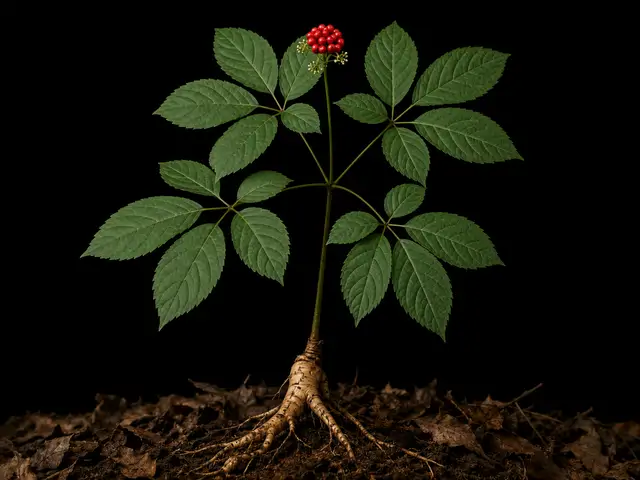
American Ginseng
American ginseng is a regulated MEDICINAL plant, not a casual forage. Wild harvest is legally restricted (CITES-listed; state seasons, a minimum plant age, seed-planting rules, and permits) and banned on many public lands - know and follow your state's law before harvesting. As a stimulating tonic, the root can interact with blood thinners and diabetes and blood-pressure drugs, is avoided in pregnancy, and should be used in moderation with professional guidance.
Overview
The storied medicinal root of eastern hardwood forests - a slow-growing shade perennial with five-fingered leaves and red berries - so valued and over-harvested that its wild harvest is now legally regulated and CITES-protected; grow and conserve it rather than digging wild.
American ginseng (Panax quinquefolius) is one of the most storied plants of eastern North America - a slow-growing woodland perennial whose forked medicinal root has been prized for centuries, above all as a tonic in East Asian medicine, and traded from Appalachian forests around the world. It is an unassuming plant to look at: a whorl of five-fingered compound leaves (hence 'five-fingers') on a knee-high stem, topped in late summer by a distinctive tight cluster of bright red berries. It grows in the deep shade of rich hardwood forests, on cool slopes, from Quebec down the Appalachians to the Ozarks.
This entry is marked Caution because ginseng is not a casual plant to harvest. Centuries of digging for the lucrative root have seriously depleted wild populations, and its trade is now tightly controlled: it is listed under CITES (the international endangered-species trade treaty), and wild harvest is regulated by individual states with set seasons, a minimum plant age, mandatory seed-planting, and permit and certification rules - and is outright banned on many public lands, where poaching remains a real problem. The responsible path for a gardener is to treat ginseng as a plant to grow and conserve - ideally 'woods-grown' under a forest canopy - and to know the law thoroughly before ever harvesting a wild root.
At a glance
- Sun
- Part shade · Shade
- Water
- Medium
- Spacing
- 6–12 in (typ. 9)
- Mature height
- 8–24 in (typ. 15)
- Start by
- Direct sow · Transplant
- Frost
- Hardy
- Germination
- 180–660 days (typ. 450) @ 50–68 °F (typ. 60)
When to plant
Zone 7a typical frost: last Apr 10 · first Oct 25
Life stages
- Years 1+ - the long establishment day 0–1825 from sowing
-
Sow into rich, shaded, well-drained woodland soilevery 0 dGinseng needs a rich hardwood-forest floor: deep to part shade (about 70-80% shade) under maples, tulip poplar, or basswood, in moist but WELL-DRAINED, humusy, calcium-rich soil, typically on cool north- or east-facing slopes. Sow stratified seed in fall about half an inch deep under natural hardwood leaf litter, which it depends on. This 'wild-simulated' method mimics how it grows in nature.
-
Expect many years, and know the plant's age by its 'prongs'Ginseng is extremely slow. Seedlings begin as a single small leaf; over years they add compound leaves ('prongs') - a mature plant of harvestable age typically has 3-4 prongs and is at least 5-10 years old. Roots take 5-10+ years to reach a marketable size, so a planting is a decade-long project. Do not disturb young plants.
Very slow, multi-year growth (a plant's prong count roughly tracks its age)Poaching of wild and planted roots (a serious, real threat)Too much sun or poor drainage causing failure -
Sow into rich, shaded, well-drained woodland soilevery 0 d
- Spring emergence Apr, May, Jun (yearly)
-
Palmate 'five-finger' leaves unfurlIn spring each plant sends up its stem topped by a whorl of compound leaves, each with about five toothed leaflets (the source of the name 'five-fingers' and the species name quinquefolius, 'five-leaved'). Keep the soil moist, shaded, and mulched with leaf litter as the plant grows through the cool season.
Whorls of five-leafleted compound leaves (prongs)Leaf scorch if it gets too much sun or dries out -
Palmate 'five-finger' leaves unfurl
- Summer flowers & red berries Jun, Jul, Aug, Sep (yearly)
-
Small green flowers, then a cluster of red berriesMature plants (usually 3+ years) produce a small round cluster of inconspicuous greenish-white flowers in early summer, which ripen to a distinctive tight cluster of bright RED berries by late summer and fall - the plant's most recognizable feature. Each berry holds one or two seeds.
-
Plant the ripe seeds (required by law where harvesting)Ripe red berries should have their seeds planted nearby to sustain the population - and where wild harvest is legal, planting the seeds of any harvested plant is a LEGAL REQUIREMENT in most states. Even if not harvesting, sowing the ripe seed helps the slow-spreading colony grow.
A tight cluster of bright red berries in late summer/fall (the key ID feature)Ripe seed to plant to sustain the patch (legally required when harvesting) -
Small green flowers, then a cluster of red berries
- Fall & winter dormancy Jan, Feb, Mar, Oct, Nov, Dec (yearly)
-
Dies back to the root; the root ring records its ageIn fall the top dies back and the plant rests as a fleshy root through winter, needing the cold to break dormancy. The root's neck adds a scar each year, so its 'age rings' record the plant's age - part of how legal harvest confirms a plant is old enough. Keep the leaf-litter mulch over the dormant roots.
Dormant roots under the leaf litter (they need winter cold and return in spring)Neck scars recording the root's age -
Dies back to the root; the root ring records its age
Watch out for
Root Rot Disease HighMay, Jun, Jul, Aug
Soil-borne rots that kill yarrow kept in wet, heavy, or poorly drained soil - the main way to lose an otherwise indestructible plant, since yarrow is adapted to dry, lean ground.
Watch for: Wilting, blackening, and collapse despite (or because of) moist soil; soft dark roots; sudden decline after a wet spell or in soggy winter ground.
Prevent: Sharp drainage is everything - lean gritty soil, full sun, minimal water, no rich amendments; raised beds or slopes in wet sites.
Treat: None once the roots rot - remove affected plants, take divisions from healthy outer growth, and replant into far sharper-draining conditions.
Over-Harvesting Disorder HighAug, Sep, Oct, Nov
The defining threat to ramps: because they grow so slowly (5-7 years to harvest size) and spread only slowly by short-dispersed seed, digging bulbs or stripping a patch can wipe out a colony that then takes a decade or more to recover - if it recovers at all. Commercial demand has led to real population declines and harvest bans.
Watch for: Shrinking patches, fewer and smaller plants year to year, and dug-up ground where bulbs were removed - signs a colony is being harvested faster than it can regrow.
Prevent: Harvest one leaf per plant and leave the bulb; take from only large, healthy patches and only a small fraction (5-10% or less); leave plants to flower and seed; never harvest small or wild-declining patches; and grow your own from bulbs or seed.
Treat: Stop harvesting a declining patch entirely and let it recover for years, allowing plants to flower, seed, and spread; supplement by sowing seed or planting bulbs, and shift future harvest to cultivated stands.
Deer (browse resistance) Wildlife MediumJun, Jul, Aug, Sep
Notably NOT a problem - wild ginger's aromatic, aristolochic-acid-rich foliage makes it dependably deer-resistant, so it's a good groundcover choice where deer browse other shade plants.
Watch for: Little to watch for - deer typically leave wild ginger alone even in high-pressure areas.
Prevent: None needed; wild ginger is one of the more reliably deer-resistant native groundcovers.
Treat: None required - its natural chemistry deters browsing, making it a useful plant in deer country.
Good & bad neighbors
Varieties · 3
The native species itself, whether truly wild or grown 'wild-simulated' under forest canopy with minimal intervention. Wild-simulated roots are gnarled, slow-grown, and highly valued, nearly matching wild ones. This is the conservation-minded way to produce ginseng - and any wild digging is bound by CITES and state law.
The famous Asian ginseng of Korea and China - a close relative used similarly as a medicinal tonic root, but traditionally regarded as more warming/stimulating, whereas American ginseng is considered cooling. Not native to North America; included for context, as it is the plant whose fame first made American ginseng so valuable.
The same species grown in tended forest beds under natural shade - more managed than wild-simulated, giving faster, larger roots in perhaps 5-8 years. A leading sustainable forest-farming approach that relieves pressure on wild populations while producing a genuine, marketable medicinal root.
Grow
Grow it 'wild-simulated' in rich, shaded, well-drained hardwood-forest soil: sow stratified seed under leaf litter on a cool slope and wait 5-10+ years. Home cultivation is the sustainable, legal alternative to digging depleted wild populations.
Ginseng can be grown - and doing so is both rewarding and the responsible alternative to harvesting stressed wild stands. It demands the conditions of its native rich hardwood forest: deep to part shade (roughly 70-80% shade, ideally under sugar maple, tulip poplar, or basswood), in moist but well-drained, humusy, calcium-rich soil, typically on cool north- or east-facing slopes with a natural layer of hardwood leaf litter. The favored approach is 'wild-simulated' cultivation: sow cold-stratified seed in fall into suitable forest soil and let it grow essentially wild, producing roots nearly indistinguishable from - and as valuable as - truly wild ones, with minimal inputs.
The hard part, again, is patience and protection. Ginseng seed has a long dormancy (often 18-22 months to germinate), and roots take 5 to 10 or more years to reach a harvestable, marketable size, so a planting is a decade-long forest-farming project. You must also guard against poaching, which is a genuine risk for a crop this valuable. Growers should understand that even cultivated ginseng may be subject to state regulation and certification when sold. Done well, though, woods-grown ginseng is a celebrated model of sustainable forest farming - a way to profit from and steward the forest while relieving pressure on wild populations.
Care
Once sown, it needs mostly the right conditions and protection: keep it shaded, in moist well-drained leaf-mulched soil, guard against poachers and root rots, and let plants flower and seed - the main tasks are patience and stewardship, not fussing.
An established ginseng planting is low-input but not carefree. The essentials are to maintain its forest conditions: keep it in deep to part shade under a hardwood canopy, in moist but well-drained soil (poor drainage invites the root diseases that are ginseng's main enemy), and replenish the natural hardwood-leaf mulch each fall, which feeds the soil and protects the roots. It needs no fertilizer beyond that natural richness.
The real concerns are disease and theft. In the shaded, humid conditions ginseng loves, fungal problems - especially root rots and foliar blights like Alternaria - are the chief cause of crop loss, so good drainage, airflow, and not crowding plants matter greatly. And because a mature root is so valuable, poaching is a serious, real risk; growers often keep their patches discreet and monitored. Beyond that, let plenty of plants flower and set their red berries, and plant the ripe seed to sustain and expand the colony (where wild harvest is legal, seed-planting is in fact required by law). The overarching 'care' for ginseng is stewardship: protect it, let it reproduce, and give it the years it needs.
Propagation & seed saving
Grown from seed, which has a long double dormancy (often 18-22 months), so seed must be stratified and sown fresh; rootlets can also be transplanted. Either way it is a years-long process, and planting seed is central to conserving the species.
American ginseng is propagated almost entirely from seed, and its seed is famously slow. Fresh seed has a deep double dormancy and typically will not germinate until it has passed through about 18-22 months and two winters of cold-and-warm cycling; growers buy stratified seed (already held through this process) to sow in fall for germination the following spring. Sow it about half an inch deep into rich, shaded, well-drained forest soil under leaf litter, and keep the bed undisturbed. Young rootlets (1-2 year seedlings) can also be transplanted in fall to establish a bed a little faster.
From there it is simply a matter of years: seedlings grow slowly, adding a prong of leaves as they age, and take many seasons to mature. Crucially, propagation is also conservation: planting the ripe red-berry seeds - whether or not you ever harvest - is how the slow-spreading, heavily-pressured populations are sustained, and it is a legal requirement of harvest in most states. For the home grower, patience-driven seed sowing is the whole method, and it doubles as an act of stewardship for a declining native.
Medicine
The root is a genuinely important traditional medicine - an adaptogenic tonic with real (if modest) modern evidence for immune and energy support - but its use is bound up with strict harvest law and real cautions, so it is presented honestly as a regulated medicinal, not a casual remedy.
Ginseng's fame rests on its root, one of the most valued medicinal roots in the world. In traditional East Asian medicine, American ginseng is classed as a cooling, restorative tonic ('adaptogen') - used to support energy, resilience to stress, and overall vitality - and this demand (largely for export to Asia) is what has driven centuries of harvest from Appalachian forests. The root's active compounds, ginsenosides, are genuinely studied: modern research offers some support for effects on immune function (such as reducing cold frequency), blood-sugar regulation, and mental fatigue, though the evidence is modest and still developing, so ginseng is best understood as a traditional tonic with promising but not conclusive science - not a proven drug.
Two honest cautions frame any medicinal use. First, the legal and conservation reality: harvesting wild root is regulated under CITES and state law (seasons, minimum age, seed-planting, permits) and banned on much public land, so the medicine cannot be responsibly separated from the rules that protect the plant - and cultivated, woods-grown root is the ethical source. Second, the health cautions: as a stimulating tonic, ginseng can interact with blood thinners and diabetes and blood-pressure medications, is generally avoided in pregnancy, and can cause overstimulation in excess, so it should be used in moderation and with professional guidance. Treated with respect for both the law and the body, it is a remarkable and historic medicinal plant.
Nutrition
Not a food crop - it is a medicinal root, not eaten for nutrition - and its greatest value beyond medicine is ecological and economic: a signature plant of intact Appalachian forests and a model sustainable forest-farming crop.
American ginseng is not a food plant and is not eaten for nutrition; it is a medicinal root, used in small tonic amounts (as tea, tincture, or chewed root) rather than as sustenance, and covered under this plant's Medicine section. Its red berries are not a human food either (they exist to make seed), though birds and small mammals disperse them.
Where ginseng's broader value lies is ecological and economic. It is a signature species of healthy, mature eastern hardwood forests - its presence indicates the rich, undisturbed, calcium-rich woodland it depends on - and conserving it means conserving that habitat and its whole community of spring wildflowers and slow-growing understory plants. Economically, it has long been a genuine forest income for Appalachian communities, and woods-grown ginseng is now a leading example of sustainable forest farming: a way to earn a living from a standing forest without clearing it, which aligns the plant's conservation with rural livelihoods. So while it feeds no one at the table, ginseng 'nourishes' both a centuries-old medicinal tradition and a model of keeping forests intact and profitable.
History
A plant that shaped early American trade - dug from Appalachian forests and exported to China since the 1700s - whose enormous value led to centuries of over-harvest, and, in response, to CITES protection, state harvest laws, and a modern conservation and forest-farming movement.
Few native plants have a bigger history than ginseng. Native peoples used American ginseng medicinally long before European contact. After a related ginseng's fame in China became known, colonists realized the American species growing in their forests was a fortune underfoot: by the mid-1700s ginseng dug from Appalachian and frontier woods was being exported to China in huge quantities - Daniel Boone famously traded in it, and 'sang digging' became a vital cash income for generations of rural and Appalachian families, a tradition that continues today.
That very value became the plant's peril. Centuries of intensive digging for the export market seriously depleted wild ginseng across its range, a decline worsened by habitat loss and, today, by poaching (including from national parks). The response has built a framework of protection: American ginseng was listed under CITES in 1975 to regulate its international trade, roughly nineteen states run licensed harvest programs with set seasons, minimum plant ages, mandatory seed-planting, and export certification, and conservation groups list it as an at-risk native. Alongside the rules has grown a movement toward sustainable woods-grown cultivation - an effort to keep both the plant and the Appalachian 'sang' tradition alive. Ginseng's story is thus a centuries-long lesson in the tension between a plant's worth and its survival.
Troubleshooting
The key issues are legal, biological, and security: know the harvest law before touching a wild root, expect a decade of slow growth, give it deep-shade well-drained forest soil to avoid root rot, plant the seed, and guard against poaching.
Can I just dig wild ginseng I find? No - not without knowing and following the law. Wild harvest is regulated under CITES and by your state (set season, minimum plant age of about 5 years/3 prongs, mandatory planting of the ripe seed, and often permits/certification) and is banned on many public lands, where digging it is poaching. Learn the rules first, and prefer growing your own. My planting grows painfully slowly: normal - ginseng seed can take 18-22 months to germinate and roots need 5-10+ years to mature; it is a decade-long project. Seed won't come up: its double dormancy requires stratification; sow stratified seed in fall and be patient. Plants rotting or leaves blighting: ginseng's main enemies are root rots and foliar blights (like Alternaria) in wet, crowded, poorly drained conditions - ensure sharp drainage, airflow, shade, and don't overcrowd. Too much sun / dry soil: leaves scorch and plants fail - it needs deep shade and consistently moist but drained soil. My roots keep disappearing: poaching is a real risk for such a valuable plant - keep patches discreet and monitored. Is my plant old enough / which is it? Count the prongs and the neck's age-rings; a legal-age plant has berries and 3-4 prongs - but again, follow the law.
Growing across climates
Hardy across the cool eastern deciduous forest (zones 3-7), defined by rich, shaded, well-drained hardwood habitat and a cold winter rather than by a broad climate; it needs deep shade and cool moist slopes and won't grow in sun, heat, or dry ground.
American ginseng is a plant of the cool eastern deciduous forest, hardy across roughly zones 3-7, and like ramps its range is set less by hardiness than by habitat: rich, moist, well-drained, calcium-rich soil in the deep shade of mature hardwoods, on cool north- and east-facing slopes. It also requires a genuine cold winter to break its seed and bud dormancy, so it is not a plant for mild-winter regions. Cool northern and montane zones (3-6): its heartland - the Appalachians, the northern hardwoods, and cool interior forests give it the shaded, moist, well-drained, cold-wintered conditions it needs, and this is where wild ginseng historically thrived. Zones 6-7 (southern Appalachians and Ozarks): present at cooler, shaded, higher-elevation and slope sites, but tied to those forest microclimates rather than the warm lowlands.
Its limits are sun, heat, drought, and poor drainage: ginseng will not grow in open sun, hot dry sites, or soggy ground, and it declines wherever its forest cover is lost. Because it depends so completely on intact, cool, shaded hardwood forest, adapting it to a garden really means recreating that woodland - deep shade, rich well-drained slope soil, hardwood leaf litter, and cold winters. Within its cool eastern-forest range, given those conditions and the patience its slow growth demands, it can be grown and conserved; outside them, it is not a plant that adapts.
No grower tips for American Ginseng yet — yours could be the first.
Sign in to share what works in your garden.