Add it to your home screen and it opens full screen: no browser bars, one tap away, and everything stays signed in. Free, nothing to download from an app store.
- Tap the Share button in your browser
- Scroll down and choose “Add to Home Screen”
- Open GrowSomeFood from your home screen
- Open your browser’s menu
- Choose “Add to Home screen” or “Install app”
- Open GrowSomeFood from your home screen
Yew
The dark evergreen hedge in front of half the houses in America, and one of the most poisonous plants people live beside - no antidote, a sweet red fruit at toddler height, and clippings that kill horses.
DEADLY POISON - never eat any part, and never let clippings reach an animal. All but the red flesh of the fruit carries taxine alkaloids that stop the heart, and there is NO antidote. Drying does not weaken it: trimmings tipped over a fence are the classic killer of horses and cattle, as with oleander. The hard seed inside each red cup is lethal if chewed, and sits at toddler height. Trim in gloves and bag every clipping. Suspected ingestion is an emergency - call poison control or a vet now.
Overview
The one thing to knowIt is also one of the most poisonous plants in ordinary cultivation.
Yew (Taxus) is the dark evergreen behind an enormous number of American front doors: the clipped hedge, the low mound under the window, the pair of columns either side of the path. Most are Japanese yew (T. cuspidata), English yew (T. baccata), or the hybrid between them (T. x media, sold as 'Hicksii', 'Densiformis' and 'Taunton').
It is also one of the most poisonous plants in ordinary cultivation. Every part except the red flesh of the fruit contains taxine alkaloids, which act directly on the heart, and there is no antidote. In animals, death is frequently sudden, with no warning signs at all.
Two ordinary situations cause almost all the harm. The first is the fruit: a soft, sweet, bright red cup at toddler height with a hard seed in the bottom that is lethal if chewed. The second is clippings. Taxine does not break down as cut foliage dries, and wilted yew becomes more attractive to grazing animals rather than less, so hedge trimmings tipped over a fence are a recognised and recurring cause of horse and cattle deaths - the same mechanism that makes oleander prunings deadly, and far more common than anyone eating the plant on purpose.
This entry is here so you can recognise yew, live safely beside the one you already have, and never make either of those two mistakes.
Quick facts
For identification. Not a growing guide.
- Life cycle
- Perennial, lives about 150 years
- Where it grows
- Full sun · Part sun · Part shade · Shade, well-drained soil
- Height
- 12 ft3 to 40
- Spread
- 10 ft3 to 25
- Cold
- Takes hard frostdamaged below -25°F
- Heat
- Struggles above 95°F
- Self-sows
- Yes. Never let it set seed.
Through the year
How to recognize it in each season.
Evergreen foliage (identify it here)
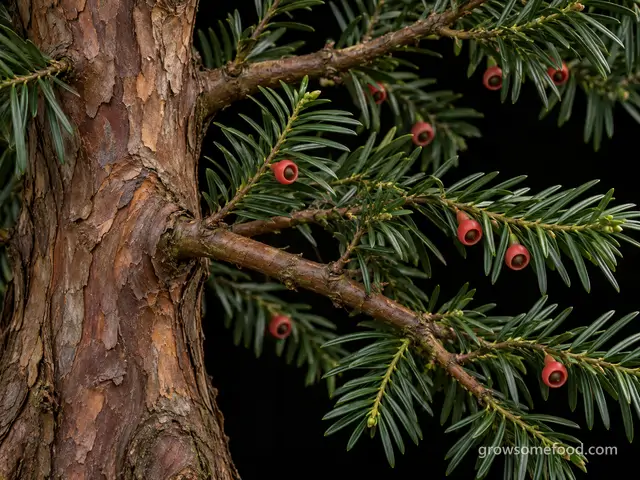
Mar to Oct, every year- Flat soft needles, two pale bands beneath, and NO resin smellYew needles are flat, half an inch to an inch and a half long, soft-tipped rather than prickly, dark glossy green above with two pale matte bands underneath, and twisted into two flat ranks along the twig. Crush one: yew has no resin or gin smell at all. Juniper and eastern red cedar smell strongly of gin and carry prickly or scale foliage; arborvitae is flat aromatic scale sprays; boxwood has paired oval leaves, not needles.
- Gloves on, and every clipping into a bagTrim wearing gloves and eye protection, and bag the trimmings for municipal green waste the same day. Do not compost them, do not burn them, and above all do not tip them over a fence, into a lane, or onto a brush pile near grazing ground. This is the single accident that kills animals, and it is the same mistake that makes oleander clippings deadly.
Key signs- Flat two-ranked needles with two pale bands beneath and no resin smell
- Clippings piled anywhere an animal can reach
- Self-sown seedlings under the hedge from bird-dropped seed
Spring pollen (male plants)
Mar to Apr, every year- Male plants puff pollen; only female plants make the red cupsYews are usually male or female on separate plants. In early spring male plants release clouds of pale pollen from tiny knobs on the undersides of the shoots - a well known allergen where yew hedges are dense. Female plants carry the red fruit later. A hedge that has never shown a red cup is simply a male plant: it is exactly as poisonous, and telling children otherwise is unsafe.
Key signs- Clouds of pollen from a clipped hedge in early spring
- The assumption that a hedge without red fruit is a safe hedge
Red arils (the child hazard)
Aug to Nov, every year- An open-ended red cup with a hard seed showing at the bottomThis is the decisive identification and the main hazard in one. Instead of a cone, a female yew carries a soft, bright red, open-ended cup about the size of a pea, with a single hard dark seed sitting visible at the bottom of it. No other common hedge evergreen produces this. Junipers carry closed blue-grey berry-like cones; arborvitae and hemlock carry small dry woody cones.
- Treat the whole fruit as poisonous around childrenThe red flesh itself is the one part without taxine, which is precisely what makes the fruit dangerous: it is sweet, it is at toddler height, and it invites a second one. The hard seed inside is among the most poisonous things in a garden if it is chewed. Birds swallow seeds whole and pass them undamaged, which is why yew seedlings appear under fences - not evidence that anything is safe.
Key signs- Red cups within reach of small children
- Fruit dropped onto paths, lawns and play surfaces
- Children told the red part is edible
Winter (clippings and dried foliage stay lethal)
Dec to Feb, every year- Winter is when animals get poisonedTaxine does not break down as the foliage dries, and wilted yew becomes more palatable to stock, not less. Winter combines the two risks: hedges get cut back, and grazing animals are short of green feed. Keep yew out of hay and bedding, fence stock well clear of any yew growing on a boundary, and check that nobody has dumped garden waste in a paddock or over a wall.
Key signs- Yew growing within reach across a paddock fence
- Garden waste dumped where stock, ponies or goats can reach it
- Dried yew foliage mixed into hay or bedding
Watch out for
5 to know. 4 are high-risk: Livestock Poisoning from Clippings, Taxine Poisoning by Ingestion (deadly), Phytophthora Root & Crown Rot, Red Aril and Seed (child hazard). 4 are active in September.
Livestock Poisoning from ClippingsSeverity High HazardnowGarden waste dumped near paddocks, pasture or bridle paths; yew growing on a boundary within reach across a fence; dried yew foliage in hay or bedding; sudden unexplained death or collapse in animals with access to a hedge.
Garden waste dumped near paddocks, pasture or bridle paths; yew growing on a boundary within reach across a fence; dried yew foliage in hay or bedding; sudden unexplained death or collapse in animals with access to a hedge.
A veterinary emergency with no antidote and a poor prognosis once signs appear - call a veterinarian immediately and name the plant. Remove all remaining animals from the source at once. Prevention is the only reliable protection.
Bag every clipping for municipal green waste the same day it is cut - never compost, never burn, never tip it over a wall or fence. Fence stock far enough from any boundary yew that nothing can reach across, and check hedges after storms for windfall branches inside a paddock.
The commonest way yew kills. Taxine does not degrade as cut foliage dries, and wilted yew becomes more palatable to stock rather than less, so hedge trimmings tipped over a fence or dumped in a lane are eaten readily. Horses are exceptionally sensitive - well under a pound of foliage can be fatal - and cattle, sheep, goats and alpacas are all at risk. Death is frequently sudden, with animals found dead and yew still in the mouth.
Taxine Poisoning by Ingestion (deadly)Severity High HazardnowAny ingestion of needles, twigs, bark or seed by a person or an animal.
Any ingestion of needles, twigs, bark or seed by a person or an animal. Symptoms can include nausea, vomiting, dizziness, abdominal pain and a slow or irregular pulse - but with yew, collapse is often the first sign, so absence of symptoms means nothing.
Suspected ingestion is an EMERGENCY - call poison control or emergency services immediately and do not wait for symptoms. There is no specific antidote; treatment is urgent supportive care for heart-rhythm effects. Say that it was yew, and take a piece of the plant if you can.
Never eat or taste any part. Teach children that nothing from this plant goes in a mouth, red fruit included. Wear gloves to trim, keep clippings out of compost, fires and animal reach, and do not plant yew where livestock graze or small children play unsupervised.
Every part of a yew except the red flesh of the aril contains taxine alkaloids, which act directly on cardiac conduction. There is no antidote, and the margin is small - a handful of needles has killed adults. Toxicity is unchanged by drying, wilting or storage, so old clippings are as dangerous as fresh growth in any month of the year.
Phytophthora Root & Crown RotSeverity High DiseasenowThe single most common cause of death in established yew, which tolerates almost everything except wet feet.
Branches brown from the inside of the plant outward, and there is no cure once a plant is affected - remove it, fix the drainage, and do not replace it with another susceptible plant in the same wet spot.
Wilting, yellowing and stunting that does not improve with watering, a thinning canopy of small pale leaves, and dieback from the shoot tips. Dig and the feeder roots are dark, soft or brittle rather than white and firm, and on many plants the tissue at the base of the stem is discolored under the bark. Worst in low spots, and wherever a downspout, driveway or compacted path drains into the bed.
Very hard to reverse once established. Improve the drainage immediately, cut watering back, and mulch with coarse material rather than fine, which stays sodden. Remove severely affected plants and correct the site before replanting - and do not put another susceptible plant back into the same wet spot. Phosphonate (phosphite) treatments can suppress it in a valuable specimen, but drainage and siting do far more.
Drainage is the whole defense. Plant on a mound, berm or raised bed in heavy soil, and never in a hollow that holds winter water. Redirect roof and hard-surface runoff away from the planting, water deeply but infrequently so the surface dries between waterings, do not pile mulch against stems, and do not overwater in cold weather when the plant is using little. Use resistant rootstocks or tolerant varieties where they exist for the crop, and never move soil from an infected area.
A soil-borne water mold (Phytophthora species) that rots feeder roots and, on many plants, the crown at the soil line whenever the ground stays saturated. Rotted roots cannot take up water, so the plant looks drought-stressed even in wet soil: the canopy thins, leaves go small and pale, growth stalls, and dieback works in from the tips over months or years. It is the commonest cause of death in plants that want moisture but cannot tolerate standing water, and it travels in surface water and on tools, boots and moved soil.
Red Aril and Seed (child hazard)Severity High HazardnowRed cups within reach of small children, fruit dropped onto paths, lawns and play surfaces, and any child reported to have eaten a red berry from a hedge.
Red cups within reach of small children, fruit dropped onto paths, lawns and play surfaces, and any child reported to have eaten a red berry from a hedge.
Call poison control immediately for any suspected ingestion, even if only the red flesh is thought to have been eaten - you cannot tell whether a seed was chewed. Do not wait for symptoms.
Clear fallen fruit from play areas in autumn, and consider removing fruiting branches at child height. Teach the rule as covering the whole plant, red part included - a nuance about the flesh being harmless is not a rule a child can apply.
In autumn female yews carry soft, sweet, bright red open-ended cups at exactly toddler height. The red flesh itself contains no taxine, which is what makes the fruit dangerous - it tastes pleasant and invites more - while the hard seed sitting in the bottom of each cup is intensely poisonous if it is chewed. A seed swallowed whole and intact often passes through, but that is not something a parent can know or rely on.
Deer Browsing (and why it proves nothing)Severity Medium WildlifeA clean browse line at deer height, hedges eaten hollow from the outside in over winter, and heavy damage in hard weather.
A clean browse line at deer height, hedges eaten hollow from the outside in over winter, and heavy damage in hard weather.
Yew regrows from old wood, so browsed hedges usually recover if protected for a season or two. Never take deer tolerance as a guide to safety for any other animal or for people.
Netting or fencing through the winter months, or repellents reapplied after rain; a hedge cannot be protected by planting choice, since yew is a preferred food rather than a deterrent.
Yew is one of the most heavily browsed evergreens in deer country, stripped to bare wood at browse height through winter when little else is green - and deer are largely unaffected by it. This matters twice: it is a real horticultural nuisance, and it is the observation that most often convinces people the plant must be safe. It is not evidence about people, dogs, horses or cattle.
Good & bad neighbors
First rule: keep Oleander apart. Not a growing conflict - a shared hazard worth knowing together.
Keep apart
-
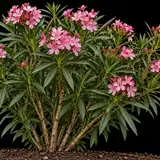
Not a growing conflict - a shared hazard worth knowing together. Yew and oleander are the two ubiquitous landscape shrubs that kill livestock through discarded clippings, and in both cases the cut material stays fully toxic once dried. If you keep animals, the rule for both is identical: bag every trimming, never burn it, never tip it over a fence.
Grower tips
Notes from growers, tagged with the zone they grow in. A person reads every post before it appears.
Nobody has posted about Yew yet.
Free account. Your post shows your grower name and zone, never your email.