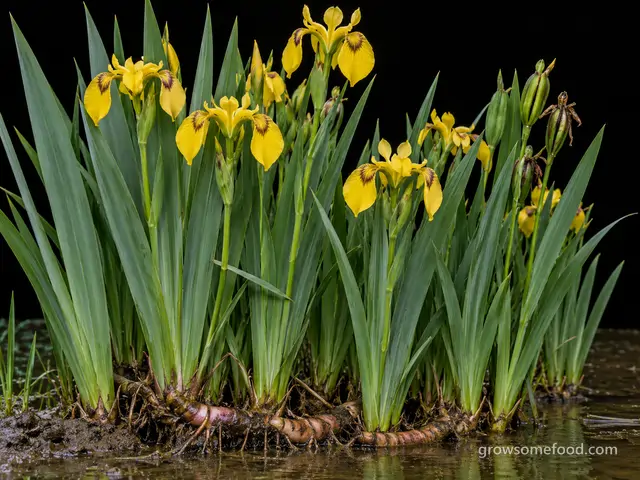
Yellow Flag Iris

Iris pseudacorus · Iridaceae
Other Perennial Herb Ornamental
Introduced - native to Europe, western Asia and North Africa; now an invasive of wetlands, pond margins, ditches and stream banks across most of the United States
Not recommended to plant. Do NOT plant this. Yellow flag is listed as a noxious or prohibited species in Washington, Oregon, Montana, Connecticut, Massachusetts, New Hampshire and Vermont among others, where selling or moving it can be illegal. It converts pond margins into solid rhizome mats. Identify and control only.

Yellow flag is TOXIC and must never be eaten. The rhizome carries irritant glycosides that cause severe nausea, vomiting and diarrhea, and the sap raises a rash or blisters on sensitive skin - wear gloves and eye protection to cut or dig it. Its sword leaves match the edible cattail and sweet flag (Acorus) at the same wet margin, so never dig a waterside rhizome on leaf appearance alone; sweet flag has a raised off-center midrib and a spicy scent. Livestock avoid it unless forced to graze it.

Overview

The big yellow pond iris sold for water gardens for a century - and a listed noxious weed in a growing list of states. If a wild iris in a marsh is yellow, it is this, and the native blue flags it is displacing are blue.

Yellow flag (Iris pseudacorus) is the tall, bold, bright yellow iris of pond edges and ditches, brought from Europe as a water-garden ornamental and planted for a century because it is beautiful, tough, and asks for nothing. In a wild wetland it behaves very differently from a garden clump. Its thick rhizomes knit into a continuous mat that traps sediment, raises the bank, and squeezes out the sedges, rushes, cattails and native blue flags that were there first, converting a diverse marsh edge into a single-species stand. Where the mat builds up enough, it can change how water moves through a ditch or a shallow margin altogether.

It is now a listed noxious or prohibited species in a number of states — Washington, Oregon, Montana, Connecticut, Massachusetts, New Hampshire and Vermont among them — where selling, planting or transporting it can be illegal. The rules differ state to state and have been changing, so check your own state's noxious-weed and invasive-plant list. Yellow flag is also toxic: the rhizome causes violent digestive upset, the sap raises a rash on many people, and its sword leaves sit in the same wet ground as the edible cattail. This entry is for identifying and controlling it, and for pointing you at the natives it should be replaced with.

At a glance

Sun
Full sun · Part sun · Part shade
Water
High
Spacing
18–480 in (typ. 36)
Mature height
24–72 in (typ. 48)
Start by
Frost
Hardy
Spread
18–600 in (typ. 48)
Soil
Tolerates wet soil
Temperature
Damaged below -30°F · struggles above 100°F
Self-sows
Yes — expect volunteers

When to plant

No planting window on record for this zone.

Life stages

  1. Spring growth (identify it before it blooms) Mar, Apr, May (yearly)
    • Recognize it: tall blue-green sword leaves in standing water
      Yellow flag pushes up broad, flat, blue-green sword leaves two to four feet tall from thick pink-brown rhizomes at the edge of ponds, ditches, marshes and slow streams, and the clumps merge into one unbroken stand. The leaves carry a raised midrib and are taller and wider than the native blue flag growing beside them. Before bloom, scale and density are the clue: a waterside iris standing chest-high in a solid colony with nothing else in it is almost always yellow flag.
    • Do not move it, and do not divide it
      This is the plant nobody should be passing over the fence. Rhizome pieces float, wash downstream and re-root, so a division given to a neighbor, or a shovelful of pond muck moved to another property, starts a new infestation. Do not plant it, do not divide it, and never dump cleared material where high water can reach it.
    Solid unbroken stands crowding out sedges, rushes and blue flagThick mats of pink-brown rhizome at the waterlineNew clumps appearing downstream of an existing stand
  2. Late-spring bloom - the yellow flower settles it May, Jun (yearly)
    • Yellow flowers mean it is NOT a native blue flag
      This is the ID moment. Yellow flag carries large, bright yellow iris flowers, usually veined brown or purple on the falls, in late spring and early summer. Across most of its US range it is the only yellow-flowered iris growing wild in a wetland: the native flags are blue to violet (Iris versicolor in the North, Iris virginica in the South), and the one native that is not blue - copper iris of the lower Mississippi valley - is coppery red-orange. Yellow in a marsh means yellow flag.
    • Cut every flower off before it sets a pod
      If you do only one thing this year, cut the spent flowers off before the pods form, bag them and bin them. A single stand floats hundreds of corky seeds downstream, and that is how it reaches water you do not own. Wear gloves - the sap irritates skin.
    Bright yellow iris flowers in a wild wetland or pond marginBlue-flowered native flags being crowded out beside it
  3. Seed pods & floating seed Jul, Aug, Sep (yearly)
    • Fat three-sided pods full of corky floating seed
      After bloom, yellow flag sets large, glossy, three-sided green pods that dry brown and split open. Each holds dozens of flattened, corky seeds that float for weeks and travel with the current, which is why infestations march downstream along a creek or drainage ditch and turn up miles from the garden that started them.
    • Cut, bag and bin the pods before they split
      Cut the pods off while they are still green and closed, bag them, and put them in the trash. Do not compost them and do not leave them on the bank, where the next high water simply carries them off. This one job does more to stop long-distance spread than any amount of digging.
    Fat three-sided green pods forming after bloomSplit brown pods and floating seed at the waterlineSeedlings establishing on bars and banks downstream
  4. Fall & winter - low water is the digging window Jan, Feb, Oct, Nov, Dec (yearly)
    • Dead leaves over a living rhizome mat
      The foliage yellows and collapses after frost, but the rhizome mat beneath is alive and will resprout in spring. Standing brown leaf fans through the winter mark exactly where the mat lies and how far it has spread, which makes the dormant season the best time to map an infestation and plan the work.
    • Dig when the water drops - every fragment counts
      Low water in late summer and fall is the practical digging window. Lift the whole rhizome mass with a fork, sift the mud for broken pieces, and bag and bin everything, because any fragment left behind resprouts and any fragment that floats away starts a new stand. Wear gloves, long sleeves and eye protection. For more than a clump or two, get help - hand-digging a large stand in mud reliably loses fragments to the water.
    Standing brown leaf fans marking the rhizome matLow water exposing the mat for diggingFragments escaping downstream during the work

Watch out for

Wetland Takeover (ecological harm) High DisorderMar, Apr, May, Jun, Jul, Aug, Sep, Oct

The core hazard is ecological. Yellow flag rhizomes knit into a continuous mat along pond margins, ditches and stream banks that excludes sedges, rushes, cattails and the native blue flags, replacing a diverse wet margin with a single-species stand. The mat traps sediment and builds the bank up over time, which can narrow a ditch, alter how water moves through a shallow margin, and convert wet habitat toward dry ground.

Watch for: An unbroken colony of tall sword leaves with nothing else growing in it; native sedges, rushes and blue flag disappearing from a margin they used to occupy; sediment building up and the waterline retreating where the mat has thickened.

Prevent: Never plant, divide, sell or move it - in several states that is also illegal. Remove new clumps while they are still clumps: a stand that has merged into a mat is an order of magnitude more work. Replant cleared margin with native wetland plants so open mud does not simply reinvade.

Treat: Cut and bag the flowers or green pods every year to stop seed. Dig small clumps entirely at low water, sifting the mud for fragments. Repeated cutting below the waterline over several seasons starves larger stands. Herbicide in or near water requires an aquatic-labelled product and, in many states, a permit and/or a licensed applicator - contact your state agency or extension office first, and follow the label, which is legally binding.

Floating Rhizome Fragments & Corky Seed High Disorderyear-round

Why it spreads faster than you can dig. Broken rhizome pieces float and re-root, so shovels, floods, muskrats and mowers all distribute the plant downstream, and casual digging in a large stand often makes it worse. Separately, each seed pod holds dozens of flattened, corky seeds that float for weeks and lodge on bars, banks and ditch shoulders far downstream - which is how one water-garden planting seeds an entire watershed.

Watch for: New clumps appearing downstream or downhill of a known stand; split brown pods and seed floating at the waterline in late summer; fragments washing loose while you dig; volunteers on ditch shoulders and gravel bars after high water.

Prevent: Cut flowers or green pods every year before they split - the single cheapest, highest-value action available. Never divide or share the plant, never compost any part, and never leave cut material on a bank where high water can take it. Clean tools and boots after working in a stand.

Treat: Bag and bin every fragment and pod; put them in the trash, not the compost or the brush pile. Sift the mud after digging. Work at low water and downstream-first where practical, and re-inspect the same water for volunteers every year for several years.

Toxic Rhizome & Irritant Sap Medium Disorderyear-round

A direct hazard to people, pets and livestock. The rhizome contains irritant glycosides and causes burning, severe nausea, vomiting and diarrhea if eaten, and the sap raises contact dermatitis and blistering on sensitive skin. Livestock are poisoned by it, though they normally refuse it unless nothing else is available. The most dangerous route is a foraging mistake: the sword leaves match the edible cattail and sweet flag (Acorus) at the same wet margin before any of them bloom.

Watch for: Rash, itching or blistering on hands and forearms after cutting or digging it bare-handed; anyone digging waterside rhizomes for cattail or calamus without confirming the plant; pets or children handling the cut rhizome, which is the most irritant part.

Prevent: Wear gloves, long sleeves and eye protection for any cutting or digging. Never harvest a waterside rhizome on leaf appearance alone - sweet flag has a raised, off-center leaf midrib and a strong spicy scent when crushed, and cattail gives itself away by its old brown spikes; iris has neither.

Treat: For skin contact, wash the area promptly and treat as contact dermatitis. If any part has been swallowed by a person or a pet, call poison control or your veterinarian rather than waiting for symptoms.

Varieties · 3

Native water-iris alternatives

Varies - violet-blue flags with gold-veined falls, or the coppery red-orange copper iris, over sword foliage at the water's edge.

alternativenativewetlandnon-invasiverecommended-instead

Plant these instead at a pond edge or in a rain garden: northern blue flag (Iris versicolor) in the North, southern blue flag (Iris virginica) in the South, or copper iris (Iris fulva) in the lower Mississippi valley. All are native water irises that form a slowly widening clump rather than a mat. Pickerelweed, soft rush, native sedges, cardinal flower and swamp milkweed fill the same wet margin. Note that the native blue flags are also toxic and grown for looks, not food.

Pale and variegated forms ('Variegata', 'Bastardii', cream selections)

Same plant with paler cream-yellow flowers, or with cream-striped spring foliage that greens out by summer.

cultivarinvasivedo-not-plantnot-sterile

The cream, pale-yellow and cream-striped forms still offered for water gardens. None of them is a sterile or safe version of the species: they carry the same spreading rhizomes and set the same fertile floating seed, and where the species is a listed noxious weed the cultivars are covered too. Treat any yellow-flowered pond iris on offer as the invasive it is.

Yellow Flag (Iris pseudacorus)

Two-to-four-foot blue-green sword leaves in standing water, topped by large bright yellow iris flowers; fat three-sided green pods drying brown and splitting.

speciesinvasivedo-not-plantnoxious-weedwetlandtoxicwater-spread

The species: a tall wetland iris with broad blue-green sword leaves, thick pink-brown rhizomes, and large bright yellow flowers veined in brown or purple in late spring. Forms unbroken mats along pond margins, ditches and stream banks and spreads by floating rhizome fragments and corky floating seed. Toxic in every part, and listed as a noxious or prohibited species in a number of states. Identify and control it; never plant, divide or move it.

Grow

How to recognize it and why never to plant it: the only yellow-flowered wild iris across most of its US range, taller and denser than the native blue flags, in standing water and saturated ground.

You should not plant yellow flag, so what matters is telling it from the native water irises it displaces — and that turns out to be easy, because of one fact worth memorizing: across most of its US range, yellow flag is the only yellow-flowered iris growing wild in a wetland. The natives are blue. Northern blue flag (Iris versicolor) and southern blue flag (Iris virginica) both carry violet-blue flowers with gold-and-white veined falls. The one native flag that is not blue is copper iris (Iris fulva) of the lower Mississippi valley, and it is coppery red-orange, nothing like this. Garden Louisiana-iris hybrids do come in yellow, so a yellow iris in a planted bed is a different question from a yellow iris in a marsh — but in wild wet ground, yellow means yellow flag.

Before bloom, go by scale and density. Yellow flag stands two to four feet tall, sometimes taller, on broad flat blue-green sword leaves with a raised midrib, growing from thick pink-brown rhizomes in shallow standing water or saturated mud. It forms an unbroken colony with nothing else growing in it. Blue flag is shorter, narrower-leaved, and forms a slowly widening clump with room around it. After bloom, the seed pods confirm it: big, glossy, three-sided green capsules that dry brown and split to release corky floating seed.

It grows in full sun to part shade in pond margins, ditches, marshes, wet meadows, slow streams and tidal fresh water, and it tolerates brackish water, drought once established, and a range of soils that would defeat most wetland plants. There is no version of it that stays put.

Propagation & seed saving

Two spread routes, both hard to stop: thick rhizome mats that expand outward and re-root from any broken fragment, and corky seeds that float for weeks and colonize downstream.

Yellow flag spreads two ways, and control fails when you only address one of them. The first is the rhizome. Thick, branching, pink-brown rhizomes expand the clump outward year after year until neighboring clumps merge into a mat, and any piece broken off by a shovel, a flood, a muskrat or a mower floats and re-roots somewhere else. This is why casual digging in a large stand often makes the problem bigger rather than smaller: what you fail to lift, the current distributes.

The second is seed. A mature stand sets large three-sided pods, each holding dozens of flattened seeds with a corky coat that lets them float for weeks. They travel with the current and lodge on bars, banks and ditch shoulders downstream, which is how a single water-garden planting seeds a whole watershed over a decade or two. Removing the flowers before the pods form, or the pods before they split, is the cheapest and most effective single intervention available to a homeowner.

There is no safe cultivar. The pale-yellow and variegated forms sold in the trade are the same species with the same rhizomes and the same fertile seed. Treat any yellow-flowered pond iris on offer as the invasive it is.

Care

Control, not care: cut the flowers and pods every year, dig small clumps out entirely at low water, and understand that any herbicide near water must be aquatic-labelled and often needs a permit or a licensed applicator.

For yellow flag, care means removal, and the sequence matters because the cheap wins come first.

Stop the seed. Every year, cut the flowers off before pods form, or the pods off while still green and closed, and bag and bin them — not the compost heap, not the bank. This takes an afternoon and immediately halts the plant's long-distance spread while you work on the rest.

Dig small clumps out. At low water in late summer or fall, lift the entire rhizome mass with a fork, sift the mud for broken pieces, bag everything, and bin it. A young clump or two can genuinely be eradicated this way. Wear gloves, long sleeves and eye protection: the sap raises a rash or blisters on sensitive skin, and the leaf edges are sharp. Do not compost any part of it.

Repeated cutting below the waterline through the growing season starves the rhizome slowly and is a reasonable approach where digging would tear up the bank, but it takes several seasons and consistency. Covering a small stand with a heavy benthic barrier for a full season also works. What does not work is a single cut, or a single dig that leaves fragments behind.

Herbicide near water is a regulated activity, not a shopping decision. A product labelled for lawns or landscape beds is not legal to apply to a pond, ditch, marsh or stream margin. Any application in or adjacent to water requires a product with an aquatic label, and in many states it also requires a permit and/or a licensed applicator — sometimes both. Contact your state environmental or agriculture agency, or your county extension office, before you spray anything near water. Whatever product is used, the label must list the site being treated and the label must be followed; it is legally binding, not advisory. For a large infestation this is genuinely a job to hand to your local weed board, conservation district or a licensed contractor, several of which run cost-share programs for exactly this species.

Then replant: blue flag iris (Iris versicolor in the North, Iris virginica in the South), pickerelweed, soft rush, native sedges, cardinal flower or swamp milkweed will hold the margin and feed pollinators without taking it over.

Nutrition

Not a food and actively toxic - the rhizome causes violent vomiting and diarrhea and the sap blisters skin. Ecologically it is a subtraction, replacing a diverse marsh edge with a single-species mat.

Yellow flag is not eaten, in any part, and it is worth being blunt about why. The rhizome contains irritant glycosides that cause burning, severe nausea, vomiting and diarrhea; the sap raises contact dermatitis and blistering on many people; and livestock are poisoned by it, though they normally refuse it unless nothing else is available. Old accounts of roasted yellow-flag seed as a coffee substitute circulate online and should be ignored.

The hazard that actually reaches people is a foraging mix-up. Yellow flag grows in exactly the same wet margin as the edible cattail, and as sweet flag (Acorus calamus, Acorus americanus), whose aromatic rhizome is deliberately dug as a flavoring — and before any of them bloom, the strap leaves look much alike. Iris rhizome mistaken for calamus is the classic documented poisoning. The tool-free checks: sweet flag has a raised, off-center midrib and a strong spicy scent when a leaf is crushed; iris has neither. Cattail gives itself away by the old brown spikes. Never dig a waterside rhizome on leaf appearance alone.

Ecologically its contribution is negative. A yellow flag mat replaces the sedges, rushes, native irises and open water margin that fed waterfowl, amphibians, native bees and the whole shallow-water food web with one plant that feeds very little, and the sediment it traps can convert wet margin into dry bank. Removing it and putting native wetland plants back is the entire story.

History

A European wetland iris carried worldwide as a garden and erosion plant - and, in the twentieth century, deliberately planted for wastewater treatment and bank stabilization before its invasiveness was understood.

Yellow flag is an old and genuinely well-loved plant in its native Europe, where it lines ditches and river margins and is widely held to be one of the plants behind the fleur-de-lis. Its rhizome yielded a black dye and, with iron salts, an ink; the roasted seed was tried as a coffee substitute; and it had a rough medicinal reputation as a violent purgative, which tells you plainly enough what it does to a digestive system. It reached North America with European settlers as a garden plant and has been sold for water gardens ever since.

What turned an ornamental into an infestation was deliberate large-scale planting. Through the twentieth century yellow flag was planted for bank stabilization, erosion control, ditch lining, and later for constructed wetlands and wastewater treatment, on the reasonable-sounding grounds that it is tough, fast, and takes up nutrients and metals. It does all of that. It also escapes every containment it is given, because its seeds float. By the 1990s it was being listed as a noxious weed in western states, and listings have since spread through New England and beyond. Its arc — from ornamental, to recommended erosion and water-treatment plant, to prohibited species — is a compact lesson in why 'tough, fast and useful' near water is a warning rather than a recommendation.

Troubleshooting

Confirm it (yellow flowers in wild wet ground, tall blue-green swords, three-sided pods), cut the pods first, dig only small clumps, never spray near water without an aquatic label and permit, and replace it with blue flag.

Is this yellow flag or the native blue flag? The flower answers it outright: yellow flag is yellow, the native flags (Iris versicolor, Iris virginica) are blue to violet. Across most of its range yellow flag is the only yellow-flowered iris growing wild in a wetland. The one native exception, copper iris of the lower Mississippi valley, is coppery red-orange. What if it is not in bloom? Go by scale and habit: yellow flag stands two to four feet on broad blue-green swords in an unbroken colony with nothing else growing in it; blue flag is shorter, narrower, and forms a clump with room around it. Its big three-sided pods are also distinctive. Can I eat any of it, or is it the cattail? No, and be careful — every part is toxic and the leaves match both cattail and sweet flag before bloom. Sweet flag has a raised off-center midrib and a spicy scent when crushed; iris has neither. Never dig a waterside rhizome on leaf appearance alone. Where do I start? Cut the flowers or the green pods and bag them. That stops the downstream spread in one afternoon. Can I just dig it out? A young clump or two, yes — at low water, lifting the whole rhizome mass and sifting the mud for fragments, because every fragment floats and re-roots. A large stand usually gets worse from casual digging. Can I spray it? Not with an ordinary lawn or garden product. Applying herbicide in or next to water requires a product with an aquatic label, and in many states a permit and/or a licensed applicator. Ask your state environmental or agriculture agency, or county extension, first; the label must list the site and must be followed. Can I give a division to a friend? No — in several states moving or selling it is illegal, and everywhere it is how new infestations start. What should I plant instead? Blue flag iris, pickerelweed, soft rush, native sedges, cardinal flower, swamp milkweed. It came back. Expected; plan on several years, and keep cutting the pods every single season in the meantime.

Growing across climates

Hardy and invasive from roughly zones 3-9 wherever there is wet ground - fresh or brackish, still or flowing - so water, not climate, decides where it becomes a problem.

Yellow flag is hardy roughly zones 3-9 and invasive through most of that range, which means climate is almost no constraint on it. What decides where it takes hold is water: pond margins, ditches, marshes, wet meadows, slow streams, lake shores and tidal fresh water. It tolerates brackish conditions, survives months of drought as a dormant rhizome, and regrows when the water returns, so seasonal wetlands and irrigation ditches are as vulnerable as permanent ponds.

Pacific Northwest and northern Rockies: some of the worst infestations in the country, and the reason Washington, Oregon and Montana list it. New England and the Northeast: widely naturalized along rivers and marshes, and the focus of the more recent prohibitions. Midwest and mid-Atlantic: established and spreading along drainage networks. Southeast and Gulf: present, and competing there with a long list of other aggressive wetland plants. Arid West: confined to irrigated ground, ditches and riparian corridors — but those are exactly the scarce, high-value habitats where it does the most harm.

Wherever you are, the pattern is the same: it moves downhill and downstream, so the infestation you can see is rarely the whole of it. Check upstream before you congratulate yourself on a clean pond, and cut the pods every year.

No grower tips for Yellow Flag Iris yet — yours could be the first.

Sign in to share what works in your garden.

Connection interrupted

Reconnecting to GrowSomeFood

Keep this page open. We are trying to restore your garden session.

Attempt of . Retrying automatically.

Still offline

Could not reconnect

Your phone may have switched networks or gone to sleep. Try again when the signal is steady.

Session expired

Reload to continue

This garden session is no longer available on the server. Reloading will start a fresh session.