
Add it to your home screen and it opens full screen: no browser bars, one tap away, and everything stays signed in. Free, nothing to download from an app store.
- Tap the Share button in your browser
- Scroll down and choose “Add to Home Screen”
- Open GrowSomeFood from your home screen
- Open your browser’s menu
- Choose “Add to Home screen” or “Install app”
- Open GrowSomeFood from your home screen

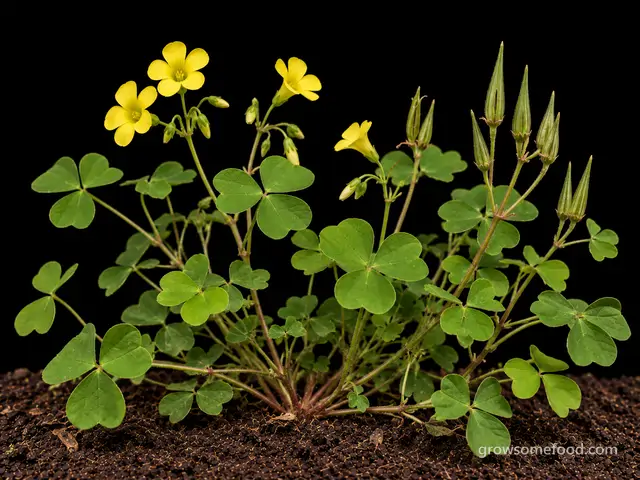
Wood Sorrel
The 'sourgrass' every kid discovers - a common clover-lookalike weed whose tangy, lemony leaves, flowers, and pods are a bright edible nibble, if you eat them in moderation.
Safety notes Wood sorrel is a safe, pleasant edible - leaves, yellow flowers, and young green pods are all edible raw and taste bright and lemony-sour (the tang is OXALIC ACID). Eat it as a garnish or nibble rather than in large quantities, and moderate it if you're prone to kidney stones. Tell it from clover by its heart-shaped leaflets and sour taste. In California, 'sourgrass' usually means the introduced Oxalis pes-caprae - a different, much higher-oxalate plant this page's guidance is not written for.
Overview
Wood sorrel (Oxalis) is one of the first wild foods many people ever taste - the clover-like 'sourgrass' or 'sour clover' that children nibble for its sharp, lemony-sour tang. It's a common little weed of lawns, gardens, sidewalk cracks, and flowerpots, with delicate heart-shaped leaflets in threes (that fold down at night) and small bright yellow flowers. Almost everyone has one growing nearby.
The one thing to knowWood sorrel (Oxalis) is one of the first wild foods many people ever taste - the clover-like 'sourgrass' or 'sour clover' that children nibble for its sharp, lemony-sour tang.
Quick facts
- Sprouts in
- 14 daysRange: 7–28 days
- Soil temperature
- 68 °FRange: 60–75 °F
- Height
- 8 inRange: 4–15 in
- Spread
- 8 inRange: 4–14 in
- Cold
- Takes light frostdamaged below -30°F
- Heat
- Struggles above 95°F
- Life cycle
- Perennial, lives about 3 years
- Save seeds
- About 70 days after plantingRange: 50–95 days
- Self-sows
- Yes, expect volunteers
- Soil
- Well-drained
- Water
- Medium
- Plant spacing
- 8 inRange: 4–12 in
When to plant
Nothing is open today. Spring sowing opens 6 months, Apr 10 to May 22.
- Direct sow Apr 10 – May 22 Opens in 173 daysAbout at to 6 weeks after your last frost (Apr 10 here)If growing on purpose, surface-sow seed in spring in sun to part shade; it germinates and establishes easily. Far more often it simply volunteers in gardens, lawns, and pots and needs no sowing.
Frost here: last around Apr 10 (Mar 27 to Apr 24 most years), first around Oct 25. Zone averages, your own yard may run a week or two either way.
Life stages
Establish, grow, repeat
Getting established and returning each season are different parts of the story.
Stage 1 of 4 · Getting established
Rooting in
Day 0 to 40 from sowing
Care at this stage
-
Recognize the shamrock-like leaves
Wood sorrel forms low clumps of clover-like leaves - three heart-shaped leaflets that often fold down at night. Unlike clover, they taste distinctly sour. It comes up readily in gardens, lawns, and pots, needing no care.
Months are typical seasonal windows; climate, variety, and plant age can shift them.
Harvest
- Tender tangy leaves and yellow flowers, spring through fall
- Young green seed pods while still soft (for eating); they turn ripe and burst if left
- Nibble leaves, flowers, and young pods · every 10 days
- A long, easygoing harvest season
Picking pick as they ripen
Watch out for
3 to know. None are high-risk for Wood Sorrel. None are active in October.
Confusion with CloverSeverity Low DisorderSeason: Apr–SepThe difference: wood sorrel has HEART-shaped (notched) leaflets and a SOUR taste; clover has oval leaflets, often a pale crescent mark, and a bland taste.
The difference: wood sorrel has HEART-shaped (notched) leaflets and a SOUR taste; clover has oval leaflets, often a pale crescent mark, and a bland taste.
No harm either way (both are edible), but for the tangy flavor you want, confirm the sour taste and heart-shaped leaflets of true wood sorrel.
Check the leaflet shape and taste a leaf - sour and heart-shaped is wood sorrel; bland and oval is clover.
Not a hazard (both are harmless) but a common ID mix-up: wood sorrel is often mistaken for clover, and knowing the difference is the point of learning it as a forage plant.
Oxalic Acid ContentSeverity Low DisorderSeason: Apr–SepN/A - a dietary consideration; the sour taste itself signals the oxalic acid.
N/A - a dietary consideration; the sour taste itself signals the oxalic acid.
No action needed beyond sensible portions - wood sorrel is safe and pleasant used as a flavoring.
Eat it as a garnish/nibble in modest amounts; moderate if prone to kidney stones (as with spinach, rhubarb, and sorrel).
A food-safety note rather than a plant problem: wood sorrel's pleasant sourness is oxalic acid, so it's eaten as a garnish in moderation, not in bulk.
Explosive Self-SeedingSeverity Low DisorderSeason: Jun–SepUpright ripe pods that split and shoot seed on contact, and new seedlings appearing far from the parent.
Upright ripe pods that split and shoot seed on contact, and new seedlings appearing far from the parent.
Hand-pull plants (easy, though it regrows from roots and the seed bank); consistent removal before pods ripen reduces its spread over time.
Pick or pull plants before the pods ripen; harvest young green pods to eat before they can burst.
Not a pest but its spread mechanism: ripe seed pods build tension and forcibly fling their seeds several feet when disturbed, scattering wood sorrel widely through gardens, lawns, and pots.
Good & bad neighbors
All of these are traditional pairings. The evidence is thin, so treat them as a nudge, not a rule.
Plant nearby
-
The plant wood sorrel is most confused with - growing both (and tasting the difference: sour vs bland) is the easiest way to learn to tell an edible wood sorrel from a clover at a glance.
-
Two common edible lawn 'weeds' offering opposite flavors - dandelion's bitter greens and wood sorrel's sour tang - together covering a lot of wild-salad flavor range.
-
Wood sorrel volunteers in the same beds as lettuce and makes a bright lemony garnish for a lettuce salad; just keep it from seeding all through the bed.

Varieties · 4
You pick one when you add Wood Sorrel to your garden. Its days to maturity set your harvest window.
Yellow Wood Sorrel (Oxalis stricta)
The common yellow wood sorrel: a low clumping native with clover-like heart-shaped leaflets, small yellow flowers, and explosive seed pods, in lawns and gardens across North America.
Variety details for Yellow Wood Sorrel (Oxalis stricta)
Low clumps of three-part heart-shaped leaflets with small five-petaled yellow flowers.
speciesnativeyellow-flowersedibleThe classic edible 'sourgrass.'
Creeping Wood Sorrel (Oxalis corniculata)
A very similar creeping wood sorrel, often with purple-tinged leaves, that sprawls and roots as it goes - an even more persistent garden and greenhouse weed, edible and used the same way as yellow wood sorrel.
Variety details for Creeping Wood Sorrel (Oxalis corniculata)
Low creeping stems with often purplish clover-like leaflets and small yellow flowers.
speciesediblesourcreepingViolet Wood Sorrel (Oxalis violacea)
A prettier native wood sorrel with pink-purple flowers and a clumping, non-weedy habit from small bulbs - a nice native wildflower for part shade, with the same edible tangy leaves and a far more restrained spread.
Variety details for Violet Wood Sorrel (Oxalis violacea)
Clumps of blue-green clover-like leaves with dainty pink-lavender flowers.
speciesnativepink-purple-flowersedibleBermuda Buttercup (Oxalis pes-caprae)
The plant most Californians mean by 'sourgrass', and not a form of yellow wood sorrel: an introduced South African species that blankets coastal lawns, roadsides, and orchards with bright yellow flowers from winter into spring, spreading from underground bulbils and rated invasive by Cal-IPC.
Variety details for Bermuda Buttercup (Oxalis pes-caprae)
Sprawling clumps of large clover-like leaves, often purple-flecked, with tall stems of bright yellow bell-shaped flowers in winter and spring.
speciesintroducedinvasivecaliforniaIt is notably higher in soluble oxalate than the native wood sorrels - high enough to have killed grazing sheep - so treat it as an occasional very small nibble at most. The garnish-and-nibble guidance on this page is written for Oxalis stricta, not for this plant, and it should not be deliberately planted. It carries no recommended zones here deliberately: a zone-fit tick beside a Cal-IPC invasive would read as an invitation to plant it.
Grower tips
Notes from growers, tagged with the zone they grow in. A person reads every post before it appears.
Nobody has posted about Wood Sorrel yet. The first one usually saves someone a season.
Free account. Your post shows your grower name and zone, never your email.