Add it to your home screen and it opens full screen: no browser bars, one tap away, and everything stays signed in. Free, nothing to download from an app store.
- Tap the Share button in your browser
- Scroll down and choose “Add to Home Screen”
- Open GrowSomeFood from your home screen
- Open your browser’s menu
- Choose “Add to Home screen” or “Install app”
- Open GrowSomeFood from your home screen
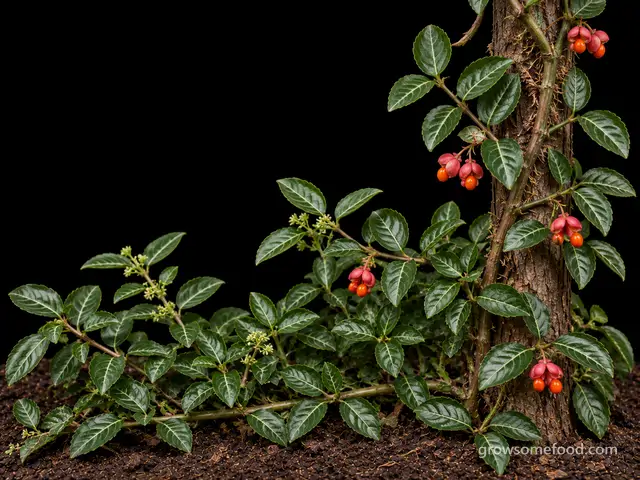
Wintercreeper
The neat evergreen groundcover from the garden center that climbs, fruits, and carpets forest floors in a solid green mat. Widely sold, widely regretted - this entry is about recognizing it and getting it out.
Wintercreeper is not food. Like other Euonymus, its fruits and seeds contain cardiac glycosides - eating them causes vomiting, diarrhea and cramping, and larger amounts can affect the heart. The split capsules are bright orange and at toddler height, so keep children and pets away from fruiting plants. Wear gloves and long sleeves to clear it: the sap irritates some skin, and the mats hide ticks. The main hazard is ecological - never plant it, and never let a cutting root.
Overview
The one thing to knowThen it finds a trunk, climbs, and switches into an adult form that flowers and fruits, and birds carry the seed into woodlots miles away.
Wintercreeper (Euonymus fortunei) was sold for a century as the perfect problem-solver: an evergreen groundcover that would grow in dry shade, cover a bank, edge a foundation, and never need anything. It does all of that. The trouble is that it does not stop. Left alone it creeps outward at a few feet a year, rooting at every node, until it forms a continuous, ankle-deep evergreen mat that nothing else grows through - no spring ephemerals, no tree seedlings, no ferns. Then it finds a trunk, climbs, and switches into an adult form that flowers and fruits, and birds carry the seed into woodlots miles away.
It is now one of the most damaging invasive plants of the lower Midwest and mid-South - Missouri, Kentucky, Ohio, Indiana, Illinois and Tennessee all have forests with wintercreeper floors - and it is spreading through the mid-Atlantic and Southeast. It is also toxic: like other Euonymus, its bright orange seeds carry cardiac glycosides, and they sit at toddler height. This entry exists to help you identify and control it, not to plant it. The good news is that wintercreeper is genuinely beatable in a home landscape, because it is evergreen and gives itself away in winter.
Quick facts
For identification. Not a growing guide.
- Life cycle
- Perennial, lives about 40 years
- Where it grows
- Full sun · Part sun · Part shade · Shade, well-drained soil
- Height
- 240 in6 to 840
- Spread
- 240 in24 to 1200
- Cold
- Takes hard frostdamaged below -25°F
- Heat
- Struggles above 100°F
- Self-sows
- Yes. Never let it set seed.
Through the year
How to recognize it in each season.
Evergreen creeping & climbing growth (identify & control)
year-round, every year- Recognize it: opposite, silver-veined, leathery leavesWintercreeper is an evergreen woody vine with small (1-2 in), thick, glossy, finely toothed leaves held in OPPOSITE pairs, each with a pale silvery midrib and veining. It creeps across the ground rooting as it goes, then climbs trees and walls by short clinging rootlets. English ivy is the usual confusion: ivy leaves are alternate and lobed with pale palmate veining, wintercreeper's are opposite, oval and toothed. Japanese honeysuckle twines rather than clings, and its leaves are untoothed.
- Free the trees first, then pull the ground matsCut every climbing stem at the base and again at chest height and carry the cut section away, then leave the upper growth to die in place rather than ripping it down and stripping bark. On the ground, pull or dig the mats while the soil is moist, following each runner back and lifting the rooted nodes. Bag what you pull - stems re-root from cuttings and from dumped brush piles. Wear gloves, and expect to go back over the same ground for several years.
Key signs- Vines thickening on tree trunks and climbing into the canopy
- Dense evergreen mats replacing the forest floor
- Stems rooting wherever they touch soil
Mature climbing growth flowers
Jun to Jul, every year- Only climbing wintercreeper flowersLike English ivy, wintercreeper leads two lives. The creeping ground form almost never flowers; once a stem climbs into good light it switches to an adult form with larger, thicker, less obviously toothed leaves and produces small, inconspicuous greenish-white flowers in early summer. Flowering means the plant has reached the seed-producing stage - so a vine that has got several feet up a trunk deserves far more of your attention than an equal area of mat on the ground.
- Take down the climbers before they set seedSevering the climbing stems is the highest-value hour you can spend on wintercreeper, because it is climbing growth that fruits and feeds the birds that carry it into woodland. Do the trunks first and the ground second, even if the ground looks worse.
Key signs- Small greenish-white flower clusters high on climbing stems
- Larger, thicker adult leaves on mature growth
Pink capsules & orange seeds (bird-spread)
Sep to Dec, every year- Pink capsules that split to bright orange seedIn fall the mature vines set small pinkish-red capsules that split open to reveal a vivid orange seed coat - unmistakable, and very like the fruit of oriental bittersweet, a relative in the same family. Birds eat them and drop the seed in woodlots and fencerows far from any garden, which is exactly how a tidy edging plant becomes a forest problem.
- Cut and bag fruiting growthCut fruiting stems before the capsules split, bag them, and put them in the trash rather than the compost heap or a brush pile. Removing the climbers each fall shuts off the seed supply even before you have finished clearing the ground - and the fruit is toxic, so this also gets it away from children and pets.
Key signs- Pink capsules splitting to orange seed
- Birds feeding in the vines
- Seedlings appearing in woods and fencerows far from any planting
Winter - it stays green while the woods sleep
Dec to Mar, every year- Winter is when it gives itself awayWintercreeper is evergreen, so in a leafless winter woodland it is often the only green thing on the ground and on the trunks. Walk the property in January and you can map the whole infestation in an hour - far faster and more accurately than in summer, when everything else is in leaf.
- Late fall to winter is the treatment windowBecause wintercreeper holds its leaves while native plants are dormant, late fall through winter is when control does the least collateral damage. Cut-stump treatment applied within minutes of the cut works far better than spraying, because the waxy evergreen leaf sheds foliar sprays. If you use a herbicide, choose a product whose LABEL lists the site you are treating - woodland, landscape bed or lawn - and follow that label; it is legally binding. Treat above freezing.
Key signs- Green mats and green trunks in a leafless winter woodland
- Seedlings that are easy to spot and pull while everything else is bare
Watch out for
4 to know. 2 are high-risk: Evergreen Smothering of the Forest Floor, Climbing, Fruiting & Bird-Spread Seed. 4 are active in September.
Evergreen Smothering of the Forest FloorSeverity High DisordernowA continuous ankle-deep green carpet under trees in March when everything else is bare; loss of trillium, trout lily, spring beauty and toothwort from ground that used to carry them; no tree seedlings of any species; vines thickening on trunks.
A continuous ankle-deep green carpet under trees in March when everything else is bare; loss of trillium, trout lily, spring beauty and toothwort from ground that used to carry them; no tree seedlings of any species; vines thickening on trunks.
Cut climbing stems at the base and again at chest height and remove the middle section, leaving the top to die in place. Hand-pull ground mats in moist soil, lifting rooted nodes. For large mats use cut-stump or foliar herbicide in late fall to winter while natives are dormant, with a product whose label lists the site; follow the label. Plan on three to five years of follow-up.
Never plant it, in any cultivar. Clear small patches while they are still small - wintercreeper spreads as a solid front, so the edge is where the work is cheapest. Replant cleared ground with native groundcovers so bare soil does not simply re-invade.
The core ecological hazard. Wintercreeper forms a continuous evergreen mat that holds the ground through winter and early spring, shading out the spring ephemerals that depend on light before the canopy closes and leaving no gap for oak, maple and hickory seedlings. Where it climbs, it weighs down and shades the trees it grows on. A woodland with a wintercreeper floor has no next generation of trees and almost none of its original wildflowers.
Climbing, Fruiting & Bird-Spread SeedSeverity High DisordernowVines climbing several feet up trunks, larger and thicker adult leaves on that growth, greenish-white flowers in early summer, pink capsules splitting to orange seed in fall, birds feeding in the vines, and seedlings appearing in woodland far from any planting.
Vines climbing several feet up trunks, larger and thicker adult leaves on that growth, greenish-white flowers in early summer, pink capsules splitting to orange seed in fall, birds feeding in the vines, and seedlings appearing in woodland far from any planting.
Cut and bag fruiting stems before the capsules split. Sever every climbing stem at the base and at chest height and remove the section between, then follow up annually - birds keep reseeding cleared ground from surrounding infestations for years.
Cut climbers off trunks before they reach fruiting size - this shuts off seed production faster than any amount of ground clearing. Never compost or dump stems; bag them and bin them. Do not assume a variegated cultivar is safe, because reverted green shoots climb and fruit like the species.
Why a garden planting becomes a regional problem. Ground-creeping wintercreeper barely flowers, but once a stem climbs into good light it matures, flowers in early summer, and sets pink capsules that split to bright orange seed in fall. Birds eat the seed and drop it in woodlots, fencerows and stream corridors far from any garden. Stems also root at every node and re-root from cuttings and dumped brush, so careless disposal starts new infestations.
Toxic Fruit & Seed (cardiac glycosides)Severity Medium DisordernowSplit pink capsules showing orange seed within reach of children or dogs, especially on mats around play areas, patios and paths; chewed capsules or orange seed coat around a pet's mouth.
Split pink capsules showing orange seed within reach of children or dogs, especially on mats around play areas, patios and paths; chewed capsules or orange seed coat around a pet's mouth.
If a child or pet has eaten the fruit or seed, call poison control or your veterinarian rather than waiting for symptoms. Do not induce vomiting unless told to.
Remove fruiting growth before the capsules split - which means cutting the climbing stems, since ground growth rarely fruits. Best of all, remove the plant from areas children and pets use.
A direct hazard to people and pets. Euonymus fruit and seed contain cardiac glycosides and irritant compounds: swallowing them causes vomiting, diarrhea and abdominal cramping, and a large quantity can disturb heart rhythm. On wintercreeper the risk is unusually accessible, because the bright orange seeds are conspicuous and sit at knee height on a groundcover rather than out of reach in a shrub.
Euonymus ScaleSeverity Medium PestnowA dusting of small white flecks along stems and the undersides of leaves; darker brown oyster-shell scales on woody stems; leaves yellowing in a fine stipple rather than uniformly; branch dieback beginning on the shaded, crowded interior of a planting.
A dusting of small white flecks along stems and the undersides of leaves; darker brown oyster-shell scales on woody stems; leaves yellowing in a fine stipple rather than uniformly; branch dieback beginning on the shaded, crowded interior of a planting.
Prune out and destroy heavily encrusted stems. Horticultural oil timed to the crawler stage in late spring, repeated per label, is the standard treatment; dormant oil helps against overwintering females. Any product used must carry a label listing the plant and site, and the label must be followed. On an invasive that you should be removing anyway, the honest treatment is removal.
The most reliable prevention is not to grow susceptible Euonymus at all. Where plants exist, keep them open and uncrowded, avoid shearing into dense shells that hold humidity and shelter scale, and inspect new nursery stock before it comes home.
An armored scale insect that is the signature pest of Euonymus. Heavy infestations coat stems and leaf undersides with small white male scales and darker brown, oyster-shaped females, sucking sap until the foliage yellows in a fine stipple, thins, and whole branches die back. It is one of the reasons Euonymus plantings so often look chronically shabby, and a well-established infestation can kill a plant outright over a few seasons.
Grower tips
Notes from growers, tagged with the zone they grow in. A person reads every post before it appears.
Nobody has posted about Wintercreeper yet.
Free account. Your post shows your grower name and zone, never your email.