
Add it to your home screen and it opens full screen: no browser bars, one tap away, and everything stays signed in. Free, nothing to download from an app store.
- Tap the Share button in your browser
- Scroll down and choose “Add to Home Screen”
- Open GrowSomeFood from your home screen
- Open your browser’s menu
- Choose “Add to Home screen” or “Install app”
- Open GrowSomeFood from your home screen

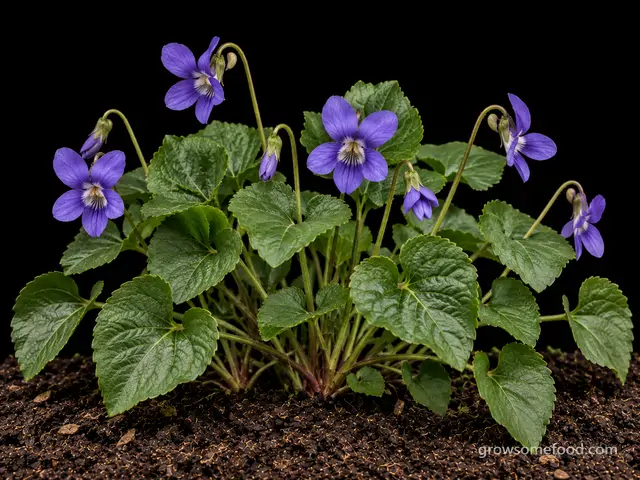
Wild Violet
The dainty blue lawn 'weed' that's a beautiful native groundcover, an edible flower, and the one plant fritillary butterflies must have to breed - beloved by naturalists, battled by lawn purists.
Safety notes Flowers and young leaves of true violets (Viola) are edible; roots, rhizomes and seeds are not (emetic in quantity), and large amounts of leaf are mildly laxative. Identify before eating leaves: lesser celandine (Ficaria verna) shares the same moist shade and is toxic raw. Celandine has thick GLOSSY kidney-shaped leaves and fat fig-like root tubers; violet leaves are MATTE and scalloped over fibrous roots. Don't pick a patch until you've seen it open a violet flower. Forage unsprayed ground.
Overview
Wild violet (Viola sororia) is a small native plant that draws sharply opposed reactions. To lawn purists it's a persistent, spreading weed dotting the turf with blue-purple flowers in spring. To native-plant gardeners and naturalists it's a cherished native groundcover: pretty, tough, shade-loving, low-maintenance, and ecologically important. It's a perfect example of how 'weed' is often just a plant in a place someone didn't choose.
The one thing to knowTo lawn purists it's a persistent, spreading weed dotting the turf with blue-purple flowers in spring.
Quick facts
- Sprouts in
- 30 daysRange: 14–60 days
- Soil temperature
- 68 °FRange: 60–72 °F
- Height
- 6 inRange: 3–10 in
- Spread
- 10 inRange: 6–15 in
- Cold
- Takes hard frostdamaged below -40°F
- Heat
- Struggles above 90°F
- Life cycle
- Perennial, lives about 8 years
- Save seeds
- About 80 days after plantingRange: 60–110 days
- Self-sows
- Yes, expect volunteers
- Soil
- Consistently moist
- Water
- Medium
- Plant spacing
- 9 inRange: 6–12 in
When to plant
Fall sowing is open for 20 more days. Next: spring, Mar 27 to May 22.
- Direct sow Oct 11 – Nov 8 Open now · 20 days leftAbout 2 weeks before to 2 weeks after your first frost (Oct 25 here)Fall-sow seed outdoors; violet seed needs cold stratification and germinates in spring, sometimes erratically. Division is easier and faster.
- Transplant Mar 27 – May 22 Opens in 159 daysAbout 2 weeks before to 6 weeks after your last frost (Apr 10 here)Set out transplants or divisions in spring into moist, humusy, part-shaded soil; it establishes and naturalizes readily. Far more often it also volunteers on its own.
Frost here: last around Apr 10 (Mar 27 to Apr 24 most years), first around Oct 25. Zone averages, your own yard may run a week or two either way.
Life stages
Establish, grow, repeat
Getting established and returning each season are different parts of the story.
Stage 1 of 4 · Getting established
Rooting in
Day 0 to 60 after transplanting
Care at this stage
-
Keep evenly moist while establishing
Wild violet likes moist, humusy, part-shaded soil - a woodland-edge or lawn plant. Water a new planting to establish; it's tough and low-care once going, spreading by rhizome and seed.
-
Mulch with leaf litter
A light woodland mulch suits it and helps it naturalize. Decide whether to let it spread as a groundcover or contain it with an edge.
Months are typical seasonal windows; climate, variety, and plant age can shift them.
Harvest
- Blue-purple flowers fully open in spring (for eating, candying, or syrup)
- Tender young heart-shaped leaves in spring for a mild green
- Pick flowers and young leaves to eat · weekly
- Early nectar and a butterfly nursery
Picking pick as they ripen
Watch out for
3 to know. None are high-risk for Wild Violet. None are active in October.
Aggressive Spread (into lawns)Severity Low DisorderSeason: Apr–AugExpanding patches in the lawn and self-sown seedlings appearing around established plants.
Expanding patches in the lawn and self-sown seedlings appearing around established plants.
Dig out whole plants with rhizomes (it resists many broadleaf herbicides); repeated removal and thick turf reduce it, but acceptance is often the easiest path.
Embrace it as a native groundcover, or contain it with edging and a dense competitive lawn; hand-dig including the rhizomes to remove it.
Not a pest but the reason it's called a weed: wild violet spreads by rhizome and by prolific self-seeding (including forcibly ejected seed from hidden summer flowers), naturalizing into lawns and beds and resisting easy removal.
Fritillary CaterpillarsSeverity Low PestSeason: Apr–JunChewed or notched leaves and dark spiny caterpillars feeding at night on the foliage.
Chewed or notched leaves and dark spiny caterpillars feeding at night on the foliage.
None - welcome the caterpillars; never spray a butterfly host plant.
None wanted - violets are the essential fritillary host; plant them precisely to feed these butterflies.
Not really a pest - fritillary butterfly caterpillars feed only on violet leaves (often at night), so some leaf damage is the whole ecological point of keeping violets.
Slugs & SnailsSeverity Low PestSeason: Apr–JunIrregular ragged holes chewed out of the middle of leaves and along the edges - not the clean-edged cuts a caterpillar leaves.
Usually cosmetic on an established patch - violets outgrow minor grazing.
Irregular ragged holes chewed out of the middle of leaves and along the edges - not the clean-edged cuts a caterpillar leaves. Seedlings that vanish overnight, or that are cut off at soil level with nothing left behind. Silvery dried slime trails across leaves, soil, pots, and paving in the morning: this is the giveaway that tells you it was mollusks rather than an insect. Chewed pits in ripe fruit, especially where it rests on the ground. Damage that shows up on the lowest, dampest leaves first and gets worse after rain or evening watering. Turn over a board, an upturned pot, or a clump of dense mulch during the day and look for the animals themselves sheltering in the cool underneath.
Hand-picking works and costs nothing: go out an hour after dark with a headlamp, drop what you find into soapy water, and repeat nightly for a week or two - persistence is what wins, not any single product. Shallow beer traps sunk to soil level catch them too, but need emptying and refilling daily to be worth anything. Iron-phosphate bait is the standard control and is far lower-risk around pets and wildlife than the old metaldehyde products, but it is not harmless: many formulations include EDTA, and a dog that eats a quantity of pellets can develop iron toxicosis. Scatter it thinly per the label, never in piles, and keep dogs off a baited bed. Clear fallen foliage and debris in autumn, where the eggs are laid. In a wet climate this is a population you manage each season rather than one you eradicate - and on most established plants light grazing is cosmetic and needs nothing at all.
Take away the daytime shelter first: lift boards and upturned pots, clear piles of debris, keep dense mulch pulled back from crowns and stems, and give crowded plantings enough airflow to dry out. Water in the morning rather than the evening so the surface is dry by the time they come out. Copper tape around containers and raised beds gives them a shock they will not cross, and it is the one barrier that reliably works. Get plants past the vulnerable stage quickly - start seedlings in pots and set them out at a decent size rather than direct-sowing into a cold wet bed, since most plants stop being worth defending once the leaves toughen. Leave the ground beetles, frogs, toads, and ground-feeding birds alone, because they eat mollusks all night for free and broad-spectrum slug pellets kill them too. Where thick-leaved or resistant varieties exist for what you are growing, they take far less damage.
Slugs and snails are nocturnal mollusks that rasp ragged holes in soft leaves, shear off seedlings at ground level, and chew into ripe fruit that touches the soil. They feed at night and in the early morning and spend the day hidden under boards, pots, dense mulch, leaf litter, and low foliage, becoming active in exactly the cool, damp, shaded conditions that suit young plants. Damage is heaviest in wet spells and on tender spring growth: a single wet week can erase a row of seedlings while an established, tough-leaved plant of the same species is barely marked. They lay clusters of small pearly eggs in damp soil and under debris, so a garden with plenty of cover carries a resident population year after year rather than being invaded from outside.
Good & bad neighbors
Plant nearby
-
Both are native part-shade woodland plants blooming in spring; violet's low carpet beneath columbine's airy stems makes a pretty, edible-flowered, pollinator-friendly shade planting.
-
Wild violet is a natural groundcover beneath a flowering dogwood or other understory tree, carpeting the moist part-shade with early flowers and fritillary habitat.
-
Native ferns and shade wildflowersFerns, foamflower, and other shade natives share violet's moist, humusy, part-shade conditions and weave together into a low-care native shade tapestry.
- Traditional pairings, thin evidence
-
A woodland-edge layering: violets underfoot, serviceberry above, both native, spring-flowering, and wildlife-supporting in moist, part-shaded ground.
Varieties · 3
You pick one when you add Wild Violet to your garden. Its days to maturity set your harvest window.
Common Blue Violet (Viola sororia)
The wild species: a low, clumping-to-spreading native with heart-shaped leaves and blue-purple (sometimes white-centered) spring flowers.
Variety details for Common Blue Violet (Viola sororia)
Low rosettes of heart-shaped leaves with five-petaled blue-purple flowers on short stems.
speciesnativeblue-purpleedibleEdible flowers and leaves, a fritillary host, and a tough shade groundcover that naturalizes freely.
Confederate Violet (Viola sororia 'Priceana')
A pretty form of the native violet with white flowers veined and centered in blue-violet - the same tough, edible, fritillary-hosting groundcover in a softer color.
Variety details for Confederate Violet (Viola sororia 'Priceana')
White flowers with blue-violet veining and centers over heart-shaped leaves.
cultivarnativewhite-with-blue-veinsediblePopular in southern lawns and gardens.
Sweet Violet (Viola odorata)
The fragrant European violet long grown for perfume and candied flowers - not native, but the classic culinary/scented violet; it naturalizes and is foraged and used the same way.
Variety details for Sweet Violet (Viola odorata)
Sweetly scented purple (or white) flowers over heart-shaped leaves; spreads by runners.
speciesnon-nativefragrantedibleGrow it for fragrance and confections.
Grower tips
Notes from growers, tagged with the zone they grow in. A person reads every post before it appears.
Nobody has posted about Wild Violet yet. The first one usually saves someone a season.
Free account. Your post shows your grower name and zone, never your email.