Add it to your home screen and it opens full screen: no browser bars, one tap away, and everything stays signed in. Free, nothing to download from an app store.
- Tap the Share button in your browser
- Scroll down and choose “Add to Home Screen”
- Open GrowSomeFood from your home screen
- Open your browser’s menu
- Choose “Add to Home screen” or “Install app”
- Open GrowSomeFood from your home screen
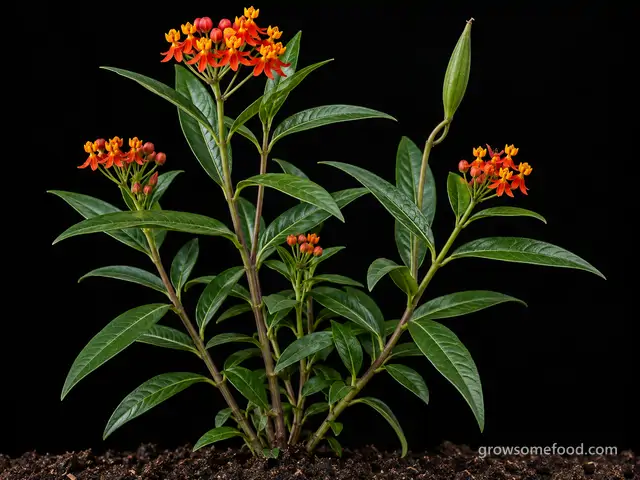
Tropical Milkweed
The milkweed nurseries actually sell, and the one to stop buying. Its red-and-yellow flowers pull monarchs in, but where winters are mild it never dies back, so parasite spores accumulate on the leaves and the butterflies break off migrating to breed through winter. Plant a milkweed native to your region instead.
Like every milkweed this is toxic if eaten, containing cardiac glycosides throughout, and it is toxic to pets and livestock; the milky sap irritates skin and is a serious eye irritant, so wear gloves when you cut it and wash before touching your face. But the real hazard here is not to you - it is to monarchs. An evergreen tropical milkweed accumulates the parasite that cripples them and pulls them out of their migration, which is why the guidance is to replace it, not grow it.
Overview
The one thing to knowIt also does real damage to the butterfly people buy it for, and the recommendation from monarch scientists and conservation groups is consistent: do not plant it, and replace the one you have.
Tropical milkweed (Asclepias curassavica) is the milkweed you are most likely to find on a garden centre bench. It is easy to grow from seed, it flowers in its first year, it blooms for months, and its brilliant orange-red-and-yellow flowers are genuinely beautiful. It also does real damage to the butterfly people buy it for, and the recommendation from monarch scientists and conservation groups is consistent: do not plant it, and replace the one you have.
The problem is that it is a tropical perennial that does not die back. Across the Gulf Coast, Florida, south Texas, coastal and southern California, and anywhere else winter frost is light or absent, it stays green and in flower all year. Two things follow. First, a protozoan parasite called OE (Ophryocystis elektroscirrha) accumulates on the leaves. Infected adult butterflies shed microscopic spores as they visit; native milkweeds die to the ground each winter and wipe the slate clean, while an evergreen plant carries the spores from one monarch generation to the next until caterpillars are ingesting crushing doses. Heavily infected monarchs emerge small, deformed and weak, and many cannot fly properly at all. Second, a lush green milkweed in November tells an arriving monarch that this is a place to breed rather than migrate, and the resident winter-breeding populations that result carry far higher parasite loads than migratory ones.
None of this is the plant's fault, and none of it is a reason to give up on milkweed. It is a reason to plant the right milkweed - common, swamp or butterfly milkweed in the East, narrowleaf milkweed in California, showy milkweed through the interior West - every one of which dies back in winter exactly as a monarch's life cycle expects.
Quick facts
For identification. Not a growing guide.
- Life cycle
- Perennial, grown as an annual
- Where it grows
- Full sun · Part sun, well-drained soil
- Height
- 36 in24 to 48
- Spread
- 18 in12 to 30
- Cold
- Killed by frostdamaged below 28°F
- Heat
- Struggles above 105°F
- Self-sows
- Yes. Never let it set seed.
Through the year
How to recognize it in each season.
Spring growth - or year-round growth in the frost-free South
Mar to May, every year- Make sure this is what you actually haveTropical milkweed is upright and shrubby to about 3 feet, with smooth, glossy, lance-shaped leaves in opposite pairs on green stems, and it bleeds white latex when cut. The giveaway is the flower: small five-petalled blooms with brilliant orange-red reflexed petals and a contrasting yellow-orange crown, in flat clusters at the stem tips. No native US milkweed has that red-and-yellow combination. The Silky Gold and Silky Deep Red strains are the same species.
- Decide now: replace it, or commit to the cutback calendarSpring is the right moment to make the call, because there are no eggs or caterpillars on it yet. If you can, dig it out and put a milkweed native to your region in its place - the same hole, the same sun, and a far better outcome for monarchs. If you are keeping it for now, put the October-to-February cutback dates in your calendar today; the harm all happens in the months people forget about.
Key signs- Red-and-yellow flowers, glossy opposite leaves, milky sap - confirm the identification
- Seedlings coming up around the parent plant and in neighbouring beds
- Whether the plant died back over winter, which tells you how bad the risk is where you live
Bloom - long, heavy, and hard to stop
Jun to Sep, every year- Check for monarch eggs and caterpillars before you cut anythingMonarchs use this plant heavily, which is the whole problem: it is attractive, so it gets used, and then it does harm. Before any pruning or removal in the growing season, go over it leaf by leaf. Move any caterpillars you find onto a native milkweed and leave eggs where they are until they hatch and the larvae can be moved.
- Deadhead every spent cluster so it cannot seedLeft alone this plant flowers and sets pods more or less continuously, and the silk-tufted seed travels. Cut the spent flower clusters off before pods form and bag them for the trash rather than composting. This is the minimum containment step even if you are keeping the plant.
- Never spray it - and never buy treated stockWhatever else you do, do not treat a milkweed with insecticide, including organic products; monarchs are laying on it. Nursery stock treated with systemic neonicotinoids keeps killing caterpillars for a season or more after purchase, which is a good reason to buy native milkweed from a native-plant nursery that can confirm its plants are untreated.
Key signs- Monarch eggs and caterpillars - move larvae to a native milkweed before any cutting
- Seed pods forming behind the spent flowers
- Oleander aphids in bright yellow clusters on stems and buds
Pods and self-sowing
Aug to Nov, every year- Cut and bag every pod before it splitsThe slender pods dry and split along one seam, and the silk-tufted seed carries a long way on the wind. In the Gulf states, Florida, south Texas and southern California this is how tropical milkweed gets out of gardens and into ditches, field margins and natural areas. Cut pods while they are still green and firm and put them in the trash, not the compost heap.
- Pull the volunteersSeedlings come up readily around the parent and downwind of it. Pull them while they are small - they are easy at two inches and have a stubborn root at two feet - and check neighbouring beds, gravel, cracks and the base of fences where the floss collects.
Key signs- Pods splitting and floss blowing across the garden
- Volunteer seedlings in beds, gravel and along fence lines
- Plants appearing beyond the garden, in ditches or on rough ground
October to February - the months that actually matter
Oct to Feb, every year- Cut it to 6 inches, once a month, October through FebruaryThis is the whole management protocol and it only works if you do it every month. In any region where frost does not kill the plant, cut every stem back to about 6 inches from the ground monthly from October through February. That strips the accumulated parasite spores off the foliage and removes the lush green signal that tells arriving monarchs to stay and breed instead of moving on. Bag the cuttings for the trash.
- Better: take it out over winter and plant a native in its placeWinter is the safest time to remove it, because there are no caterpillars to displace. Dig the crown out, bag the top growth and pods, and plant a milkweed native to your region in the same spot - swamp or common milkweed and butterfly weed in the East, narrowleaf milkweed in California, showy milkweed through the interior West. One winter's work ends the problem permanently.
- If you are near a California overwintering grove, remove it outrightWithin roughly five miles of the coastal California groves where monarchs cluster from October to February, the advice is not to cut back but to take milkweed out altogether, this species first. Milkweed was historically scarce along that immediate coast, and any of it near the groves pulls butterflies out of overwintering and into winter breeding.
Key signs- A plant still green and flowering in December - the exact condition to avoid
- Caterpillars feeding in midwinter, which means monarchs have stopped migrating here
- Deformed, undersized or crumple-winged adults emerging, a classic sign of heavy parasite load
Watch out for
3 to know. 2 are high-risk: Disrupted Migration and Winter Breeding, OE Parasite Build-Up on Evergreen Foliage. 3 are active in September.
Disrupted Migration and Winter BreedingSeverity High DisordernowThis is the harm that persists even where OE build-up is modest, because a plant only has to stay green into November to send the wrong signal.
It is the main reason the guidance is to replace the plant rather than simply manage it.
Green, flowering milkweed in late autumn and winter. Monarch eggs and caterpillars on the plant in November, December or January. Adults present and breeding locally through the winter months in a region they should have left. Any of these mean the plant is doing the thing this entry warns about.
Cut the plant to the ground and keep it cut through the winter, or better, dig it out and replace it with a native. There is nothing to do for butterflies that have already settled to breed except remove the cue so it does not happen again next year.
Grow regional native milkweeds, which brown off and disappear on schedule and give the migration the cue it evolved with. If tropical milkweed stays, the monthly October-to-February cutback to 6 inches removes the green signal as well as the spores. Within about five miles of the California coastal overwintering groves, remove milkweed altogether rather than cutting it back.
The second harm, and it is behavioural rather than infectious. Monarchs heading south in autumn read the landscape for cues, and a milkweed still lush and flowering in October or November tells an arriving butterfly that this is a place to lay eggs rather than a place to pass through. Where tropical milkweed is common in the warm South and the mild-winter West, resident year-round breeding populations have established that no longer migrate at all. Those populations carry far heavier parasite loads than migratory monarchs, they are exposed to cold snaps their offspring cannot survive, and every butterfly that stops is one subtracted from a migration already in serious decline.
OE Parasite Build-Up on Evergreen FoliageSeverity High DiseasenowThe severity of this depends on your winter.
In zones 9-11 it is the central reason not to grow this plant. Where hard frost kills it to the ground each year, the mechanism largely breaks down and the risk is much lower - see the ClimateAdaptation section for the regional picture.
A tropical milkweed still green and in leaf through the winter is the condition itself. In the butterflies, watch for adults emerging small or misshapen, wings that fail to expand or stay crumpled, individuals that cannot hold on to the chrysalis or drop when they try to fly, and heavy losses among a batch of caterpillars raised on the same year-round plant.
There is no treatment for an infected butterfly, and no spray or wash for the plant that is worth doing. The action is on the plant: remove it in winter when it is free of caterpillars, bag the top growth and pods, and put a regional native milkweed in the same spot. Move any caterpillars you find onto native milkweed first.
The reliable fix is to grow a milkweed native to your region instead, because it dies back each winter and clears the spores by itself. If this plant stays, cut every stem to about 6 inches from the ground once a month from October through February and bag the cuttings for the trash - and understand that partial or forgotten cutbacks do very little. Do not raise large numbers of caterpillars indoors on cuttings from an evergreen plant, and do not move plants or caterpillars between gardens.
This is not a disease of the plant - it is a disease the plant passes to monarchs. OE, short for Ophryocystis elektroscirrha, is a protozoan parasite of monarch butterflies. Infected adults shed microscopic spores onto the leaves they touch; caterpillars eat the spores with the foliage and the parasite multiplies inside them. Native milkweeds die to the ground every winter, which clears the spore load and resets the cycle. Tropical milkweed in a frost-free climate stays green year after year, so spores accumulate on foliage that is never removed and each monarch generation ingests a heavier dose than the last. Heavily infected butterflies emerge undersized and weak, sometimes unable to expand their wings, and they fly shorter distances and live shorter lives.
Oleander AphidSeverity Low PestnowVery heavy on tropical milkweed, and year-round on an evergreen plant in the frost-free South, since the aphids never get the winter break that a native milkweed's dieback gives them.
Dense colonies of vivid yellow aphids packed along the stems and over the flower buds, sticky honeydew, sooty mold, and ants working the plant.
Blast them off with a jet of water, or wipe them off by hand - checking first for monarch eggs and small caterpillars on the same stems. Otherwise simply tolerate them, since predators usually catch up. Do NOT spray, including with insecticidal soap or neem, which kill caterpillars too.
Encourage lady beetles and lacewings and let them do the work; a strong plant carries a heavy colony without real harm. Never use insecticide on a monarch host plant. Soft, over-watered, over-fed growth carries far more of them, so growing the plant hard reduces the problem.
Bright yellow, black-legged aphids that cluster densely on milkweed stems, buds and new growth. They are conspicuous and very common but rarely fatal to an established plant - and they cannot be sprayed, because any insecticide that kills them also kills the monarch eggs and caterpillars the plant is there to support.
Good & bad neighbors
Plant nearby
-
Plant this instead for dry sunny ground across most of the country. A native, non-running, drought-proof monarch host with vivid orange flowers - and unlike tropical milkweed it is a perennial that returns on its own.
-
Plant this instead in California. The most widespread native milkweed in the state and the main larval host of the western monarch, summer-dry and fully winter-dormant.
-
Plant this instead through the interior West and the Plains. The principal western monarch host, drought-proof and hardy to zone 3, and it dies back cleanly each winter.
-
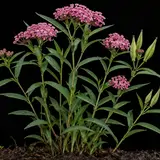
Plant this instead across the East and Midwest. A native monarch host for ordinary to damp soil that forms a tidy clump, carries fragrant pink flowers, and dies back every winter the way a monarch's life cycle expects.
-
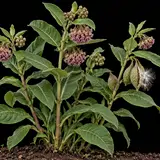
Plant this instead in the East and Midwest where a spreading patch is welcome - a meadow, a fence line, a wild corner. The most productive monarch host there is, and a native that dies back every winter.
Grower tips
Notes from growers, tagged with the zone they grow in. A person reads every post before it appears.
Nobody has posted about Tropical Milkweed yet.
Free account. Your post shows your grower name and zone, never your email.