Add it to your home screen and it opens full screen — no browser bars, one tap away, and everything stays signed in. Free, nothing to download from an app store.
- Tap the Share button in your browser
- Scroll down and choose “Add to Home Screen”
- Open GrowSomeFood from your home screen
- Open your browser’s menu
- Choose “Add to Home screen” or “Install app”
- Open GrowSomeFood from your home screen
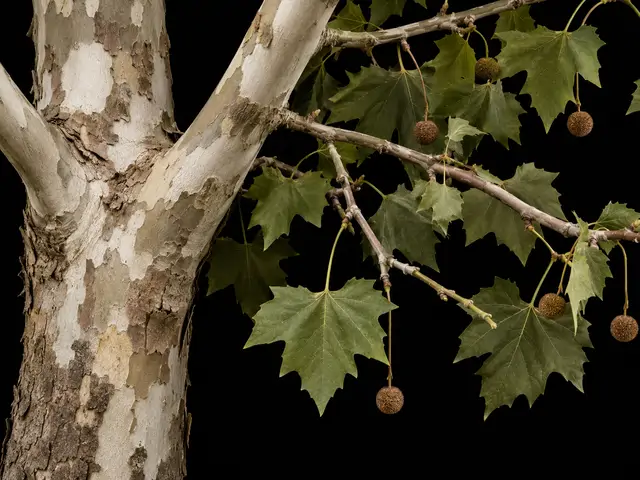
American Sycamore
American sycamore is safe to grow and handle - it's a large shade and riparian tree, not a food plant. Two practical notes: the tiny hairs shed from its new leaves and seed balls can irritate the eyes, nose, and throat (a minor spring cough for sensitive people, sometimes called 'sycamore itch'), and the tree is genuinely messy, dropping bark, big leaves, twigs, and spiky seed balls. Its very large size and spreading roots also mean it needs lots of room away from buildings and pipes.
Overview
One of the most massive trees of eastern North America - a fast-growing giant of riverbanks and bottomlands, unmistakable for its striking mottled, peeling bark that glows ghostly white, and for the dangling 'buttonball' seeds that give it its folk names.
The American sycamore (Platanus occidentalis) is a giant among eastern trees - one of the most massive by trunk diameter on the continent, a fast-growing colossus of riverbanks and bottomlands that commonly reaches 75-100+ feet with an enormous trunk and a broad, spreading crown. Its most famous feature is its bark: the outer bark flakes away in irregular puzzle-piece patches to reveal a smooth, camouflage patchwork of cream, tan, olive, and white beneath, so that the upper trunk and branches glow a striking, ghostly white - unmistakable across a winter landscape.
It's a tree of water and grandeur: native to streamsides, floodplains, and wet bottomlands, superbly wet-tolerant, and long-lived, with ancient hollow trunks that have famously sheltered everything from pioneers to owls and chimney swifts. Round, dangling seed balls ('buttonballs') hang through winter and give it the names buttonwood and buttonball tree. The trade-offs are honest: it's huge, fast, and messy (shedding bark, big leaves, twigs, and seed balls), it's prone to anthracnose leaf blight, and its roots are aggressive - so it belongs in big, open, moist spaces, not small yards. Where there's room, though, few native trees are so grand.
At a glance
- Sun
- Full sun · Part sun
- Water
- Medium
- Spacing
- 480–960 in (typ. 720)
- Mature height
- 900–1680 in (typ. 1200)
- Start by
- Direct sow · Transplant
- Frost
- Hardy
- Germination
- 15–60 days (typ. 30) @ 60–80 °F (typ. 70)
When to plant
Zone 7a typical frost: last Apr 10 · first Oct 25
Life stages
- Years 1-3 - fast young tree day 0–1095 from transplant
-
Keep it moist while establishingevery 6 dWater a young sycamore deeply and regularly through its first 2-3 years. It's a bottomland, streamside tree that loves moist ground and grows very fast - keep it well watered, and it can add several feet a year once settled in.
-
Mulch the root zoneA wide mulch ring conserves the moisture sycamore loves and keeps mowers off the trunk; keep it back from the bark. Sycamore has large, spreading, often surface roots that can lift pavement and invade pipes, so plan the site accordingly.
-
Site it with LOTS of room for a huge treeAmerican sycamore becomes one of the most massive trees in eastern North America - 75-100+ feet tall with an enormous trunk and spreading roots. Give it a large, open, moist site well away from buildings, pavement, sewer and drain lines, and power lines; this is a tree for parks, big yards, and streamsides, not small lots.
Fast early growth (normal - one of the quickest large natives)Surface and pipe-seeking roots near pavement or plumbingAnthracnose causing leaf browning and early drop in cool wet springsDeer browsing young saplings -
Keep it moist while establishingevery 6 d
- Spring & summer canopy Apr, May, Jun, Jul, Aug (yearly)
-
Huge leaves and the famous mottled barkSycamore's big, broad, maple-like leaves give dense summer shade, and its signature feature is the bark: the outer bark flakes off in irregular patches to reveal a smooth, striking patchwork of cream, tan, olive, and white beneath - a camouflage-mottled trunk that glows, especially higher up and in winter.
-
Watch for anthracnose in cool, wet springsSycamore's main issue is anthracnose, a fungus that browns and kills new leaves and shoots in cool, wet spring weather, sometimes causing heavy early leaf drop and a second flush. It looks alarming but rarely kills an established tree - it re-leafs and carries on.
Anthracnose (brown, dead new leaves and shoot dieback in cool wet springs; usually cosmetic)Shedding bark and dropped twigs/leaves littering beneath (normal - sycamore is messy)Powdery mildew or lace bugs (minor)Fine leaf and seed-ball hairs shedding in spring (can irritate eyes/throat) -
Huge leaves and the famous mottled bark
- Fall, seed balls & winter Jan, Feb, Mar, Oct, Nov, Dec (yearly)
-
Ghostly white winter branches and hanging 'buttonballs'In winter, sycamore is unmistakable: the leaves drop (with modest yellow-brown fall color), revealing bright, ghostly white upper branches and trunk, hung with the round, dangling seed balls ('buttonballs') that give it the names buttonwood and buttonball tree. Old sycamores are often massive and hollow, sheltering wildlife.
-
Prune in late winter while dormantPrune in the dormant season to remove dead, damaged, or crossing wood and train a strong central leader while young. Established sycamores need little pruning; clean up the shed bark, twigs, and seed balls as a matter of tidiness rather than tree health.
Hanging round seed balls breaking up and releasing fluffy seeds (and self-sowing on moist ground)Striking white bark and hollow old trunks (winter features and wildlife habitat)Storm and ice damage on the fast, sometimes brittle wood -
Ghostly white winter branches and hanging 'buttonballs'
Watch out for
Sycamore Anthracnose Disease MediumApr, May, Jun
The main disease of American sycamore: a fungus that infects and kills expanding leaves and new shoots in cool, wet spring weather, causing brown, dead patches along the leaf veins, curled and blighted leaves, shoot dieback, and often heavy early leaf drop and a witches'-broom of twiggy regrowth. It's disfiguring but rarely kills an established tree.
Watch for: Brown, dead areas following the veins of young leaves in a cool wet spring, blackened dying shoot tips, heavy premature leaf drop, and clusters of twiggy regrowth after repeated infection.
Prevent: Rake up and remove fallen infected leaves and prune out blighted twigs to reduce overwintering spores; ensure good air circulation; plant the resistant London plane (or a resistant cultivar) on problem or urban sites.
Treat: None usually warranted on a large tree - it re-leafs and recovers; sanitation reduces severity, and fungicide is generally impractical and unnecessary except for high-value young trees in wet regions.
Sycamore Lace Bug Pest LowJun, Jul, Aug, Sep
Tiny, lacy-winged sap-sucking insects that feed on the undersides of sycamore leaves in summer, causing a fine yellow-white stippling on the upper leaf surface and dark 'varnish' spots of excrement beneath; heavy infestations can bronze the foliage but rarely harm a large, established tree.
Watch for: Fine yellow-to-white stippling and bronzing on the upper leaf surface, tiny lacy insects and shiny black excrement spots on the undersides, worse in hot, dry summers.
Prevent: Encourage the lacewings, lady beetles, and other predators that control lace bugs; keep the tree vigorous and watered, since drought-stressed trees suffer more.
Treat: Rarely warranted on a big tree - the damage is cosmetic and the tree tolerates it; a strong hose spray or insecticidal soap helps on accessible young trees if desired.
Seed & Leaf Hair Irritation Disorder LowApr, May, Jun
Not a plant disease but a human nuisance: sycamore's new spring leaves and its breaking-up seed balls shed fine hairs that become airborne and can irritate the eyes, nose, throat, and skin of sensitive people, sometimes causing a brief spring cough sometimes called 'sycamore itch.'
Watch for: Fine fuzzy hairs on new leaves and dispersing seed-ball fluff in spring, and minor throat/eye/skin irritation or coughing in sensitive individuals near the tree.
Prevent: Site large sycamores away from patios, windows, and seating areas where people spend time in spring; the irritation is brief and seasonal, tied to leaf-out and seed-ball breakup.
Treat: No treatment needed for the tree; sensitive people can limit close exposure during the brief spring shedding period. The nuisance passes as the leaves harden off and the seed balls finish dispersing.
Good & bad neighbors
Varieties · 4
The wild native: one of the most massive eastern trees (75-100+ feet), fast-growing, superbly wet-tolerant, with striking mottled cream-and-white peeling bark, huge leaves, and dangling buttonball seeds. A grand riparian and shade tree for big, moist spaces - messy and anthracnose-prone but magnificent.
A widely planted London plane cultivar selected for good anthracnose resistance, a uniform upright form, and toughness - one of the standard street and park trees where a large, mottled-barked, disease-resistant tree is wanted.
A modern London plane selection with a strong central leader, uniform pyramidal-to-oval form, excellent anthracnose and disease resistance, and reduced seed-ball litter - bred as an improved, tidier large street and shade tree.
The famous urban street tree - a hybrid of American and Oriental sycamore that keeps the mottled bark and grand form but resists anthracnose far better and tolerates pollution, compaction, and hard pruning. The go-to 'sycamore' for cities, streets, and tough sites.
Grow
Full sun and moist, deep soil (it loves wet, low ground) in zones 4-9; extremely fast and easy, but plant it only where there's lots of room, since it becomes enormous, messy, and aggressive-rooted.
American sycamore is easy, fast, and adaptable, but it needs the right scale of site. It wants full sun and deep, moist soil - it's a bottomland and streamside tree that thrives in wet, low, even periodically flooded ground where many trees fail, and also grows in ordinary soil once established. It's hardy across zones 4-9 and grows very fast, among the quickest of large natives.
The whole growing decision is room. This becomes one of the biggest trees in the eastern forest, with a huge trunk, a wide crown, and large, spreading, sometimes surface and pipe-seeking roots - so plant it only in a big, open, moist space (a park, a large yard, a streambank, a wet low corner) well away from buildings, pavement, sidewalks, foundations, and sewer/drain lines. Be ready for the mess, too: sycamore continually sheds bark, big leaves, twigs, and spiky seed balls, so it's a poor choice over a patio, lawn you want pristine, or pool. Given a large, moist, out-of-the-way site, though, it's a tough, fast, magnificent shade and riparian tree with almost no other demands.
Care
Low-care once established except for cleanup - water young trees, tolerate anthracnose (usually cosmetic), prune in late winter, and rake up the abundant bark, leaves, and seed balls if tidiness matters.
An established sycamore is a tough, low-maintenance tree. Water young trees (it loves moisture and tolerates wet ground), mulch the root zone, and prune in the dormant season to remove dead or crossing wood and train a strong central leader while young. It's essentially trouble-free in terms of tree health - big, fast, and resilient - so most of its 'care' is really cleanup: the tree continually drops shed bark, large leaves, twigs, and seed balls, and if it overhangs a used area you'll be raking regularly (siting it away from paths avoids this).
Its one notable ailment is anthracnose, a fungus that browns and kills new leaves and shoots in cool, wet springs, sometimes causing heavy early leaf drop and dieback of shoot tips. It looks alarming, but it rarely harms an established tree - the sycamore simply pushes out a second flush of leaves and carries on; raking and removing fallen infected leaves reduces next year's spores, and no spraying is needed on a large tree. (The introduced London plane hybrid is more resistant, for tough urban sites.) Watch also for the fine hairs shed by new leaves and seed balls in spring, which can irritate sensitive throats and eyes. Otherwise, sycamore asks little beyond room and the occasional rake.
Storage
No food crop to store - sycamore is grown for grandeur, bark, and shade; its historic 'harvest' was its distinctive interlocked wood ('lacewood'), used for butcher blocks, boxes, and veneer.
American sycamore isn't a food plant, so there's nothing to harvest or store from the garden. Its historic 'harvest' was its wood. Sycamore timber has an unusual interlocked grain that makes it very hard to split - a drawback for firewood but a virtue for uses needing toughness - so it was long used for butcher's blocks, boxes and crates, barrels, furniture, and flooring. Quartersawn, its rays produce a beautiful freckled figure sold as 'lacewood' for fine veneer and furniture.
In the modern landscape, though, the tree's value is entirely living: fast shade, striking mottled bark, streambank stabilization, and wildlife habitat. Its round seed balls break apart to release fluffy, wind- and water-borne seeds that feed finches and other birds rather than people, and its great hollow trunks are famous wildlife shelters, not storage. There's nothing to preserve on a shelf - a sycamore banks grandeur, shade, and habitat over its long life, and its 'products' are the timber and the streambank it holds together, not anything for the pantry.
Propagation & seed saving
Easiest from a nursery transplant or from seed on moist bare ground (it self-sows freely on wet banks); also grows readily from hardwood cuttings, and the London plane hybrid is grown for tough sites.
Sycamore is easy to propagate. For most gardeners a nursery transplant is simplest - it establishes fast and grows quickly into a big tree. From seed, sycamore is prolific: the round seed balls break apart into fluffy, tufted seeds that blow and float away, and the tree self-sows readily on the moist, bare mud and sandbars of riverbanks - so seed sown (or scattered) on damp, exposed ground germinates freely in spring, which is exactly how it colonizes floodplains in the wild.
It also grows well from hardwood cuttings, rooting more easily than many trees, which is one reason it (and its relatives) have long been used as fast street and shade trees. For tough urban sites, gardeners often plant the London plane (Platanus × acerifolia), a vigorous hybrid of American and Oriental sycamore that resists anthracnose better and tolerates pollution and compaction, and its cultivars are propagated by cuttings. For a true native, though, a young American sycamore transplant, a self-sown seedling from a moist bank, or a rooted cutting all work easily - the challenge is never propagating it, only finding a big enough, moist enough spot for the giant it becomes.
Nutrition
Not a food plant - it's grown for grandeur and shade; its ecological value lies in seeds for birds, famously hollow trunks that shelter wildlife, and its vital role stabilizing streambanks and riparian habitat.
American sycamore isn't a food plant. Its value is ecological and functional, and it's considerable. As a dominant riparian tree - lining streams, rivers, and floodplains - it does crucial work stabilizing banks, slowing floodwaters, shading and cooling the water for fish, and anchoring the whole streamside ecosystem. Its seeds, released from the buttonball seed heads, feed finches (goldfinches and purple finches especially), chickadees, and other birds through winter, and its foliage hosts native insects.
Sycamore's most distinctive habitat contribution is its hollow trunks. Old sycamores frequently become massive and hollow while still living, and these great cavities are prized shelter and nesting sites for a remarkable range of wildlife - owls, wood ducks, raccoons, bats, honeybees, and, famously, chimney swifts, which historically nested in hollow sycamores before chimneys existed. A single ancient hollow sycamore can be a wildlife apartment building. So while a sycamore won't feed the gardener, it feeds birds, shelters wildlife in its hollows, and holds the living streambank together - one of the most ecologically valuable trees of the eastern waterways.
History
A tree of superlatives in early America - colonists sheltered inside hollow giants, its interlocked wood made butcher blocks and buttons, and the related London plane became the great street tree of the world's cities.
The American sycamore loomed large - literally - in the early American landscape. Colonial-era accounts marvel at its enormous hollow trunks: settlers and travelers are recorded sheltering (and even briefly living) inside great hollow sycamores, penning livestock in them, and using them as impromptu cabins on the frontier. The tree's toughness and interlocked grain made its wood the classic butcher's block and a material for crates, barrels, and - in the buttonwood era - buttons (one of its folk names is 'buttonwood').
Its cultural reach runs further through its relatives. The London plane (Platanus × acerifolia), a hybrid of the American sycamore and the Oriental plane, became the great street tree of the world's cities - lining the boulevards of London, Paris, and countless towns - thanks to its tolerance of pollution, poor soil, and hard pruning. In American finance, the 'Buttonwood Agreement' of 1792, signed by merchants under a buttonwood (sycamore) tree on Wall Street, is regarded as the founding of the New York Stock Exchange. Between its giant hollow trunks, its useful wood, and its city-tree lineage, the sycamore is woven through American history.
Troubleshooting
Most issues are the tree being big and messy or getting anthracnose (usually cosmetic); watch also for aggressive surface/pipe roots and the fine spring hairs that can irritate sensitive people.
New leaves and shoot tips browning and dying in a cool, wet spring, with heavy early leaf drop: anthracnose, sycamore's main disease - alarming but rarely fatal to an established tree, which re-leafs and carries on; rake up infected leaves, and choose the resistant London plane for tough sites. Constant mess of shed bark, big leaves, twigs, and seed balls: normal - sycamore is genuinely messy; site it away from paths, patios, and pools, and rake as needed. Roots lifting pavement or clogging pipes: sycamore has large, aggressive, moisture-seeking roots - keep it well away from sidewalks, foundations, and sewer/drain lines. Spring cough, itchy eyes/throat near the tree: the fine hairs shed from new leaves and seed balls can irritate sensitive people ('sycamore itch') - a brief, minor spring nuisance. White powdery coating or stippled leaves: powdery mildew or lace bugs - usually cosmetic. Limb breakage in storms: the fast wood can be brittle - train good structure young and remove damaged limbs. The tree is simply too big: the honest one - sycamore is enormous, so it belongs only where there's real room.
Growing across climates
Broadly hardy across the eastern U.S. (zones 4-9) and outstandingly wet-tolerant; it thrives on moist bottomlands and streambanks, with its main limits being dry sites, small spaces, and anthracnose in cool wet springs.
American sycamore is native and hardy across the eastern United States, zones 4-9, and it's defined by its love of moisture. Zones 5-8 (its heartland): the moist bottomlands, floodplains, and streambanks of the East and Midwest grow the grandest sycamores, where their wet-tolerance and fast growth make them dominant riparian trees. Zones 8-9 (the South): excellent on moist, low, and streamside sites, handling heat and humidity well. Zone 4 and the cold north: hardy near its northern limit. Its real strength is wet-site tolerance - it grows in periodically flooded, low, damp ground where most large trees fail - and its real limits are dry sites and small spaces: it's not a tree for hot, dry, droughty ground or for a small lot. The one climate-linked nuisance is anthracnose, which flares in cool, wet springs and browns the new leaves (rarely serious; the resistant London plane is the answer for problem sites). Given a big, moist, sunny space, though, American sycamore is a tough, fast, adaptable giant across most of the eastern half of the country - especially where the ground is wet.
No grower tips for American Sycamore yet — yours could be the first.
Sign in to share what works in your garden.