Add it to your home screen and it opens full screen — no browser bars, one tap away, and everything stays signed in. Free, nothing to download from an app store.
- Tap the Share button in your browser
- Scroll down and choose “Add to Home Screen”
- Open GrowSomeFood from your home screen
- Open your browser’s menu
- Choose “Add to Home screen” or “Install app”
- Open GrowSomeFood from your home screen
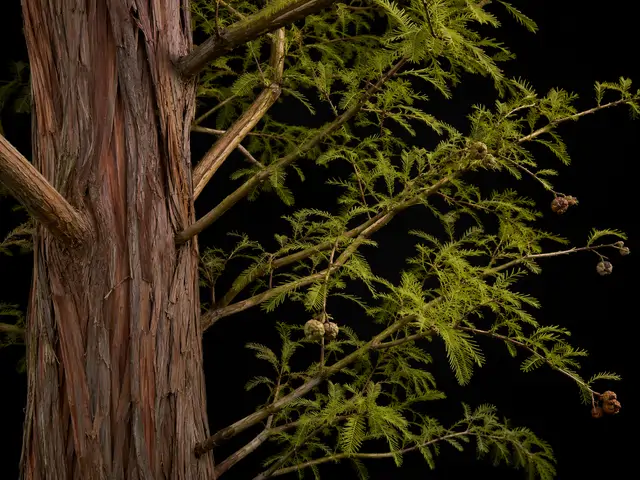
Bald Cypress
Bald cypress is safe to grow and handle - it's an ornamental shade tree, not a food plant. The main practical caution is its 'knees': woody root projections that rise from the ground around trees on wet sites and can be a mowing and tripping hazard near lawns and paths. It's also a very large, long-lived tree, so site it with room for the long term.
Overview
The stately deciduous conifer of Southern swamps - feathery green needles, glowing russet fall color, a buttressed trunk and mysterious 'knees,' and an almost unmatched ability to grow in standing water or ordinary soil alike.
Bald cypress (Taxodium distichum) is one of the most distinctive and adaptable native trees in North America - a deciduous conifer that breaks all the rules. It's a cone-bearing relative of the redwoods, yet it drops its needles each fall like a broadleaf, first turning a soft, glowing russet-orange. In summer its feathery, flat sprays of bright-green needles cast a light, airy shade; in winter its bare, sculptural silhouette shows off a buttressed, fluted trunk and shreddy reddish bark.
It's the signature tree of Southern swamps and blackwater rivers - the moss-hung cypress of the bayous - and on wet ground it famously sends up woody 'knees' from its roots. Yet its great garden virtue is versatility: bald cypress grows happily in standing water OR ordinary, even fairly dry, upland soil, tolerates clay, compaction, and city conditions, is nearly pest-free, and is exceptionally long-lived (some wild trees exceed a thousand years). Wet or dry, North or South, it's one of the finest large native trees you can plant.
At a glance
- Sun
- Full sun · Part sun
- Water
- Medium
- Spacing
- 240–600 in (typ. 420)
- Mature height
- 600–1440 in (typ. 840)
- Start by
- Direct sow · Transplant
- Frost
- Hardy
- Germination
- 30–120 days (typ. 60) @ 60–80 °F (typ. 70)
When to plant
Zone 7a typical frost: last Apr 10 · first Oct 25
Life stages
- Years 1-3 - young tree day 0–1095 from transplant
-
Keep it wet while establishingevery 6 dBald cypress is famously wet-tolerant, so never let a young one dry out - water deeply and often through the first 2-3 years, especially away from water. It's one of the few large trees that thrives in standing water, but a new transplant still needs steady moisture to root in.
-
Mulch the root zoneA wide mulch ring conserves moisture and protects the trunk from mowers; keep it back from the bark. On wet sites the tree may begin forming 'knees' - decide early whether that spot suits them.
-
Site it with room and think about the kneesBald cypress becomes a large, long-lived pyramidal tree (50-70+ feet, occasionally over 100). On wet ground it sends up woody 'knees' around the base that interfere with mowing - so on a lawn, plant it where knees won't be a problem, or expect fewer knees on drier, well-drained sites.
Drying out (the one thing this wet-lover won't forgive when young)Knees emerging on wet or lawn sites (a mowing hazard)Bagworms on young trees (hand-pick the spindle-shaped cases) -
Keep it wet while establishingevery 6 d
- Spring & summer - soft green needles Apr, May, Jun, Jul, Aug, Sep (yearly)
-
A conifer that acts like a broadleafBald cypress is a deciduous conifer: it leafs out in spring with soft, feathery, bright-green needles arranged in flat sprays, gives light airy shade all summer, and drops its needles in fall - unusual and beautiful. It's nearly pest- and disease-free.
-
Water in drought on dry sitesEstablished bald cypress is adaptable to ordinary well-drained soil once rooted in, but it appreciates water in extended drought - it's a swamp tree at heart and shows stress sooner than a true dryland tree.
Bagworms and spider mites (usually minor)Twig gall midges (harmless)Yellowing on high-pH alkaline soils (iron chlorosis) -
A conifer that acts like a broadleaf
- Fall color & winter dormancy Jan, Feb, Mar, Oct, Nov, Dec (yearly)
-
Rusty-orange fall color, then bare for winterBefore dropping, the needles turn a warm russet-orange to cinnamon-brown - a soft, glowing fall show - and then the tree stands bare and sculptural through winter, revealing its buttressed trunk, peeling reddish bark, and (on wet sites) its ring of knees.
-
Prune lightly while dormantBald cypress needs almost no pruning - it makes a naturally strong pyramidal form with a single leader. Remove any dead or damaged wood in the dormant season; avoid cutting the central leader.
Small round cones dropping and self-sowing on wet groundKnees enlarging around the base on wet sitesReddish shredding bark and buttressed, fluted trunk base (attractive winter features) -
Rusty-orange fall color, then bare for winter
Watch out for
Iron Chlorosis (Alkaline Soil) Disorder MediumMay, Jun, Jul, Aug
Yellowing of the leaves (with green veins) caused by the tree's inability to take up iron in high-pH, alkaline soils - sweetgum prefers slightly acidic ground and shows chlorosis and decline on limey soils.
Watch for: Pale yellow leaves with green veins, worst on new growth, in alkaline or high-pH soils; overall thin, weak growth and poor color over time.
Prevent: Plant sweetgum only in neutral-to-acidic soil; avoid alkaline sites, or choose a more pH-tolerant tree there.
Treat: Acidify the soil and apply chelated iron as a stopgap; the durable fix is siting the tree in suitable acidic soil - chronically chlorotic sweetgums decline.
Cypress Knees (Mowing Hazard) Disorder LowApr, May, Jun, Jul, Aug, Sep
Not a pest but a growth habit: on wet sites and near lawns, bald cypress sends up woody root projections ('knees') around its base. Their exact function is debated, but they interfere with mowing and can be a tripping hazard.
Watch for: Rounded or pointed woody knobs emerging from the ground in a ring around the trunk, more numerous on wet or frequently watered sites.
Prevent: Plant bald cypress on drier, well-drained ground (where few or no knees form) or where knees are welcome in a naturalized bed - not in open mown lawn.
Treat: Knees resprout if cut and cutting can wound the roots, so the realistic answer is siting; mulching over a naturalized area lets them coexist without a mowing conflict.
Bagworms Pest LowJun, Jul, Aug
Caterpillars that build and live inside spindle-shaped 'bags' woven from bits of foliage, feeding on needles; heavy infestations can defoliate branches on young or small conifers, though established bald cypress usually shrugs them off.
Watch for: Small hanging spindle-shaped bags covered in needle fragments, moving on the foliage, and localized needle loss where they feed.
Prevent: Hand-pick and destroy the bags in fall through spring to remove overwintering eggs, especially on young trees; encourage the parasitic wasps that control them.
Treat: Hand-pick on small trees; Bt (Bacillus thuringiensis) works on young caterpillars early in the season. Large established trees rarely need treatment.
Good & bad neighbors
Varieties · 4
The wild species: a large pyramidal deciduous conifer of Southern swamps and floodplains, with feathery green summer needles, russet-orange fall color, a buttressed trunk, and (on wet sites) woody knees. Grows equally well in standing water or ordinary soil, and lives for centuries.
A dwarf, dense, slow-growing bald cypress reaching only 8-20 feet, with the same feathery foliage and russet fall color in miniature - a choice for small gardens, containers, and wet spots where a full-size tree is too big.
A closely related Southeastern native (sometimes treated as a variety) of ponds, wet flatwoods, and cypress domes, with more upright, awl-like foliage and a narrower, finer-textured form - smaller and often used where a more delicate wet-site cypress is wanted.
A narrow, uniform, columnar-pyramidal bald cypress selection with a strong central leader - a tidy, predictable form for streets, avenues, and smaller landscapes where the wild spreading base won't fit.
Grow
Full sun and moist to wet soil are ideal, but it adapts to ordinary and even dry ground once established; extremely tough, pest-free, and hardy over a huge range (zones 4-10) - just give it room and mind the knees on lawns.
Bald cypress is wonderfully easy and adaptable. It's happiest in full sun and moist to wet soil - it will grow at a pond edge, in a rain garden, or in seasonally flooded ground where almost nothing else survives - but, surprisingly, once established it also does very well in ordinary well-drained garden soil and tolerates clay, compaction, drought, and urban conditions. It's hardy across an enormous range, roughly zones 4 to 10, and is nearly free of serious pests and diseases.
Two siting notes. First, give it room: it becomes a large pyramidal tree (50-70+ feet, occasionally over 100) with a long life, so plant it well clear of buildings. Second, mind the knees: on wet sites, bald cypress sends up woody root projections around its base that make mowing difficult and can be a tripping hazard - so on a lawn, either site it where knees won't matter or plant it on drier ground (which usually produces few or no knees). Keep a young tree well watered, and it will settle in fast and grow steadily for centuries.
Care
About as low-care as a big tree gets - keep young trees moist, water in drought on dry sites, prune almost never, and manage or accept the knees on wet ground.
An established bald cypress needs remarkably little care. Keep young trees consistently moist (this wet-lover won't forgive drying out early), water established trees in extended drought on drier sites, and mulch the root zone. It builds a naturally strong, single-leader pyramidal form, so it needs almost no pruning - just remove dead or damaged wood in the dormant season and never cut the central leader.
The main ongoing management question is the knees. These woody projections rise from the roots on wet sites and around trees near lawns; they can't be cut off without risking harm to the tree and tend to resprout, so the realistic approach is to plant where they're welcome (a naturalized wet area or bed, not open lawn) or on drier ground where they seldom form. Otherwise, bald cypress is essentially trouble-free: it shrugs off most pests, tolerates flooding and drought alike, and asks little beyond room to grow. Watch only for iron chlorosis (yellowing) on high-pH alkaline soils, where it's a poorer choice.
Storage
There's no crop to store - bald cypress is grown for its form, foliage, fall color, and wet-site tolerance; its historic 'harvest' was the famous rot-resistant cypress lumber.
Bald cypress is an ornamental and habitat tree, so there's nothing to harvest or store from the garden. What people historically 'stored' from it was its extraordinary wood: old-growth bald cypress heartwood is so decay- and water-resistant that it was called 'the wood eternal' and prized for boats, shingles, water tanks, greenhouse benches, and outdoor construction throughout the South - a legacy of overharvesting that felled most of the ancient swamp forests.
In the modern garden the tree's value is entirely living: soft summer shade, russet fall color, a sculptural winter trunk, and unmatched tolerance of wet ground for rain gardens and pond edges. Its small round cones and seeds are a food for waterfowl and wildlife rather than for the kitchen. What a bald cypress really banks is time - a strong, long-lived, low-care tree for the wettest corner of the yard.
Propagation & seed saving
Easiest from a nursery transplant; grows from fresh seed sown on wet ground (needs saturation and cold), and from cuttings - but seedlings are slow, so most gardeners plant a young tree.
For most gardeners the practical route is a nursery transplant - bald cypress transplants readily (unlike many taprooted trees) and establishes fast in moist soil, quickly becoming a usable tree. It's widely sold as a tough, adaptable landscape and street tree.
From seed, bald cypress is a swamp tree at heart: its seeds need saturated, muddy ground and a period of cold-moist stratification to germinate, so sow fresh cleaned seed on wet soil in fall and let winter do the work; germination comes in spring and seedlings grow steadily where kept wet. It can also be grown from hardwood or softwood cuttings by nurseries. Because seedlings take years to make a real tree and need consistently wet conditions to start, buying a young transplant is far simpler for a yard. However you start it, keep it moist while it establishes and give it room for the centuries ahead.
Nutrition
Not a food plant - it's grown for beauty and wet-site tolerance; its value is ecological, as a keystone of Southern swamps providing wildlife food, nesting habitat, flood control, and clean water.
Bald cypress isn't a food plant. Its worth is ecological and functional, and it is enormous. As the dominant tree of Southern swamps, floodplains, and blackwater rivers, bald cypress underpins whole wetland ecosystems: its seeds feed ducks, wild turkeys, wading birds, squirrels, and other wildlife; its hollows and canopy shelter birds, bats, and mammals (bald cypress swamps are prime nesting habitat, historically for birds like the ivory-billed woodpecker); and its submerged roots and 'knees' provide cover and spawning habitat for fish.
Beyond wildlife, cypress swamps do vital ecosystem work: they buffer storm surge and floodwaters, slow erosion, filter pollutants, and store large amounts of carbon in tree and soil. In the garden, that same tolerance makes bald cypress a superb rain-garden and pond-edge tree, soaking up runoff and stabilizing wet ground. So while it won't feed you, few trees do more for water, wildlife, and resilience across the wet South.
History
The 'wood eternal' of the South - ancient cypress swamps were logged for their nearly rot-proof lumber, and individual trees rank among the oldest living things in eastern North America.
Bald cypress is woven through the history of the American South. Its heartwood is remarkably resistant to decay, insects, and water - so much so that it was marketed as 'the wood eternal' and used for shingles, boats, docks, water tanks, coffins, and buildings meant to last. That prized durability drove the logging of the great cypress swamps from the 1800s into the 1900s, when vast ancient forests of the Deep South were cut over; sunken 'sinker' cypress logs are still salvaged from river bottoms and valued today.
The tree is also astonishingly old. Individual bald cypresses in swamps like North Carolina's Black River have been dated to well over 1,600 years - among the oldest known living trees in eastern North America and some of the oldest wetland trees on Earth. Draped in Spanish moss over dark water, the cypress swamp became an icon of Southern wilderness in art, literature, and legend, and the tree is celebrated as the state tree of Louisiana. Its combination of great age, durability, and swamp mystique gives it a place few trees hold.
Troubleshooting
Remarkably trouble-free - the common issues are knees interfering with mowing, iron chlorosis on alkaline soil, drying out when young, and minor bagworms or mites.
Woody knees rising around the base: normal on wet sites and near lawns - they can't be safely cut off (they resprout and cutting can harm the tree), so plant bald cypress where knees are welcome, or on drier ground where few form. Yellowing leaves with green veins (chlorosis): iron deficiency on high-pH, alkaline soil - bald cypress dislikes alkaline ground; it's a poor choice there, or treat with soil acidification and iron as a stopgap. Young tree browning or struggling: often it dried out - keep new bald cypress consistently moist while establishing. Spindle-shaped bags hanging in the foliage: bagworms - hand-pick the cases on young trees; rarely serious on established ones. Fine stippling and webbing in hot, dry weather: spider mites - usually minor and controlled by natural predators or a hose spray. Small galls on twigs: harmless twig midge galls - no action needed. Overall, bald cypress is one of the most pest- and disease-free large native trees you can grow.
Growing across climates
Extraordinarily wide-ranging and adaptable (zones 4-10), thriving in heat, humidity, flooding, drought, and city conditions; its main limits are alkaline soil and, at the cold northern edge, a short season.
Bald cypress has one of the broadest tolerances of any large tree, hardy and successful from the Gulf Coast into the Upper Midwest and Northeast, roughly zones 4 to 10. Zones 8-10 (Deep South): its native swamp heartland - it thrives in heat, humidity, and standing water, forming the classic cypress swamps and making a superb wet-site and street tree. Zones 6-7: excellent and increasingly popular as a tough, adaptable shade and rain-garden tree well beyond its swampy origins. Zones 4-5: surprisingly hardy far north of its natural range, growing well in cold climates as long as the season ripens its growth; northern-sourced trees are hardiest. Its real limitations are alkaline soil (which causes iron chlorosis, so it's a poor choice on high-pH ground) rather than temperature or moisture. Few trees tolerate such a range of conditions - wet or dry, hot or cold, wild swamp or paved street - which is exactly why bald cypress is planted so widely today.
No grower tips for Bald Cypress yet — yours could be the first.
Sign in to share what works in your garden.