
Add it to your home screen and it opens full screen: no browser bars, one tap away, and everything stays signed in. Free, nothing to download from an app store.
- Tap the Share button in your browser
- Scroll down and choose “Add to Home Screen”
- Open GrowSomeFood from your home screen
- Open your browser’s menu
- Choose “Add to Home screen” or “Install app”
- Open GrowSomeFood from your home screen

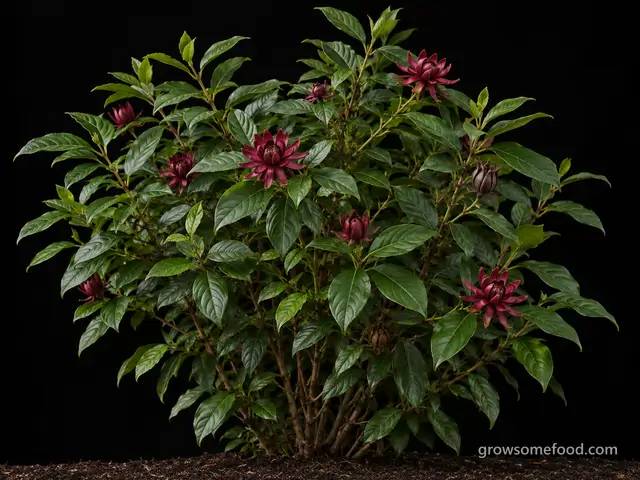
Sweetshrub
An adaptable, easy native shrub grown above all for fragrance - unusual maroon flowers with a rich fruity scent and spicy-aromatic bark and wood - that thrives from sun to shade, resists deer and pests, but should never be eaten (its seeds are toxic).
Safety notes Sweetshrub is a fragrant ornamental, not a food plant. Despite the folk name 'Carolina allspice' (settlers ground the aromatic bark as a cinnamon substitute), no part should be eaten: the seeds contain the toxic alkaloid calycanthine and have poisoned livestock, and other parts are considered toxic. The true edible 'spicebush' is the unrelated Lindera benzoin (alternate leaves, red berries); this is not that plant. Enjoy the fragrance, but never use any part as food or spice.
Overview
Sweetshrub (Calycanthus floridus), also called Carolina allspice, is a beloved native shrub grown first and foremost for its fragrance. Its unusual, dark red-brown (maroon) flowers, with many strap-like petals, open in late spring carrying a rich fruity scent variously described as strawberry, pineapple, banana, or melon - and the bark, wood, and leaves are spicy-aromatic when bruised or scratched, giving it year-round appeal to the nose. Site it by a path or door and it perfumes the garden.
The one thing to knowSweetshrub (Calycanthus floridus), also called Carolina allspice, is a beloved native shrub grown first and foremost for its fragrance.
Quick facts
- Sprouts in
- 90 daysRange: 30–180 days
- Soil temperature
- 70 °FRange: 60–75 °F
- Height
- 8 ftRange: 6–12 ft
- Spread
- 8 ftRange: 5–12 ft
- Cold
- Takes hard frostdamaged below -20°F
- Heat
- Struggles above 95°F
- Life cycle
- Perennial, lives about 30 years
- Save seeds
- About 150 days after plantingRange: 120–180 days
- Self-sows
- Yes, expect volunteers
- Soil
- Consistently moist
- Water
- Medium
- Plant spacing
- 6 ftRange: 4–10 ft
When to plant
Fall sowing is open for 19 more days. Next: spring, Mar 27 to May 29.
- Direct sow Oct 11 – Nov 8 Open now · 19 days leftAbout 2 weeks before to 2 weeks after your first frost (Oct 25 here)Seed from the urn-shaped capsules can be fall-sown after stratification, but seedlings are slow and their fragrance is unpredictable, so cuttings, division, or a scented nursery plant are better. Handle the toxic seeds carefully.
- Transplant Mar 27 – May 29 Opens in 158 daysAbout 2 weeks before to 7 weeks after your last frost (Apr 10 here)Plant container sweetshrub in spring into moist, humusy, well-drained soil in full sun to shade; site it near a path or door to enjoy the fragrance. Buy a plant in bloom if scent matters, since fragrance varies.
- Transplant Aug 16 – Sep 27 Opens in 300 daysAbout 10 weeks before to 4 weeks before your first frost (Oct 25 here)Fall planting works well in milder zones; keep the soil moist and mulch the roots until dormancy.
Frost here: last around Apr 10 (Mar 27 to Apr 24 most years), first around Oct 25. Zone averages, your own yard may run a week or two either way.
Life stages
Establish, grow, repeat
Getting established and returning each season are different parts of the story.
Stage 1 of 4 · Getting established
Years 1-2 - rooting in
The first year after planting
Care at this stage
-
Keep evenly moist while establishing
Sweetshrub is an adaptable woodland shrub that likes moist, humusy, well-drained soil - keep a new plant evenly watered through its first two years. It is quite forgiving once established, tolerating a range of soils and light, but appreciates steady moisture while rooting in.
-
Mulch and site it where you can smell it
Mulch the root zone to conserve moisture. The fruity-scented flowers and aromatic bark are the whole point, so site sweetshrub near a path, patio, or door where you will brush against it and enjoy the fragrance. It suckers modestly into a clump over time.
Months are typical seasonal windows; climate, variety, and plant age can shift them.
Watch out for
3 to know. None are high-risk for Sweetshrub. None are active in October.
Variable / Absent FragranceSeverity Medium DisorderSeason: Apr–JunFlowers that are showy but carry little or no scent, especially on unnamed seed-grown plants.
Flowers that are showy but carry little or no scent, especially on unnamed seed-grown plants.
There is no way to add fragrance to a scentless plant; replace it with a proven fragrant selection if scent is the goal.
Buy a plant in bloom so you can smell it, or choose a named fragrant selection (Athens, Michael Lindsey) propagated vegetatively.
Sweetshrub's signature fruity fragrance varies enormously from plant to plant, and seed-grown individuals can be nearly scentless - the most common disappointment, since fragrance is the main reason to grow it.
Reduced Bloom & Fall Color in ShadeSeverity Low DisorderSeason: Apr–JunSparse flowering and dull, less vivid fall color on plants in heavy shade.
Sparse flowering and dull, less vivid fall color on plants in heavy shade.
Give more light by limbing up surrounding plants or relocating; flowering and fall color improve with more sun.
Site in full sun to part shade for the most flowers if bloom is a priority, while accepting fewer flowers as the trade-off for shade tolerance.
Sweetspire flowers and colors best with good light; in too much shade it blooms less and its famous fall color is muted - a common reason for an underwhelming display.
Drought StressSeverity Low DisorderSeason: Jun–AugWilting on hot afternoons, browning and crisping along leaf edges and tips, premature leaf drop, collapsed flower stems, and thin, stunted growth - showing up first on young plants and on the driest, most exposed side of the planting.
Sweetshrub prefers moist, humusy conditions and scorches in hot, dry, exposed sites. A cooler, shadier spot fixes it permanently.
Wilting on hot afternoons, browning and crisping along leaf edges and tips, premature leaf drop, collapsed flower stems, and thin, stunted growth - showing up first on young plants and on the driest, most exposed side of the planting.
Water deeply and consistently, then mulch. Mild wilting reverses within a day or two, but a prolonged drought sets a plant back hard and can kill a young one outright. If a plant scorches every summer, the site is wrong - move it to damper ground rather than trying to water it through.
Match the site to the plant: put a moisture-loving species where the ground actually stays damp - a rain garden, pond edge, ditch, seep or low spot - rather than in an ordinary border you intend to keep watered. Mulch to hold moisture and keep the roots cool, water deeply through every dry spell while the plant is establishing, and avoid hot, windy, exposed positions.
Not a pest but a siting problem, and on a moisture-loving plant it is usually the thing that actually kills it. When the soil dries out, leaf edges brown and crisp, foliage wilts and drops early, flowering and fall color are cut short, and growth thins. Hot sun, wind and exposed positions make it worse by pulling water out faster than the roots can replace it. A plant that wants reliably moist or wet ground has no drought tolerance to fall back on, and young or recently planted ones have the least of all.
Good & bad neighbors
Plant nearby
-
Evergreen christmas fern and other woodland ferns underplant sweetshrub beautifully, sharing its moist, humusy, shaded conditions and softening its base year-round.
-
A woodland-edge pairing: dogwood's spring bracts above sweetshrub's fragrant maroon flowers, both native understory plants thriving in dappled shade and moist soil.
-
Two shade-tolerant native shrubs - sweetshrub's fragrant maroon flowers and oakleaf hydrangea's summer cones and burgundy fall color - layer a rich, fragrant part-shade native border.
-
Both aromatic native understory shrubs for shade - sweetshrub's fruity flowers and spicebush's spicy foliage combine fragrance and wildlife value in a woodland-edge planting (note the two are unrelated despite shared regional names).
Varieties · 4
You pick one when you add Sweetshrub to your garden. Its days to maturity set your harvest window.
Sweetshrub (Calycanthus floridus)
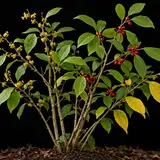
The wild species: an adaptable native shrub 6-10 feet tall with unusual maroon fruity-scented flowers, spicy-aromatic bark and wood, golden fall color, and urn-shaped seed capsules.
Variety details for Sweetshrub (Calycanthus floridus)
Rounded shrub with glossy leaves, dark maroon strappy-petaled flowers, and brown urn-shaped seed capsules.
speciesnativefragrant-flowersaromatic-barkGrows sun to shade and resists deer and pests; fragrance varies by individual, and all parts (especially seeds) are toxic - grown ornamentally, never eaten.
Athens
A distinctive selection with chartreuse-yellow (rather than maroon) flowers and an exceptionally strong, reliable fruity fragrance.
Variety details for Athens
Sweetshrub with fragrant chartreuse-yellow strappy flowers instead of the usual maroon.
cultivaryellow-flowersvery-fragrantreliable-scentPrized for guaranteeing good scent and for its unusual green-gold blooms; a top choice when fragrance and a softer flower color are wanted.
Michael Lindsey
A superior selection of the maroon-flowered type with reliably strong fragrance, especially glossy dark foliage, good golden fall color, and a somewhat more compact, refined habit.
Variety details for Michael Lindsey
Compact sweetshrub with very glossy leaves, fragrant deep-maroon flowers, and good yellow fall color.
cultivarmaroon-flowersvery-fragrantcompactA dependable, well-rounded choice for scent and garden performance.
Aphrodite / Hartlage Wine (hybrids)
'Hartlage Wine' is Calycanthus x raulstonii, a cross of this native sweetshrub with Chinese C.
Variety details for Aphrodite / Hartlage Wine (hybrids)
Vigorous shrub with large, waxy, magnolia-like deep-red flowers over glossy foliage.
hybridlarge-flowersshowyred-flowerschinensis - large wine-red flowers, lightly scented. 'Aphrodite' is a C. chinensis x C. occidentalis (western sweetshrub) hybrid with large, fragrant red flowers, so it is a relative rather than a selection of C. floridus and carries no eastern sweetshrub in it. Both are grown for dramatic bloom over a long season; treat both as toxic like the species.
Grower tips
Notes from growers, tagged with the zone they grow in. A person reads every post before it appears.
Nobody has posted about Sweetshrub yet. The first one usually saves someone a season.
Free account. Your post shows your grower name and zone, never your email.