
Add it to your home screen and it opens full screen: no browser bars, one tap away, and everything stays signed in. Free, nothing to download from an app store.
- Tap the Share button in your browser
- Scroll down and choose “Add to Home Screen”
- Open GrowSomeFood from your home screen
- Open your browser’s menu
- Choose “Add to Home screen” or “Install app”
- Open GrowSomeFood from your home screen

Sumac
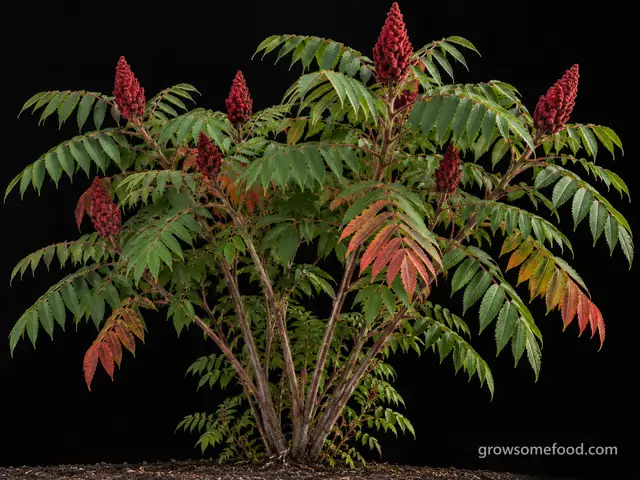
A tough, dramatic native shrub with tropical-looking leaves, upright red berry clusters you can turn into lemonade and spice, and jaw-dropping scarlet fall color - vigorous enough to naturalize a whole bank.
Safety notes IMPORTANT: the red-berried sumacs (staghorn, smooth, spice) are EDIBLE and safe - their tart red clusters make a lemonade-like drink and the spice 'sumac.' Do NOT confuse them with POISON SUMAC (Toxicodendron vernix), a wet-swamp plant with DROOPING WHITE/GREEN berries that causes a severe poison-ivy-type rash. The rule: red, upright, fuzzy clusters = edible sumac; white, drooping berries in wet ground = poison sumac, do not touch. Those with cashew/mango allergies may react.
Overview
Sumac (the red-berried native Rhus species - staghorn, smooth, and their kin) is a bold, useful, and often underappreciated native shrub or small tree. It has a striking, almost tropical look - big compound leaves and, on staghorn sumac, velvety antler-like stems - and in fall it produces some of the most brilliant scarlet and orange color of any North American plant. Its upright, fuzzy, deep-red berry clusters are both beautiful and genuinely useful: steeped in water they make a tart pink 'sumac-ade' (like lemonade), and dried and ground they yield the tangy Middle Eastern spice 'sumac' used in za'atar.
The one thing to knowIt has a striking, almost tropical look - big compound leaves and, on staghorn sumac, velvety antler-like stems - and in fall it produces some of the most brilliant scarlet and orange color of any North American plant.
Quick facts
- Sprouts in
- 40 daysRange: 20–90 days
- Soil temperature
- 72 °FRange: 65–80 °F
- Height
- 15 ftRange: 10–25 ft
- Spread
- 20 ftRange: 10–30 ft
- Cold
- Takes hard frostdamaged below -40°F
- Heat
- Struggles above 100°F
- Life cycle
- Perennial, lives about 30 years
- Save seeds
- About 120 days after plantingRange: 90–150 days
- Self-sows
- Yes, expect volunteers
- Soil
- Well-drained
- Water
- Low
- Plant spacing
- 10 ftRange: 5–20 ft
When to plant
Fall sowing is open for 20 more days. Next: spring, Mar 27 to May 8.
- Direct sow Oct 11 – Nov 8 Open now · 20 days leftAbout 2 weeks before to 2 weeks after your first frost (Oct 25 here)Sow seed in fall; the hard seed coat needs scarification (hot water or acid) plus cold stratification to germinate, so suckers/transplants are much easier.
- Transplant Mar 27 – May 8 Opens in 159 daysAbout 2 weeks before to 4 weeks after your last frost (Apr 10 here)Dig and replant rooted suckers in spring - the easiest way to propagate sumac, which practically divides itself.
- Transplant Apr 10 – May 22 Opens in 173 daysAbout at to 6 weeks after your last frost (Apr 10 here)Plant in spring into full sun and well-drained soil, with room to spread; it establishes fast and needs no rich soil or watering once going.
Frost here: last around Apr 10 (Mar 27 to Apr 24 most years), first around Oct 25. Zone averages, your own yard may run a week or two either way.
Life stages
Establish, grow, repeat
Getting established and returning each season are different parts of the story.
Stage 1 of 4 · Getting established
Year 1 - rooting in
Day 0 to 75 after transplanting
Care at this stage
-
Water to establish, then leave it alone
Water a new sumac to root in over its first weeks; once established it's extremely drought-tolerant and needs no watering - it thrives on poor, dry, rocky ground where little else will.
-
Plan for the spread from day one
Sumac spreads fast by root suckers into a colony. Decide up front: give it a bank, slope, or wild area to fill, or contain it with a mowed edge, a deep root barrier, or by growing it where you can mow the suckers - it's not for a small tidy bed.
Months are typical seasonal windows; climate, variety, and plant age can shift them.
Harvest
- Berry clusters deep red, upright, and fuzzy in late summer, tasting tart (lick a berry - it should be sour)
- Harvest before heavy rain, which washes out the tart, flavorful coating
- Cut the red berry clusters for drink or spice · every 5 days
- Then the fall color show
Picking pick as they ripen
Watch out for
3 to know. None are high-risk for Sumac. None are active in October.
Aggressive SuckeringSeverity Medium DisorderSeason: Apr–SepNew shoots emerging from the roots several feet from the parent, and a steadily widening thicket over the years.
New shoots emerging from the roots several feet from the parent, and a steadily widening thicket over the years.
Mow, dig, or pull suckers to hold the line; cutting the whole colony back tolerates the plant but doesn't stop suckering - the mowed-edge approach is most practical.
Site it where spread is welcome (banks, wild areas); contain it with a mowed edge, a deep root barrier, or by growing a less-aggressive type ('Tiger Eyes,' fragrant sumac).
Not a pest but the defining management issue: staghorn and smooth sumac spread vigorously by root suckers into broad colonies, popping up well beyond the original plant.
Confusion with Poison SumacSeverity Medium DisorderSeason: Jun–SepThe key difference - edible sumac has RED, upright, fuzzy berry clusters in dry sunny sites; poison sumac has WHITE/green, DROOPING berries and grows in wet swamps and bogs.
The key difference - edible sumac has RED, upright, fuzzy berry clusters in dry sunny sites; poison sumac has WHITE/green, DROOPING berries and grows in wet swamps and bogs.
For a poison-sumac rash, wash the skin promptly and treat it like poison ivy; a widespread rash, or one on the face, warrants a doctor. Urushiol also lingers on tools, gloves, boots, and clothing, so wash all of them separately afterwards. If you remove the plant, cut and bag it with your skin covered, and NEVER burn poison sumac or its cut wood, leaves, or roots - the smoke carries urushiol, and breathing it causes a dangerous lung reaction that needs medical care. The edible red sumac itself is harmless.
Only harvest red, upright, fuzzy berry clusters from dry sites; never touch or eat anything with white drooping berries; when in doubt, don't. If you must remove a poison sumac, cover your skin, bag the cuttings, and NEVER burn it.
Not a threat to the plant but a safety hazard to the forager: edible red sumac can be confused by beginners with the unrelated, toxic POISON sumac (Toxicodendron vernix), which causes a severe poison-ivy-type rash.
Leaf Spots & AphidsSeverity Low PestSeason: Jun–AugCosmetic leaf spots, small pouch-like galls on leaves (aphid-induced), or light aphid clusters, generally without real harm.
Cosmetic leaf spots, small pouch-like galls on leaves (aphid-induced), or light aphid clusters, generally without real harm.
None warranted; these are cosmetic on a robust plant.
None needed - sumac's vigor easily outgrows these minor issues.
Minor and largely cosmetic: occasional leaf spots, sumac leaf galls (from aphids), or mites may appear, but sumac is a tough, essentially trouble-free plant.
Good & bad neighbors
Plant nearby
-
Blazing star's purple spikes contrast sumac's bold foliage and red cones on the same dry, sunny terms, both drawing pollinators to a naturalized planting.
-
Shares sumac's lean, dry, full-sun conditions and adds monarch value; both are tough natives for a low-water, wildlife-rich bank or border edge.
-
Both are tough, sun-loving, drought-tolerant natives that light up late in the season and support pollinators and wildlife - a natural pairing for a wild bank or meadow edge.
-
Little BluestemA tough native prairie grass that shares sumac's dry, sunny, lean conditions and complements its bold form and fall color in a naturalistic dry planting.
Varieties · 4
You pick one when you add Sumac to your garden. Its days to maturity set your harvest window.
Tall suckering sumac (staghorn, smooth) 3 varieties
Staghorn Sumac (Rhus typhina)
The classic large sumac: 15-25 feet, with velvety, antler-like ('staghorn') fuzzy stems, big tropical-looking leaves, upright deep-red edible berry clusters, and jaw-dropping scarlet-orange fall color.
Variety details for Staghorn Sumac (Rhus typhina)
Open large shrub with fuzzy antler-like branches, red berry cones, and fiery fall foliage.
speciesnativevelvety-stemsedible-berriesBold and beautiful, but a vigorous sucker-spreader for large spaces.
Smooth Sumac (Rhus glabra)
The most widespread native sumac and similar to staghorn but with smooth (hairless) stems - equally tough, with edible red berry clusters and brilliant fall color.
Variety details for Smooth Sumac (Rhus glabra)
Colony-forming shrub with smooth stems, red berry cones, and scarlet fall color.
speciesnativeedible-berriesbrilliant-fallNative across nearly the entire lower 48.
Tiger Eyes (Rhus typhina 'Bailtiger')
A popular ornamental cutleaf staghorn sumac with lacy chartreuse-to-gold foliage that glows orange-red in fall, on a more compact plant that suckers less aggressively than the species - the best sumac for a smaller garden.
Variety details for Tiger Eyes (Rhus typhina 'Bailtiger')
Lacy golden dissected leaves on a compact, less-suckering shrub, blazing in fall.
cultivargold-foliageless-aggressivecutleaf
Low fragrant sumac (three-leaf) 1 variety
Fragrant / Three-leaf Sumac (Rhus aromatica)
A low (2-6 foot), non-invasive native sumac good as a tough groundcover or low shrub, with fragrant foliage, red edible berries, and good fall color - far better behaved than the tall suckering species, and space it 4-6 feet apart rather than at the species spacing above.
Variety details for Fragrant / Three-leaf Sumac (Rhus aromatica)
Low spreading shrub with three-part fragrant leaves, small red berry clusters, and red-orange fall color.
speciesnativelow-growinggroundcover'Gro-Low' is a popular selection. Know the lookalike before you handle it: its three-leaflet leaf closely resembles poison ivy, and the red-cluster rule you learned for poison sumac does not cover it. Fragrant sumac's end leaflet is stalkless (sessile) and the crushed leaves are aromatic; poison ivy's end leaflet sits on a distinct stalk, its leaves are not aromatic, and its fruit is white or tan, never red. Check the catalog's poison-ivy entry if you are not certain.
Grower tips
Notes from growers, tagged with the zone they grow in. A person reads every post before it appears.
Nobody has posted about Sumac yet. The first one usually saves someone a season.
Free account. Your post shows your grower name and zone, never your email.