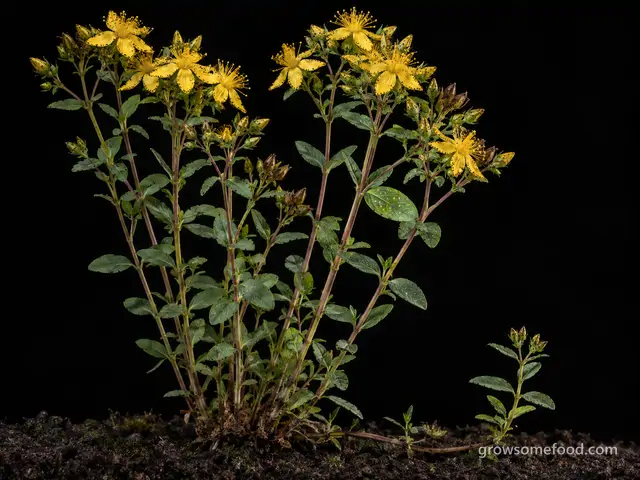
St. John's Wort

Hypericum perforatum · Hypericaceae
Herb Perennial Herb Medicinal
Introduced - native to Europe, western Asia and North Africa; naturalized in nearly every US state and genuinely invasive through the West, the northern Rockies and the Pacific Northwest
Not recommended to plant. Do not plant it. Hypericum perforatum is a listed noxious weed across much of the West: it spreads by creeping runners and long-lived seed, takes over rangeland, and photosensitises grazing livestock. The tidy garden hypericums sold as 'Hidcote' are different, well-behaved species.

Not a casual tea herb. St. John's wort switches on the liver enzyme CYP3A4 and the transporter P-glycoprotein, so the body clears many prescription drugs faster and they stop working - oral contraceptives (breakthrough bleeding, pregnancy), warfarin, transplant anti-rejection drugs, HIV antiretrovirals, some heart and cancer drugs. With SSRIs it can cause serotonin syndrome. Never take it without telling your prescriber. It also photosensitises skin, and grazing livestock severely.

Overview

Hold a leaf to the light and it is full of translucent pinholes; crush a flower bud and your fingers stain red. That plant is the biggest drug-interaction problem in herbal medicine - it makes the body clear contraceptives, blood thinners, transplant and HIV drugs faster - and a listed noxious weed across much of the West.

St. John's wort is a wiry, knee-high perennial with flat-topped clusters of bright yellow flowers that open around midsummer — traditionally around St John's Day, 24 June, which is where the name comes from. It grows on roadsides, old pasture, logged ground and rangeland from New England to the Pacific, and most people meet it either as a supplement on a pharmacy shelf or as the plant taking over a field.

The identification is two gestures. Hold a leaf up to the sky: it is peppered with translucent dots that look like pinholes — oil glands, and the reason the species is called perforatum. Then crush an unopened flower bud between your fingers: they stain purple-red. That red is hypericin, and it is behind both halves of this plant's story.

The medicine. St. John's wort is the most heavily studied herb in the world, with real trial evidence behind standardised extracts in mild to moderate depression. It is also the single biggest source of drug interactions in herbal medicine, because it switches on the liver enzyme CYP3A4 and the transporter P-glycoprotein and makes the body clear a large share of all prescription drugs faster than intended. Oral contraceptives fail. Anticoagulants stop protecting. Transplant patients reject organs. That story is set out in full under Medicine, and it is the main reason this page exists.

The weed. In the American West the same plant is Klamath weed, a listed noxious weed that spread across millions of acres of northern California and the Pacific Northwest rangeland in the first half of the twentieth century. It runs from a woody crown by short creeping runners, banks seed that stays alive in the soil for a decade or more, and photosensitises grazing animals — sheep, cattle and horses that eat it blister and peel on any unpigmented skin. Do not plant it. The neat garden shrubs sold as St John's wort, like 'Hidcote', are different species of Hypericum and are not this plant.

At a glance

Sun
Full sun · Part sun
Water
Low
Spacing
12–30 in (typ. 18)
Mature height
12–40 in (typ. 30)
Start by
Frost
Hardy
Spread
12–40 in (typ. 24)
Soil
Well-drained
Temperature
Damaged below -30°F · struggles above 100°F
Self-sows
Yes — expect volunteers

When to plant

No planting window on record for this zone.

Life stages

  1. Spring: shoots from the crown and from creeping runners Mar, Apr, May, Jun (yearly)
    • Hold a leaf up to the light - the 'perforations' settle it
      Shoots come up in a tight clump from a woody crown, plus outliers from short creeping runners. Leaves are small, stalkless, opposite, and in pairs down a two-ridged stem. Hold one up to the sky: it is peppered with translucent dots that look like pinholes, which is what perforatum means. They are oil glands, not holes. Nothing else you are likely to confuse it with has them.
    • Dig young clumps out whole while they are still clumpsevery 21 d
      A new plant can be dug. Work in moist soil, lift with a fork rather than slicing with a spade, and take the whole woody crown plus the short lateral runners spreading out from it - a crown left behind resprouts, and so does a runner with a bud on it. Check the spot every few weeks for the rest of the season and pull each resprout. On rangeland this is only realistic for small, new infestations.
    Paired stalkless leaves peppered with translucent pinhole dotsA two-ridged, wiry stem rather than a round oneShort runners pushing new shoots out beyond the clump
  2. Midsummer: yellow flowers, and the red stain Jun, Jul, Aug (yearly)
    • Crush a bud - the fingers go purple-red
      Flat-topped clusters of bright yellow five-petalled flowers open around midsummer, each with a burst of long stamens and black dots along the petal edges. Crush an unopened bud between your fingers and they stain purple-red: that is hypericin, the compound behind both the medicinal reputation and the photosensitisation of livestock. It is a definitive field test.
    • Cut it at bloom, before the capsules set
      Flowering is the deadline. A stand cut at full bloom sheds no seed that year, which is the cheapest single thing you can do to stop it spreading; it will regrow from the crown, so this is containment rather than control. If you are treating rather than cutting, systemic products work best on actively growing plants at bud to early bloom, and again on autumn regrowth. Use a product whose label lists the site you are treating and follow that label.
    Flat-topped clusters of bright yellow flowers with long stamensBlack dots along the petal marginsPurple-red stain on your fingers from a crushed budPale sunburned skin on grazing animals in the same pasture
  3. Late summer: capsules, and a seed bank that outlasts you Aug, Sep, Oct (yearly)
    • Bag the seed heads rather than shaking them loose
      Flowers give way to small three-parted capsules that dry rusty brown and split, releasing thousands of tiny seeds per plant. The seed is sticky when wet and travels on boots, tires, hooves, hay and mud, and it stays viable in the soil for a decade or more. Where you find capsules, slide a bag over the stem before you cut it, and put everything in the trash rather than the compost heap.
    • Mark the patch now - next year's work is here
      Rusty capsule heads and reddening foliage make late summer the easiest time of year to see the true extent of a stand from a distance. Walk the edges and mark them. The seed bank means a patch that looks clean after one good season is not clean, and the ground you mark now is the ground to check every spring for the next several years.
    Small three-parted capsules drying rusty brownFoliage reddening in late summerNew patches downslope, along tracks and at gateways
  4. Winter: dead stems over a living crown Jan, Feb, Nov, Dec (yearly)
    • The standing dead stems map the stand for you
      Top growth dies back to wiry reddish-brown stems that stand through winter holding their empty capsules, while the crown and its runners stay alive underground. That makes winter a good time to survey a property honestly - walk the stems, mark the outliers, and plan the spring. Nothing about a hard winter reduces the stand; the crowns shrug off zone-3 cold.
    Wiry reddish-brown stems standing with empty capsule headsOutlying stems well beyond the patch you rememberedFresh basal growth appearing under the dead stems in late winter

Watch out for

Herb-Drug Interactions (CYP3A4 & P-glycoprotein) High Disorderyear-round

St. John's wort is the textbook herb-drug interaction. It induces the liver enzyme CYP3A4 and the drug transporter P-glycoprotein, which between them handle a large share of all prescription medicines, so the body clears those medicines faster than the prescribed dose assumes and they stop working. Documented consequences include contraceptive failure with breakthrough bleeding and unplanned pregnancy, loss of anticoagulant control on warfarin, organ rejection in transplant patients on ciclosporin or tacrolimus, and loss of viral suppression on HIV antiretrovirals. Digoxin, some statins and several cancer drugs are also affected. Separately, combined with SSRIs, SNRIs, triptans or tramadol it can contribute to serotonin syndrome. The effect builds over one to two weeks and fades over a similar period, so stopping matters as much as starting.

Watch for: A prescription that suddenly seems less effective after starting a supplement - breakthrough bleeding on a contraceptive, an INR that will not settle, rising viral load, transplant rejection markers. Agitation, sweating, tremor, fast heartbeat or confusion after combining it with an antidepressant, a triptan or tramadol, which needs urgent medical attention. Increased sunburn on fair skin at higher doses.

Prevent: Tell your prescriber and your pharmacist before you take it and before you stop it, and treat it as a drug rather than a tea. Do not add it on top of a prescribed antidepressant, and do not swap one for the other yourself. Anyone on a contraceptive, an anticoagulant, a transplant medicine, an HIV medicine, an antiarrhythmic or cancer treatment should treat this as a conversation to have before the first dose. Home-made preparations have no dose control at all.

Treat: This is a medical matter, not a garden one. Do not stop a prescription because of an interaction - contact the prescriber, who can adjust monitoring or dosing while the enzyme effect washes out over one to two weeks. Suspected serotonin syndrome is an emergency: seek immediate care. Nothing on this page substitutes for a clinician's advice.

Photosensitisation of Grazing Livestock High DisorderApr, May, Jun, Jul, Aug, Sep

The hypericin that stains your fingers red when you crush a bud is a photodynamic pigment. Animals that graze the plant absorb it, and it reacts with sunlight in the skin, so any area with little pigment or thin cover burns severely from the inside out. Sheep, cattle, goats and horses are all affected, and pale-skinned or white-faced animals suffer most: white faces, pink muzzles, ears, eyelids and udders blister, weep, swell and peel. Affected stock become restless, seek shade, go off feed and lose condition, and severe cases can be fatal. This is a real economic reason the plant was fought so hard on western rangeland - and hay cut from an infested field carries the compound with it.

Watch for: Reddened, swollen, weeping or peeling skin on white faces, pink muzzles, ears, eyelids and udders while pigmented areas stay normal. Animals crowding into shade, restless or rubbing, off feed, dropping condition and milk yield. Damage showing up in animals fed hay from an infested field, with no plant visible in their pasture.

Prevent: Keep the plant out of pasture and hay ground: cut stands at full bloom so they cannot seed, treat or remove infestations, and keep the sward dense, since the plant colonises overgrazed and bare ground. Do not turn pale-skinned stock onto a heavily infested paddock, particularly in bright weather when the young growth is most palatable. Check hay ground before cutting.

Treat: Move affected animals out of the sun and off the infested ground immediately, and call a vet - severe photosensitisation is painful, prone to infection, and can kill. Provide shade and clean water, and keep animals off the stand until it has been controlled. Do not feed hay from an infested field to pale-skinned stock.

Rangeland Invasion & a Decade-Long Seed Bank High DisorderMar, Apr, May, Jun, Jul, Aug, Sep, Oct

The reason it is a listed noxious weed across much of the West. It runs two ways at once: a woody crown pushes out short lateral runners so a single plant thickens into a patch and regrows from any crown or runner fragment, while a mature plant sets thousands of tiny seeds that are sticky when wet and stay viable in the soil for ten years or more. It colonises bare, disturbed, logged and overgrazed ground, displaces forage grasses, and at its historic peak covered millions of acres of northern California and Pacific Northwest rangeland. Because the seed bank outlasts almost any control programme, a patch that looks clean after one good season is not clean.

Watch for: A clump thickening outward with new shoots a few inches beyond the old crown. New patches appearing at gateways, along tracks, downslope and wherever soil or hay has been moved. Rusty capsule heads and reddening foliage in late summer, which is the easiest time to see the true extent of a stand. Seedlings reappearing on ground cleared several seasons ago.

Prevent: Do not plant it, and do not move it. Clean boots, tires, mower decks and machinery before leaving an infested area, and do not move soil or hay from infested to clean ground. Keep pasture dense and avoid overgrazing, because it establishes on bare disturbed soil and struggles against thick competition. Cut stands at full bloom so they cannot seed while you plan the longer job.

Treat: Dig small clumps whole in moist soil, taking the woody crown and the lateral runners, then remove every resprout for the rest of the season. On larger infestations, systemic herbicide timed to bud and early bloom, or to autumn regrowth, is the practical tool - use a product whose label lists the site and follow that label, including grazing and haying restrictions. Where the introduced Chrysolina leaf beetles are active, leave them to work. Reseed cleared ground with competitive grasses, and plan on checking the same ground for several years.

Klamath Weed Beetles (Chrysolina) Medium PestApr, May, Jun, Jul, Aug

A pest of the plant and a friend to everyone else. Chrysolina quadrigemina and C. hyperici are small metallic blue-green to bronze leaf beetles imported from Europe and released in northern California in 1945-46 as biological control for Klamath weed. Adults and larvae feed on the foliage and growing tips, defoliating plants and exhausting the crown over repeated seasons. The release collapsed the western infestation and is regarded as the first major biological control success against a weed in North America; the beetles are now established through much of the West and hold many stands at a fraction of their historic size. They feed only on Hypericum and are harmless to other plants.

Watch for: Small shiny metallic beetles on the shoots in spring, and grey-green larvae on the growing tips. Foliage skeletonised, shoots stripped and stands thinning out year on year. Patches that flower poorly or not at all where beetles have been working through the spring.

Prevent: No prevention is wanted on the weed itself. If you grow one of the ornamental hypericums, the beetles can occasionally move onto it in the West; keep valued shrubs away from a heavy weed stand and check the growing tips in spring.

Treat: Do not spray a weed stand the beetles are working on - you would be removing the most effective control available and it costs you nothing. On an ornamental hypericum, hand-picking is usually enough; a targeted insecticide is rarely justified for cosmetic damage.

Varieties · 3

Common St. John's Wort (Hypericum perforatum) - do not plant

Knee-high wiry clump topped with flat clusters of bright yellow flowers over small paired leaves that show pinhole dots against the light.

speciesintroducedinvasivenoxious-weeddo-not-plantmedicinalphotosensitiser

The plant this entry is about, and the one in the supplements: a 1 to 3 foot herbaceous perennial with wiry two-ridged stems, small paired stalkless leaves peppered with translucent oil glands, flat-topped clusters of yellow flowers with black-dotted petal margins, and buds that stain purple-red when crushed. Spreads from a woody crown by short runners and by seed that stays viable in the ground for a decade or more. A listed noxious weed across much of the West, and a severe photosensitiser of grazing livestock. Identify it and remove it; do not plant it.

'Hidcote' and the garden hypericums - NOT this plant

Woody shrubs with large saucer-shaped golden flowers, larger and showier than the small starry blooms of the weedy species.

relatedornamentalshrubcontrastdo-not-treat

The neat landscape shrubs sold as St John's wort - 'Hidcote', H. x moserianum, and the berried florist types - are different species with large saucer-shaped yellow flowers on woody frames. They are clump-forming, not invasive, and nothing on this page about noxious weed listings or livestock applies to them; they are also not the medicinal plant. One relative does deserve a caution: H. calycinum, sold as Aaron's beard or creeping St John's wort, is a low evergreen groundcover that runs hard by rhizome and is difficult to remove once established.

Shrubby St. John's Wort (Hypericum prolificum) - the native alternative

Rounded 2 to 4 foot shrub with peeling bark, narrow blue-green leaves and dense clusters of golden stamen-filled flowers.

relatednativeshrubwell-behavedpollinatorplant-this-instead

If you want the yellow midsummer flowers without the weed, this is the plant to grow. A tough, well-behaved native shrub of the eastern and central states, 2 to 4 feet, with narrow blue-green leaves, peeling bark and dense golden flowers full of stamens that bees work hard from June into August. It stays where it is put, tolerates poor soil and drought, and is not invasive anywhere. Several other native hypericums, including St Andrew's cross and the shrubby H. kalmianum of the Great Lakes, fill the same role regionally.

Grow

Recognition and movement rather than planting: paired stalkless leaves full of translucent dots, a two-ridged stem, yellow flowers with black-dotted petal edges and red-staining buds - spreading by short crown runners and by sticky seed that rides on boots, tires, hooves and hay and stays viable for a decade.

You are not going to plant this, so what matters is knowing it and knowing how it moves.

The plant. An upright perennial, usually 1 to 3 feet, growing in a tight clump from a woody crown. The stems are wiry, often reddish, and carry two raised ridges running down opposite sides — roll one between your fingers and you can feel that it is not round. Leaves are small, oval, stalkless, and set in opposite pairs, and every one of them is dotted with translucent oil glands that show as pinpricks against the light. There are usually black dots along the leaf and petal margins too.

The flowers are the showy part: flat-topped clusters of bright yellow five-petalled blooms about three-quarters of an inch across, each with a spray of long stamens, opening from June into August. Crushed buds stain purple-red. Small three-parted capsules follow and dry rusty brown, and the plant reddens as it goes over.

How it spreads is both ends at once. Below ground the woody crown pushes out short lateral runners that send up new shoots a few inches away, so a single plant thickens into a patch and any crown or runner fragment left in the ground regrows. Above ground a mature plant sets thousands of tiny seeds, sticky when wet, that travel on boot treads, tires, mower decks, hooves, dog coats, hay and moving soil — and then wait, staying viable in the seed bank for ten years or more. That combination is why one clean-looking season means nothing.

Lookalikes. The important distinction is with the garden hypericums. Shrubby St John's wort (Hypericum prolificum) is a well-behaved native eastern shrub, and the popular landscape selections like 'Hidcote' and H. x moserianum are woody, clump-forming and not invasive; all of them are shrubs with larger flowers, and none has the wiry two-ridged herbaceous stem of H. perforatum. Hypericum calycinum, sold as Aaron's beard or creeping St John's wort, is a different problem — a low evergreen groundcover that spreads hard by rhizome and is best kept out of a small garden for that reason alone. Among the native herbaceous hypericums, the tell remains the same: pinhole oil glands on the leaves, ridged stem, red-staining bud.

Care

Control, not care. Cut at full bloom so it cannot seed, dig small clumps out whole including the crown and runners, and expect to keep checking the ground for years because the seed bank outlives the plants. Grazing sheep on it is the one thing never to do.

Everything here is control. The plant has two engines — a woody crown that runs sideways and a seed bank that lasts a decade — and a method has to answer both.

Cutting is the cheapest useful action. A stand cut at full bloom sheds no seed that year. It will regrow from the crown, so this is containment rather than a cure, but it stops the problem getting bigger while you plan. Cutting after the capsules brown does nothing except scatter them.

Digging works on a new plant or a small clump. Moist soil, a fork rather than a spade, lift the whole woody crown and follow the short runners out sideways — a crown fragment or a runner bud left behind simply resprouts. Then keep the appointment: check every two or three weeks through the season and pull each resprout, because it is the repeated removal that empties the crown. Do not rototill a patch, and do not compost what you pull.

Herbicide is what large infestations actually get treated with, and timing decides the result: systemic products work on actively growing plants from bud to early bloom, and again on autumn regrowth, when reserves are moving down into the crown. Use a product whose label lists the site you are treating — pasture, rangeland, non-crop area, ornamental bed — and follow that label, which is legally binding. Pasture products often carry grazing and haying restrictions. Expect several years of follow-up.

Biological control is the one genuinely famous success story here. The leaf beetles Chrysolina quadrigemina and C. hyperici, released in northern California in the 1940s, collapsed Klamath weed across millions of acres and are now established through much of the West; in many places they hold the plant at a fraction of its former abundance without anyone doing anything. If your stand is being skeletonised by small metallic beetles, that is what is happening, and it is worth leaving alone.

Then close the ground. St. John's wort colonises bare, disturbed, overgrazed ground and struggles against dense established vegetation. Reseeding a cleared area with competitive grasses and managing grazing so the sward stays thick does more long-term work than any single treatment. And clean your boots, tires and mower before you leave an infested area — that is how it makes the jumps no amount of digging can undo.

Traditional & historical uses

The most-studied herb in the world and the biggest drug-interaction problem in herbal medicine at the same time. It induces CYP3A4 and P-glycoprotein, cutting the effect of contraceptives, anticoagulants, transplant drugs and HIV antiretrovirals, and it can push serotonergic drugs into serotonin syndrome. Educational information, not medical advice.

This section records how people have traditionally used this plant, and what is known about the risks. It is history and general information — not medical advice, and not a recommendation to treat anything. Plants are not dosed like medicines, some interact with prescriptions, and some are harmful in ways that are not obvious. Talk to a clinician before using any plant medicinally.

Two things about St. John's wort are true at once, and the second is the reason this page exists.

What the research actually shows. Standardised extracts of the flowering tops have been through dozens of randomised trials for depression — more than any other herbal preparation has ever received. Systematic reviews of that work have generally found them better than placebo and broadly comparable to standard antidepressants for mild to moderate depression, with fewer reported side effects; in Germany it has been a licensed medicine for decades. The picture is much weaker for severe depression, trial quality and extract strength vary a great deal, and in the United States the product is sold as an unregulated supplement, so what is in the bottle varies between brands and between batches. None of that is a recommendation. Depression is something to take to a clinician, and this is a plant with consequences.

The interactions are the headline. St. John's wort switches on the liver enzyme CYP3A4 and the drug transporter P-glycoprotein. Between them, those two handle a large share of all prescription medicines, and turning them up means the body clears those medicines faster than the dose assumes. The drug does not become dangerous; it stops working. The documented consequences include failed oral contraceptives, with breakthrough bleeding and unplanned pregnancies; loss of control on warfarin and other anticoagulants; organ rejection in transplant patients taking ciclosporin or tacrolimus; loss of viral suppression on HIV antiretrovirals, which risks resistance; and reduced levels of digoxin, some statins, some cancer drugs, and many others. The effect builds over one to two weeks and takes a similar time to wear off after stopping, so stopping it abruptly can send drug levels the other way.

The other interaction is serotonergic. Combined with SSRIs, SNRIs, triptans, tramadol or other serotonergic drugs, St. John's wort can contribute to serotonin syndrome — agitation, sweating, tremor, fast heartbeat, and in serious cases a medical emergency. Never add it on top of a prescribed antidepressant, and never swap one for the other without your prescriber managing the change.

Its own side effects are mostly mild — stomach upset, restlessness, sleep disturbance — with one exception worth knowing: photosensitivity. Hypericin makes skin more reactive to sunlight, and while serious cases in people are uncommon at ordinary doses, fair-skinned users on higher doses do burn more easily. In grazing animals the same compound causes severe, sometimes fatal photosensitisation, which is covered under this plant's threats.

The practical rule is short: tell your prescriber and your pharmacist before you take St. John's wort and before you stop it, and treat it as a drug rather than as a harmless tea. This is educational information, not medical advice.

History

Named for St John's Day and hung over doorways against evil for a thousand years, gathered for the blood-red oil, then shipped to America - where it became Klamath weed, took millions of acres of western range, and was beaten back by imported leaf beetles in one of the great biological-control successes.

The name is medieval and literal. The plant blooms around 24 June, St John's Day, and the red juice from its crushed buds was read as the blood of John the Baptist; wort is simply the Old English word for a useful plant. It was gathered at midsummer, hung over doors and windows to turn away evil, and steeped in oil to make the deep red infused oil still sold today for bruises and burns. Classical writers knew it, medieval herbals list it, and it carried a reputation for lifting melancholy long before anyone could say why.

It came to North America with European settlers, and in the West it turned into something else entirely. Around Klamath County, Oregon and the northern California ranges it escaped into overgrazed, logged and disturbed country and became Klamath weed, spreading across millions of acres of rangeland by the 1940s, driving down grazing capacity and land values and blistering the livestock that ate it. The response became a landmark: entomologists imported the European leaf beetles Chrysolina quadrigemina and C. hyperici, released them in northern California in 1945-46, and watched the infestation collapse. It was the first great biological control success against a weed in North America, and it is why a plant that once dominated whole valleys now persists there as scattered patches. A monument to the beetle stands in Humboldt County.

The modern chapter is pharmaceutical. German research from the 1980s onward standardised extracts of the flowering tops and put them through clinical trials, and by the 1990s St. John's wort had become one of the best-selling supplements in the world. Then, in 2000, published reports of transplant patients rejecting organs and of HIV drug levels collapsing revealed the enzyme induction behind it, and regulators worldwide issued warnings. In a single decade the plant went from folk remedy to blockbuster supplement to the standard textbook example of a herb-drug interaction — which is, in the end, the most useful thing a gardener can know about it.

Troubleshooting

How to be sure it is this plant and not a garden hypericum, why a cleared patch keeps coming back, what the white sunburn on your pale-faced sheep means, whether the beetles eating it are a problem, and what to do if you are taking it and about to start a prescription.

“Is this it, or a garden St John's wort?” Check the stem and the leaf. Hypericum perforatum is herbaceous, with a wiry two-ridged stem and small paired leaves peppered with translucent pinhole dots. The landscape plants — 'Hidcote', H. x moserianum, the native shrubby H. prolificum — are woody shrubs with bigger flowers and no ridged herbaceous stem. When in doubt, crush a bud: the red stain is the giveaway.

“I cleared it and it came back.” Expected, from either engine. Either a piece of the woody crown or a runner bud stayed in the ground, or the seed bank germinated — and that seed stays viable for ten years or more. Plan on several seasons of checking the same ground rather than a single push.

“My sheep have blistered, peeling faces.” That is classic photosensitisation, and it happens on unpigmented skin: white faces, pink noses, bare ears and udders. Get the animals off the stand and out of direct sun, and call a vet — severe cases are painful and can be fatal. Pale-skinned animals are at the highest risk, and hay cut from an infested field carries the problem indoors.

“Small metallic beetles are eating it.” Leave them. Those are almost certainly the imported Chrysolina biocontrol beetles, and they are the reason the West is not still buried in this plant. Do not spray a stand that beetles are working on.

“I take it, and my doctor just prescribed something.” Say so, before the first dose, and say so again if you plan to stop taking it — the enzyme effect takes one to two weeks to build and a similar time to fade, so both starting and stopping shift your drug levels. The same goes for the pharmacist. If you are on a contraceptive, an anticoagulant, a transplant drug, an HIV medication or an antidepressant, treat this as urgent rather than routine.

“Can I just make the red oil from what is growing here?” The tradition is real, and this catalog is still not going to walk you through it: the plant is a noxious weed you should be removing rather than cultivating, home preparations have no dose control, and the interactions are the same whatever form it is in. If you want the oil, buy it, and tell your prescriber you use it.

“Is it illegal to have?” It is not federally listed, but it is a state-listed noxious weed across much of the West — including California, Colorado, Idaho, Montana, Nevada, Oregon and Washington — where planting, selling or moving it is restricted and control may be required. Listings change; check your own state's current noxious weed list before assuming either way.

Growing across climates

Hardy roughly zones 3 to 9 and recorded in nearly every state, but it dominates where summers are dry and the ground is disturbed or overgrazed: the Pacific Northwest, northern California, the northern Rockies and the northern Plains. Humid Southeast heat and dense competition hold it back.

St. John's wort is hardy over a very wide range — roughly zones 3 to 9 — and has been recorded in nearly every state and Canadian province. Where it becomes a problem is a narrower map, and it tracks disturbance and dry summers rather than cold.

Pacific Northwest, northern California and the northern Rockies: its American heartland, and the ground where it earned the name Klamath weed. Dry summers, logged and grazed country and abundant open disturbed soil suit it perfectly, and it is a listed noxious weed through most of this region. Biological control keeps many stands well below their historic peaks, but the plant is everywhere.

Northern Plains and Great Lakes: common on roadsides, old fields and pasture, locally dense on light soils and thin ground, and listed in several states.

Northeast and mid-Atlantic: widespread and familiar on roadsides and old pasture, but usually a component of the vegetation rather than a takeover — wetter summers and heavy competition from other perennials keep it in check.

Southeast: present, least aggressive. Hot humid summers, dense warm-season growth and heavy disease pressure hold it back, and it rarely dominates.

Arid Southwest: largely limited to irrigated ground, mountain meadows and higher elevations; it needs more moisture than open desert offers.

What favours it everywhere is bare, disturbed, overgrazed and light-textured ground with full sun. What limits it is shade, dense established vegetation and repeated cultivation. Winter is no help at all — the crown is hardy well past anything the temperate US produces.

No grower tips for St. John's Wort yet — yours could be the first.

Sign in to share what works in your garden.

Connection interrupted

Reconnecting to GrowSomeFood

Keep this page open. We are trying to restore your garden session.

Attempt of . Retrying automatically.

Still offline

Could not reconnect

Your phone may have switched networks or gone to sleep. Try again when the signal is steady.

Session expired

Reload to continue

This garden session is no longer available on the server. Reloading will start a fresh session.