
Add it to your home screen and it opens full screen: no browser bars, one tap away, and everything stays signed in. Free, nothing to download from an app store.
- Tap the Share button in your browser
- Scroll down and choose “Add to Home Screen”
- Open GrowSomeFood from your home screen
- Open your browser’s menu
- Choose “Add to Home screen” or “Install app”
- Open GrowSomeFood from your home screen

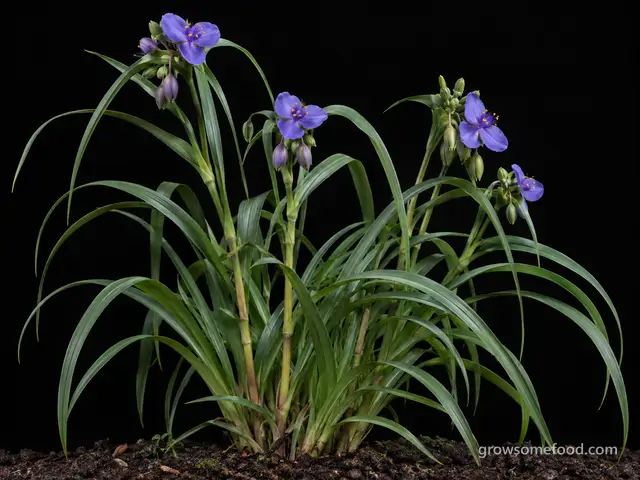
Spiderwort
A tough, easygoing native with clusters of three-petaled blue-purple flowers that each last a single morning - long-blooming, shade-tolerant, edible-flowered, and happy in almost any moist soil.
Safety notes Flowers and tender young shoots are edible and non-toxic to people. Before eating spring shoots, confirm the ID: tear a leaf or stem and look for fine sticky 'spider-web' threads across the break, and a closed sheath clasping the stem. Young iris (flat, fanned, no mucilage, toxic) and daylily look alike before bloom. Sap can redden sensitive skin; eat greens in moderation. These natives are pet-safe; the 'wandering dude' houseplant Tradescantia is a different plant that irritates cats and dogs.
Overview
Spiderwort (Tradescantia virginiana and the taller T. ohiensis) is one of the most obliging native perennials there is. From grassy, arching clumps of strap-like leaves rise weeks of jewel-toned three-petaled flowers in blue, violet, purple, magenta, or white, each bloom open for just a single morning before it dissolves to a jelly-like drop - the source of the folk name 'widow's tears.' Fresh flowers keep opening from the coiled buds for a month or more, so the show carries on.
Quick facts
- Sprouts in
- 20 daysRange: 10–40 days
- Soil temperature
- 68 °FRange: 60–75 °F
- Start indoors
- 6 weeks before transplantRange: 5–8 weeks
- Height
- 18 inRange: 12–36 in
- Spread
- 18 inRange: 12–24 in
- Cold
- Takes hard frostdamaged below -30°F
- Heat
- Struggles above 95°F
- Life cycle
- Perennial, lives about 8 years
- Save seeds
- About 90 days after plantingRange: 70–120 days
- Self-sows
- Yes, expect volunteers
- Soil
- Consistently moist
- Water
- Medium
- Plant spacing
- 18 inRange: 12–24 in
When to plant
Fall sowing is open for 20 more days. Next: spring, Mar 27 to May 22.
- Direct sow Oct 11 – Nov 8 Open now · 20 days leftAbout 2 weeks before to 2 weeks after your first frost (Oct 25 here)Fall-sow seed outdoors so winter cold stratifies it; seedlings appear in spring and reach blooming size the following year. It also self-sows readily on its own.
- Transplant Mar 27 – May 22 Opens in 159 daysAbout 2 weeks before to 6 weeks after your last frost (Apr 10 here)Set out transplants or divisions in spring into moist, humusy soil in sun to part shade; they establish fast and usually bloom the first year.
- Transplant Aug 30 – Oct 4 Opens in 315 daysAbout 8 weeks before to 3 weeks before your first frost (Oct 25 here)Divide and replant established clumps in early fall so they root before winter; fall is a good time to lift and split crowded spiderwort.
Frost here: last around Apr 10 (Mar 27 to Apr 24 most years), first around Oct 25. Zone averages, your own yard may run a week or two either way.
Life stages
Establish, grow, repeat
Getting established and returning each season are different parts of the story.
Stage 1 of 4 · Getting established
Rooting in
Day 0 to 50 after transplanting
Care at this stage
-
Keep evenly moist to establish
Spiderwort likes moist, humusy soil in sun to part shade. Water a new plant to root it in; it's tough and adaptable once going, and forms a grassy clump that spreads slowly and self-sows.
-
Mulch to hold moisture
A light mulch keeps the roots cool and moist, which helps spiderwort keep flowering into summer rather than going dormant early in dry heat.
Months are typical seasonal windows; climate, variety, and plant age can shift them.
Harvest
- Three-petaled blue-purple flowers fully open in the morning (for eating or garnish)
- Tender young leaves and stem tips in spring for a mild cooked or salad green
- Pick flowers, and young leaves/stems to eat · every 5 days
- Enjoy the morning pollinators
Picking pick as they ripen
Watch out for
3 to know. None are high-risk for Spiderwort. None are active in October.
Slugs & SnailsSeverity Low PestSeason: Apr–JunIrregular ragged holes chewed out of the middle of leaves and along the edges - not the clean-edged cuts a caterpillar leaves.
Usually cosmetic on an established clump, which outgrows light grazing.
Irregular ragged holes chewed out of the middle of leaves and along the edges - not the clean-edged cuts a caterpillar leaves. Seedlings that vanish overnight, or that are cut off at soil level with nothing left behind. Silvery dried slime trails across leaves, soil, pots, and paving in the morning: this is the giveaway that tells you it was mollusks rather than an insect. Chewed pits in ripe fruit, especially where it rests on the ground. Damage that shows up on the lowest, dampest leaves first and gets worse after rain or evening watering. Turn over a board, an upturned pot, or a clump of dense mulch during the day and look for the animals themselves sheltering in the cool underneath.
Hand-picking works and costs nothing: go out an hour after dark with a headlamp, drop what you find into soapy water, and repeat nightly for a week or two - persistence is what wins, not any single product. Shallow beer traps sunk to soil level catch them too, but need emptying and refilling daily to be worth anything. Iron-phosphate bait is the standard control and is far lower-risk around pets and wildlife than the old metaldehyde products, but it is not harmless: many formulations include EDTA, and a dog that eats a quantity of pellets can develop iron toxicosis. Scatter it thinly per the label, never in piles, and keep dogs off a baited bed. Clear fallen foliage and debris in autumn, where the eggs are laid. In a wet climate this is a population you manage each season rather than one you eradicate - and on most established plants light grazing is cosmetic and needs nothing at all.
Take away the daytime shelter first: lift boards and upturned pots, clear piles of debris, keep dense mulch pulled back from crowns and stems, and give crowded plantings enough airflow to dry out. Water in the morning rather than the evening so the surface is dry by the time they come out. Copper tape around containers and raised beds gives them a shock they will not cross, and it is the one barrier that reliably works. Get plants past the vulnerable stage quickly - start seedlings in pots and set them out at a decent size rather than direct-sowing into a cold wet bed, since most plants stop being worth defending once the leaves toughen. Leave the ground beetles, frogs, toads, and ground-feeding birds alone, because they eat mollusks all night for free and broad-spectrum slug pellets kill them too. Where thick-leaved or resistant varieties exist for what you are growing, they take far less damage.
Slugs and snails are nocturnal mollusks that rasp ragged holes in soft leaves, shear off seedlings at ground level, and chew into ripe fruit that touches the soil. They feed at night and in the early morning and spend the day hidden under boards, pots, dense mulch, leaf litter, and low foliage, becoming active in exactly the cool, damp, shaded conditions that suit young plants. Damage is heaviest in wet spells and on tender spring growth: a single wet week can erase a row of seedlings while an established, tough-leaved plant of the same species is barely marked. They lay clusters of small pearly eggs in damp soil and under debris, so a garden with plenty of cover carries a resident population year after year rather than being invaded from outside.
AphidsSeverity Low PestSeason: May–JulDense clusters of tiny insects packed onto shoot tips, flower buds, and the undersides of young leaves.
The midsummer cut-back that refreshes the clump also removes any aphid colony along with it.
Dense clusters of tiny insects packed onto shoot tips, flower buds, and the undersides of young leaves. Curled, cupped, or distorted new growth that never opens properly. A sticky shine on the leaves - and on whatever sits under the plant - that later goes black with sooty mold. Tiny white cast skins left behind where a colony has been feeding. Ants running steadily up and down the stems, which is often the first thing you notice. Mottled, streaked, or misshapen leaves that do not grow out can mean a virus the aphids brought with them rather than the feeding itself.
Knock the colonies off with a hard jet of water and repeat every few days - on most plants that alone ends it. Pinch out or prune off the worst-infested tips rather than treating the whole plant. If colonies keep rebuilding, spray insecticidal soap or horticultural oil directly onto the insects, covering leaf undersides, and repeat weekly until they are gone; treat early or late in the day, and never spray a wilted or heat-stressed plant. Avoid broad-spectrum insecticides - they kill the ladybugs, lacewings, and parasitic wasps that were about to solve the problem for you, and aphid numbers usually come back worse afterward. Anything you spray must be labeled for the plant you are treating; follow that label and observe its pre-harvest interval. On anything you eat, wash leaves, heads, and buds well before use, since aphids hide down in crowns, folds, and tight growth.
Go easy on nitrogen: the soft, lush growth that heavy feeding produces is exactly what aphids breed on. Check new growth once a week through spring and early summer so you catch colonies while they are still small, and rub the first few out with your fingers. Leave flowering plants nearby and skip broad-spectrum sprays - ladybugs, lacewings, hoverflies, and parasitic wasps do most of this work for free, and they only stay if there is something for them to eat. Keep ants off the plant where you can, since they protect aphids from those predators. Water steadily so plants are not stressed, and check any new plant over before you bring it home or move it indoors, since aphids usually arrive on something else.
Aphids are small soft-bodied sap-suckers - green, black, gray, pink, or waxy white, and mostly wingless - that gather in dense colonies on the tenderest new growth: shoot tips, buds, and the undersides of young leaves. They breed extremely fast in mild weather, so a few can become hundreds inside a week. Their feeding curls and distorts soft growth, and the sticky honeydew they excrete coats everything below and turns black with sooty mold. Ants often farm and defend the colonies for that honeydew. A few aphids are normal on almost any plant and a healthy plant shrugs them off; only dense, persistent colonies do real damage, and some aphids also spread plant viruses as they feed.
Spider MitesSeverity Low PestSeason: Jun–AugFine pale stippling or speckling across the upper leaf surface, as though the color had been sandblasted out of it, and later a dull bronze or rusty cast over the whole leaf.
They flare in hot dry spells, mostly on drought-stressed plants. Cutting the clump back hard - which spiderwort needs in midsummer anyway - resets it to clean growth.
Fine pale stippling or speckling across the upper leaf surface, as though the color had been sandblasted out of it, and later a dull bronze or rusty cast over the whole leaf. Delicate webbing across leaf joints, shoot tips, and undersides - that comes with a heavy infestation and means you caught it late. Leaves that dry, curl, and drop early while the plant looks thirsty no matter how much you water it. Hold a leaf over a sheet of white paper and tap it: the specks that fall and then start walking are mites. With a hand lens, look on the undersides for the mites themselves, pale or reddish, and their round translucent eggs. Damage that shows up first on the hottest, dustiest, most sheltered side of a plant, or on a pot sitting near a radiator indoors.
Start with water. A strong jet aimed at the leaf undersides, repeated every few days for a couple of weeks, knocks populations down and breaks the cycle - on many plants that alone ends it. On anything that regrows quickly, shearing back badly infested growth resets the plant to clean foliage. If it keeps building, spray insecticidal soap or horticultural oil directly onto the undersides where the mites actually live, and repeat every five to seven days for three rounds: contact sprays do not kill the eggs, so a single application always fails. Anything you spray must be labeled for the plant you are treating - follow the label and observe its pre-harvest interval on anything you eat. Predatory mites are an effective release in a greenhouse or on an indoor plant. Above all, correct the heat, dust, and drought stress that caused it, or the mites simply come back.
Do not let plants get drought-stressed - that is the single strongest trigger, and a plant watered steadily through heat is far less likely to have a mite problem at all. Hose the foliage down, undersides included, during hot dry spells: it knocks mites off, washes away the dust they thrive in, and raises the humidity around the plant for a while. Indoors and under cover, keep the air from going hot, dry, and stagnant, wipe or rinse the leaves occasionally, and keep pots away from radiators and heating vents. Inspect any plant carefully before you bring it indoors for winter or set it among others, since mites almost always arrive on something else. Avoid broad-spectrum insecticides: they wipe out the predatory mites, lacewings, and lady beetles that do most of this work for you, and reliably leave you with a worse outbreak than you started with.
Spider mites are not insects but tiny sap-feeding arachnids, smaller than a grain of salt, and you almost always notice the damage before you notice them. They live on the undersides of leaves and drain the cells one at a time, which is why the leaf goes finely stippled with pale dots before it bronzes and dries. They breed explosively in hot, dry, dusty, still air - a generation can pass in a week at high temperature - so a barely visible population becomes a webbed, bronzed plant within a fortnight. Drought-stressed plants and plants wintered indoors in dry heated air are the classic hosts. Broad-spectrum insecticides make matters worse rather than better, because they kill the predatory mites and lady beetles that normally hold mites in check.
Good & bad neighbors
Plant nearby
-
A natural pairing for moist, part-shaded ground - spiderwort's early blue flowers give way to cardinal flower's scarlet late-summer spikes, extending the season for pollinators in the same damp bed.
-
Both are adaptable native part-shade perennials with overlapping late-spring bloom; columbine's airy spurred flowers above spiderwort's grassy clumps make a pretty, pollinator-friendly woodland-edge pairing.
-
Native ferns and shade wildflowersFerns, foamflower, and other shade natives share spiderwort's moist, part-shaded conditions and hide its midsummer cut-back gap, weaving together into a soft woodland planting.
-
Two easy native part-shade plants that share moist, humusy soil; violet's low spring carpet beneath spiderwort's taller clumps makes a low-care, edible-flowered native tapestry.
- Traditional pairings, thin evidence
-
In a sunnier spot, coreopsis's gold daisies contrast spiderwort's blue-purple flowers, both long-blooming natives that draw pollinators; give spiderwort a touch more moisture than lean-loving coreopsis.
Varieties · 6
You pick one when you add Spiderwort to your garden. Its days to maturity set your harvest window.
Virginia Spiderwort (Tradescantia virginiana) 1 variety
Virginia Spiderwort (Tradescantia virginiana)
The classic eastern native species: grassy clumps 12-24 inches tall topped by weeks of three-petaled blue to violet-purple flowers, each open for a single morning.
Variety details for Virginia Spiderwort (Tradescantia virginiana)
Arching strap-like leaves with clusters of blue-purple three-petaled flowers on branching stems.
speciesnativeblue-purpleclumpingTough, shade-tolerant, edible-flowered, and the parent of most garden hybrids.
Ohio Spiderwort (Tradescantia ohiensis) 1 variety
Ohio Spiderwort (Tradescantia ohiensis)
A taller (to 3 feet), more upright prairie species with distinctly waxy blue-green foliage and clear blue to violet flowers.
Variety details for Ohio Spiderwort (Tradescantia ohiensis)
Tall, waxy blue-green grassy stems topped with clusters of clear blue three-petaled flowers.
speciesnativebluewaxy-foliageThe most drought- and sun-tolerant spiderwort and the hardiest of the group: reliable to roughly -40F and zone 3, a full zone below the -30F figure shown in this page's at-a-glance, which is set by the commoner T. virginiana. A standout for meadows and prairie plantings - give it full sun and dry, lean ground rather than the moist part shade the rest of this guide assumes.
Garden Hybrids (Andersoniana Group) 4 varieties
Sweet Kate / Blue and Gold
A striking hybrid (Andersoniana Group) pairing electric golden-chartreuse foliage with deep blue flowers - a vivid, popular selection for lighting up part-shade.
Variety details for Sweet Kate / Blue and Gold
Bright chartreuse-gold grassy foliage contrasting with rich cobalt-blue flowers.
hybridchartreuse-foliageblue-flowerscompactBest foliage color in some shade, as harsh sun can scorch the bright leaves.
Concord Grape
A refined hybrid with rich grape-purple flowers over cool blue-green foliage on a tidy, well-behaved clump - a garden favorite for its clean color combination and less floppy habit than the species.
Variety details for Concord Grape
Deep purple flowers set against blue-green strappy leaves on a neat mound.
hybridpurpleblue-green-foliagewell-behavedZwanenburg Blue
An old, reliable hybrid with unusually large, deep blue-violet flowers on vigorous plants - one of the showiest blues and a long-blooming, dependable garden performer.
Variety details for Zwanenburg Blue
Large, deep blue-violet three-petaled flowers on robust grassy clumps.
hybridlarge-flowereddeep-bluecut-flower
Grower tips
Notes from growers, tagged with the zone they grow in. A person reads every post before it appears.
Nobody has posted about Spiderwort yet. The first one usually saves someone a season.
Free account. Your post shows your grower name and zone, never your email.