Add it to your home screen and it opens full screen: no browser bars, one tap away, and everything stays signed in. Free, nothing to download from an app store.
- Tap the Share button in your browser
- Scroll down and choose “Add to Home Screen”
- Open GrowSomeFood from your home screen
- Open your browser’s menu
- Choose “Add to Home screen” or “Install app”
- Open GrowSomeFood from your home screen

Solomon's Seal
The blue-black BERRIES are toxic and the raw rhizome is not eaten. Young SHOOTS are edible cooked, but the plant is slow and harvesting sets it back. The dangerous confusion is LILY-OF-THE-VALLEY (Convallaria), which comes up in the same beds at the same time and is poisonous - cooking does not make it safe. It carpets the ground with short spears under a foot; Solomon's seal spears are spaced out and grow into one arching 2-4 ft stem. Cut shoots only from a clump you watched flower last year.
Overview
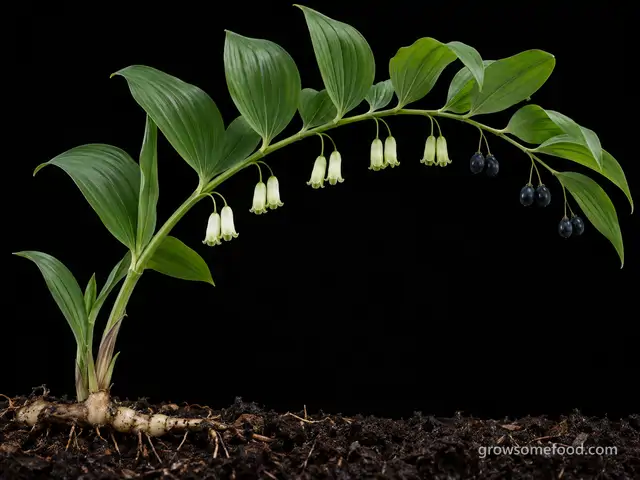
The elegant arching backbone of the shade garden - unbranched stems lined with neat leaves and dangling greenish-white bells, followed by blue-black berries and golden fall color; an easy, long-lived native.
Solomon's seal (Polygonatum biflorum) is one of the most graceful and useful plants for a shady garden - a native woodlander prized above all for its form. Each spring, asparagus-like shoots rise and unfurl into gracefully arching, unbranched stems lined with neat rows of parallel-veined leaves. Beneath the arch dangle pairs of small, greenish-white, bell-shaped flowers, understated but charming, followed by blue-black berries in late summer and a clear golden turn to the foliage in fall.
It's an easy, tough, long-lived plant that spreads slowly by rhizome into elegant colonies, giving structure and a horizontal, layered line to the shade garden that few other plants offer. The odd name comes from the round scars left on the rhizome as each year's stem dies away, thought to resemble the ancient seal of King Solomon. The young shoots are traditionally edible cooked (like asparagus), and the rhizome has a folk-medicine history, but the berries are toxic - so it's grown for its beauty, not the table. Deer-resistant, shade-loving, and dependable, Solomon's seal is a shade-garden classic.
At a glance
- Sun
- Part shade · Shade
- Water
- Medium
- Spacing
- 12–24 in (typ. 18)
- Mature height
- 18–48 in (typ. 30)
- Start by
- Direct sow · Transplant · Division
- Frost
- Hardy
- Germination
- 60–500 days (typ. 300) @ 45–70 °F (typ. 60)
- Spread
- 12–36 in (typ. 24)
- Soil
- Consistently moist
- Temperature
- Damaged below -35°F · struggles above 90°F
- Seed ready
- 120–180 days (typ. 150) (for saving)
- Self-sows
- Yes — expect volunteers
When to plant
Zone 7a typical frost: last Apr 10 · first Oct 25 (spring frost runs Mar 27–Apr 24 in a typical spread of years)
Life stages
- Rhizome rooting in day 0–120 from transplant
-
Keep evenly moist while settlingPlant a nursery-grown plant or dormant rhizome into rich, moist, humusy shade and keep it evenly moist. Solomon's seal spreads slowly by rhizome into elegant arching colonies - give it room and a permanent spot.
-
Mulch with leaf litterA woodland mulch of shredded leaves keeps the rhizome cool and moist and mimics the forest floor. It's slow the first year or two, then fills in steadily.
Slow first-year establishment (normal)The colony slowly widening by rhizome each year -
Keep evenly moist while settling
- Spring shoots & arching stems Mar, Apr (yearly)
-
Watch the arching stems riseIn spring, asparagus-like shoots push up and unfurl into gracefully arching, unbranched stems lined with neat, parallel-veined leaves. The elegant arching form is the plant's signature - one of the best structural natives for a shade garden.
-
Keep the soil from dryingSteady moisture keeps the foliage lush and the stems tall and arching; water in dry spells, especially in more open shade.
Emerging asparagus-like shoots (edible cooked, but harvesting sets the plant back - and never cut spears from a clump you didn't watch flower last year; lily-of-the-valley looks the same at this stage and is poisonous)Slugs on new shootsArching stems lengthening -
Watch the arching stems rise
- Dangling spring bells Apr, May, Jun (yearly)
-
Look under the arch for the bellsPairs of small, greenish-white, bell-shaped flowers dangle in a neat row along the underside of the arching stems - understated and elegant, best appreciated by lifting or looking under the stem. Bumblebees and hummingbirds visit them.
-
Let the berries form for later colorAfter bloom, the flowers give way to small berries that ripen to blue-black by late summer, hanging in a row beneath the arch. They're ornamental (and bird food), but toxic to people - leave them for the show and the birds.
Paired greenish-white bells hanging under the stemsBumblebees and hummingbirds visitingBerries beginning to form -
Look under the arch for the bells
- Blue-black berries & gold foliage Aug, Sep, Oct (yearly)
-
Enjoy the fall color and berriesBy late summer the berries ripen to blue-black under the arching stems, and the foliage turns a soft, clear gold in fall - a lovely, quiet autumn moment in the shade garden. Birds eat the (human-toxic) berries.
-
Keep the blue-black berries from childrenThe berries are toxic to people. In areas where small children play, keep this plant out of reach or be aware of the fruit; otherwise leave the berries to feed birds and self-sow the plant.
Blue-black berries under the stems (toxic to people, bird food)Golden fall foliageChildren tempted by the berries -
Enjoy the fall color and berries
- Winter dormancy Jan, Feb, Nov, Dec (yearly)
-
Cut back spent stemsAfter the foliage yellows and dies down, cut the spent stems to the ground (or leave them to collapse naturally). Solomon's seal rests as a rhizome through winter and returns in spring; it's fully cold-hardy.
-
Refresh leaf litter in fallAutumn leaves left in place or leaf mold added over the dormant rhizome feed and insulate it. No other winter care is needed.
Foliage down for winter (normal)The colony ready to divide in early spring if you want more -
Cut back spent stems
Watch out for
Solomon's Seal Sawfly Medium
Grayish, caterpillar-like sawfly larvae that feed in groups on the undersides of the leaves and can quickly skeletonize or strip the foliage of a Solomon's seal, sometimes defoliating stems in a season - increasingly common in some regions.
Watch for: Grayish larvae lined up on leaf undersides and leaves rapidly chewed to lace or bare ribs in late spring to early summer.
Prevent: Scout the leaf undersides in late spring and act early; healthy plants tolerate damage since it comes late in the season.
Treat: Hand-pick or hose off the larvae, or use spinosad or insecticidal soap for heavy infestations; the rhizome survives and the plant returns fine next year.
Slugs & Snails Low
Slugs and snails are nocturnal mollusks that rasp ragged holes in soft leaves, shear off seedlings at ground level, and chew into ripe fruit that touches the soil. They feed at night and in the early morning and spend the day hidden under boards, pots, dense mulch, leaf litter, and low foliage, becoming active in exactly the cool, damp, shaded conditions that suit young plants. Damage is heaviest in wet spells and on tender spring growth: a single wet week can erase a row of seedlings while an established, tough-leaved plant of the same species is barely marked. They lay clusters of small pearly eggs in damp soil and under debris, so a garden with plenty of cover carries a resident population year after year rather than being invaded from outside.
Watch for: Irregular ragged holes chewed out of the middle of leaves and along the edges - not the clean-edged cuts a caterpillar leaves. Seedlings that vanish overnight, or that are cut off at soil level with nothing left behind. Silvery dried slime trails across leaves, soil, pots, and paving in the morning: this is the giveaway that tells you it was mollusks rather than an insect. Chewed pits in ripe fruit, especially where it rests on the ground. Damage that shows up on the lowest, dampest leaves first and gets worse after rain or evening watering. Turn over a board, an upturned pot, or a clump of dense mulch during the day and look for the animals themselves sheltering in the cool underneath.
Prevent: Take away the daytime shelter first: lift boards and upturned pots, clear piles of debris, keep dense mulch pulled back from crowns and stems, and give crowded plantings enough airflow to dry out. Water in the morning rather than the evening so the surface is dry by the time they come out. Copper tape around containers and raised beds gives them a shock they will not cross, and it is the one barrier that reliably works. Get plants past the vulnerable stage quickly - start seedlings in pots and set them out at a decent size rather than direct-sowing into a cold wet bed, since most plants stop being worth defending once the leaves toughen. Leave the ground beetles, frogs, toads, and ground-feeding birds alone, because they eat mollusks all night for free and broad-spectrum slug pellets kill them too. Where thick-leaved or resistant varieties exist for what you are growing, they take far less damage.
Treat: Hand-picking works and costs nothing: go out an hour after dark with a headlamp, drop what you find into soapy water, and repeat nightly for a week or two - persistence is what wins, not any single product. Shallow beer traps sunk to soil level catch them too, but need emptying and refilling daily to be worth anything. Iron-phosphate bait is the standard control and is far lower-risk around pets and wildlife than the old metaldehyde products, but it is not harmless: many formulations include EDTA, and a dog that eats a quantity of pellets can develop iron toxicosis. Scatter it thinly per the label, never in piles, and keep dogs off a baited bed. Clear fallen foliage and debris in autumn, where the eggs are laid. In a wet climate this is a population you manage each season rather than one you eradicate - and on most established plants light grazing is cosmetic and needs nothing at all.
They chew the tender emerging shoots in cool, damp spring shade - usually cosmetic on an established colony.
Leaf Scorch (sun & drought) Low
Leaf scorch is not a disease and there is nothing to spray for it. It is what happens when a leaf loses water faster than the roots can replace it: the tissue farthest from the veins - the margins and the tips - dries out first and turns brown and papery, and the browning works inward while the rest of the leaf stays green. Hot sun, dry soil, drying wind, heat reflected off paving or a wall, a small or damaged root system, and a plant sited somewhere sunnier or drier than it wants are the usual causes, singly or together. It also happens in winter on evergreens, when bright sun and wind pull water out of the leaves while the ground is frozen and the roots cannot resupply. Shade and woodland plants, shallow-rooted plants, and anything recently planted scorch most easily.
Watch for: Browning that starts at the leaf edges and tips and spreads inward, with a fairly sharp line between the crisp brown tissue and the green that is still healthy. Leaves and fronds going dry, papery, and crisp rather than soft, yellow, or spotted - that is what separates this from a fungal problem. Damage worst on the side of the plant facing the sun or the prevailing wind and on the most exposed upper leaves, while the shaded interior stays fine. Symptoms appearing sharply after a heat wave, a dry spell, or a bright windy week in winter. Whole leaves or fronds shed early as the plant cuts its losses.
Prevent: Site the plant where it actually wants to be. This is a placement problem far more often than a watering problem, and a shade plant in hot afternoon sun will scorch every summer however much you water it. Give shade and woodland plants part-to-full shade and shelter from hot afternoon sun and drying wind. Keep the root zone consistently moist and mulch it well with leaf litter or another organic mulch, which holds water and keeps the roots cool - the single most useful routine step. Water deeply and thoroughly during dry spells rather than little and often, so moisture reaches the whole root zone. Pay particular attention through the first year after planting, when the root system is small and cannot keep up with the leaves. On evergreens in cold regions, make sure the plant goes into winter well watered, and keep it out of bright, windy, exposed positions.
Treat: Water deeply, mulch, and improve the shade - that is the whole treatment, because there is nothing here to kill. Leaves that are already scorched will not recover, so trim off badly browned foliage or fronds for appearance if you want to; the crown and roots are usually unharmed and push out fresh growth once conditions improve. On a plant that scorches badly every year the answer is to move it rather than to keep watering harder, because the siting is what is wrong. Some plants respond well to being cut back hard, which brings a clean flush of new foliage. And on plants that naturally die back or brown off late in the season, scorching at the end of a dry summer is normal and needs nothing at all.
Solomon's seal tolerates dry shade once established, but not hot sun or prolonged drought. Improve the shade and moisture and it recovers; the damage is usually cosmetic for the season.
Good & bad neighbors
Varieties · 3
Very tall, bold arching stems to 5-6 feet with large leaves and dangling bells; an architectural shade plant.
The large native form (sometimes listed as P. commutatum), reaching 4-6 feet or more in rich moist soil with correspondingly bigger leaves and bolder arching stems - a dramatic, architectural presence for a larger shade garden. Same easy care as the smaller type, on a grander scale.
Arching unbranched stems with parallel-veined leaves and dangling greenish-white bells, then blue-black berries.
The wild native species: gracefully arching, unbranched stems 2-4 feet long lined with neat leaves and hung with paired greenish-white bells, followed by blue-black berries and golden fall color. An easy, tough, long-lived structural plant for the shade garden.
Arching stems with white-margined leaves and fragrant white bells, brightening shade.
The hugely popular garden form of the fragrant European species, with arching stems and leaves crisply edged in creamy white that light up shady corners, plus sweetly scented white bells. Not native, but a beloved and well-behaved shade-garden classic that brightens dark spots beautifully.
Grow
Give it rich, moist, humusy shade, plant rhizomes or nursery stock, and let it slowly form arching colonies - it's easy, adaptable, tough, and long-lived.
Solomon's seal is one of the easier woodland natives to please: part to full shade and rich, moist-but-well-drained, humusy soil, though it's notably adaptable and tolerates a range of soils, dry shade once established, and even a bit of morning sun with enough moisture. A shaded bed, a spot beneath trees, or a north-facing border all suit it. Enrich with leaf mold and mulch with shredded leaves.
Plant dormant rhizomes in fall (eyes up, an inch or two deep) or set out nursery-grown plants in spring, and give the colony room to spread - it widens gently by rhizome into a handsome patch over the years, never aggressively. It's slow the first year or two, then fills in steadily and reliably. Once established, it's remarkably low-care, drought-tolerant for a shade plant, and deer-resistant. Its arching, structural form makes it invaluable for giving a shade garden height, line, and a sense of layers, whether massed as a groundcover or used as a specimen among lower woodland plants.
Care
Very low care - keep it reasonably moist, mulch with leaf litter, cut back spent stems in late fall or early spring, and divide occasionally if you want more.
Solomon's seal is close to no-maintenance once settled. Keep the soil reasonably moist (it tolerates dry shade once established but looks best with steady moisture), refresh a leaf-litter mulch each fall, and it needs no fertilizer in decent woodland soil. Cut the spent stems to the ground after they yellow in fall, or leave them to collapse and tidy in early spring.
The plant is largely trouble-free: it's deer-resistant, and pests and diseases are few, with only occasional slug damage on spring shoots or the specific Solomon's seal sawfly whose larvae can skeletonize leaves in some regions (see Troubleshooting). The main ongoing 'care' is simply enjoying it and, if you want more plants, lifting and dividing the rhizome in early spring or fall - an easy way to expand a colony or share it. Keep the toxic berries in mind where small children play. Otherwise, this is one of the most dependable, self-sufficient plants in the shade garden.
Harvest
Grown for its arching beauty, not harvest. The young shoots are traditionally edible cooked and the stems make fine cut foliage, but harvesting shoots sets the slow plant back, the berries are toxic, and a poisonous lookalike (lily-of-the-valley) comes up alongside it.
Solomon's seal is grown for its form and foliage, not as a food crop, and that's the honest framing. The graceful arching stems are excellent cut foliage for arrangements, adding an elegant line, and cutting a few does no harm to an established colony. The young spring shoots are traditionally edible cooked - peeled and boiled like asparagus, a foraging use with a long history - but because the plant is slow to build its colony, harvesting shoots sets it back, so it's better grown for beauty than nibbled.
If you do take shoots, one warning outranks everything else on this page. Lily-of-the-valley (Convallaria majalis) emerges in the same shade beds at the same time, as similar smooth, parallel-veined spears, and it is heart-poisonous - its cardiac glycosides are not destroyed by cooking, so boiling does not make it safe. Before flowering there is no petal to check, so use the growth habit: Convallaria comes up as a dense carpet of short spears, two or three leaves each, never taller than about eight inches and never forming a stem; Solomon's seal spears stand individually spaced, stouter, and elongate into one arching leafy stem. The only rule worth relying on is this: cut shoots only from a clump you personally watched arch, flower, and die back last year, standing where you planted it. If you can't say that, don't cut it.
What you should not harvest are the berries: the blue-black fall fruits are toxic to people, so leave them to feed birds and to self-sow the plant. (The rhizome also has a folk-medicine tradition but is not a food.) In short, take a few arching stems for the vase if you like, admire the flowers and berries in place, and treat the young-shoot foraging as historical trivia rather than a reason to raid a slow-growing colony.
Storage
Nothing meaningful to store - it's an ornamental; the plant persists in the ground as a long-lived rhizome, and seed (if grown that way) is sown fresh and germinates slowly.
There's nothing to store for the pantry - Solomon's seal is an ornamental (its edible-shoot use is a fresh, occasional foraging tradition, not a storage crop), and its berries are toxic. As a perennial, the plant stores itself in the ground as a durable, long-lived rhizome, dying back each fall and returning every spring, so a planting is self-renewing and permanent, with cut foliage the only thing you'd bring indoors.
If you propagate from seed, know that it's slow: the seed cleaned from ripe berries needs sowing fresh and often requires two winters of cold before it germinates, with several more years to a sizable plant, so it doesn't store dry usefully. For nearly all gardeners, rhizome division is the practical route, and the rhizome itself is the plant's natural storage organ, holding the reserves that push up next spring's arching stems.
Propagation & seed saving
Easiest by rhizome division in early spring or fall - just cut the rhizome into pieces with growth 'eyes'; seed works but is very slow, needing fresh sowing and two winters to germinate.
Solomon's seal is easy to propagate by rhizome division, which is the standard and fastest method. In early spring (before growth) or in fall, lift the rhizome and cut it into pieces, each with at least one growth bud (an 'eye'), then replant them horizontally an inch or two deep in moist, humusy shade. Divisions establish readily and quickly build into new arching colonies, making this the go-to way to expand or share the plant.
From seed, propagation is slow and best left to the patient: clean the seed from ripe berries and sow it fresh, as it typically needs a warm-then-cold cycle over two winters to germinate, and seedlings take several more years to reach flowering size. Because division is so much quicker and reliable, most gardeners simply divide an existing clump. However you propagate, choose nursery-grown stock or divisions rather than digging from the wild.
Nutrition
Grown as an ornamental, not for nutrition; its young shoots are a traditional cooked wild vegetable and its rhizome a folk medicine, but its garden value is beauty and wildlife support.
Solomon's seal isn't grown for nutrition - it's an ornamental woodland plant. That said, it has a real, if minor, food and medicine history. The young spring shoots were traditionally gathered and eaten cooked, like asparagus, and the starchy rhizome was used as a survival food (after cooking) and, more notably, in folk and traditional medicine for bruises, joints, and digestion - the source of the name 'sealwort.' These are historical uses; in the garden the plant is far too slow and valued to harvest for the table, and its berries are toxic.
Its real garden 'nutrition' is ecological and aesthetic. The dangling spring bells offer nectar to bumblebees and hummingbirds, and the blue-black fall berries feed birds, which disperse the seed. As a structural, deer-resistant native that gives the shade garden its elegant arching line and a quiet succession of flowers, berries, and gold fall color, Solomon's seal earns its place through beauty and wildlife value rather than as a food.
Traditional & historical uses
Solomon's seal rhizome ('sealwort') has a long herbal tradition on both continents - poultices for bruises, sprains, and broken bones, and preparations for the skin and digestion, from which its 'seal' names partly derive. The tradition is gentle and topical-leaning but not clinically proven, and the berries are toxic. Educational history, not medical advice.
This section records how people have traditionally used this plant, and what is known about the risks. It is history and general information — not medical advice, and not a recommendation to treat anything. Plants are not dosed like medicines, some interact with prescriptions, and some are harmful in ways that are not obvious. Talk to a clinician before using any plant medicinally.
Solomon's seal has one of the older and gentler herbal reputations in the woodland flora, centered on its thick, jointed rhizome - the old name 'sealwort' reflects both the seal-like scars on the root and a traditional use to help 'seal' wounds. Across Europe (with the related Polygonatum multiflorum and P. odoratum) and North America, the mashed or decocted rhizome was applied as a poultice for bruises, sprains, sore joints, and even broken bones, and taken in preparations for skin and digestive complaints. Its soothing action is usually attributed to the rhizome's mucilage and steroidal saponins.
This is a genuine, long-documented folk tradition rather than a clinically proven medicine, and it is still used in Western and East Asian herbalism today (Chinese medicine uses related Polygonatum species as yu zhu). Honest caveats apply: the effects rest on tradition and limited study rather than rigorous modern evidence, and any medicinal use is the province of knowledgeable practitioners. To be plain about the apparent contradiction on this page - this catalog lists the rhizome as a toxic part, and that stands. The traditional preparations were processed, cooked or decocted and often dosed by a practitioner, not eaten raw; the raw rhizome is not food, the blue-black berries are toxic, and no home preparation of either is recommended here. This section is educational history - in the garden, Solomon's seal earns its place as an elegant, easy native, its herbal past simply part of its charm.
History
An old-world and new-world herbal plant whose curious name comes from the seal-like scars on its rhizome; long valued in folk medicine ('sealwort') and now a beloved shade-garden native.
Solomon's seal carries an evocative name and a long herbal history. The name is usually explained by the round, seal-like scars left on the rhizome where each year's stem dies away - marks thought to resemble the legendary seal of King Solomon - or by the plant's reputation for 'sealing' wounds. Across both Europe (with the related Polygonatum multiflorum and P. odoratum) and North America, the rhizome was a staple of folk medicine, used in poultices for bruises and broken bones and in remedies for the skin and digestion, earning the folk name 'sealwort.'
The young shoots were also known as an edible wild vegetable, cooked like asparagus, and the rhizome as an emergency food. In the ornamental tradition, Solomon's seal has long been a cherished plant of the shade and woodland garden on both continents, valued for its unmatched arching grace; the variegated form of the fragrant European species is an especially popular garden plant. Today the native American Solomon's seal is a mainstay of native and woodland shade gardens, grown for its beauty and reliability, its herbal past a piece of its charm.
Troubleshooting
An easy plant with few problems: slow early growth is normal, sawfly larvae can skeletonize leaves in some areas, and the cautions that matter are the toxic berries and the poisonous shoot-stage lookalike, lily-of-the-valley.
It's slow and barely spread the first year: normal - Solomon's seal takes a season or two to establish, then fills in steadily; be patient and keep it mulched and moist. Leaves suddenly skeletonized to lace: Solomon's seal sawfly - grayish caterpillar-like larvae that can quickly strip the leaves in late spring in some regions; hand-pick them or hose them off, and the plant recovers (it's usually cosmetic since it's late in the season). Chewed spring shoots: occasional slugs; deer generally leave the plant alone. Leaf scorch or early dieback: too dry or too sunny - give it more shade and moisture. Is it safe to eat the shoots? The lookalike that matters is lily-of-the-valley (Convallaria majalis), a very common shade groundcover that comes up at the same time, in the same beds, as similar smooth, purple-tinged, parallel-veined spears - and it is heart-poisonous. Boiling does not make it safe; its cardiac glycosides survive cooking. At the spear stage the flower cue below is useless, because neither plant has flowered yet. Two things you can see: Convallaria comes up as a dense carpet of many identical short spears from a shallow running rhizome, each opening only two or three leaves from a basal sheath and never elongating past about eight inches or forming a stem; Solomon's seal spears stand individually spaced along a thick jointed rhizome, are noticeably stouter, and keep elongating into one leafy arching stem two to four feet long. The only reliable rule: cut shoots ONLY from a clump you personally watched arch, flower, and die back the previous year, standing where you planted it. If you can't say that, don't cut it. Which Solomon's seal is this? True Solomon's seal (Polygonatum) hangs its flowers along the arching stem; 'false Solomon's seal' (Maianthemum) carries a plume at the stem tip - a plant-ID curiosity, not a safety issue, since Maianthemum is harmless. Berries: remember they're toxic to people - keep them from small children, and leave them for the birds.
Growing across climates
Widely adaptable and hardy (roughly zones 3-9), thriving across the eastern half of the country in shade; tolerant of dry shade once established, with heat handled given enough moisture and shade.
Solomon's seal is one of the more climate-flexible woodland natives, hardy and dependable across roughly zones 3-9 through the eastern half of the continent. Zones 3-6: fully cold-hardy and vigorous in cool, moist, shaded woodland soils, with excellent golden fall color. Zones 7-9: equally at home in the southeastern woodlands where it's native, given shade and reasonably moist, humus-rich soil; provide consistent moisture and cool shade toward the warm end and it handles heat well.
One of its virtues is tolerance: once established, Solomon's seal handles dry shade better than most woodlanders, coping with the root competition and drier soil beneath trees where fussier plants fail - a genuinely useful trait. It's fully cold-hardy and needs a winter chill to reset dormancy, so it isn't a plant for frost-free climates, but across its broad temperate range it's a reliable, adaptable, structural shade plant that asks only for shade, decent soil, and a place to spread.
Grower tips
No grower tips for Solomon's Seal yet. Yours could be the first.
Sign in to share what works in your garden.