
Add it to your home screen and it opens full screen: no browser bars, one tap away, and everything stays signed in. Free, nothing to download from an app store.
- Tap the Share button in your browser
- Scroll down and choose “Add to Home Screen”
- Open GrowSomeFood from your home screen
- Open your browser’s menu
- Choose “Add to Home screen” or “Install app”
- Open GrowSomeFood from your home screen
Saguaro
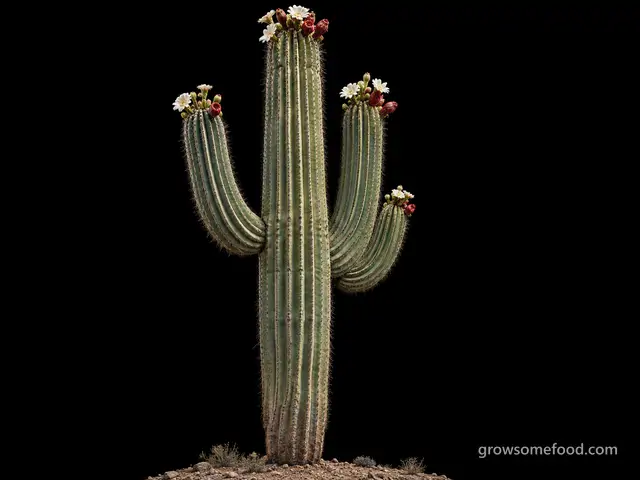
The towering, arm-raised icon of the Sonoran Desert and the Arizona state flower - a protected, century-living giant that grows with almost unbelievable slowness, feeds desert wildlife, and belongs in the ground only as a patient, nursery-grown xeriscape centerpiece.
Safety notes Fruit and seeds are edible and were a central traditional food of the Tohono O'odham, but the plant is PROTECTED under Arizona law: it must not be collected, cut, or moved without a permit, and a landowner must notify the Arizona Department of Agriculture 20-30 days BEFORE destroying or moving a protected native plant - including a saguaro on their own property. The hazard to people is physical: long, stiff, sharp spines. Grow only nursery-propagated plants and site well away from paths.
Overview
The saguaro (Carnegiea gigantea) is the living emblem of the American Southwest - the tall, pleated, arm-raised column that says 'desert' in a single silhouette. Found only in the Sonoran Desert of southern Arizona, a sliver of southeastern California, and northwestern Mexico, it is the largest cactus in the United States, reaching 40 to 60 feet and living 150 to 200 years. Its waxy white night-blooming flower is the Arizona state flower, and its red summer fruit has fed the region's people and wildlife for millennia.
The one thing to knowFound only in the Sonoran Desert of southern Arizona, a sliver of southeastern California, and northwestern Mexico, it is the largest cactus in the United States, reaching 40 to 60 feet and living 150 to 200 years.
Quick facts
- Sprouts in
- 14 daysRange: 7–30 days
- Soil temperature
- 85 °FRange: 75–95 °F
- Height
- 40 ftRange: 15–60 ft
- Spread
- 72 inRange: 24–120 in
- Cold
- Killed by frostdamaged below 20°F
- Heat
- Struggles above 120°F
- Life cycle
- Perennial, lives about 150 years
- Self-sows
- Yes, expect volunteers
- Soil
- Well-drained
- Water
- Low
- Plant spacing
- 15 ftRange: 8–30 ft
When to plant
No planting window on record for this zone. Nearest zone with one: 9a.
Frost here: last around Apr 10 (Mar 27 to Apr 24 most years), first around Oct 25. Zone averages, your own yard may run a week or two either way.
Life stages
Establish, grow, repeat
Getting established and returning each season are different parts of the story.
Stage 1 of 5 · Getting established
The slow start (years 1-10)
About the first 5 years after planting
Care at this stage
-
Give a young saguaro a nurse plant and shade
In the wild, saguaro seedlings almost always start beneath a 'nurse plant' (like a paloverde or bursage) that shields them from sun, cold, and being eaten. Mimic this: shade a young plant from the harshest sun and any frost for its first years while it establishes. Growth is measured in inches per year.
-
Water lightly while young, then almost never
A young, rooting saguaro benefits from occasional deep watering during warm months to establish, but always let the gritty soil dry completely between. Overwatering and wet soil are the main way to kill it. Once established it needs essentially no supplemental water.
Months are typical seasonal windows; climate, variety, and plant age can shift them.
Watch out for
3 to know. 2 are high-risk: Root Rot, Bacterial Necrosis. None are active in October.
Root RotSeverity High DiseaseSeason: Jan, Feb, Jul, Aug, Nov, DecWilting in the middle of the day on a plant whose soil is damp - the classic tell, and the reason people water a rotting plant and finish it off.
Gritty, sharply drained soil in full sun; water sparingly, let the soil dry fully, and withhold water entirely in winter. If the base is rotting the plant is often lost - salvage is difficult once basal rot sets in.
Wilting in the middle of the day on a plant whose soil is damp - the classic tell, and the reason people water a rotting plant and finish it off. Leaves yellowing from the bottom up, dull off-color foliage, and growth that stalls for no visible reason. Whole shoots, or one side of the plant, collapsing while the rest still looks fine. Soft, dark, or mushy tissue at the base of the stem or at the crown, sometimes with a sour smell. Lift a failing plant and look at the roots: healthy ones are firm and pale, rotted ones are brown or black and slimy, and the outer layer slips off between your fingers leaving a thread of core behind. Seedlings that topple over at soil level are the same problem, called damping-off.
There is no cure for tissue that has already rotted, so act on the conditions rather than looking for a spray. Stop watering at once and fix the drainage - open up compacted soil, or move the plant to a raised, sharply drained position or a container. Lift a badly affected plant, cut away every soft dark root and rotted section with a clean blade back to firm pale tissue, and replant only the healthy parts into fresh free-draining soil or mix. Often the better move is to give up on the plant and save its offspring instead: cuttings, offsets, or divisions taken from firm healthy growth root readily and give you a clean start. Bin the rotted material rather than composting it, and correct the drainage before you replant, because the rot comes straight back in the same wet spot.
Drainage is the whole defense. Match the plant to the site first - something that wants sharp drainage will not survive heavy clay or a low, water-collecting spot however well you tend it. Where the ground is heavy, plant on a raised bed, berm, or slope, or grow in a container. Set plants at the depth they were already growing, since burying the crown or the root flare is a common cause of rot, and keep mulch pulled back a few inches from the stem base instead of piled against it. Water the soil rather than the calendar: check that the top inch or two is dry before watering again, cut back hard in cool weather and winter dormancy, and never leave a pot standing in a full saucer. Do not plant or dig in soggy ground, and go easy on rich amendments for plants that want it lean. Rotate annual crops, and start with clean healthy plants and fresh mix.
Root rot is not one organism but a group of soil fungi and water molds - Pythium, Phytophthora, Fusarium, Rhizoctonia and others - that sit harmlessly in most soils and only turn destructive when the ground stays saturated. Waterlogged soil drives the air out, the roots suffocate, and the weakened tissue is invaded and goes soft, brown, and stringy. Because the damage is underground you usually see it first as something that looks like drought: wilting, yellowing, stunting, a plant that does not respond to being watered. Overwatering, heavy compacted ground, a low spot that collects runoff, a pot with no drainage or a saucer left standing full, and cold wet soil in winter are the usual causes. Once roots have actually rotted there is no cure - this is a problem you prevent rather than treat.
Bacterial NecrosisSeverity High DiseaseSeason: May–SepDark brown-to-black soft lesions, sunken oozing patches with a bad smell, and blackening tissue that spreads over weeks.
Dark brown-to-black soft lesions, sunken oozing patches with a bad smell, and blackening tissue that spreads over weeks.
For a valued plant, cut out small early lesions with a clean, sterilized tool down to firm green tissue and let the wound dry and callus in the sun. Widespread or basal rot may be fatal; consult a cactus specialist.
Avoid wounding the plant, protect from frost cracking, keep soil sharply drained and dry (never overwater), and site in full sun with good airflow.
The most serious saguaro disease: a soft, spreading bacterial rot (associated with Erwinia-type bacteria) that produces dark, sunken, oozing, foul-smelling lesions, often entering through frost cracks or wounds. Extensive rot, especially at the base, can collapse and kill even a large old plant.
Frost Damage (young plants)Severity Medium DisorderSeason: Dec–FebBlackened, scarred, water-soaked, or collapsing tissue and cracked skin following a hard or extended freeze, especially at the growing tip.
Blackened, scarred, water-soaked, or collapsing tissue and cracked skin following a hard or extended freeze, especially at the growing tip.
Leave lightly frost-scarred tissue in place (it hardens off); watch scarred areas for secondary rot and cut out any soft, spreading lesions. Severely frozen young plants may not recover.
Grow within its warm range (roughly zones 8-11); protect young plants with frost cloth on hard-freeze nights; keep soil dry going into cold; use a warm, sheltered microclimate.
Cold injury during hard or prolonged freezes, worst on young plants near the cool edge of its range (it is hardy only to about the low 20s F). Established plants tolerate light frost and often resprout from the base if top-killed.
Good & bad neighbors
Plant nearby
-
Palo Verde / Bursage (nurse plants)In the wild, saguaro seedlings survive by starting under nurse plants like paloverde and triangle bursage, which shade them from sun and cold. Recreating this shelter greatly improves the survival of a young saguaro.
-
Brittlebush's silvery mounds and spring yellow daisies soften the base of a saguaro and share its exact dry, sunny, low-water desert conditions.
-
A classic Sonoran Desert pairing: both are drought-proof low-desert natives with bold vertical form, sharing full sun and sharply drained soil in a xeriscape, and together covering both the night (bat and moth) and the day (hummingbird) pollinator shifts.
-
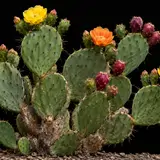
A natural desert-garden association - both are Sonoran cacti wanting heat, full sun, and sharp drainage, and their contrasting forms (paddles vs column) read as an authentic desert planting.
Varieties · 2
You pick one when you add Saguaro to your garden. Its days to maturity set your harvest window.
Wild-type Saguaro (Carnegiea gigantea)
The single species: a massive columnar cactus reaching 40-60 feet over 150-200 years, with pleated water-storing trunks, arms that appear only after many decades (if at all), waxy white night flowers (the Arizona state flower), and red edible fruit.
Variety details for Wild-type Saguaro (Carnegiea gigantea)
Tall fluted green column, sometimes with upraised arms, crowned by white flowers and red fruit in early summer.
speciesnativegiantslow-growingProtected in Arizona; grow only nursery-raised plants.
Crested (Cristate) Saguaro
A rare natural growing-point mutation in which the tip fans into an undulating crest or fan shape instead of a normal column.
Variety details for Crested (Cristate) Saguaro
Normal saguaro column topped or interrupted by a fanning, brain-like crested growth.
raremutationfan-crestcollectorPrized and much-photographed in the wild (and equally protected); occasionally propagated for collectors. Not a true separate variety but a striking fasciated form of the same species.
Grower tips
Notes from growers, tagged with the zone they grow in. A person reads every post before it appears.
Nobody has posted about Saguaro yet. The first one usually saves someone a season.
Free account. Your post shows your grower name and zone, never your email.