Russian Olive

Elaeagnus angustifolia · Elaeagnaceae
Other Perennial Tree Other
Introduced - native to western and central Asia and southeastern Europe; invasive along rivers, ditches and shelterbelts across the western US and Great Plains, and spreading in the Northeast
Not recommended to plant. Do NOT plant this. Colorado lists it as a List B noxious weed and New Mexico as Class C, and several New England states ban its sale. Birds spread it along every western river, where it replaces cottonwood and willow, and its thorns cause deep puncture wounds.

Russian olive is not poisonous - the dry, mealy fruits are genuinely edible and are eaten across Central Asia and Iran. That is no reason to plant or keep it. The real hazard is mechanical: stout thorns up to two inches long cause deep puncture wounds that infect easily and flatten tires, so wear thick gloves, eye protection and stout boots to cut it, and rake the brush up rather than leaving it. If you forage an existing tree, skip roadside and ditch-bank stands, which are sprayed.

Overview

The silvery, thorny shelterbelt tree the government once handed out by the thousand - now a listed noxious weed in Colorado and New Mexico that has replaced cottonwood and willow along western rivers. Edible fruit, and still never plant it.

Russian olive (Elaeagnus angustifolia) is the gray-silver, thorny, sweet-smelling tree that lines ditches, fence rows, shelterbelts, and river bottoms across the Great Plains and the interior West. It was planted deliberately, by the hundreds of thousands, as a tough windbreak and wildlife tree for country that kills most trees — and it did the job. Then it left the shelterbelt. Birds carry its fruit for miles, and it now forms dense thickets along rivers, irrigation ditches, canals, and wet meadows, crowding out the cottonwood and willow that western river corridors and the wildlife in them depend on.

It is a List B noxious weed in Colorado and a Class C noxious weed in New Mexico, several New England states ban its sale, and states across the West and Plains list it as noxious or invasive — check your own state's list, and note that a noxious-weed listing can carry a management obligation, not just a sales ban. Like autumn olive, its eastern cousin, it comes with an honest paradox: the fruit is genuinely edible, eaten across Central Asia and Iran, where it is called senjed. That is a reason to use what you cut, not a reason to keep it. This entry is here to help you tell it from autumn olive, remove it properly, and choose a native windbreak instead.

At a glance

Sun
Full sun · Part sun
Water
Low
Spacing
96–360 in (typ. 180)
Mature height
144–420 in (typ. 300)
Start by
Direct sow · Cuttings
Frost
Hardy
Spread
120–360 in (typ. 240)
Soil
Well-drained
Temperature
Damaged below -40°F · struggles above 105°F
Self-sows
Yes — expect volunteers

When to plant

No planting window on record for this zone.

Life stages

  1. Silver leaves & thorny growth (identify & control) Apr, May, Jun, Jul, Aug, Sep, Oct (yearly)
    • Recognize it: narrow leaves silvery on BOTH sides, and real thorns
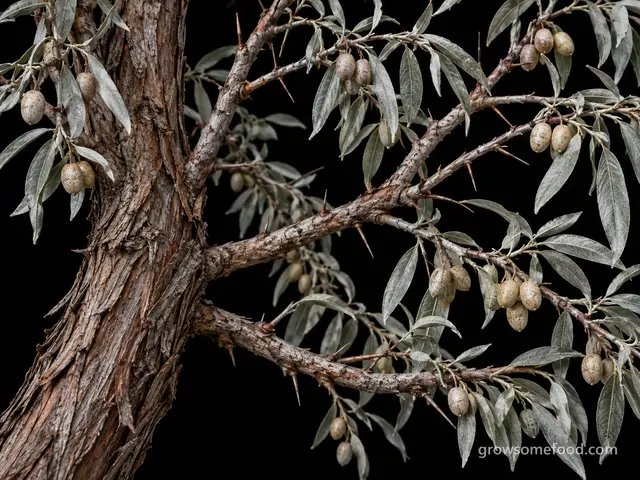
      Russian olive is a small, often crooked tree to about 25 feet, with shaggy brown bark and silvery twigs. The leaves are narrow and lance-shaped - willow-like - and covered in silvery scales on BOTH surfaces, so the whole tree reads gray-green from a distance. Branches carry stout thorns up to two inches long. Autumn olive, the eastern relative, is a shrub with oval leaves that are green above and silver only beneath.
    • Pull seedlings, and never cut a big one without treating the stump
      Seedlings and small saplings pull or dig out of moist soil, roots and all. Anything larger resprouts hard from the stump and root crown if you only cut it, so plan a cut-stump or basal-bark treatment at the same time, using a product whose LABEL lists the site you are treating and following that label. Wear thick gloves, eye protection, and boots - the thorns cause deep, easily infected punctures.
    Narrow willow-like leaves silvery on both surfacesStout thorns to two inches on the branchesThickets closing in along ditches, fence lines, river banks, and old shelterbelts
  2. Intensely fragrant early-summer flowers May, Jun (yearly)
    • Small silvery-yellow flowers you smell before you see
      In late spring and early summer the tree covers itself in small, bell-shaped, silvery-yellow flowers with a heavy sweet fragrance that carries a long way - many people know Russian olive by the smell of a river bottom in June before they can name the tree. Pleasant, and a warning: a flowering tree is about to set the fruit crop that birds will spread all winter.
    • Flag flowering trees for removal before fruit set
      Note which trees are flowering heavily and plan to take those out first - they are the seed source for the whole reach of ditch or river below them. On a working property, this is also the moment to talk to the irrigation district, county weed office, or extension service if the stand is bigger than hand tools can handle.
    Heavy sweet fragrance along ditches and river bottoms in JuneSmall silvery-yellow bell-shaped flowersHeavy bloom signaling a heavy fruit crop to come
  3. Dry silvery fruits & bird spread Aug, Sep, Oct, Nov (yearly)
    • Mealy silver-tan fruits, not red berries
      By late summer the tree carries heavy crops of small oval fruits, silvery to yellow-tan and speckled, dry and mealy rather than juicy, each with one hard striped stone. This is the clearest split from autumn olive, whose fruit is soft, red, and flecked with silver. Birds and mammals eat them through fall and winter, and the seed passes through and germinates readily downstream.
    • Remove fruiting trees first
      Fruiting trees are the engine of the invasion; take them out ahead of the non-fruiting ones. If you want to use the fruit from a tree you are removing, that is fine - it is edible - but skip roadside and ditch-bank trees, which are sprayed on a schedule, and never plant a seed or move a rooted sucker. Bag or burn fruit-laden trimmings per local rules rather than dumping them on a bank.
    Heavy crops of dry, mealy, silver-tan fruitsBirds and deer working the fruiting trees through fall and winterSeedlings appearing downstream and along fence lines the following year
  4. Winter form & the treatment window Jan, Feb, Mar, Nov, Dec (yearly)
    • Silver twigs, thorns, and fruit still hanging
      Bare, Russian olive is still easy to name: silvery-scaly twigs, long stout thorns, shaggy shredding brown bark, and often last year's tan fruit still hanging. Along a western river in winter, the gray-tan tangled thickets between the cottonwoods are almost always this tree - and the contrast shows you exactly how much ground it has taken.
    • Cut-stump and basal-bark work is a cool-season job
      Late fall through winter is the standard window for cut-stump and basal-bark treatment: the plants are dormant, the thorns are visible, and there is less risk to surrounding vegetation. Treat the cut face within minutes of the saw. Use a product whose label lists your site, follow the label, and if the tree stands in or over water - a ditch, canal, creek, or wet meadow - use an aquatic-labelled product and expect to need a permit or a licensed applicator.
    Silvery twigs, stout thorns, and shredding brown barkOld tan fruit hanging into winterGray thickets filling the space between cottonwoods along a river

Watch out for

Riparian Takeover (ecological harm) High Disorderyear-round

The core hazard is ecological: Russian olive forms dense thorny thickets along rivers, irrigation ditches, canals, reservoir margins, and wet meadows, shading out the cottonwood and willow seedlings that western riparian corridors depend on. Those corridors are narrow ribbons of habitat in dry country, and replacing them with a thicket that supports far fewer native insects thins the whole food web while changing how banks and channels behave.

Watch for: Gray-silver thickets filling the space between cottonwoods; no young cottonwood or willow coming up along a reach; thorny stands closing over ditch banks, fence lines, and wet meadow edges.

Prevent: Never plant it; remove fruiting trees along a whole reach rather than one property; keep native cover established so the gap does not simply refill from upstream seed.

Treat: Kill the roots with cut-stump or basal-bark treatment in the dormant season, on-label; near water use an aquatic-labelled product with the required permit or licensed applicator, then revegetate with cottonwood, native willow, and native shrubs and follow up for three to five years.

Anything that alters natural flood timing - dams, diversions, channel work - tips the balance further toward Russian olive, because cottonwood and willow need specific flood conditions to regenerate and it does not.

Bird- and Water-Spread Seed & Hard Resprouting High DisorderJan, Apr, May, Jun, Aug, Sep, Oct, Nov, Dec

Why it reaches everywhere and resists removal: heavy crops of stony fruit are eaten by birds, deer, raccoons, and livestock and pass through intact, while fruit and seed also float down ditches and floodwater to germinate on bare wet silt. Any tree that is cut without treatment sprouts vigorously from the stump and root crown, and low branches buried in silt can root where they lie.

Watch for: Seedlings along fence lines, under perch trees, and downstream of any fruiting tree; new stands appearing after a flood or ditch cleaning; thorny multi-stemmed clumps where a single tree was cut in a previous year.

Prevent: Remove fruiting trees first to shut off the seed; do not plant seed or move rooted suckers; bag or dispose of fruit-laden trimmings under local rules rather than dumping them on a bank.

Treat: Cut low and treat the fresh stump surface within minutes, or basal-bark stems under about six inches in the dormant season, using a product whose label lists your site and following that label. Expect to re-treat sprouts for several seasons.

Because seed arrives from upstream, one-property control rarely holds - county weed offices and irrigation districts often coordinate reach-wide work and sometimes cost-share it.

Soil Enrichment by Nitrogen Fixation Medium DisorderApr, May, Jun, Jul, Aug, Sep, Oct

A subtler and longer-lasting harm: Russian olive fixes its own nitrogen, so it establishes on lean, raw, alkaline, and salty ground where native plants struggle, then enriches that ground with nitrogen and leaf litter. Naturally lean floodplain and shrub-steppe soils shift toward conditions that favor weedy annuals and other invaders, so the site stays altered after the trees are gone.

Watch for: Russian olive colonizing bare, salty, or infertile ground; flushes of weedy annual grasses and forbs in the enriched soil beneath and around old stands.

Prevent: Remove trees before a stand matures and builds up litter and nitrogen; do not plant it on reclamation, shelterbelt, or lean sites, which is exactly where it was historically recommended.

Treat: Remove the trees, then monitor for follow-on weeds and revegetate deliberately with natives suited to the now-altered soil rather than assuming the original community returns on its own.

This is the same mechanism autumn olive causes in the East, and it is the reason a cleared Russian olive site often comes back in cheatgrass and weedy annuals rather than natives.

Thorn Punctures & Equipment Damage Medium Disorderyear-round

A direct hazard to the person doing the work. Russian olive carries stiff thorns up to two inches long that drive deep into hands, knees, and feet and leave punctures that seal over and infect easily. The thorns stay sharp long after the branch dies, so old brush piles, cut slash, and drop-limbs remain dangerous, and they routinely puncture tires, hoses, and irrigation line.

Watch for: Thorns on cut brush and old slash piles; punctures that swell, redden, or stay painful days later; repeated flat tires on equipment working near a stand.

Prevent: Wear thick leather gloves, long sleeves, eye protection, and stout boots to cut or handle it. Rake and dispose of slash rather than leaving it; keep brush off drive lanes and out of pasture and play areas.

Treat: Clean deep punctures thoroughly and watch them - a puncture that swells, reddens, or stays painful needs medical attention, and tetanus protection should be current for anyone doing this work.

The thorn hazard is the most common reason a homeowner stops halfway through removing one of these; plan protective equipment and slash disposal before you start the saw.

Varieties · 3

Autumn Olive & thorny olive (the other invasive Elaeagnus)

Autumn olive: multi-stemmed shrub, oval green-over-silver leaves, red silver-flecked berries. Thorny olive: sprawling evergreen shrub with wavy leaf edges and rusty-speckled undersides.

relatedinvasivedo-not-plantlookalike

The relatives you are most likely to confuse it with, both also invasive. Autumn olive (E. umbellata) is a shrub of the East and Midwest with oval leaves green above and silver beneath, and soft red berries flecked with silver. Thorny olive or silverthorn (E. pungens) is the evergreen one in the Southeast, with wavy-edged leaves and brown-speckled undersides. All three are controlled the same way, and none of them should be planted - see the autumn olive entry in this catalog for the eastern picture.

Native windbreak alternatives

Varies by species - tough native shrubs and small trees for shelterbelts and riparian ground, several of them silvery, thorny, or berry-bearing like Russian olive but belonging where they grow.

alternativenativenon-invasiverecommended-instead

Plant these instead. Silver buffaloberry (Shepherdia argentea) is the closest match of all - a native, silvery, thorny, nitrogen-fixing, berry-bearing shrub built for exactly the same hard, dry, alkaline country. Add golden currant, chokecherry, American plum, skunkbush sumac, hackberry, or Rocky Mountain juniper for a mixed windbreak that will not seed the river. On a bank or wet meadow, plant native cottonwood and willow, which is what Russian olive displaced in the first place. Your county extension office or conservation district can supply a regionally appropriate species list.

Russian Olive (Elaeagnus angustifolia)

Small crooked tree to about 25 feet with shredding brown bark, silvery twigs and stout two-inch thorns; narrow willow-like leaves silvery on both surfaces; small silvery-yellow fragrant flowers in June; dry, mealy, silver-tan fruits with one striped stone.

speciesinvasivedo-not-plantnoxious-weednitrogen-fixerbird-spreadthornyedible-fruit

The invasive tree: a crooked, thorny, silver-leaved small tree with intensely fragrant June flowers and heavy crops of dry, mealy, silver-tan fruit spread by birds and floodwater. It fixes nitrogen, tolerates drought, salt, alkali and cold to forty below, and replaces cottonwood and willow along western rivers and ditches. A List B noxious weed in Colorado and Class C in New Mexico, banned from sale in several New England states. Its fruit is genuinely edible - identify and control it anyway, and never plant it.

Grow

How to recognize it and why never to plant it: a crooked small tree with narrow willow-like leaves silvery on both sides, stout two-inch thorns, intensely fragrant June flowers, and dry mealy silver-tan fruit - fixing nitrogen and seeding every river below it.

You should never plant Russian olive — recognizing it, and telling it from its relatives, is what matters. It is a small, often crooked tree to about 25 feet (sometimes a large shrub), with shaggy, shredding brown bark and silvery twigs. Its leaves are narrow and lance-shaped, willow-like, and silvery-scaled on BOTH surfaces, so the whole crown reads gray from a distance. Branches carry stout thorns up to two inches long. In June it is smothered in small silvery-yellow bell flowers with a heavy sweet fragrance you notice long before you see the tree, and by late summer it carries dry, mealy, silver-tan fruits, each with one hard striped stone.

The comparison people need is with autumn olive (E. umbellata), the invasive of the East and Midwest: autumn olive is a multi-stemmed shrub with oval leaves that are green above and silver only beneath, and its fruit is soft, juicy, and red flecked with silver. Narrow silver-on-both-sides leaves and dry tan fruit mean Russian olive; oval green-over-silver leaves and red berries mean autumn olive. (A third, E. pungens, thorny olive, is the evergreen one in the Southeast.) Russian olive's biology is what makes it a landscape problem: it is a nitrogen fixer, so it establishes on lean, raw, and salty ground where natives struggle and then enriches it; it tolerates drought, flooding, alkalinity, and salinity; it is hardy to about forty below; and it resprouts hard from a cut stump. Tough enough for the Plains is exactly what makes it unstoppable along a river.

Propagation & seed saving

How it spreads: heavy crops of bird- and mammal-dispersed fruit that germinate readily on wet, bare, even salty river silt, plus vigorous sprouting from cut stumps and root crowns and rooting from buried branches.

Russian olive spreads mainly by seed. A mature tree sets thousands of stony fruits; birds, deer, raccoons, and livestock eat them through fall and winter and pass the seed intact, which is how new trees appear along fence lines, under perch trees, and miles down a river system from any planting. Water does the rest: fruit and seed float and travel on irrigation ditches and spring floods, then germinate on the wet, bare silt that flooding leaves behind — the same nursery bed that cottonwood and willow seedlings depend on, except Russian olive can also handle the salty, alkaline patches they cannot.

It also holds ground vegetatively. Cut or damaged trees sprout vigorously from the stump and root crown, so a plain cut turns one trunk into a thorny multi-stemmed clump, and low branches buried by silt or soil can root where they lie. Once a stand closes in, it shades out cottonwood and willow seedlings and holds the site indefinitely, which is why removing the trees is only half the job: unless native cover is re-established, the seed rain from upstream simply refills the gap. Control that works therefore combines killing the roots, removing fruiting trees over a whole reach rather than one property, and revegetating with natives.

Care

Control and replacement, not care: pull seedlings, cut-stump or basal-bark treat anything larger in the dormant season (it resprouts), use an aquatic-labelled product with a permit near ditches and rivers, follow up for years, and replant natives.

Scale the method. Seedlings and small saplings pull or dig out of moist soil — take the root crown, and wear thick gloves. Anything larger resprouts hard when merely cut, so the roots have to be killed: cut low and treat the fresh stump surface within minutes, or use a basal-bark application on stems under about six inches, generally in the dormant season from late fall through winter, when the plants are quiet and the thorns are visible. On big riparian projects, machines pull or mulch the stems and crews follow with treatment of the sprouts; either way the follow-up matters more than the first pass. Whatever you use, it must be a product whose label lists the site you are treating, and you must follow that label — rates, protective equipment, buffers, and grazing intervals are legally binding.

Water changes the rules, and this tree lives at the water. Treating plants standing in or over a ditch, canal, creek, river, or wet meadow requires a product specifically labelled for aquatic sites, and that work commonly requires a permit and often a licensed applicator — on irrigation systems you may also need to clear it with the ditch company or irrigation district, since treated water goes on somebody's crop downstream. Ask your county weed office, extension service, or state department of agriculture before you start; many counties will help, and some cost-share the work because Russian olive is a listed weed.

Sequence it: take out fruiting trees first, work with your neighbors along the same reach if you can, and plan on three to five years of follow-up on sprouts and seedlings. Then put natives back, or the ground simply refills: silver buffaloberry is the closest match — a native, silvery, thorny, nitrogen-fixing, berry-bearing windbreak shrub — alongside golden currant, chokecherry, American plum, skunkbush sumac, hackberry, or Rocky Mountain juniper. On a river bank, cottonwood and native willows are the point of the whole exercise.

Nutrition

Honestly, the dry mealy fruits are edible and are a traditional food across Central Asia and Iran - but that is no reason to plant it. Ecologically it is a net loss: it displaces cottonwood and willow and enriches river soils in ways that favor more weeds.

Russian olive carries the same honest paradox as autumn olive and kudzu: it is genuinely edible and it must not be planted. The fruit is dry, mealy, and sweet-tart, more like a date than an olive, with one hard striped stone; in Iran and across Central Asia it is a real food, dried and eaten as senjed, ground into flour, and included among the seven symbolic items of the Persian new-year table. In the US it makes a decent jelly and a passable dried snack, and it is fine to use fruit from a tree you are cutting down. Skip roadside, ditch-bank, and right-of-way trees, which are sprayed on a schedule, and never plant a seed or move a rooted sucker.

None of that offsets what it does to a river. Western riparian corridors are narrow ribbons of habitat in dry country, and they are built on cottonwood and willow, which feed native insects, hold banks, and shade water. Russian olive replaces them with a thorny thicket that supports far fewer native insects and a poorer bird community, holds banks differently, and can dry and change how a channel behaves. As a nitrogen fixer it also enriches soils that were naturally lean, which tends to favor other weedy species rather than the natives adapted to them — so its effect outlasts the individual tree. Its own fruit does feed birds through winter, which is exactly the mechanism of its spread rather than a redeeming feature. The right relationship is removal, with a bucket of fruit as a consolation prize.

History

Introduced in the 1800s and distributed by the thousand for Dust Bowl shelterbelts, erosion control and wildlife plantings, Russian olive was recommended by the same agencies that now list it as a noxious weed.

Russian olive reached North America in the 1800s as an ornamental, and came into its own in the twentieth century as an answer to hard country. After the Dust Bowl, federal and state programs planted enormous numbers of trees for shelterbelts and windbreaks across the Plains, and Russian olive was close to ideal on paper: it survived drought, wind, cold to forty below, alkaline and salty soils, and neglect; it fixed its own nitrogen; it grew fast; and it fed wildlife. Conservation districts and extension services handed out seedlings by the thousand for windbreaks, erosion control, mine reclamation, and wildlife plantings well into the second half of the century.

Then the birds moved it off the farm. By the 1980s and 1990s, land managers across the interior West were watching river corridors turn from cottonwood galleries into Russian olive thickets, and the same agencies that had distributed it began listing it as a weed. Today it is a List B noxious weed in Colorado and a Class C noxious weed in New Mexico, listed or restricted in other western and northeastern states, and the subject of large, expensive riparian restoration programs. It is one of the clearest cautionary tales in this catalog: a plant recommended by responsible people, for good reasons, in a landscape that needed help — and a reminder that tough enough to survive anything is exactly the trait that becomes uncontrollable once a bird gets involved.

Troubleshooting

Confirm it against autumn olive (narrow silver-on-both-sides leaves, dry tan fruit, thorns), never just cut it, treat stumps on-label in the dormant season, get a permit and an aquatic product near ditches and rivers, and replant natives.

Is this Russian olive or autumn olive? Russian olive is a tree with narrow, willow-like leaves silvery on both sides, stout two-inch thorns, and dry, mealy, silver-tan fruit. Autumn olive is a shrub with oval leaves green above and silver beneath, and soft red berries flecked with silver. Is it legal to have? It is a listed noxious weed in Colorado (List B) and New Mexico (Class C) and restricted elsewhere; a listing can carry a duty to manage it, not just a ban on selling it, so check your state and county rules. I cut it down and it came back as a thorn bush. Expected — it sprouts from the stump and root crown. Cut low and treat the fresh cut face immediately, or basal-bark small stems in the dormant season, always on-label. It is growing in my irrigation ditch. That is aquatic work: use an aquatic-labelled product, expect to need a permit or a licensed applicator, and clear it with your ditch company or irrigation district first — treated water goes downstream onto someone's field. Can I eat the fruit? Yes; it is dry and mealy, better dried, and a traditional food in Central Asia and Iran. Avoid roadside and ditch-bank trees, which are sprayed, and do not let edibility become a reason to keep the tree. Why do the thorns hurt so much? They are stiff and deep-puncturing, and punctures infect easily — wear thick gloves, boots, and eye protection, and clean any deep puncture properly. What should I plant for a windbreak instead? Silver buffaloberry, golden currant, chokecherry, American plum, skunkbush sumac, hackberry, or Rocky Mountain juniper.

Growing across climates

Extraordinarily tough - hardy to roughly zone 2 and drought-, salt- and alkali-tolerant - so its limits are set by water and disturbance rather than climate: worst along western rivers, ditches and shelterbelts from the Plains through the Great Basin.

Russian olive is about as climate-proof as an introduced tree gets in North America: hardy to roughly zone 2, tolerant of drought once established, and comfortable on alkaline and saline soils that defeat most trees. That is precisely why it was planted from the Dakotas to New Mexico. Its invasion is heaviest through the Great Plains, the Rocky Mountain states, the Great Basin, and the interior Southwest — Colorado, New Mexico, Utah, Wyoming, Montana, Idaho, Nevada, and the Dakotas — with populations in the Pacific Northwest interior and a spreading foothold in the Northeast.

What actually governs it is water and disturbance, not temperature. It needs a wet germination bed, so it concentrates along rivers, irrigation ditches, canals, reservoir margins, and wet meadows, and it exploits the bare silt left by floods, grading, and grazing. Anything that alters a river's natural flooding — dams, diversions, channel work — tends to favor it over cottonwood and willow, which need specific flood timing to regenerate; the more managed the river, the more Russian olive. Hotter, drier conditions and heavier salt loads in irrigated valleys widen that advantage further. Wherever you are in its range the advice is the same: never plant it, learn the silver-both-sides leaves and the dry tan fruit, take out fruiting trees first, treat the roots rather than merely cutting, and get the right product and permits before you touch anything standing in water.

No grower tips for Russian Olive yet — yours could be the first.

Sign in to share what works in your garden.

Connection interrupted

Reconnecting to GrowSomeFood

Keep this page open. We are trying to restore your garden session.

Attempt of . Retrying automatically.

Still offline

Could not reconnect

Your phone may have switched networks or gone to sleep. Try again when the signal is steady.

Session expired

Reload to continue

This garden session is no longer available on the server. Reloading will start a fresh session.