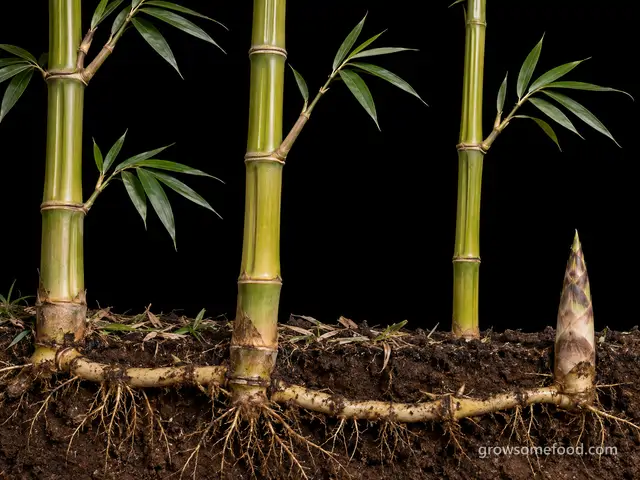
Running Bamboo

Phyllostachys spp. · Poaceae
Other Perennial Grass Other
Introduced - the running bamboos sold in US nurseries are almost all Phyllostachys from China and Japan. North America has one native bamboo genus, the river canes (Arundinaria).
Not recommended to plant. Do NOT plant running bamboo. Its rhizomes travel 10-20 feet a year under fences, patios, and property lines; removal costs thousands and can end in a neighbor lawsuit. Connecticut regulates it by state law and many northeastern towns have bamboo ordinances. Plant clumping bamboo instead.

Bamboo is not poisonous to touch, and cooked shoots are an everyday Asian food - but RAW shoots are not safe. Phyllostachys shoots carry cyanogenic glycosides (taxiphyllin) that release cyanide; peel and boil them uncovered in plenty of water for at least 20 minutes, and never eat them raw or lightly steamed. Cut shoots also leave hard angled spikes that go through a shoe, so cut them flush with the ground. The largest hazard, though, is to property and to your neighbors.

Overview

The fastest privacy screen money can buy, and the one that most often ends in a lawsuit. Running bamboo spreads underground at 10-20 feet a year, crosses fences and property lines, and costs thousands to remove. This entry is for telling running from clumping, containing it, and getting rid of it.

Running bamboo — almost always a Phyllostachys in the United States — is sold as the miracle privacy screen: evergreen, 20 to 40 feet tall, unkillable, and fast. All of that is true, and the last two words are the problem. The visible grove is only part of the plant. Underground, running bamboo produces long horizontal rhizomes that travel through the top foot of soil at 10 to 20 feet a year, pass under fences, driveways, patios, and property lines, and send up new canes wherever they surface. A screen that looked tidy for four years becomes an unmanageable grove in year five, and by then it is usually on somebody else’s side of the fence too.

This is why running bamboo is one of the very few garden plants that regularly produces legal disputes and municipal ordinances. Connecticut regulates it at the state level, restricting how close to a property line it may be planted and making the owner answerable for spread onto adjoining land, and dozens of towns across New York and New Jersey have passed their own bamboo rules. Professional removal of an established grove routinely runs into thousands of dollars.

Nothing here is an argument against bamboo as a plant. Clumping bamboos exist, behave themselves, and give you most of the same look; cooked bamboo shoots are a genuine crop; the canes are the most useful garden stake there is. This entry exists to help you work out which kind you are looking at, hold the line on one you already have, and remove one you no longer want.

At a glance

Sun
Full sun · Part sun · Part shade
Water
Medium
Spacing
36–600 in (typ. 120)
Mature height
120–840 in (typ. 360)
Start by
Division
Frost
Hardy
Spread
120–2400 in (typ. 720)
Soil
Well-drained
Temperature
Damaged below -10°F · struggles above 105°F

When to plant

No planting window on record for this zone.

Life stages

  1. Shooting season (the one control window) Apr, May, Jun (yearly)
    • Recognize it: hollow jointed canes, and new canes far from the clump
      Bamboo canes (culms) are hollow, round, and divided by solid joints, with leafy branches at each node. The tell for a RUNNING bamboo is not the cane but the pattern: new canes appear scattered several feet to many yards from the original plant - in lawn, borders, gravel, and next door - while a clumping bamboo only ever widens one tight, solid clump. Phyllostachys, the genus behind nearly every runner sold here, also has two branches per node and a flattened groove up one side of each internode.
    • Snap off every unwanted shoot while it is still softevery 4 d
      New shoots are tender for only a few days - you can snap or kick them off at ground level with no tools. Leave one standing and it hardens into a permanent cane at full height within 6-8 weeks, and it will never be that easy again. Walking the perimeter twice a week through shooting season and knocking down everything outside the line you want is the single most effective thing you can do, and repeated over two or three seasons it is what actually starves a grove out.
    New canes erupting many feet outside the clump - in lawn, borders, or the neighbor's yardShoots pushing up through gravel, mulch, deck boards, and pavement jointsCulms reaching full height in 6-8 weeks and never growing taller or thicker againSharp spikes left behind where shoots were cut above ground level
  2. Summer and fall rhizome run Jul, Aug, Sep, Oct (yearly)
    • Follow the rhizomes, not the canes
      The plant that matters is underground. Running bamboo makes long, pale, jointed rhizomes that travel horizontally in roughly the top 12 inches of soil - occasionally deeper around obstacles - and extend 10 to 20 feet in a season in a good climate. Push a spade in a few feet beyond the last cane and you will find them. Where the rhizome goes this summer is where the canes come up next spring, so that is the line you have to hold.
    • Root-prune the whole perimeter once a year
      Once a year, drive a sharp spade its full depth in a continuous line around the grove and cut every rhizome crossing it. Pull the severed pieces out rather than leaving them - any fragment with a live bud can resprout. If a rhizome barrier is installed (60-mil HDPE, 24-30 inches deep, sloped outward, about 2 inches proud of the soil), walk it in late summer and cut off the rhizomes it has deflected up over the lip. A barrier nobody inspects fails.
    Pale jointed rhizomes running just under the sod well outside the groveRhizomes arching up over the lip of a containment barrierBamboo appearing on the far side of a fence, wall, or driveway
  3. Winter (digging, trenching, and planning) Jan, Feb, Mar, Nov, Dec (yearly)
    • Dig, trench, and cut back while the grove is quiet
      Most bamboos hold their leaves through winter, but nothing is shooting, so this is when to do the heavy work: excavate rhizome masses, open or re-cut a containment trench, and cut a grove you intend to eliminate flat to the ground so that spring shoots emerge into open sight. Bag or burn what you remove where local rules allow - never dump bamboo rhizomes on a brush pile, in a wood, or over a bank, because every joint with a bud is a new grove.
    • Check the property line before the spring flush
      Winter is the honest audit: walk the boundary, look for canes on the wrong side of it, and check whether your town has a bamboo ordinance. Dealing with three escaped canes in February is a conversation; dealing with thirty in July is a dispute.
    Canes standing on a neighbor's side of the lineRhizome masses exposed by digging - remove every fragmentOld culms dying back naturally after about 10 years (normal, not a sign of decline)

Watch out for

Runaway Rhizome Spread High DisorderApr, May, Jun, Jul, Aug, Sep, Oct

The defining hazard of running (leptomorph) bamboo. Underground rhizomes travel horizontally through roughly the top foot of soil, commonly 10 to 20 feet in a single season, and send up new canes wherever they surface. They pass under fences, driveways, patios, and property lines, come up through lawn, gravel, mulch, and deck boards, and cannot be pulled out like a weed. A planting that looked like a tidy screen for three or four years becomes an unmanageable grove in year five - and by then it is usually next door as well.

Watch for: New canes appearing many feet outside the original planting, especially out in lawn or in a neighbor's bed. Shoots pushing up through gravel, mulch, deck boards, and pavement joints. Pale jointed rhizomes, like miniature canes, turning up whenever you dig near the grove. Bamboo on the far side of a fence, wall, or driveway from the plant you actually own.

Prevent: The only certain prevention is not planting it - choose a clumping bamboo or a native screening plant instead. If a runner is already in the ground, contain it: a continuous 60-mil HDPE rhizome barrier buried 24-30 inches deep, sloped outward, with about 2 inches standing above grade so escaping rhizomes are deflected up where you can see and cut them. An open trench or mown strip a foot deep does the same job. Either way it only works if you walk the line every year and cut what has crossed it.

Treat: There is no single-season fix. The reliable non-chemical method is starvation: cut every cane to the ground, then knock down every new shoot as it appears, through the whole growing season, for two to three years, until the rhizomes exhaust their stored starch. Digging works only if the entire rhizome mass comes out, since every fragment with a live bud resprouts - which usually means excavating a foot or more of soil. Where herbicide is used, cut the grove, let it releaf, and treat the fresh foliage with a product whose label lists the site you are treating; the label is legally binding, so read and follow it, and expect several seasons of follow-up.

This applies to Phyllostachys, the genus behind nearly every running bamboo sold in the US. Clumping bamboos (Fargesia, Bambusa, Chusquea) have pachymorph rhizomes that turn upward within a few inches and simply widen the clump - they do not run.

Neighbor Damage & Bamboo Ordinances Medium Disorderyear-round

Running bamboo is one of the few garden plants that reliably generates legal disputes, because the rhizomes cross property lines underground and the plant you bought becomes the neighbor's problem. Connecticut regulates running bamboo by state law, restricting planting near a property boundary and making the owner answerable for spread onto adjoining land, and dozens of municipalities across New York and New Jersey have adopted their own bamboo ordinances requiring containment, setbacks, or removal - some with disclosure requirements when a property is sold. There is no federal listing, and most of the country has no rule at all, so this is a local question.

Watch for: Bamboo emerging on a neighbor's side of the line, in a shared bed, or in a right-of-way. Shoots lifting or cracking pavers and patio slabs, coming up along asphalt edges, and appearing inside a garage, shed, or crawlspace. A complaint from a neighbor or a notice from a town code officer.

Prevent: Do not plant it. If you inherit a stand, find out what your town and state actually require before you do anything, keep a maintained barrier or trench well inside your own line rather than on it, and talk to the neighbor early - jointly maintained containment is far cheaper than a dispute.

Treat: Contain and remove it on your own side and keep a record of what you did and when. Where an ordinance applies, follow its containment or removal requirements. Where bamboo has already crossed a boundary, the practical fix is a barrier or trench along the line maintained by both sides; who pays for what is a question for a local attorney, not a garden guide.

Raw Bamboo Shoots (Cyanogenic) Medium DisorderApr, May, Jun

Bamboo shoots are a real food, but not raw. Fresh shoots of Phyllostachys and most other bamboos contain cyanogenic glycosides - taxiphyllin above all - which release hydrogen cyanide when the tissue is cut or chewed, with the highest concentrations at the tip and in the outer layers of a freshly cut shoot. Poisonings happen where shoots are eaten raw or barely cooked. Boiling drives the compounds off, which is why every traditional preparation in Asia begins with a long boil in an open pot, and why canned shoots are safe as sold.

Watch for: A bitter, acrid taste - properly boiled shoots are mild and faintly sweet, so bitterness means the job is not finished. Headache, dizziness, nausea, or rapid breathing after eating undercooked shoots warrants medical attention.

Prevent: Peel off the sheaths, trim the woody base and the pointed tip, slice the shoot, and boil it in plenty of water in an UNCOVERED pot for at least 20 minutes so the volatile compounds can escape; then drain and rinse. Change the water and boil again if it still tastes bitter. Never eat bamboo shoots raw, and do not treat a light steam or a stir-fry as sufficient cooking.

Treat: Re-boil a bitter shoot in fresh water or discard it. Seek medical advice for symptoms following a meal of undercooked shoots.

A genuine food-safety rule rather than a caution about the invasive habit - and one more reason not to let 'I will eat the shoots' become the justification for planting a running bamboo.

Varieties · 6

Black Bamboo (Phyllostachys nigra)

Slender canes 15-25 feet that age from green to glossy brown-black, with fine airy foliage.

runningdo-not-plantornamentalblack-culms

The beautiful one, and the reason many people plant a runner despite the warnings: canes emerge green and darken to near-black over their first year or two. It runs exactly like the rest of the genus. If you want it, grow it in a large above-ground container or accept a maintained barrier and annual root-pruning for the life of the planting.

Clumping bamboo (Fargesia, Bambusa) - the safe substitute

One dense, solid, fountain-shaped clump of canes - never scattered outliers.

alternativeclumpingnon-runningrecommended-instead

Clumping bamboos have pachymorph rhizomes that turn upward within a few inches, so the plant widens a dense clump by inches a year and never sends a cane out into the lawn. Fargesia (umbrella and fountain bamboos) is the cold-climate choice for zones 5-8 and prefers part shade and cool summers; Bambusa gives the big tropical look in zone 8b and warmer. This is what to buy if you want bamboo.

Golden Bamboo (Phyllostachys aurea)

Yellow-green canes 15-30 feet with distinctively compressed, swollen joints in the lower few feet.

runningdo-not-plantnaturalizedsoutheast

The classic fishing-pole bamboo, and the running bamboo most thoroughly naturalized in the United States - it lines streams, roadsides, and old homesites across the Southeast, where it forms monocultures that exclude everything else. Recognizable by the crowded, swollen, tortoise-shell nodes at the base of each cane.

Native screening alternatives

Varies - tall native grasses for a seasonal screen, evergreen or deciduous shrubs for a permanent one.

alternativenativenon-invasiverecommended-instead

For a screen without the rhizomes: switchgrass and big bluestem give a 5-8 foot warm-season wall from midsummer through winter and feed birds and insects; inkberry holly gives evergreen structure; ninebark and elderberry make a fast deciduous hedge. Ask a local native-plant nursery what screens best for your region and soil.

River Cane (Arundinaria gigantea) - the native bamboo

Slender canes 6-20 feet with fan-like clusters of leaves; forms open colonies in moist bottomland.

nativerunningconservationcanebrake

North America does have a bamboo: the river canes of the Southeast and lower Midwest, which once formed vast canebrakes along river bottoms and are now among the continent's most reduced habitats. It is a running bamboo too, so it is not a tidy garden substitute, but for a large native restoration or streambank planting it is the ecologically right answer where Phyllostachys is the wrong one.

Yellow-Groove Bamboo (Phyllostachys aureosulcata)

Green canes to 20-30 feet with a yellow groove up alternating sides of each internode; some canes zig-zag at the base.

runningdo-not-plantcold-hardyscreen

The most-planted hardy running bamboo in the Northeast and Midwest - 20-30 feet, cold to about -10F, and the species behind a large share of the neighbor disputes. Named for the yellow groove up each green internode. Vigorous, tough, and completely unstoppable without a maintained barrier.

Grow

How to recognize it and why never to plant it: hollow jointed canes with a groove up each internode and two branches per node, and - the real tell - new canes coming up scattered far from the original plant instead of in one tight clump.

You should not plant running bamboo, so what matters is identifying it. All bamboos are giant grasses with hollow, round, jointed canes (culms), papery sheaths on new growth, and leafy branches at the nodes. Phyllostachys, the genus behind nearly every running bamboo sold in America, has two diagnostic features: two branches at each node (one larger, one smaller), and a flattened groove running up one side of each internode, alternating sides as you go up the cane. Canes are typically 10 to 40 feet tall and 1 to 3 inches thick.

The character that actually decides the question is the spread pattern, not the cane. A running bamboo puts up new canes scattered — three feet out into the lawn, ten feet into a border, twenty feet away in the neighbor’s bed — with open ground in between. A clumping bamboo (Fargesia, Bambusa, Chusquea) only ever widens one dense, solid clump by a few inches a year, and there is never a cane standing alone out in the grass. If you are unsure, dig: a running bamboo’s rhizome is long, pale, jointed like a miniature cane, and heads off horizontally; a clumper’s turns upward within a few inches.

One more growth fact shapes everything about control: a bamboo cane reaches its full height and thickness in six to eight weeks and then never grows again. All the plant’s expansion goes into rhizomes and next year’s shoots. That is why cutting canes does nothing on its own, and why interrupting the shoots is the whole game.

Two catalog lookalikes are worth naming, because both get called bamboo. Japanese knotweed is nicknamed Japanese bamboo and does form bamboo-like hollow canes — but it has zig-zag stems, broad shovel-shaped leaves, and dies to the ground every winter. Nandina is sold as heavenly bamboo and is not a bamboo at all; it is a barberry relative with lacy compound leaves and red berries.

Propagation & seed saving

How it actually spreads: long leptomorph rhizomes in the top foot of soil, resprouting from any fragment with a live bud. Seed is almost irrelevant - most groves flower once in many decades and then die.

Running bamboo spreads by leptomorph rhizomes: slender, jointed, mostly horizontal underground stems that run through roughly the top 12 inches of soil, occasionally diving deeper to get around an obstacle. Each joint carries a bud that can become either another rhizome or a shoot, and the network stores enormous quantities of starch — which is why a cut grove comes back with such force and why control has to be measured in years rather than weeks.

Every fragment with a live bud is a new plant. That makes soil movement the main long-distance vector: dumped clumps, shared divisions over the fence, contaminated fill, and rototilling through a rhizome mat all start new groves. It is also why digging half-heartedly makes things worse — a spade that chops a rhizome into six pieces has just planted six bamboos.

Seed barely matters. Most bamboo species flower gregariously, meaning every plant of a clone worldwide flowers in the same few years after intervals that can run from 30 to 120 years, sets seed, and then dies. If your grove suddenly flowers, turns straw-colored, and collapses, that is what happened; it is not a disease, and it is the one time a grove can be removed cheaply.

Care

Containment or removal, not care: a maintained 60-mil barrier or annual root-pruned trench holds it; getting rid of it means cutting everything down and knocking off every shoot for two to three seasons, or excavating the whole rhizome mass.

If you are keeping it, contain it properly. The standard is a continuous 60-mil HDPE rhizome barrier buried 24 to 30 inches deep, sloped slightly outward, with about 2 inches standing proud of the soil so escaping rhizomes are deflected up where you can see them. The seams must be clamped, not merely overlapped, and the barrier is only half the job: you have to walk it every year in late summer and cut off whatever has climbed over the lip. The low-tech equivalent works just as well — an open trench or a regularly mown strip about a foot deep around the grove, inspected and re-cut annually. What does not work is a bed edging, a landscape-fabric skirt, a concrete path, or a fence.

If you are removing it, plan on years. The reliable non-chemical method is starvation. Cut or mow every cane flat to the ground, then return every week or two through the whole growing season and knock down every new shoot while it is soft. Repeat for two, usually three seasons. The rhizomes are living on stored starch; deny them leaves long enough and the network dies. Mowing a bamboo patch on a lawn schedule does the same thing and is why bamboo never invades a mown lawn.

Excavation is the fast option and the expensive one: the entire rhizome mass has to come out, which usually means a machine and a foot or more of soil, and any fragment left behind restarts the clock. It is what most professional removals amount to.

If you use herbicide, the pattern that works is to cut the grove down, let it releaf, and treat the fresh foliage — bamboo is a grass, so grass-active products apply, and repeat treatments are normal. Use a product whose label lists the site you are actually treating (lawn, ornamental bed, fencerow, non-crop area), and follow that label exactly: it is a legally binding document, and it also tells you what you may plant afterward. Do not treat near a pond, ditch, or stream unless the product is specifically labeled for aquatic sites. Expect several seasons of follow-up regardless of method — anyone promising a one-application fix has not removed bamboo before.

In the kitchen

Bamboo shoots are a genuine vegetable, but only after peeling and a long uncovered boil - raw shoots are cyanogenic. Cutting shoots is also a control method, which makes this the one honest use for a grove you already have.

Bamboo shoots are one of the great vegetables of East and Southeast Asia, and the spring shoots of Phyllostachys are exactly what is eaten — P. edulis (moso) is the main commercial species, and the common ornamental runners are all usable. Cut them short and fat, before the sheaths open and the shoot greens up, taking them flush with the ground with a sharp spade. That is also, conveniently, the single best control action there is.

The preparation rule is not optional. Fresh shoots contain cyanogenic glycosides (taxiphyllin above all), which release hydrogen cyanide when the tissue is cut or chewed. Strip off the tough sheaths, trim the woody base and the pointed tip, slice the shoot, and boil it in plenty of water in an uncovered pot for at least 20 minutes — the pot stays open because the volatile compounds have to leave. Drain, rinse, and taste: mild and sweet is done, still bitter means boil again in fresh water or throw it out. Never eat bamboo shoots raw, and do not treat a quick steam or a stir-fry as sufficient cooking. (Canned shoots have already been processed and are ready as sold.)

After that, they are excellent — crisp, faintly sweet, and good in stir-fries, braises, soups, and pickles. Just do not let a bag of shoots become the argument for planting a grove. Harvesting shoots from bamboo you already have is sensible; planting running bamboo in order to harvest shoots is how people end up with the rest of this page.

Troubleshooting

Running or clumping, the neighbor question, whether it wrecks foundations, why cutting alone fails, what to do when a grove flowers and dies, and what to plant instead.

Is mine running or clumping? Look at where new canes come up. Scattered canes with open ground between them, or a cane out in the lawn, means running. A single dense clump widening a few inches a year means clumping. Dig if you need to: a running rhizome is long, pale, and horizontal; a clumper’s turns up almost immediately.

Can I just cut it down? Not once. Cutting canes removes this year’s leaves and nothing else — the rhizomes hold years of stored starch and will re-shoot hard. Cutting only works as repeated cutting: every cane down, then every new shoot knocked off through two or three full growing seasons.

Will it break my foundation? There is no good evidence that bamboo cracks sound concrete. What it genuinely does is exploit what is already open: it comes up through expansion joints, paver sand, asphalt edges, cracks, and the gap beside a footing, and shoots can lift pavers and deck boards and appear inside garages and crawlspaces. That is a real and expensive nuisance, and it is a reason to keep it well away from structures — but the horror story about bamboo destroying foundations is overstated.

My neighbor’s bamboo is coming into my yard. In most places you may cut what crosses onto your property, and a maintained trench or barrier on your own side of the line is the practical defense. Whether the neighbor owes you anything depends on where you live — Connecticut and a number of northeastern towns have specific bamboo rules, most places do not — so check your town code first, talk to the neighbor second, and treat a lawyer as the last resort rather than the first.

Is it illegal to plant? In some places, yes or nearly so. Connecticut regulates planting near property lines and holds owners responsible for spread; many New York and New Jersey municipalities require containment, setbacks, or removal, and some require disclosure at sale. There is no federal listing. Check your own town before you buy anything labeled bamboo.

It flowered and then died. That is gregarious flowering — bamboo clones flower once every few decades, set seed, and die. Nothing you did caused it. Take the opportunity: a flowering grove is at its weakest and easiest to remove.

The cut stubs stab through my shoes. Cut culms and shoots leave hard angled spikes. Always cut flush with the ground, and go back and re-cut anything left standing a few inches proud.

What should I plant instead? For an evergreen screen, a clumping bamboo (Fargesia in cool climates, Bambusa in zone 8 and warmer) does the same job without running. For a native alternative, tall warm-season grasses like switchgrass and big bluestem give a 5-8 foot summer screen that supports wildlife, and inkberry holly, ninebark, or elderberry make a real hedge.

History

Introduced to the US in the 1880s-1900s by USDA plant explorers and promoted for erosion control, poles, and shoots, running bamboo became the suburban privacy screen of the late 20th century - and then the subject of the first municipal bamboo ordinances.

Bamboo arrived in the United States as a serious agricultural project. USDA plant explorers, most famously David Fairchild, imported dozens of Asian species around the turn of the twentieth century, and a federal bamboo research station near Savannah, Georgia spent decades trialing them for poles, paper pulp, erosion control, and shoots. Many of the runners naturalized from those trials and from the nursery trade that followed, and golden bamboo (Phyllostachys aurea) is now thoroughly established along streams, roadsides, and old homesites across the Southeast.

The suburban chapter came later. From the 1970s onward running bamboo was marketed hard as an instant privacy screen — cheap, evergreen, and startlingly fast — and homeowners planted it along thousands of property lines with no idea what a leptomorph rhizome was. The consequences arrived on a predictable ten-year delay, and by the 2000s municipalities in New York, New Jersey, and Connecticut were writing bamboo into their codes, with Connecticut passing a state law in 2013. It is one of the clearest cases in American gardening of a plant whose sale was never restricted until neighbors started suing each other.

Growing across climates

Hardy across roughly zones 5-10 depending on species, and most aggressive in the warm, humid Southeast and the maritime Pacific Northwest; hard winters kill canes back but not rhizomes, so cold does not contain it.

The running bamboos cover an enormous climate range. The hardiest — Phyllostachys bissetii, P. aureosulcata — take roughly -10°F to -20°F and are grown into zone 5; most of the rest are comfortable in zones 6-10. Spread is fastest where the growing season is long and wet: the humid Southeast, where golden bamboo has naturalized widely, and the maritime Pacific Northwest, where mild winters and constant moisture let rhizomes run nearly year-round.

Cold does not contain it, which is the point people get wrong. In a hard winter the canes may brown off or die outright, and the grove looks finished — but the rhizomes are insulated underground and survive, and the grove re-shoots from the ground in spring, often more densely than before. In the far North a top-killed bamboo behaves like a coarse perennial grass rather than a screen, which is a good reason not to plant it there either.

Drought and deep shade slow it. Poor, dry, compacted soil and heavy shade will hold a grove to a crawl for years, and that is usually why an old planting looks harmless — until an irrigation line, a wet season, or a neighbor’s new lawn gives it what it was missing. Wherever you are, the guidance is the same: identify whether it runs, contain it with a maintained barrier or trench if you keep it, and remove it while it is still measured in feet rather than yards.

No grower tips for Running Bamboo yet — yours could be the first.

Sign in to share what works in your garden.

Connection interrupted

Reconnecting to GrowSomeFood

Keep this page open. We are trying to restore your garden session.

Attempt of . Retrying automatically.

Still offline

Could not reconnect

Your phone may have switched networks or gone to sleep. Try again when the signal is steady.

Session expired

Reload to continue

This garden session is no longer available on the server. Reloading will start a fresh session.