Add it to your home screen and it opens full screen: no browser bars, one tap away, and everything stays signed in. Free, nothing to download from an app store.
- Tap the Share button in your browser
- Scroll down and choose “Add to Home Screen”
- Open GrowSomeFood from your home screen
- Open your browser’s menu
- Choose “Add to Home screen” or “Install app”
- Open GrowSomeFood from your home screen
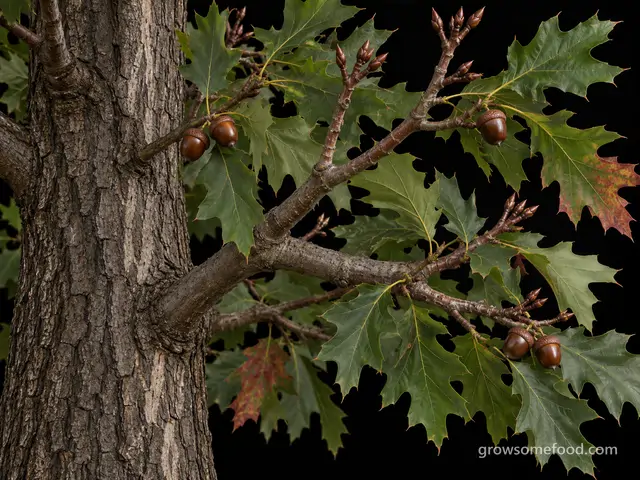
Red Oak
The oak you can actually plant: fast for its genus, easy to transplant, brilliant in fall, and the same keystone wildlife tree as white oak - feeding more caterpillar species than anything else on the continent. Its one vulnerability is oak wilt, which kills red oaks in a season.
Red-oak acorns are edible only after thorough leaching - they are far more tannic than white-oak acorns and need many changes of water until no bitterness is left. Never eat raw acorns. Acorns and oak leaves are also toxic to dogs, a common autumn poisoning and an obstruction risk, and oak buds and young leaves poison cattle and other livestock eaten in bulk in spring. Discourage dogs from eating acorns under the tree. The tree itself is entirely safe to grow, handle and prune.
Overview
Northern red oak (Quercus rubra) is the oak that fits real life. Where white oak is a slow, deep-taprooted 300-year monument, red oak grows fast for an oak - often two feet a year when young - transplants readily because its roots are fibrous and spreading rather than one deep taproot, and reaches a fine 60-80 foot rounded shade tree in a human lifetime. That combination is why it became the standard street, park, and yard oak across the Northeast and Midwest, and it is the most sensible first oak for most gardeners.
Ecologically it carries the full weight of the genus. Oaks feed more species of native caterpillar than any other tree in North America - hundreds of them - and those caterpillars are the protein that nearly every songbird raises its young on, so an oak is a bird nursery in a way no ornamental can match. Red oak's contribution is distinctive: its acorns are higher in fat and tannin than a white oak's, so wildlife eats them second, which means they carry over into winter and feed deer, turkeys, squirrels, and jays through the months after the sweeter acorns are gone. Add russet-to-scarlet fall color that is often better than white oak's, and there is very little not to like.
The catch is one disease. The red-oak group has almost no resistance to oak wilt, which can kill a mature tree in a single season, and it spreads to fresh wounds made in spring and early summer. The rule that follows is short and absolute: never cut a red oak between April and July.
Quick facts
- Sprouts in
- 120 days30 to 210
- Soil to sprout
- 60 °F45 to 70
- Life cycle
- Perennial, lives about 200 years
- Seed to save
- Second yearafter overwintering a few plants
- Height
- 70 ft50 to 90
- Spread
- 60 ft40 to 75
- Cold
- Takes hard frostdamaged below -40°F
- Heat
- Struggles above 95°F
- Self-sows
- Yes, expect volunteers
Full sun or part sun · medium water · well-drained soil · 40 ft apart (25 to 70) · direct sow or transplant
When to plant
Fall sowing is open for 48 more days. Next: spring, Mar 20 to May 22.
- Direct sow Sep 20 – Nov 8 Open now · 48 days leftAbout 5 weeks before to 2 weeks after your first frost (Oct 25 here)Plant sound acorns an inch or two deep in fall right where you want the tree, protected from squirrels by a screen or wire cage. Red-oak acorns need winter cold to break dormancy and germinate the following spring - do not let them dry out before you sow.
- Transplant Aug 16 – Sep 27 Closes in 6 daysAbout 10 weeks before to 4 weeks before your first frost (Oct 25 here)Fall planting works in zones 4 and warmer - roots keep growing after leaf drop. In the coldest zones stick to spring, and water any fall-planted oak until the ground freezes.
- Transplant Mar 20 – May 22 Opens in 180 daysAbout 3 weeks before to 6 weeks after your last frost (Apr 10 here)Spring is the standard window. Red oak transplants far more readily than white oak thanks to its fibrous roots, which is why it is the usual nursery and street oak - but give it acidic, well-drained soil and plenty of room, and water it through its first summers.
Frost here: last around Apr 10 (Mar 27 to Apr 24 most years), first around Oct 25. Zone averages, your own yard may run a week or two either way.
Life stages
One stage to settle in, then three that repeat each year. Windows are typical; your zone and weather move them.
Years 1-3 - young tree
The first year after planting- WaterWater deeply while establishingweeklyWater a young red oak deeply and regularly through its first two or three years, especially in drought. Unlike white oak it has a fibrous, spreading root system rather than a deep taproot, which is exactly why it transplants easily and why nurseries and cities plant it - but a newly moved tree still has far less root than canopy for the first few seasons.
- MulchMulch wide, keep it off the trunkA broad mulch ring protects the shallow roots and the thin young bark from mowers and string trimmers and holds moisture. Keep it a few inches back from the bark rather than piling it against the trunk.
- ProtectGive it room and acidic, well-drained soilRed oak becomes a 60-80 foot tree with a broad rounded crown, so site it well away from buildings, pavement, and power lines. It wants slightly acidic, well-drained ground; in high-pH or limestone soils it yellows with chlorosis, and a Shumard or chinkapin oak is the better choice there.
- ProtectCage it against deer browse and buck rubA wire cage or trunk guard around a young oak, left on until the trunk thickens and the canopy is above browse height, prevents both browsing and the autumn antler rubbing that girdles and kills young trees. This is the highest-value thing you can do for a young oak.
Watch for- Deer browsing and autumn buck rub on young trunks
- Yellow leaves with green veins in alkaline soil (chlorosis)
- String-trimmer damage to thin young bark
- Dry soil in the first three summers
Spring & summer canopy
Apr to Aug, every year- ProtectMake NO cuts or wounds from April through JulyThis is the one rule that matters most on a red oak. Fresh wounds in spring and early summer attract the sap beetles that carry oak wilt, and the red-oak group is the group the disease kills - an infected red oak can go from healthy to dead in a single season. Do not prune, do not stake into the trunk, and keep mowers and trimmers away. If a storm breaks a limb in this window, paint the wound immediately.
- InspectA caterpillar nursery - leave the leavesOaks feed more kinds of native caterpillar than any other tree in North America - hundreds of species - and those caterpillars are what nesting songbirds feed their chicks. Expect and welcome some chewed leaves and the occasional gall; most damage is cosmetic and is the point of the tree. Never spray a keystone tree.
- WaterWater in serious droughtevery 2 weeksAn established red oak is fairly drought-tolerant, but drought is what turns a survivable problem into a fatal one on this species - a tree stressed by drought or defoliation is the one two-lined chestnut borer kills. Soak the root zone deeply in an extended dry spell, especially on a young tree.
Watch for- ANY wound between April and July - the oak wilt window
- Sudden wilting and bronzing from the top of the canopy down (oak wilt - act immediately)
- Caterpillars and galls (mostly harmless and valuable wildlife food)
- Spongy moth in an outbreak year - buff egg masses on the trunk and near-total defoliation by early July
Acorn drop (fall)
Sep to Oct, every year- HarvestGather acorns (for wildlife, for planting, or leach for food)every 3 daysA mature tree drops acorns in fall, heavily in periodic 'mast' years. Red-oak acorns take TWO growing seasons to ripen, so a heavy crop this year means the flowers were set the spring before last. Float-test them and discard the floaters. For food, red-oak acorns are far more tannic than white-oak acorns and need much longer leaching: cold-leach in repeated changes of cold water over days for flour, or hot-leach in several changes of boiling water for nutmeat.
- InspectWatch the wildlife feast - and let some carry overRed-oak acorns are higher in fat and tannin than white-oak acorns, so wildlife eats them second - which is exactly their ecological value. They keep on the ground and stay edible into winter, feeding deer, turkeys, squirrels, jays, and woodpeckers through the hungry months after the sweeter white-oak crop is gone. Leaving them is a genuine wildlife harvest.
Watch for- Boom-and-bust mast years (heavy crops every 2-5 years, light between)
- Weevil-infested acorns (a float test discards them)
- Acorns on paths and drives - they roll underfoot and are slippery when crushed
- Dogs eating fallen acorns (a common autumn poisoning)
Fall color & winter dormancy
Oct to Feb, every year- PrunePrune ONLY in winter dormancyPrune red oaks only in the dormant season, roughly November through February. Pruning wounds in spring and summer attract the sap beetles that spread oak wilt, and the red-oak group has almost no resistance to it. Save all pruning for the cold months, take out dead and crossing wood then, and paint over any wound you are forced to make in the growing season.
- InspectDo not move or accept oak firewoodOak wilt travels in firewood: fungal mats form under the bark of wood cut from an infected red oak, and beetles carry spores from a stacked pile to a healthy tree. Burn oak firewood where it was cut, and if you have wood from a tree that died suddenly, cover the pile with plastic sealed at the ground until it is fully dry.
- InspectEnjoy the fall color, then rake the leaves off the lawnRed oak turns russet to brilliant scarlet in fall, often better than white oak. The leaves are tough and slow to break down, so rake heavy drifts off lawn - but leave a soft layer of leaf litter in beds and under the canopy, where the caterpillars the tree feeds complete their life cycle in it.
Watch for- Storm damage needing repair - do it now, not in spring
- Oak firewood arriving from elsewhere (an oak wilt route)
- Vole and rabbit gnawing at the base of young trunks under snow
Harvest
- Mature tree (20-30+ years) - young oaks do not bear acorns
- Acorns fully brown and dropping in fall, heaviest in periodic 'mast' years
- For food: acorns leached of tannins until no bitterness at all remains - which takes far longer than it does for white oak
- Gather acorns (for wildlife, for planting, or leach for food) · every 3 days
- Watch the wildlife feast - and let some carry over
Picking pick as they ripen
Watch out for
6 to know. 2 are high-risk: Oak Wilt, Spongy Moth. 2 are active in September.
Oak WiltSeverity High DiseaseThis is the threat that defines red oak care.
The red-oak group has almost no resistance: an infected tree often dies within weeks to a single season, and the fungus then moves underground through root grafts into neighboring oaks. Two habits prevent nearly all of it - make no cut or wound between April and July, and never move or accept oak firewood. If a red oak wilts from the top down in summer, call a certified arborist the same week.
Wilting, yellowing or bronzing of leaves and rapid canopy dieback, often spreading outward tree-to-tree through a stand; veinal chlorosis on live-oak leaves.
Consult a certified arborist - management may include trenching to break root grafts and fungicide injection of high-value trees; there is no simple cure once a tree is infected.
NEVER prune or wound oaks in the warm growing season - prune only in the cool dormant months and immediately paint any cuts or storm wounds; avoid moving oak firewood; sever root grafts between trees in known outbreak areas.
A deadly fungal disease that clogs the tree's water-conducting vessels, spread by sap-feeding beetles to fresh wounds and tree-to-tree through connected roots. Live oaks are highly susceptible in parts of their range (notably central Texas), where interconnected roots let it spread through whole groves.
Spongy MothSeverity High PestRed oaks are among the caterpillar's most preferred hosts and take outbreaks harder than white oaks - severity is High here rather than Medium for that reason.
The lethal sequence is defoliation followed by drought followed by two-lined chestnut borer, so the single most useful thing you can do in an outbreak summer is water the tree deeply rather than reach for a spray.
Buff, felt-like egg masses about the size of a quarter on the trunk, limbs, and nearby structures in fall and winter; hairy caterpillars with paired red and blue dots in late spring; and, the real signal, near-total leaf loss by early July rather than scattered chewing.
In a normal year, do nothing: chewed leaves are the point of a keystone tree, and never spray an oak on principle. Only in a genuine outbreak (near-total defoliation, or a second consecutive year) consider Btk timed to the small early-instar caterpillars, which spares most other insects, and water the tree deeply through the summer. Consult an arborist for a large or high-value tree.
Scrape egg masses off the trunk into soapy water over winter, and wrap a burlap band around the trunk in early summer to trap caterpillars that climb down by day. Keep the tree deeply watered through a defoliation summer - drought stress is what turns defoliation into death.
An introduced defoliating caterpillar (Lymantria dispar) of the Northeast, mid-Atlantic, and upper Midwest. In most years it is part of the ordinary caterpillar traffic an oak feeds; in outbreak years it strips white oaks bare by early July, and a second or third consecutive defoliation - especially in a drought summer - can kill a mature tree.
Deer (browse resistance)Severity Medium WildlifenowDeer are the main reason planted oak seedlings fail, and in much of the eastern US heavy deer pressure is why oak forests are not regenerating at all.
Cage or tube every young red oak and leave the guard on until the trunk is thick and the lowest branches are above browse height - autumn buck rub kills more young oaks than browsing does.
Growth cleanly missing overnight, with the plant browsed back to a level line about as high as a deer can comfortably reach. Ragged, torn stem ends rather than the clean angled cut a rabbit leaves - the single most reliable identifier. Buds and flowers gone while the foliage below is untouched, since deer often take the best part first. Hoof prints and droppings in soft ground near the damage. Repeat visits, with fresh damage each morning once a planting has been found. On young trees, shredded and stripped bark and broken low branches in autumn - that is antler rubbing rather than feeding.
There is no chemical fix, only exclusion and recovery. Get physical protection up immediately after the first damage, because deer return to a known meal, and reinforce or rotate whatever you were relying on before. Most plants regrow from browsing if the crown and roots are intact - feed and water a grazed plant and protect the regrowth while it comes back. What does not recover in the same season is anything whose buds or flowers have been taken, and a young tree whose bark has been rubbed right around the trunk is usually lost. Where deer pressure is genuinely heavy, the honest answer is to fence properly or to grow the plants deer leave alone, rather than to keep replacing losses.
Fencing is the only thing that reliably works. Eight feet is the standard for excluding deer, or two parallel four-foot fences a few feet apart, which they will not jump because they cannot judge the landing. Short of that, cage individual plants: a sturdy wire cage or trunk guard around every young tree, left on until the trunk is thick and the canopy is above browse height, prevents both browsing and antler rubbing and is the single highest-value thing you can do for a young tree. Repellent sprays do help at moderate pressure, but they wash off and deer habituate, so reapply after rain and rotate between different types through the season. Motion-activated sprinklers, scent deterrents, and noise devices work for a while and then stop. Siting matters too: plants close to the house, in daily traffic, and screened behind other planting get browsed less than the same plant out at the boundary.
Deer are the largest garden problem across much of the country, and where pressure is high they set the limit on what you can grow at all. They browse at night and around dawn and dusk, taking tender shoots, leaves, buds, flowers, and fruit within about five feet of the ground, and they come back night after night to anything they have found and liked. Because they have no upper incisors they tear rather than cut, leaving ragged stem ends - that is how you tell deer damage from a rabbit's clean angled cut. In fall, bucks rub their antlers on young trunks and can strip the bark right around a stem, which kills a young tree outright. Palatability varies enormously between plants and between seasons: a herd short of food in late winter eats things it ignores in June, and no plant is truly deer-proof.
Two-Lined Chestnut BorerSeverity Medium PestThis is the beetle that finishes off red oaks after a drought or a spongy moth year, so it belongs on the same page as both.
Nearly all of the prevention is simply keeping the tree unstressed - water in drought, and keep construction and paving out from under the canopy.
Dieback that starts in the upper canopy and works downward year on year, with leaves wilting, browning, and hanging on the branch rather than dropping cleanly. Small D-shaped exit holes about an eighth of an inch across in the bark of dying limbs - the definitive sign. Winding, frass-packed galleries under the bark when a dead branch is peeled. Sprouts breaking out along the trunk and larger limbs as the tree tries to compensate. A history that fits: a drought summer, a defoliation year, recent construction over the roots, or a grade change around the trunk.
There is no home spray that reaches larvae already under the bark. Prune out dead and dying limbs - in winter, never in the April-to-July oak wilt window unless the tree is being removed - and destroy or debark the wood so emerging adults do not move to the next tree. Then treat the cause: water deeply and consistently, relieve compaction, mulch the root zone, and remove whatever stress started it. A tree caught early with only upper-canopy dieback often recovers over several seasons; one that has lost more than about half its crown usually does not, and an arborist should assess whether it is now a hazard.
Vigor is the entire defense, because the beetle cannot get into a healthy tree. Water deeply during drought and through and after any defoliation year, which is the single most valuable intervention. Protect the root zone: no trenching, grade changes, paving, or heavy equipment inside the canopy drip line, and mulch instead of mowing to the trunk. Avoid wounding the trunk and lower limbs. Do not stack freshly cut oak with bark on near living oaks, since the beetles emerge from it. And prune only in winter, both for this and for oak wilt.
A native beetle whose larvae tunnel in the inner bark and cut off the tree's supply lines. It is almost exclusively a secondary attacker: it cannot colonize a vigorous tree, and it finds oaks already weakened by drought, defoliation, root damage from construction, or soil compaction. Adults lay eggs in bark crevices in early summer, and the flat-headed larvae mine winding galleries through the phloem, girdling branches from the top of the canopy downward. On a tree that has been defoliated by caterpillars and then hit by a dry summer, this beetle is frequently what actually kills it, usually over two or three years rather than in one season.
Acorn WeevilSeverity Low PestnowRed-oak acorns are recalcitrant in the same way - never dry them out or freeze them - but unlike white-oak acorns they are dormant and need a cold, moist winter before they will germinate.
So the storage rule here is moist and cold, not sow-immediately: fall-sow outdoors, or hold them in damp sand or peat at around 35-40F until spring. Float-test either way.
Small round exit holes in fallen acorns and larvae inside; infested acorns float in a water test.
Discard infested acorns; no treatment needed for the tree. If you are holding sound acorns for planting, hot-water treatment is the only safe option - about 120°F / 49°C for 30 minutes, then cool and sow promptly. Never dry or freeze white-oak acorns - they are recalcitrant and die; see Storage.
For food or planting, do a float test and discard the floaters; gather acorns promptly after they drop.
Long-snouted weevils whose larvae develop inside acorns, hollowing them out - a factor if you're gathering acorns for food or planting, but harmless to the tree itself.
Oak GallsSeverity Low PestRed oaks host a particularly varied gall community, and the big round 'oak apple' galls people bring indoors to identify are usually from a red-oak-group tree.
Nothing to do. If you do want to cut galled twigs out, do it in winter, never in the April-to-July oak wilt window.
Round balls, woolly patches, or bumps on leaves and twigs, each housing a developing insect; sometimes abundant but rarely harmful.
None warranted; leave them. Heavily galled twigs can be pruned out in the cool season if you object to the look.
None needed - galls rarely harm the tree and support wildlife.
Tiny gall wasps and mites induce the tree to form bumps, balls, and woolly or spiky growths on leaves and twigs. Diverse and curious but essentially harmless, and part of the oak's rich insect community.
Good & bad neighbors
Plant nearby
-
Oak and cherry are the top two host genera in eastern North America, and between them they support more caterpillar species - and therefore more nesting birds - than any other pair of trees you could plant. Give each of them room.
-
The natural pairing, and a genuinely useful one: white-oak acorns are sweet and eaten first, red-oak acorns are fatty and tannic and carry over into midwinter, so the two together feed wildlife across the whole cold season instead of one burst in October.
-
The classic native understory tree beneath a high oak canopy, mirroring the natural composition of an eastern oak-hardwood forest and adding spring bloom and high-fat autumn fruit for migrating birds.
-
Native woodland groundcovers and sedgesUnderplanting an oak with native sedges, woodland wildflowers, and an undisturbed leaf-litter layer gives the caterpillars the tree feeds somewhere to complete their life cycle - a 'soft landing' that finishes the job the canopy starts. Lawn mown to the trunk does the opposite.
-
A native understory small tree that flowers and fruits in the light shade at an oak's edge, giving the layered woodland structure that makes a keystone tree far more useful than one standing alone in lawn.
-
A shade-tolerant native shrub for the ground beneath an oak that hosts spicebush swallowtail in its own right - building a two-layer host planting rather than a single specimen tree.
Varieties · 4
You pick one when you add Red Oak to your garden. Its days to maturity set your harvest window.
Northern Red Oak (Quercus rubra)
Broad rounded crown of pointed bristle-tipped lobed leaves turning russet to scarlet; smooth grey striped bark on young trunks.
speciesnativekeystonefast-growingThe wild species and the standard planted oak of the Northeast and Midwest: a 60-80 foot rounded shade tree with pointed, bristle-tipped lobed leaves turning russet to brilliant scarlet in fall, smooth grey bark with pale 'ski trail' stripes when young, and large flat-capped acorns that take two seasons to ripen. Fast for an oak, easy to transplant, and tolerant of city soil and road salt - the practical keystone tree for most gardens.
Shumard Oak (Quercus shumardii)
Large tree with deeply cut, bristle-tipped leaves turning rich red, and a broad open crown.
speciesnativesouthernheat-tolerantThe southern member of the red-oak group and the right substitute wherever northern red oak struggles - the Deep South, hot summers, and above all alkaline or limestone soils where red oak goes chlorotic. It is fast, large, long-lived, tolerant of both heat and periodic wet ground, and carries the same wildlife value with excellent red fall color. A superb street and park tree from Texas to the mid-Atlantic.
Scarlet Oak (Quercus coccinea)
Open irregular crown of deeply cut, sharply bristled leaves igniting to brilliant scarlet in late fall.
speciesnativedry-soilbrilliant-fall-colorThe red-oak-group species for dry, poor, sandy, acidic ground, where it outperforms northern red oak, and the one grown for fall color above all - a genuinely brilliant scarlet that holds late. Its crown is more open and irregular and it is harder to transplant than red oak, so buy a small tree. Excellent on a thin dry upland site; poor on wet or alkaline soil.
Pin Oak (Quercus palustris)
Pyramidal tree with fine drooping lower branches and small deeply cut leaves turning bronze-red.
speciesnativewet-tolerantfast-growingThe fast, cheap, widely planted red-oak-group species for heavy, wet, poorly drained ground, with a distinctive pyramidal shape and lower branches that sweep down toward the ground. It is worth knowing its two flaws before planting one: it becomes badly chlorotic in any soil above about pH 7, and it is the species most affected by bacterial leaf scorch in the mid-Atlantic. The drooping lower limbs also need clearing over a walk or drive. Good on acidic wet clay, a mistake almost anywhere else.
Grower tips
Notes from growers, tagged with the zone they grow in. A person reads every post before it appears.
Nobody has posted about Red Oak yet. The first one usually saves someone a season.
Free account. Your post shows your grower name and zone, never your email.